
Comprehensive Guide to GST on Financial Services: Navigating Compliance, Input Tax Credit, and Strategy
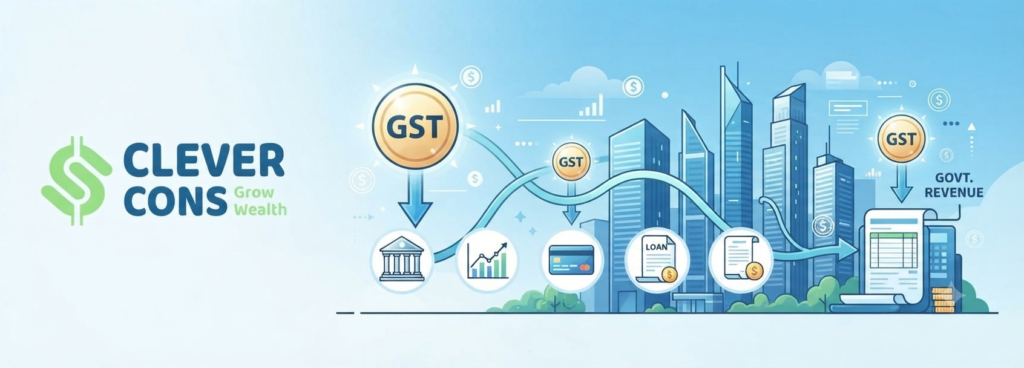
The integration of the Goods and Services Tax (GST) framework transformed economies globally, and the financial services sector experienced one of the most profound shifts. Financial institutions—spanning banks, Non-Banking Financial Companies (NBFCs), asset management companies (AMCs), insurance providers, and fintech startups—deal fundamentally with money, risk, credit, and investments. Because financial transactions do not mirror standard retail sales of physical goods, applying a unified consumption tax like GST introduced layers of operational complexity.
At CleverCoins, we turn complex tax regulations into strategic advantages. This deep-dive masterclass breaks down everything you need to know about GST on financial services, compliance hurdles, input tax credit mechanisms, and actionable strategies to protect your bottom line.
1. The Core Framework: Understanding Financial Services Under GST
When GST was rolled out, the primary challenge legislators faced was defining how services like lending, insurance, investment advisory, and foreign exchange should be taxed. Unlike manufacturing, where value addition is clear, financial services often involve hidden margins, spreads, and composite supplies.
Classification of Services
Financial services are broadly split into two categories under GST:
-
Fee-Based Services: Advisory fees, loan processing charges, account maintenance fees, locker rentals, wealth management commissions, and merchant banking fees. These are explicitly taxable under the forward charge mechanism (FCM) at the standard rate of 18%.
-
Consideration by Way of Interest or Discount: The GST law specifically excludes “interest or discount on loans, advances, or deposits” from the definition of taxable supply of services. This is a critical relief measure, ensuring that standard borrowing costs do not inflate exponentially due to an extra 18% tax burden.
2. Sector-Wise Breakdown of GST Implications
A. Banking and Traditional Lending Institutions
Banks handle millions of transactions daily, making classification an administrative nightmare.
-
Loans and Advances: Interest earned on term loans, working capital loans, and mortgages remains exempt from GST.
-
Processing and Penal Fees: Loan processing fees, document verification charges, late payment penalties, and cheque bounce charges are considered separate services incidental to the loan and attract an 18% GST rate.
-
Default and Inter-bank Transactions: Penal interest levied for delayed payment of loans is generally exempt if it is categorized strictly as interest. However, if the bank labels it as liquidated damages or administrative penal service charges, tax authorities may attempt to levy 18% GST.
B. Insurance Sector (Life, Health, and General)
Insurance is heavily regulated, and its taxation reflects complex actuarial calculations.
-
Life Insurance: For term insurance policies, the entire premium is subject to GST (usually 18%). For investment-linked products like Unit Linked Insurance Plans (ULIPs), GST is applicable only on the fund management and administrative charges, not on the investment allocation portion.
-
Reinsurance: Reinsurance services—where insurers pass a portion of their risk to global reinsurers—are subject to specific export/import rules and localized GST provisions.
-
Health and General Insurance: General and health insurance policies attract an 18% GST rate. This has historically been a point of debate regarding consumer affordability, though input tax credit (ITC) provisions help corporate buyers offset these costs.
C. Mutual Funds and Asset Management Companies (AMCs)
Investors often wonder how mutual fund investments are impacted.
-
Management Fees: Total Expense Ratios (TER) charged by AMCs include management fees. The GST component (18%) is absorbed within the scheme’s net asset value (NAV) or charged transparently to the investor depending on the regulatory structure.
-
Brokerage and Distribution: Commissions paid to distributors, agents, and platform providers are service fees attracting 18% GST, typically managed via Reverse Charge Mechanism (RCM) or direct billing.
3. The Complex Maze of Input Tax Credit (ITC) for Financial Institutions
For a regular manufacturing company, claiming Input Tax Credit (ITC) on raw materials is straightforward. For a bank or NBFC handling hundreds of exempt supplies (like interest income) alongside taxable supplies (like fee-based income), ITC tracking is a massive compliance hurdle.
Section 17(2) and Rule 38 Reversal Mechanics
Under the law, a banking company or financial institution cannot claim 100% of the ITC on its common input services (such as IT infrastructure, housekeeping, legal consultation, and marketing) if it has exempt income (interest).
-
The 50% Option: To simplify this, Section 17(4) of the CGST Act provides an option for banking companies and financial institutions: they can forfeit 50% of the eligible ITC on inputs, capital goods, and input services every month, and utilize the remaining 50% without tracking complex proportional apportionment formulas.
-
Exclusions: The 50% restriction does not apply to supplies made to another registration entity having the same PAN (inter-branch supplies).
Recent Regulatory Updates: IMS and GST 2.0
With the introduction of modern compliance protocols like the Invoice Management System (IMS), matching your GSTR-2B with your actual books is non-negotiable. Financial institutions face immense risks of blocked credit if vendors delay filing their GSTR-1. Real-time reconciliation logic is now mandatory to avoid losing lakhs of rupees in unclaimed ITCs.
4. Cross-Border Financial Services and Export of Services
Global financial hubs and outsourcing centers (like Global Capability Centers or GCCs in India) provide back-office, data processing, and analytical support to parent entities abroad.
-
Export Conditions: To qualify as an “export of services” (and thus be zero-rated under GST):
-
The supplier must be located in India.
-
The recipient must be located outside India.
-
The place of supply of service must be outside India.
-
The payment for such service must be received in convertible foreign exchange (or in INR wherever permitted by RBI).
-
The supplier and recipient are not merely establishments of a distinct person.
-
-
Intermediary Services Trap: A major litigation point for fintechs and financial consultants is the “Intermediary” rule. If a firm acts as an arrangement agent bringing two parties together rather than providing the core service directly, the place of supply defaults to the location of the service provider, making it liable to local 18% GST instead of treating it as a zero-rated export. Navigating this boundary requires seasoned tax consultancy.
5. Common Litigation Hotspots and Audits
Tax authorities frequently audit financial sector organizations. The primary areas of dispute include:
-
Corporate Guarantees: Recent amendments clarified valuation rules for corporate guarantees provided by holding companies to subsidiaries. Even in financial ecosystems, internal group guarantees attract valuation considerations under GST.
-
Recovery Agents and Direct Selling Agents (DSAs): Banks hire DSAs for loan sourcing. While the bank pays commissions to DSAs, many individual DSAs fall under the unregistered threshold, triggering Reverse Charge Mechanism (RCM) compliance liabilities for the bank under Section 9(4).
-
Recovery of Bad Debts vs. Assignment of Debts: When a bank assigns its non-performing assets (NPAs) to an Asset Reconstruction Company (ARC), complex taxation nuances arise regarding whether the discount or assignment consideration invites GST.
6. Strategic Best Practices for Financial Institutions
To stay compliant and optimize cash flow in the current regulatory climate, financial entities should implement the following blueprint:
-
Automated Reconciliation Systems: Adopt real-time invoice matching solutions to align your IMS dashboard and prevent ITC blockages.
-
Evaluate the 50% Rule vs. Pro-Rata Tracking: Run an internal financial simulation to check whether opting for the standard 50% ITC reversal under Section 17(4) saves more money compared to meticulous branch-wise pro-rata calculations.
-
Robust Vendor Master Audits: Ensure all vendors and recovery agents have updated GST registrations to minimize unexpected RCM liabilities.
-
Proactive Advisory Partnership: Tax codes change rapidly. Partnering with specialized consultancy firms like CleverCoins ensures your operations remain safe, optimized, and immune to sudden audit shocks.
Conclusion
GST on financial services is far from a simple flat-rate calculation. It is a sophisticated landscape governed by fine distinctions between interest and fees, strict apportionment rules, and rigorous cross-border compliance standards. By staying ahead of regulatory changes and automating your compliance workflows, you can protect your bottom line and turn tax management into a strategic advantage.
Stop reacting to tax compliance—start navigating it strategically with CleverCoins. Contact our team today for a comprehensive audit of your financial services tax framework.
- Phone: +91 77389 59862
- Email: client@clevercoins.org
- Address: Ideal Market, Mumbra, Thane-400612





