6-Digit HSN Code Mandatory in GST: Complete List for MSME Products
If you run a small manufacturing unit, a trading firm, or a growing MSME, you have probably seen the question “Which HSN code should I put on this invoice?” more often than you’d like. A wrong or missing HSN code can lead to GSTR-1 errors, buyers refusing invoices, notices from the department, and disputes over the GST rate.
This guide explains who needs a 6-digit HSN code under GST, where it must appear, and how to find the right code for your product. It also includes a sector-wise HSN list for common MSME products, along with mistakes to avoid and a compliance checklist.
Quick answer: Under Notification No. 78/2020 – Central Tax, taxpayers with aggregate annual turnover (AATO) up to ₹5 crore in the preceding financial year must report at least 4-digit HSN codes, while those above ₹5 crore must report at least 6 digits in Table 12 of GSTR-1/1A. Even if you fall in the lower slab, using the 6-digit code is the safer practice. gstvyapar
Table of Contents
- What is an HSN code?
- Structure of HSN: 2, 4, 6 and 8 digits
- Why HSN codes matter for MSMEs
- Is 6-digit HSN mandatory? Turnover-wise rules
- Phase-wise implementation of HSN reporting
- Where HSN codes must be mentioned
- How to find the correct HSN code
- Complete HSN code list for MSME products (sector-wise)
- SAC codes for MSME service providers
- HSN code vs GST rate: the 2026 position
- Common HSN mistakes MSMEs make
- Penalties and notices for wrong HSN
- Worked example
- HSN compliance checklist
- FAQs
- Conclusion
1. What Is an HSN Code?
HSN stands for Harmonized System of Nomenclature. It is an international product classification system developed by the World Customs Organization (WCO). More than 200 countries use it to classify goods for customs, tariffs and trade statistics.
India adopted HSN for GST so that every product has one standard code. This lets the government and taxpayers use the same classification when deciding tax rates, preparing invoices and filing returns.
For services, GST uses a parallel system called the Services Accounting Code (SAC). SAC codes are 6 digits and begin with 99.
In plain terms, an HSN code answers one question: “What exactly are you selling?” The code tells the GST system what the product is. The GST rate depends on the notification that applies to that code and product description.
2. Structure of HSN: 2, 4, 6 and 8 Digits
An HSN code gets more specific as the number of digits grows.
| Digits | Level | What it tells you | Example |
|---|---|---|---|
| 2 | Chapter | Broad category | 61 – Knitted apparel |
| 4 | Heading | Product group | 6109 – T-shirts, singlets, knitted |
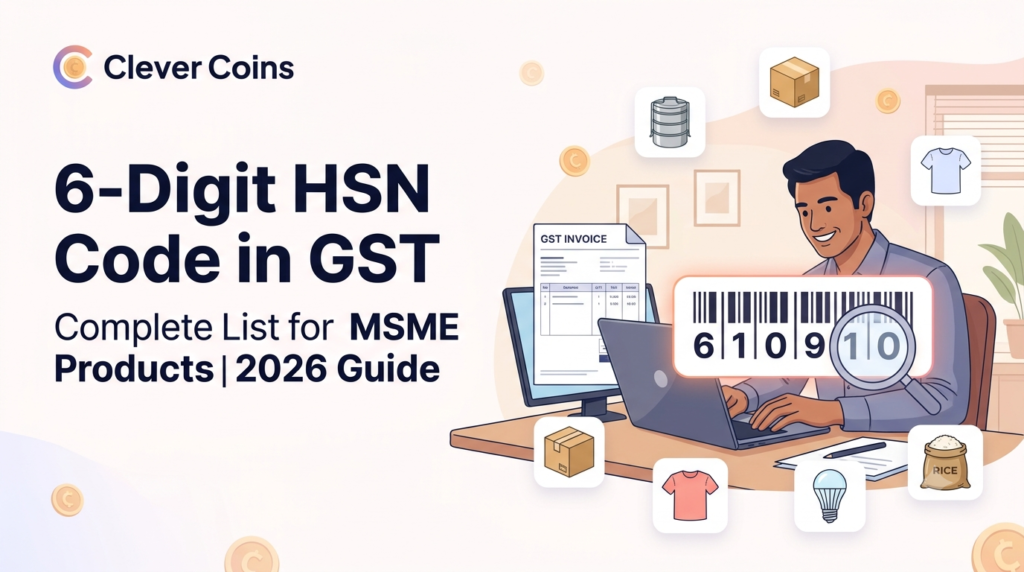
| 6 | Sub-heading | Specific product type | 610910 – T-shirts of cotton |
| 8 | Tariff item | India-specific detail (customs) | 61091000 |
The first six digits are the same in every country that follows the HS system. Digits 7 and 8 are added by India for customs tariffs. For domestic GST invoices, 4 or 6 digits are usually enough. Imports and exports need the full 8-digit ITC-HS code. Imports and exports need the full 8-digit code. calcguru
3. Why HSN Codes Matter for MSMEs
Many small business owners treat HSN as a formality, but it affects several parts of compliance.
Correct tax rate. The GST rate is linked to the product classification. If the code is wrong, you might charge too little tax (a liability for you) or too much (a problem for your customer).
Input tax credit (ITC) for your buyers. If the HSN on your invoice doesn’t match what your buyer reports or what appears in the e-way bill, the credit can be questioned. Buyers will start asking for corrected invoices.
Return filing without errors. Table 12 of GSTR-1 asks for an HSN-wise summary of outward supplies. An invalid code can block or complicate filing.
Smooth e-invoicing and e-way bills. The e-invoice portal (IRP) and the e-way bill system both validate HSN data.
Data matching by the department. GST authorities use analytics to compare HSN data across GSTR-1, GSTR-3B, e-way bills and e-invoices. A mismatch is an easy flag.
Credibility with larger buyers. Corporate buyers, government departments and exporters expect clean invoices. A properly classified invoice shows that your compliance is in order.
4. Is 6-Digit HSN Mandatory? Turnover-Wise Rules
The requirement depends on your Aggregate Annual Turnover (AATO) in the preceding financial year. For FY 2026-27, that means your turnover in FY 2025-26.
| Preceding-year AATO | Minimum HSN digits (GSTR-1 Table 12) | On tax invoices |
|---|---|---|
| Up to ₹5 crore | 4 digits | 4 digits on B2B invoices; B2C optional |
| Above ₹5 crore | 6 digits | 6 digits on all invoices (B2B and B2C) |
| Imports and exports | 8 digits | 8-digit ITC-HS code |
A business at exactly ₹5 crore falls in the lower slab, and the 6-digit requirement starts above that figure. accountune
Key points for MSMEs:
- Turnover is checked on the preceding financial year. If you crossed ₹5 crore in FY 2025-26, you must use 6 digits from 1 April 2026, even if no reminder appears on the portal.
- “AATO” is computed on a PAN basis. It includes taxable supplies, exempt supplies, exports and inter-state supplies of all your GST registrations under the same PAN. It excludes taxes and inward supplies on which you pay tax under reverse charge.
- The GSTR-1 rule and the invoice rule are linked, but not identical. For a business up to ₹5 crore, a 4-digit code on B2B invoices satisfies the invoice rule, and Table 12 needs at least 4 digits as well.
- Using more digits is always allowed. Nothing prevents a small MSME from using the 6-digit or 8-digit code. In fact, this often prevents disputes.
- Composition taxpayers have lighter invoice requirements, but they still report HSN in their annual return (GSTR-4).
- Services use SAC. Service providers use the 6-digit SAC code, which already has 6 digits by default.
E-invoicing makes 6 digits unavoidable
From 15 December 2023, taxpayers with AATO of ₹5 crore and above have had to report a minimum of 6-digit HSN in e-invoices. MSMEs approaching the e-invoicing threshold should therefore update their item master with 6-digit codes before they cross it. tallysolutions
What about the claim that 6-digit is mandatory for everyone?
You may read online articles saying all B2B suppliers now need 6 digits. As of the latest sources I checked, the government’s own advisories and most professional guides still describe the ₹5 crore split (4 digits up to ₹5 crore, 6 digits above). Domestic invoices are generally governed by the 4-digit or 6-digit rule linked to AATO, and 8-digit HSN is not mandatory on every domestic invoice. Always confirm the latest position on the GST portal or with your tax consultant, because notifications can change. taxque
5. Phase-Wise Implementation of HSN Reporting
The GST Network (GSTN) did not enforce HSN reporting overnight. It rolled it out in phases.
| Phase | What changed |
|---|---|
| Phase 1 (2021 onwards) | Up to ₹5 crore: 2 digits; above ₹5 crore: 4 digits |
| Phase 1, Part II (Aug 2022) | Above ₹5 crore: 6 digits, with manual entry |
| Phase 2 (Nov 2022) | Up to ₹5 crore: 4 digits; above ₹5 crore: 6 digits |
| Phase 3 (from May 2025 return period) | Same digit rules, but manual entry is no longer allowed; HSN must be picked from a drop-down |
Under the Phase 3 rules, manual entry of HSN is not allowed and the code has to be selected from a drop-down. GSTN also made Table 13 of GSTR-1/1A (documents issued) mandatory from the same period. GSTN; Reporting of HSN codes in Table 12 and list of documents in table 13 of GSTR-1/1A +2
What this means in practice is that your item master must hold codes that exist in the portal’s HSN list. A code copied from an old spreadsheet may no longer appear in the drop-down.
6. Where HSN Codes Must Be Mentioned
1. Tax invoices. The invoice should show the HSN of each line item, the description, quantity, taxable value and tax rate.
2. Bill of supply and credit/debit notes. Where applicable, HSN should flow through to these documents so that adjustments match the original invoice.
3. GSTR-1 / GSTR-1A (Table 12). This is the HSN-wise summary of outward supplies. It requires the HSN code, description, unit of quantity, total quantity, total value, taxable value and tax amounts.
4. E-invoices (IRP). Mandatory HSN fields are validated by the Invoice Registration Portal.
5. E-way bills. Movement of goods valued above the prescribed limit needs an e-way bill with a valid HSN. Mismatches between the invoice and the e-way bill attract queries during transit checks.
6. GSTR-9 (annual return). The HSN-wise summary of outward and inward supplies is reported in the annual return, in line with the applicable thresholds.
7. GSTR-4 (composition). Composition taxpayers report HSN in their annual statement.
8. Shipping bills and import documents. These use the 8-digit ITC-HS code.
7. How to Find the Correct HSN Code
Finding the HSN of a product is a skill, and it follows a method.
Step 1: Describe the product precisely. Note the material, form, use and state. “Stainless steel tiffin box, kitchenware” is better than “steel item.”
Step 2: Identify the chapter. Chapters are grouped by material or function. For example, Chapter 39 is plastics, Chapter 73 is iron and steel articles, and Chapter 94 is furniture.
Step 3: Narrow down to the heading, then the sub-heading. Read the chapter notes and the heading descriptions. Choose the most specific description that fits, not the most general.
Step 4: Follow the General Rules of Interpretation (GRI). The HS system has six rules. In short: the specific description beats the general one, mixtures follow the component that gives them their essential character, and the code with the last numerical order is the fallback only when nothing else resolves the question.
Step 5: Cross-check on official sources. Verify the code on the GST portal’s HSN search, the CBIC tariff and the customs tariff. Check that the rate notification covers your product description, not just the number.
Step 6: Check what your competitors and suppliers use, but don’t copy blindly. If your supplier’s invoice shows a code, compare it with your own analysis. When there is a genuine conflict, seek advice.
Step 7: Document your decision. Keep a short classification note for every product: description, code, basis for classification, date and rate notification. This note is valuable if you ever receive a department query.
Step 8: Lock the code in your billing software. Create the item master once, and let invoices pull from it, so that every invoice uses the same code.
8. Complete HSN Code List for MSME Products (Sector-Wise)
The tables below list commonly used 6-digit HSN codes for typical MSME products. The tariff has many sub-headings, so treat these as a starting reference. Always match your exact product description against the official tariff before using a code. The list gives only the code, not the GST rate, because the rate depends on the notification, product details and branding, and it has been revised recently.
8.1 Food and Agro Products
| Product | 6-digit HSN |
|---|---|
| Rice, semi-milled or wholly milled | 100630 |
| Wheat or meslin flour | 110100 |
| Gram (besan) and pulse flour | 110610 |
| Black tea, packed up to 3 kg | 090230 |
| Coffee, roasted, not decaffeinated | 090121 |
| Pepper, whole | 090411 |
| Dried chillies | 090421 |
| Ginger, neither crushed nor ground | 091011 |
| Turmeric (curcuma) | 091030 |
| Butter | 040510 |
| Ghee and other milk fats | 040590 |
| Natural honey | 040900 |
| Sweet biscuits | 190531 |
| Bread, pastry, cakes, papad and similar baked products | 190590 |
| Namkeen, snacks and other food preparations | 210690 |
| Pickles and preserved vegetables | 200190 |
| Jams, jellies and fruit preparations | 200799 |
| Refined sugar | 170199 |
| Mustard oil, refined | 151499 |
| Groundnut oil, refined | 150890 |
| Cashew kernels | 080132 |
| Almonds, shelled | 080212 |
| Packaged drinking and mineral water | 220110 |
| Sweetened non-alcoholic beverages | 220210 |
8.2 Textiles, Apparel and Home Furnishing
| Product | 6-digit HSN |
|---|---|
| T-shirts and vests, cotton, knitted | 610910 |
| Men’s trousers, cotton | 620342 |
| Women’s trousers, cotton | 620462 |
| Men’s shirts, cotton, woven | 620520 |
| Socks and hosiery, cotton | 611595 |
| Cotton yarn (multiple grades under 5205) | 520512 |
| Bed linen, cotton, printed | 630221 |
| Towels and toilet linen, cotton terry | 630260 |
| Jute sacks and bags | 630510 |
| Other made-up textile articles | 630790 |
8.3 Plastics, Packaging, Paper and Printing
| Product | 6-digit HSN |
|---|---|
| Plastic boxes, crates and cases | 392310 |
| Plastic sacks and bags (polymers of ethylene) | 392321 |
| Plastic bottles, carboys and flasks | 392330 |
| Stoppers, lids and caps | 392350 |
| Plastic tableware and kitchenware | 392410 |
| Other plastic articles | 392690 |
| Corrugated paper cartons | 481910 |
| Folding cartons, non-corrugated | 481920 |
| Registers, notebooks and diaries | 482010 |
| Exercise books | 482020 |
| Printed paper labels | 482110 |
| Paper cups, plates and dishes | 482369 |
| Glass bottles and jars | 701090 |
| Printed books | 490199 |
| Other printed matter, stickers and flyers | 491199 |
8.4 Metal Products and Hardware
| Product | 6-digit HSN |
|---|---|
| Stainless steel table and kitchen articles | 732393 |
| Other iron and steel articles | 732690 |
| Bolts and screws | 731815 |
| Nuts | 731816 |
| Aluminium kitchenware | 761510 |
| Other aluminium articles | 761699 |
| Hinges, base metal | 830210 |
| Other locks | 830140 |
| Fittings for furniture, base metal | 830242 |
| Metal structures and parts (fabrication) | 730890 |
| Pipes and tubes, iron or steel | 730630 |
| Hand tools, other | 820559 |
8.5 Electrical, Electronics and Machinery
| Product | 6-digit HSN |
|---|---|
| Centrifugal pumps | 841370 |
| Table, ceiling and wall fans | 841451 |
| Electric motors, AC single-phase | 850140 |
| Food grinders and mixers (domestic) | 850940 |
| Lead-acid batteries | 850710 |
| Switches (≤1,000 V) | 853650 |
| Control panels (≤1,000 V) | 853710 |
| Insulated wires and cables (≤1,000 V) | 854442 |
| LED lamps | 853950 |
| LED luminaires and light fittings | 940542 |
| Packing and wrapping machinery | 842240 |
8.6 Furniture, Wood and Construction Materials
| Product | 6-digit HSN |
|---|---|
| Wooden furniture, other | 940360 |
| Wooden office furniture | 940330 |
| Wooden bedroom furniture | 940350 |
| Upholstered seats with wooden frames | 940161 |
| Wooden doors, frames and thresholds | 441820 |
| Other builders’ joinery and carpentry | 441899 |
| Other articles of wood | 442199 |
| Portland cement, other | 252329 |
| Building bricks, ceramic | 690410 |
| Concrete blocks and building articles | 681011 |
| Ceramic floor and wall tiles | 690721 |
| Porcelain sanitary ware | 691010 |
8.7 FMCG, Chemicals and Personal Care
| Product | 6-digit HSN |
|---|---|
| Toilet soap, bars | 340111 |
| Detergents put up for retail sale | 340220 |
| Shampoo | 330510 |
| Hair oils and other hair preparations | 330590 |
| Toothpaste | 330610 |
| Perfumes and toilet waters | 330300 |
| Beauty and skin-care preparations | 330499 |
| Agarbatti and incense | 330741 |
| Candles | 340600 |
| Footwear polish | 340510 |
| Hand sanitiser and disinfectants (retail) | 380894 |
| Insecticides | 380891 |
| Acrylic water-based paints | 320910 |
| Other adhesives | 350699 |
| Ayurvedic and other medicaments in measured doses | 300490 |
| Sanitary pads | 961900 |
8.8 Footwear, Leather, Handicrafts, Toys and Stationery
| Product | 6-digit HSN |
|---|---|
| Leather footwear | 640399 |
| Leather handbags | 420221 |
| Leather wallets | 420231 |
| Other wooden handicrafts | 442090 |
| Baskets and wickerwork | 460219 |
| Imitation jewellery | 711719 |
| Silver jewellery | 711311 |
| Toys | 950300 |
| Sports goods, other | 950699 |
| Ball-point pens | 960810 |
| Pencils | 960910 |
8.9 Automotive and Engineering Components
| Product | 6-digit HSN |
|---|---|
| Other motor-vehicle parts and accessories | 870899 |
| Brakes and parts | 870830 |
| New rubber tyres for cars | 401110 |
| Other rubber articles | 401699 |
| Bicycle parts | 871499 |
Important: Some of these codes have several sub-types. For example, cotton yarn is under heading 5205 and the 6-digit code depends on yarn count and type. Rate notifications may also treat branded and unbranded versions differently. Use this list to narrow your search, then confirm the exact sub-heading.
9. SAC Codes for MSME Service Providers
Services follow the SAC system. Many service MSMEs don’t realise they need one, but the SAC must appear on service invoices just as HSN appears on goods invoices. Here are some commonly used SAC groups. Confirm the exact 6-digit code on the official list before use.
| Service | SAC (code or group) |
|---|---|
| Management consulting | 998311 |
| IT consulting and support | 998313 |
| IT design and development | 998314 |
| Advertising services | 998361 |
| Commercial training and coaching | 999293 |
| Job work / manufacturing services on others’ inputs | 9988 group |
| Maintenance and repair services | 9987 group |
| Goods transport services | 9965 group |
| Construction services | 9954 group |
| Accommodation and food services | 9963 group |
| Rental and leasing services | 9973 group |
10. HSN Code vs GST Rate: The 2026 Position
An HSN code is not the same as a GST rate. The code identifies the product. The rate is set by a separate rate notification, and many entries depend on conditions such as branding, packaging, value or end use.
India restructured its rates in September 2025. The system now runs on slabs of 0%, 5%, 18% and 40%, with the old 12% and 28% slabs removed from 22 September 2025. Later notifications have refined certain tariff classifications, and the GST Council made further recommendations in October 2026 that will need legal notifications before they take effect. accountunetaxque
For an MSME, this has three practical consequences:
- Never rely on an old HSN-with-rate list. Many products moved to different slabs.
- Keep the notification number and effective date in your product master. If a rate changes, you can see which items are affected.
- Review your item master after every Council meeting. Changes often arrive as notifications days or weeks after the meeting itself.
11. Common HSN Mistakes MSMEs Make
Using a generic 4-digit code after crossing ₹5 crore. A common trap is that even if the invoice shows only 4 digits, the GSTR-1 must report 6 once you cross the turnover limit. gstbillmaker
Copying a competitor’s code. The competitor may have made the same error, or their product may differ slightly.
Using one code for many products. A manufacturer selling five types of product under one “miscellaneous” code will fail validation, and a rate dispute becomes likely.
Mixing up HSN and SAC. A company doing job work, repair or installation may be supplying services even though it handles goods.
Ignoring composite and mixed supplies. If you sell a machine with installation, classification may follow the principal supply. Seek advice.
Not updating after notifications. Items get reclassified or re-rated. Old masters cause wrong tax.
Different codes for the same item across documents. If your invoice, e-way bill and GSTR-1 show different HSNs for one product, the mismatch is visible to the system.
Wrong description with a right code. The code and the description must agree.
Leaving B2C lines blank when the rule requires them. Above ₹5 crore, the 6-digit code is required on all invoices.
Forgetting Table 13. Document-issued details are now mandatory, so the return cannot be filed with that table blank.
12. Penalties and Notices for Wrong HSN
The law does not set a single “HSN penalty,” but a wrong classification can lead to several consequences.
- Short payment of tax. If the correct rate was higher, the department can demand the difference with interest.
- Interest under Section 50. This applies on tax paid late or short.
- Penalty provisions under the CGST Act. Depending on the facts, these may apply for incorrect invoices, wrong reporting or tax evasion.
- Scrutiny notices. GSTN data now cross-references HSN codes across GSTR-1, e-way bills and e-invoicing, and notices are typically answered in Form GST ASMT-10. fintax24
- Return filing blocks. An invalid HSN can stop you from filing GSTR-1.
- Buyer disputes. Buyers may refuse payment or demand credit notes if their ITC is at risk.
- Detention of goods in transit. A mismatch between the invoice and e-way bill can lead to delays.
Honest classification errors can usually be corrected. Disputes tend to arise when a pattern suggests deliberate under-classification to pay a lower rate.
13. Worked Example
Ramesh Steel Works is an MSME in Thane that makes stainless steel tiffin boxes and kitchen containers. Its turnover in FY 2025-26 was ₹3.4 crore.
- Which rule applies for FY 2026-27? AATO is below ₹5 crore, so the minimum is 4 digits (7323).
- What should Ramesh actually use? The 6-digit code 732393 describes the product more precisely. Using it protects Ramesh against buyer queries and prepares him for growth.
- What happens if turnover reaches ₹5.6 crore in FY 2026-27? From 1 April 2027, Ramesh must report at least 6 digits on all invoices and in GSTR-1, and e-invoicing becomes relevant.
- What does he do in the meantime? He creates a clean item master, adds the notification reference to each item, and trains his billing staff.
14. HSN Compliance Checklist for MSMEs
- Confirm your AATO for the preceding financial year, on a PAN basis.
- Decide your required digit level (4, 6 or 8) for each type of transaction.
- Build or clean your item master, with one code per product.
- Verify each code on the GST portal drop-down and the official tariff.
- Record the rate notification and effective date for each item.
- Keep short classification notes for products with any doubt.
- Make sure invoices, e-invoices and e-way bills show the same HSN.
- Check Table 12 and Table 13 before filing GSTR-1.
- Reconcile HSN-wise data between GSTR-1, GSTR-3B and books each quarter.
- Re-check your item master after major GST Council changes.
- Train billing and accounts staff, and restrict who can edit codes.
- Review again when your turnover is close to ₹5 crore.
15. Frequently Asked Questions (FAQs)
Q1. Is a 6-digit HSN code mandatory for all MSMEs?
No. MSMEs with preceding-year turnover up to ₹5 crore need at least 4 digits, and those above ₹5 crore need at least 6 digits. Using 6 digits voluntarily is a good practice.
Q2. Can I use an 8-digit HSN code on domestic invoices?
Yes, you can use more digits than the minimum, provided the code is valid. It is not generally mandatory for domestic supplies, but exports and imports require it.
Q3. What if I don’t know my product’s HSN code?
Use the GST portal’s HSN search, check the customs tariff, and consult a GST professional if the product could fit more than one heading.
Q4. Is HSN required on B2C invoices?
For businesses up to ₹5 crore, it is optional on B2C invoices. Above ₹5 crore, it must appear on all invoices.
Q5. Do service providers need HSN?
They use SAC, which is already 6 digits.
Q6. Can I type any HSN code in GSTR-1?
No. From the May 2025 return period, the HSN has to be chosen from the drop-down in Table 12.
Q7. Do composition taxpayers need HSN?
They don’t need it on the bill of supply, but they report it in their annual return, GSTR-4.
Q8. What if I used the wrong HSN in an earlier invoice?
Correct it through the proper mechanism, such as a credit note, a debit note or an amendment in GSTR-1, depending on the facts. If a rate difference arises, pay the tax and interest voluntarily.
Q9. Does HSN decide the GST rate?
It identifies the product, and the rate notification then applies the rate, often with conditions.
Q10. When do I move from 4 digits to 6?
From the start of the financial year after the one in which your turnover exceeded ₹5 crore.
Q11. Is an HSN code needed for e-way bills?
Yes. A valid HSN is required, and it should match the invoice.
Q12. Where can I find the official list?
The GST portal, the CBIC website, and the customs tariff all publish HSN data. Avoid old spreadsheets.
16. Conclusion
For most MSMEs, the HSN rule is simple on paper: 4 digits up to ₹5 crore and 6 digits above it. In practice, accuracy matters more than the digit count. The code must describe your product, match across invoices, e-way bills and returns, and be backed by the right rate notification. Because GSTN now validates HSN codes automatically, shortcuts are riskier than they used to be.
If you are growing fast, adopt the 6-digit code now. Build a clean item master and document your classifications. Then review them after every major GST change.
Need help with HSN classification, GST registration or GSTR-1 filing? The experts at Clever Coins can review your product list, assign and verify HSN/SAC codes, and handle your GST compliance end to end. Consult us on WhatsApp or explore our GST Registration, GST Annual Return Filing and Udyam Registration services.
Related reading on Clever Coins:
- GST Audit Limit for MSMEs: When is GSTR-9C Audit Mandatory in 2026?
- Section 16(4) ITC Time Limit: The Supreme Court Judgement and Its Impact on MSMEs
Disclaimer: This article is for general information and is not legal or tax advice. HSN codes and GST rates are subject to change by notification. Verify codes and rates on the official GST portal and CBIC website, or consult a qualified professional, before relying on them.