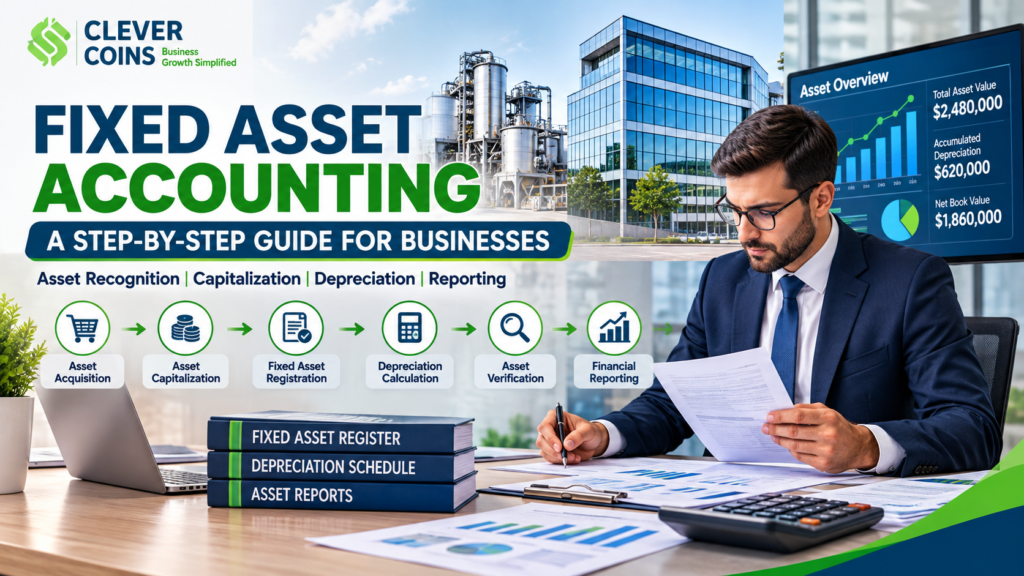
Step-by-Step Process for Fixed Asset Accounting: A Complete Guide for Businesses
Introduction
Every business, regardless of its size or industry, requires certain physical resources to operate efficiently. From office furniture and computers to manufacturing machinery, company vehicles, buildings, electrical equipment and production tools, these resources support daily business operations and contribute to long-term growth.
However, purchasing an asset is only the beginning of its financial lifecycle. Businesses must also determine how to record it, calculate its value, allocate depreciation, maintain supporting documentation, monitor its physical condition and eventually account for its sale or disposal.
This entire process is known as fixed asset accounting.
Fixed asset accounting is an essential part of financial management because it helps businesses maintain accurate financial statements, monitor investments, control unnecessary expenditure and comply with applicable accounting and taxation requirements.
For startups and growing businesses, improper asset accounting can create several problems, including incorrect profit calculations, inaccurate balance sheets, excessive tax payments, missing assets and difficulties during financial audits.
A properly structured fixed asset accounting system ensures that every asset is recorded accurately from acquisition to retirement.
In this comprehensive guide, we will explain the step-by-step process for fixed asset accounting, including asset identification, recognition, capitalization, depreciation, asset tracking, reconciliation, impairment, disposal, reporting and best practices.
Whether you are a startup founder, business owner, accountant, finance manager or accounting student, this guide will help you understand how fixed asset accounting works in practical business situations.
1. What Is Fixed Asset Accounting?
Fixed asset accounting is the systematic process of identifying, recording, valuing, tracking, depreciating and reporting long-term tangible assets owned or controlled by a business.
These assets are generally acquired to support business operations rather than to be sold as part of normal business activities.
Fixed assets are commonly presented under the heading Property, Plant and Equipment (PPE) in financial statements.
Examples include:
Land and buildings
Office furniture and fixtures
Computers and laptops
Manufacturing machinery
Company-owned vehicles
Electrical equipment
Air conditioning systems
Office equipment
Production tools
Warehouse equipment
Plant and industrial installations
Fixed asset accounting helps businesses understand the original cost of assets, their accumulated depreciation, their remaining carrying value and their current operational status.
For example, suppose a manufacturing company purchases machinery for ₹10,00,000. The machinery is expected to support production for several years.
Instead of treating the entire purchase amount as an ordinary operating expense immediately, the company generally recognizes the machinery as a fixed asset and allocates its depreciable amount over its estimated useful life.
This process ensures that the cost of using the machinery is reflected across the accounting periods that benefit from it.
Why Is Fixed Asset Accounting Important?
Fixed asset accounting is important for several reasons.
1. Accurate financial reporting
Fixed assets represent significant investments. Proper accounting ensures that assets, depreciation and carrying values are correctly reflected in the balance sheet and profit and loss statement.
2. Better financial planning
Businesses can identify how much capital is invested in equipment, machinery, vehicles and infrastructure. This information helps management plan future purchases and replacements.
3. Depreciation management
Assets generally lose value through usage, ageing, technological obsolescence or other factors. Fixed asset accounting ensures that depreciation is calculated and recorded systematically.
4. Tax compliance
Businesses need accurate asset records to calculate depreciation deductions under applicable income-tax provisions.
5. Fraud prevention
A properly maintained asset register makes it easier to identify missing, unauthorized or improperly transferred assets.
6. Audit readiness
Auditors may examine purchase invoices, asset registers, depreciation schedules, physical verification records and disposal documents. Proper accounting makes this process easier.
7. Operational efficiency
Management can identify underutilized assets, assets requiring maintenance and equipment approaching the end of its useful life.
2. Understanding the Different Types of Fixed Assets
Before starting the accounting process, businesses should understand the different categories of fixed assets.
A. Tangible Fixed Assets
Tangible fixed assets are physical resources that can be seen and touched.
Examples include:
Buildings
Land
Machinery
Vehicles
Computers
Office furniture
Electrical equipment
Factory equipment
These assets generally have a useful life extending beyond one accounting period.
B. Intangible Assets
Intangible assets are identifiable non-physical resources that provide economic benefits to a business.
Examples include:
Patents
Copyrights
Trademarks
Software licenses
Certain acquired technology rights
Although intangible assets are not tangible fixed assets, they require separate accounting under applicable intangible asset standards.
Their cost is generally amortized over their useful lives when appropriate.
C. Capital Work-in-Progress
Capital Work-in-Progress (CWIP) represents expenditure incurred on assets that are still being constructed, installed or developed and are not yet ready for their intended use.
Examples include:
Construction of a factory
Installation of manufacturing equipment
Construction of an office building
Development of qualifying infrastructure
Once the asset is ready for its intended use, the eligible accumulated cost is transferred from CWIP to the relevant fixed asset category.
D. Right-of-Use Assets
Under applicable lease accounting requirements, a lessee may recognize a right-of-use asset representing its right to use an underlying leased asset.
Examples include certain leased offices, warehouses, vehicles and equipment.
These assets are accounted for under the applicable lease accounting standard rather than automatically being treated like ordinary owned assets.
3. Step-by-Step Process for Fixed Asset Accounting
The fixed asset accounting process should follow a structured sequence.
The following steps explain the complete lifecycle of a fixed asset.
Step 1: Identify and Classify the Fixed Asset
The first step is identifying whether a purchased item qualifies as a fixed asset.
Not every business purchase should be recorded as a fixed asset.
For example:
A manufacturing machine expected to be used for eight years may qualify as a fixed asset.
Office furniture expected to be used for several years may qualify as a fixed asset.
Printer paper and stationery are generally treated as consumables.
Products purchased for resale are classified as inventory.
Routine repairs and maintenance are generally recognized as expenses.
Businesses should evaluate the nature of the item, its intended purpose, expected useful life, applicable recognition requirements and internal capitalization policy.
Under Ind AS 16, Property, Plant and Equipment, an item generally qualifies for recognition when:
It is probable that future economic benefits associated with the asset will flow to the entity.
Its cost can be measured reliably.
Businesses should also establish appropriate asset categories, such as land, buildings, machinery, computers, vehicles and furniture.
Proper classification makes depreciation calculations, financial reporting and audit verification easier.
Step 2: Establish a Fixed Asset Capitalization Policy
A capitalization policy explains which expenditure should be recorded as an asset instead of an immediate expense.
It should define:
Minimum capitalization thresholds, where appropriate
Asset recognition criteria
Treatment of individual and grouped assets
Useful life estimation procedures
Residual value assumptions
Depreciation methods
Asset identification procedures
Approval requirements
Treatment of subsequent expenditure
Documentation requirements
For example, a business may establish an internal policy that qualifying equipment costing ₹25,000 or more is individually capitalized.
However, this threshold is only an illustration, not a universally prescribed accounting limit.
The policy must comply with applicable accounting standards and legal requirements. Materiality should be considered carefully, and businesses should not use an arbitrary threshold to avoid recognizing material assets.
A written capitalization policy ensures consistency and reduces accounting errors.
Step 3: Collect and Verify Asset Purchase Documents
After identifying an asset, the accounting team should collect all relevant supporting documents.
Important documents include:
Supplier purchase invoice
Purchase order
Goods receipt note
Delivery challan
Payment receipt
Bank transaction details
Installation invoice
Transportation invoice
Customs documentation, where applicable
Approval from the authorized department
Warranty and insurance documents
The accounting team should verify the supplier details, invoice amount, asset description, quantity, applicable taxes and payment information.
The purchase invoice should also be matched with the purchase order and goods receipt documentation.
This process reduces the possibility of duplicate payments, incorrect asset recording and unauthorized purchases.
Step 4: Determine the Initial Cost of the Fixed Asset
After verifying the documents, the next step is calculating the asset’s initial cost.
The initial cost of a fixed asset generally includes:
1. Purchase price
The amount paid to acquire the asset, including applicable non-refundable purchase taxes and import duties, after deducting trade discounts and rebates.
2. Transportation costs
Freight and transportation charges directly attributable to bringing the asset to the required location.
3. Installation expenses
Expenses associated with installing machinery or equipment.
4. Site preparation costs
Eligible expenses incurred to prepare the location where the asset will operate.
5. Professional fees
Certain engineering, architectural and technical consultancy charges directly attributable to acquiring or constructing the asset.
6. Testing expenses
Eligible costs incurred to determine whether the asset is functioning properly and is ready for its intended use.
7. Dismantling and restoration obligations
The initial estimate of qualifying dismantling, removal and restoration costs may form part of the asset’s cost when the relevant accounting requirements are satisfied.
8. Eligible borrowing costs
Borrowing costs directly attributable to acquiring, constructing or producing a qualifying asset may need to be capitalized under the applicable borrowing-cost standard.
Example of Fixed Asset Cost Calculation
Suppose a company purchases manufacturing machinery with the following expenses:
| Particulars | Amount |
|---|---|
| Machinery purchase price | ₹8,00,000 |
| Transportation | ₹30,000 |
| Installation | ₹40,000 |
| Site preparation | ₹20,000 |
| Testing expenses | ₹10,000 |
| Total eligible cost | ₹9,00,000 |
The initial recognized cost of the machinery is ₹9,00,000, assuming all listed costs qualify for capitalization.
Routine employee training, general administrative expenses and ordinary maintenance costs are generally not included in the asset’s cost unless a specific accounting requirement provides otherwise.
Importantly, recoverable GST is generally excluded from the asset’s cost when the business is entitled to recover it. Non-recoverable taxes may form part of the cost.
Step 5: Record the Asset in the Accounting Books
Once the asset’s cost is determined, the accounting team records the transaction in the general ledger.
The usual accounting entry for a qualifying asset purchased in cash or through a bank is:
Journal Entry:
Debit: Machinery Account ₹9,00,000
Credit: Bank Account ₹9,00,000
For a credit purchase:
Debit: Machinery Account ₹9,00,000
Credit: Supplier Account ₹9,00,000
If recoverable GST applies, the relevant input tax credit should be recorded separately, subject to applicable GST requirements.
The asset should be recorded under the appropriate fixed asset account rather than being incorrectly charged entirely to the profit and loss statement.
The accounting entry should be supported by the approved purchase documents.
Step 6: Assign a Unique Asset Identification Number
After recording the asset, the business should assign a unique asset identification number.
This number helps the accounting and administration teams identify and track the asset throughout its lifecycle.
For example:
MACH-001: Manufacturing machinery
COMP-001: Office computer
VEH-001: Company vehicle
FURN-001: Office furniture
BUILD-001: Office building
The identification number should be mentioned in the fixed asset register and, where practical, displayed on the physical asset using an asset tag or barcode.
Businesses with large asset portfolios can use QR codes, barcode scanners or RFID-based systems.
This step improves accountability and simplifies physical verification.
Step 7: Create and Maintain a Fixed Asset Register
A fixed asset register is a detailed record containing information about every recognized fixed asset.
It acts as the central database for asset management and accounting.
A well-maintained fixed asset register should include:
| Field | Description |
|---|---|
| Asset ID | Unique identification number |
| Asset name | Description of the asset |
| Asset category | Machinery, vehicle, furniture, etc. |
| Purchase date | Date of acquisition |
| Invoice number | Purchase invoice reference |
| Supplier name | Vendor details |
| Original cost | Capitalized cost |
| Location | Physical asset location |
| Department | Responsible department |
| Custodian | Person responsible for the asset |
| Useful life | Estimated useful life |
| Residual value | Estimated disposal value |
| Depreciation method | Applicable depreciation method |
| Accumulated depreciation | Total depreciation recorded |
| Net book value | Remaining carrying amount |
| Disposal date | Date of asset disposal, if applicable |
The asset register should be updated whenever an asset is purchased, transferred, modified, depreciated, impaired or disposed of.
It should also be reconciled periodically with the general ledger.
Step 8: Determine the Useful Life of the Asset
Useful life refers to the period during which an asset is expected to be available for use by the business, or the number of production units expected to be obtained from it.
Useful life is an important factor in depreciation calculation.
Businesses should consider:
Expected usage
Physical wear and tear
Maintenance practices
Technological developments
Industry practices
Legal or contractual restrictions
Expected replacement schedules
Operating conditions
For example:
Office computers may have a relatively short useful life.
Manufacturing machinery may remain operational for several years.
Buildings may have a considerably longer useful life.
Company vehicles may have a useful life based on mileage, operating conditions and maintenance.
Useful life should reflect the entity’s actual expectations and applicable accounting requirements.
Under Ind AS 16, useful life, residual value and depreciation methods are reviewed at least at each financial year-end, with changes accounted for as changes in accounting estimates where required.
Step 9: Estimate the Residual Value
Residual value is the estimated amount a business expects to recover from disposing of an asset at the end of its useful life, after deducting estimated disposal costs.
For example:
A company purchases equipment for ₹5,00,000.
After five years, the company expects to sell the equipment for ₹50,000.
If the estimated disposal costs are ₹5,000, the residual value is:
₹50,000 − ₹5,000 = ₹45,000.
Therefore:
Original cost = ₹5,00,000
Residual value = ₹45,000
Depreciable amount = ₹4,55,000.
Residual value should be based on reasonable assumptions and available evidence rather than arbitrary estimates.
Step 10: Select the Appropriate Depreciation Method
Depreciation is the systematic allocation of an asset’s depreciable amount over its useful life.
It reflects the consumption of an asset’s economic benefits.
There are several depreciation methods.
A. Straight-Line Method (SLM)
Under the straight-line method, the depreciable amount is allocated equally over the asset’s useful life.
Formula:
Annual Depreciation = (Asset Cost − Residual Value) ÷ Useful Life
Example:
Asset cost = ₹5,00,000
Residual value = ₹50,000
Useful life = 5 years
Annual depreciation:
(₹5,00,000 − ₹50,000) ÷ 5
= ₹90,000 per year.
This method is suitable when the asset’s economic benefits are expected to be consumed relatively evenly over time.
B. Written Down Value Method (WDV)
Under the written down value method, depreciation is calculated at a fixed percentage on the asset’s opening carrying amount or written down value.
Formula:
Depreciation = Opening Written Down Value × Depreciation Rate
Example:
Asset cost = ₹5,00,000
Depreciation rate = 20%
First-year depreciation:
₹5,00,000 × 20% = ₹1,00,000.
Closing written down value:
₹5,00,000 − ₹1,00,000 = ₹4,00,000.
Second-year depreciation:
₹4,00,000 × 20% = ₹80,000.
This method results in higher depreciation during earlier years compared with later years.
C. Units of Production Method
Under this method, depreciation is calculated according to actual usage or production.
Formula:
Depreciation per Unit = (Asset Cost − Residual Value) ÷ Estimated Total Production Units
Example:
Machinery cost = ₹10,00,000
Residual value = ₹1,00,000
Expected lifetime production = 90,000 units
Depreciation per unit:
₹9,00,000 ÷ 90,000 = ₹10.
If the machinery produces 8,000 units during a year:
Annual depreciation = 8,000 × ₹10 = ₹80,000.
This method is useful when asset consumption is closely related to production volume.
Important accounting consideration: Under Ind AS 16, the depreciation method must reflect the expected pattern of consumption of the asset’s future economic benefits. Revenue-based depreciation is not an acceptable method under IAS 16/Ind AS 16.
Step 11: Calculate and Record Depreciation
Once the depreciation method, useful life and residual value are established, depreciation should be calculated for the applicable accounting period.
Depreciation generally begins when the asset is available for use, meaning it is in the location and condition necessary to operate as intended by management.
It does not necessarily begin on the invoice date or payment date.
The accounting entry is:
Debit: Depreciation Expense Account
Credit: Accumulated Depreciation Account
For example, if annual depreciation is ₹90,000:
Debit: Depreciation Expense ₹90,000
Credit: Accumulated Depreciation ₹90,000
Depreciation expense is reflected in the profit and loss statement, while accumulated depreciation reduces the asset’s carrying amount in the balance sheet.
Businesses should follow a consistent depreciation schedule and account for additions, disposals and changes in estimates appropriately.
Step 12: Monitor Subsequent Expenditure
After acquiring an asset, businesses may incur additional expenses to maintain, improve or replace it.
These expenses must be evaluated carefully.
There are two major categories.
Capital expenditure
Expenditure that meets the applicable recognition requirements and provides additional future economic benefits may be capitalized.
Examples include:
Major machinery upgrades
Qualifying improvements to buildings
Replacement of significant components
Major inspections that meet recognition criteria
Revenue expenditure
Routine expenditure that maintains an asset’s existing operating condition is generally recognized as an expense.
Examples include:
Routine servicing
Regular cleaning
Minor repairs
Ordinary maintenance
Consumable replacement
For example, replacing a major identifiable component of machinery may require capital recognition if the recognition criteria are satisfied.
However, routine replacement of minor consumables is generally treated as an expense.
The accounting team should also derecognize the carrying amount of a replaced component when required.
Step 13: Conduct Physical Verification of Fixed Assets
Physical verification is the process of checking whether assets recorded in the fixed asset register actually exist and are located where the records indicate.
This is an important internal control activity.
A company should conduct physical verification at planned intervals, depending on the size, nature and risk of its asset portfolio.
The process generally includes:
Generate the latest fixed asset register.
Divide assets by location or department.
Assign verification responsibilities.
Inspect physical assets.
Match asset identification numbers.
Verify asset condition.
Identify missing or damaged assets.
Investigate differences.
Update the asset register.
Document verification results.
For example, if the fixed asset register shows 50 company laptops but physical verification identifies only 47, the accounting team should investigate the missing three assets.
Possible reasons include:
Employee transfers
Unrecorded disposals
Theft
Incorrect asset tagging
Data entry mistakes
Assets transferred between departments
Physical verification helps reduce asset losses and strengthens financial controls.
Step 14: Reconcile the Fixed Asset Register With the General Ledger
Asset reconciliation ensures that the fixed asset register agrees with the corresponding general ledger balances.
The accounting team should compare:
Opening asset balances
New additions
Capital work-in-progress transfers
Asset disposals
Depreciation
Impairment losses
Revaluation adjustments, where applicable
Closing asset balances
A reconciliation should investigate every material difference.
For example, if the fixed asset register reports machinery costing ₹25,00,000 while the general ledger shows ₹24,00,000, the difference must be identified and corrected where necessary.
Possible causes include unrecorded additions, incorrect journal entries, duplicate records or disposal errors.
Regular reconciliation helps ensure accurate financial statements.
Step 15: Identify and Record Asset Impairment
An asset may lose value because of physical damage, technological obsolescence, declining demand, operational changes or other adverse circumstances.
This may indicate impairment.
Under the applicable impairment accounting standard, businesses assess whether the carrying amount of an asset exceeds its recoverable amount.
Recoverable amount is generally the higher of:
Fair value less costs of disposal.
Value in use.
Value in use represents the present value of expected future cash flows from the asset or relevant cash-generating unit.
Example:
Machinery carrying amount = ₹6,00,000
Recoverable amount = ₹4,50,000
Potential impairment loss = ₹1,50,000.
The impairment loss is recognized in accordance with the applicable accounting standard.
Businesses should not assume that depreciation alone automatically reflects every reduction in asset value.
Step 16: Account for the Sale or Disposal of Fixed Assets
Eventually, businesses may sell, scrap, abandon or otherwise dispose of fixed assets.
Disposal accounting requires removing the asset’s cost and accumulated depreciation from the accounting records.
The difference between the net disposal proceeds and the asset’s carrying amount is generally recognized as a gain or loss on disposal.
Example:
Original asset cost = ₹5,00,000
Accumulated depreciation = ₹3,50,000
Carrying amount = ₹1,50,000
Selling price = ₹1,80,000
Gain on disposal = ₹30,000, before considering applicable selling costs and other adjustments.
The disposal process should include:
Management approval
Asset identification
Verification of original cost
Calculation of accumulated depreciation
Determination of carrying amount
Sale or scrap documentation
Receipt of disposal proceeds
Removal from the asset register
Accounting for the gain or loss
The accounting team should also evaluate applicable GST and income-tax implications.
Step 17: Prepare Fixed Asset Schedules for Financial Reporting
At the end of each financial year, businesses should prepare fixed asset schedules supporting their financial statements.
These schedules should include:
Gross asset cost
Opening balances
Additions
Disposals
Transfers
Revaluation movements, if applicable
Accumulated depreciation
Impairment losses
Closing carrying amount
A typical fixed asset movement schedule may look like this:
| Particulars | Amount |
|---|---|
| Opening gross asset cost | ₹20,00,000 |
| Additions during the year | ₹5,00,000 |
| Disposals | ₹2,00,000 |
| Closing gross asset cost | ₹23,00,000 |
| Opening accumulated depreciation | ₹6,00,000 |
| Current-year depreciation | ₹2,00,000 |
| Depreciation removed on disposal | ₹60,000 |
| Closing accumulated depreciation | ₹7,40,000 |
| Net carrying amount | ₹15,60,000 |
The figures are illustrative.
The final schedules should reconcile with the balance sheet, depreciation expense and supporting accounting records.
4. Fixed Asset Accounting Example: Complete Practical Illustration
Let’s understand the complete process through a practical example.
ABC Manufacturing Private Limited purchases machinery for its production facility.
The purchase details are:
| Particulars | Amount |
|---|---|
| Machinery purchase price | ₹10,00,000 |
| Transportation | ₹40,000 |
| Installation | ₹30,000 |
| Testing | ₹10,000 |
| Total capitalized cost | ₹10,80,000 |
Assume the following:
Useful life: 5 years
Residual value: ₹80,000
Depreciation method: Straight-line
Asset available for use: At the beginning of the financial year
Calculation of Annual Depreciation
Depreciable amount:
₹10,80,000 − ₹80,000 = ₹10,00,000.
Annual depreciation:
₹10,00,000 ÷ 5 = ₹2,00,000.
Therefore, the company records annual depreciation of ₹2,00,000, assuming the estimates remain unchanged.
Accounting Entries
At the time of purchase:
Debit: Machinery Account ₹10,80,000
Credit: Bank/Supplier Account ₹10,80,000
At the end of the first year:
Debit: Depreciation Expense ₹2,00,000
Credit: Accumulated Depreciation ₹2,00,000
Asset Value After Depreciation
| Financial Year | Depreciation | Closing Carrying Amount |
|---|---|---|
| Year 1 | ₹2,00,000 | ₹8,80,000 |
| Year 2 | ₹2,00,000 | ₹6,80,000 |
| Year 3 | ₹2,00,000 | ₹4,80,000 |
| Year 4 | ₹2,00,000 | ₹2,80,000 |
| Year 5 | ₹2,00,000 | ₹80,000 |
At the end of the fifth year, the carrying amount equals the estimated residual value.
This example demonstrates how fixed asset accounting maintains the asset’s value throughout its useful life.
Actual depreciation calculations may differ depending on acquisition dates, availability for use, component accounting, applicable standards and changes in estimates.
5. Fixed Asset Accounting Under Indian Accounting Standards
Businesses operating in India should understand the accounting and legal framework applicable to their organization.
A. Ind AS 16 – Property, Plant and Equipment
Ind AS 16 establishes the requirements for recognizing, measuring, depreciating and accounting for property, plant and equipment.
Important areas include:
Asset recognition
Initial cost measurement
Subsequent measurement
Cost model
Revaluation model
Component accounting
Depreciation
Useful life
Residual value
Derecognition
Financial statement disclosures
Applicability depends on the entity’s reporting requirements and applicable rules.
B. Companies Act, 2013 – Schedule II
Schedule II of the Companies Act, 2013 provides useful-life guidance for computing depreciation for companies covered by its provisions.
It also addresses residual value and other depreciation-related requirements.
Companies should evaluate the useful life of their assets with reference to the applicable schedule and relevant regulatory requirements.
Where a company uses a useful life different from the prescribed useful life, the applicable justification and disclosure requirements must be considered.
C. Income-Tax Act, 2025
Businesses should distinguish accounting depreciation from depreciation deductions permitted under income-tax law.
As of November 2026, the Income-tax Act, 2025 has been effective from 1 April 2026.
Section 33 deals with deduction for depreciation, while the applicable Income-tax Rules, 2026 provide detailed computational requirements.
The earlier Income-tax Act, 1961 generally addressed depreciation under Section 32. The transition should be considered when dealing with earlier tax periods and assessments.
Accounting depreciation and tax depreciation may differ because their purposes, useful-life assumptions and calculation methods are not necessarily the same.
Businesses should maintain separate depreciation calculations where required.
6. Difference Between Accounting Depreciation and Tax Depreciation
One of the most important aspects of fixed asset accounting is understanding the difference between accounting depreciation and tax depreciation.
| Particulars | Accounting Depreciation | Tax Depreciation |
|---|---|---|
| Purpose | Financial reporting | Income-tax computation |
| Basis | Accounting standards | Income-tax legislation and rules |
| Useful life | Based on expected economic benefits and applicable requirements | Based on prescribed tax provisions |
| Method | Appropriate accounting depreciation method | Applicable statutory tax method |
| Financial impact | Profit and loss and asset carrying value | Taxable business income |
| Records | Financial fixed asset register | Tax depreciation schedule |
For example, a company may calculate depreciation using the straight-line method for financial reporting but use the applicable written-down-value block method for tax purposes.
This difference may create temporary differences that require deferred tax accounting under the applicable standard.
Maintaining separate schedules is therefore essential.