Export Finance Options: Cost, Process, and Timeline Explained
Expanding into international markets is one of the highest-leverage growth strategies for manufacturers, traders, and service providers. Yet cross-border trade introduces a structural cash flow bottleneck that domestic commerce rarely matches. When you sell domestically, payment cycles typically span 15 to 45 days. In international trade, manufacturing lead times, customs clearance, ocean freight transit, port inspections, and buyer credit terms regularly stretch the cash conversion cycle to 90, 120, or even 180 days.
Without specialized working capital, fulfilling a large overseas purchase order can paralyze your day-to-day operations. Export finance options bridge this liquidity gap, turning confirmed purchase orders, shipped goods, and unpaid international invoices into immediate operational cash while shielding your balance sheet from buyer default and currency volatility.
This guide breaks down every major export financing instrument available today, detailing their exact fee structures, interest benchmarks, end-to-end application workflows, documentation checklists, and realistic approval timelines.
What Is Export Finance and Why Does It Matter?
Export finance encompasses specialized short-, medium-, and long-term funding mechanisms, payment guarantees, and credit insurance products designed specifically for cross-border sellers. Unlike standard corporate overdrafts or unsecured business loans—which rely heavily on historical balance sheet strength and domestic collateral—export financing underwrites the underlying international trade transaction itself.
The International Cash Conversion Trap
Consider a mid-sized textile or engineering exporter that secures a $250,000 order from a European buyer on 60-day Open Account terms:
Days 1–45 (Production): You spend $160,000 upfront on raw materials, labor, packaging, and compliance testing.
Days 46–75 (Transit): Goods sit on a container vessel for 30 days before clearing destination customs.
Days 76–135 (Credit Window): The buyer’s 60-day payment clock starts only after delivery or Bill of Lading issuance.
For more than four months, $160,000 of your cash is locked inside inventory and receivables. Export finance compresses this 135-day cash drought into a continuous liquidity loop—funding raw material procurement on Day 1 and unlocking up to 80%–95% of the invoice value within 48 hours of shipment.
The Two Core Stages of Export Financing
To select the right facility, you must map your funding gap across the two distinct phases of an export transaction:
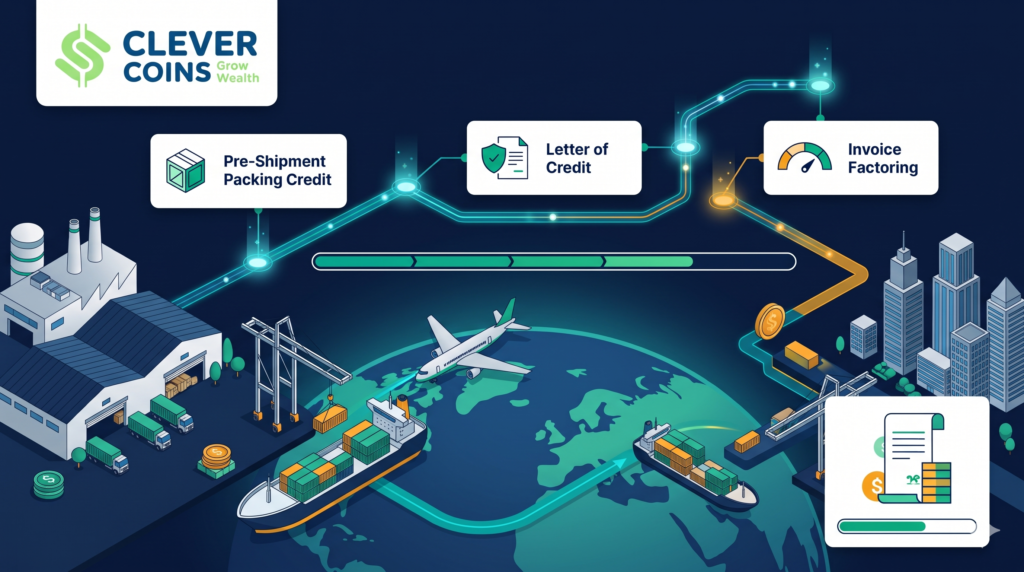
Pre-Shipment Finance (Order to Dispatch): Working capital released before goods leave the port. It covers raw material purchases, processing, assembly, quality testing, warehousing, and export packaging.
Post-Shipment Finance (Dispatch to Settlement): Liquidity released after goods are shipped and transport documents (such as a Bill of Lading or Airway Bill) are generated, bridging the waiting period until the overseas buyer settles the invoice.
Complete Breakdown of Export Finance Options
Modern trade finance spans traditional banking facilities, digital cross-border fintech platforms, and government-backed Export Credit Agencies (ECAs). Below is an in-depth examination of the eight primary export finance options.
1. Pre-Shipment Packing Credit (EPC / PCFC)
Packing Credit is a dedicated short-term working capital loan issued by commercial banks against a confirmed export order or an irrevocable Letter of Credit (LC). Exporters can typically draw funds in either local currency (such as Export Packing Credit in INR) or major foreign currencies via Packing Credit in Foreign Currency (PCFC)—denominated in USD, EUR, GBP, or JPY.
How It Works: Once you submit a confirmed purchase order, the bank sanctions a packing credit limit (typically 75% to 90% of the FOB contract value). Funds are disbursed directly to raw material suppliers or your working capital account. When the goods ship, the packing credit is automatically liquidated using the proceeds from your post-shipment finance facility.
Ideal For: Manufacturers and merchant exporters with confirmed purchase orders who need cash to procure raw materials and fulfill production.
Key Advantage: Borrowing in foreign currency (PCFC) links your interest rate to global benchmarks like SOFR (Secured Overnight Financing Rate), which is frequently substantially cheaper than domestic currency borrowing, while providing a natural hedge against exchange rate fluctuations.
2. Post-Shipment Bill Discounting and Negotiation
Once your cargo leaves the port, you hold commercial invoices and shipping documents proving fulfillment. Export Bill Discounting allows you to sell or pledge those receivables to your bank at a slight discount for immediate cash.
Under a Letter of Credit (LC Negotiation): If the buyer has opened a confirmed or irrevocable LC, the bank faces minimal payment risk because the issuing bank guarantees payment upon compliant document presentation. The bank pays you immediately upon verifying the shipping documents.
Under Documentary Collection (DP / DA Bills): For Documents Against Payment (DP) or Documents Against Acceptance (DA) trades, the bank advances 80% to 90% of the invoice value upfront and collects the balance from the buyer’s bank on the maturity date.
Recourse vs. Non-Recourse: Standard bank bill discounting is usually with recourse, meaning if the foreign buyer defaults (outside of a confirmed LC), the bank can reclaim the advanced funds from you.
3. International Invoice Factoring (Open Account Financing)
Global buyers increasingly demand Open Account terms (Net 30, Net 60, or Net 90) rather than paying the steep fees required to open Letters of Credit. Export Factoring solves this by allowing you to assign your unpaid export invoices to a specialized factor or digital trade finance provider.
How It Works: You ship the goods, issue the invoice, and upload the invoice plus Bill of Lading to the factoring platform. Within 24 to 72 hours, the factor advances 80% to 90% of the invoice face value. Once the overseas buyer pays the factor at maturity (say, Day 60), the factor remits the remaining 10% to 20% reserve back to you, minus their factoring fee.
Non-Recourse Protection: Many international factors offer non-recourse factoring, absorbing 100% of the credit risk if your buyer goes bankrupt or defaults due to insolvency.
Ideal For: SMEs and mid-market exporters selling repeatedly to established overseas buyers on Open Account terms without collateral.
4. Export Forfaiting (Medium- to Long-Term Receivables)
Forfaiting is the purchase of medium- to long-term export receivables—typically arising from capital goods, heavy machinery, or infrastructure contracts—on a strictly 100% non-recourse basis.
How It Works: The exporter sells deferred payment instruments (such as promissory notes, bills of exchange, or deferred payment LCs guaranteed by the importer’s bank) to a forfaiter at a fixed discount. The exporter receives immediate cash for up to 100% of the contract value (minus the discount) and removes the receivable entirely from its balance sheet.
Repayment Horizon: Typically spans 180 days to 5 years (and occasionally up to 7 years for major industrial equipment).
Ideal For: Exporters of machinery, industrial plants, vehicles, and technology systems offering multi-year installment terms to foreign buyers.
5. Letter of Credit (LC) Confirmation and Financing
While a Letter of Credit is technically a payment guarantee rather than a direct loan, it serves as the foundational instrument unlocking low-cost bank financing.
LC Confirmation: If your buyer’s bank is located in an emerging market or a region with geopolitical instability, your local bank can add its Confirmation to the LC. For a confirmation fee, your domestic bank guarantees payment even if the foreign issuing bank or country defaults.
Silent Confirmation & UPAS LCs: Under a Usance Payable at Sight (UPAS) LC, the exporter gets paid immediately at sight by the financing bank, while the buyer enjoys a 90- to 180-day credit window funded by the bank—giving both parties their ideal cash flow outcome.
6. Buyer’s Credit and Supplier’s Credit (ECA-Backed)
For large-ticket capital goods and infrastructure projects, commercial banks partner with Export Credit Agencies (ECAs)—such as EXIM Bank (India/US), UK Export Finance (UKEF), Euler Hermes (Germany), or Sinosure (China)—to structure long-term credit.
Buyer’s Credit: A financial institution in the exporter’s country lends directly to the foreign buyer (or the buyer’s bank) so the buyer can pay the exporter upfront in cash. Under OECD consensus rules, the buyer typically pays a 15% minimum cash down payment, while the remaining 85% is financed over 2 to 10+ years.
Supplier’s Credit: The exporter extends deferred payment terms directly to the foreign buyer and refinances those receivables through its own bank or ECA.
7. Trade Credit Insurance (ECGC / Private Underwriters)
While not a direct cash loan, Export Credit Insurance (offered by national agencies like ECGC or private insurers like Allianz Trade, Atradius, and Coface) protects exporters against commercial default (buyer insolvency or protracted non-payment) and political risks (war, currency transfer freezes, import license cancellations).
Financing Multiplier: Holding an export credit insurance policy dramatically lowers the risk profile of your receivables, enabling commercial banks to increase your borrowing limit by 15% to 25% and slash interest spreads.
8. Supply Chain Finance & Inventory / Warehouse Receipt Finance
For exporters holding finished stock in bonded warehouses or fulfillment centers overseas (such as Amazon FBA warehouses in the US or EU), lenders provide advances against Warehouse Receipts or digital marketplace payout histories.
How It Works: Once goods enter an approved third-party logistics (3PL) warehouse, the lender advances 60% to 75% of the wholesale inventory value. As inventory sells down, proceeds repay the facility.
Comprehensive Comparison: Export Finance Options at a Glance
| Export Finance Option | Stage | Advance Rate | Typical Cost / Interest | Standard Tenure | Recourse / Risk |
| Pre-Shipment Packing Credit (PCFC) | Pre-Shipment | 75% – 90% of order | SOFR + 1.5% to 3.5% p.a. | 90 – 180 days (up to 360/450 days) | With Recourse to Exporter |
| Local Currency Packing Credit | Pre-Shipment | 75% – 90% of order | 8.5% – 12.0% p.a. (minus subvention) | 90 – 180 days | With Recourse to Exporter |
| LC Bill Discounting / Negotiation | Post-Shipment | Up to 100% of bill | SOFR + 1.25% to 2.75% p.a. | 30 – 180 days | Non-Recourse (if LC Confirmed) |
| International Invoice Factoring | Post-Shipment | 80% – 90% upfront | 0.75% – 2.25% per 30 days | 30 – 120 days | Non-Recourse or With Recourse |
| Export Forfaiting | Post-Shipment | Up to 100% (less discount) | Fixed discount: SOFR + 2.0% – 5.0% | 180 days – 5 years | 100% Non-Recourse |
| ECA Buyer’s Credit | Pre & Post-Shipment | Up to 85% of contract | CIRR or SOFR + 1.0% – 3.0% + ECA fee | 2 – 10+ years | Sovereign / ECA Backed |
| Inventory / 3PL Finance | Post-Shipment / Storage | 60% – 75% of stock value | 1.0% – 2.0% per month | 30 – 180 days | Secured by Warehouse Receipt |
Export Finance Costs Explained: Interest, Fees, and Hidden Charges
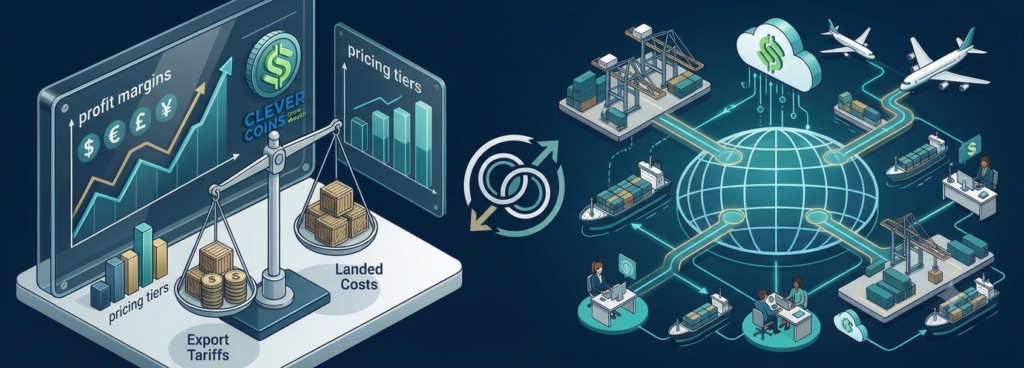
Understanding the true all-in cost of export finance requires looking beyond the headline interest rate. Lenders structure pricing around three distinct components: benchmark interest spreads, transactional processing fees, and risk/currency premiums.
1. Benchmark Interest Rates (SOFR vs. Domestic Prime Rates)
Foreign Currency Facilities (PCFC & Foreign Bill Discounting): Priced off overnight risk-free rates—primarily SOFR for USD, ESTR for EUR, and SONIA for GBP—plus a bank credit spread of 125 to 350 basis points (1.25% to 3.50%) depending on your credit rating and collateral. If SOFR sits near 4.3%, your all-in foreign currency borrowing cost typically lands between 5.55% and 7.80% per annum.
Domestic Currency Facilities: Priced against the bank’s Marginal Cost of Funds-Based Lending Rate (MCLR) or External Benchmark Lending Rate (EBLR), typically ranging from 8.5% to 12.5% per annum. In jurisdictions like India, eligible MSME exporters may qualify for government Interest Equalization Schemes (subvention) that reduce effective borrowing costs by 2% to 3%.
2. Factoring and Fintech Discount Fees
Unlike banks that charge annual percentage rates (APR) plus collateral setup fees, digital trade finance platforms and factors charge a transparent flat discount fee based on invoice tenure and buyer creditworthiness:
30-Day Invoice: 0.70% to 1.25% of invoice value
60-Day Invoice: 1.30% to 2.25% of invoice value
90-Day Invoice: 1.90% to 3.25% of invoice value
3. Ancillary and Hidden Transaction Fees
Always audit your sanction letter or facility agreement for these secondary charges:
Facility Setup / Processing Fee: 0.25% to 1.00% of the sanctioned credit limit (charged annually upon renewal).
LC Advising, Confirmation & Discrepancy Fees: LC advising costs $75–$150; LC confirmation ranges from 0.50% to 2.50% per quarter depending on the issuing country’s sovereign risk; document discrepancy fees run $75–$150 per presentation error.
SWIFT & Courier Charges: $25 to $60 per international message or physical document dispatch.
Foreign Exchange (FX) Conversion Spread: Banks often embed a 0.25% to 1.50% margin above the interbank spot rate when converting USD/EUR export proceeds into your local currency. Negotiating a treasury-linked FX rate can save more money than a 1% reduction in loan interest.
Crystallization / Overdue Penalties: If a foreign currency loan (such as PCFC) is not repaid within the stipulated tenure (typically 180 to 360 days), the bank automatically crystallizes the loan into local currency at the prevailing commercial selling rate and applies penal interest of 2% to 4% above commercial rates, retroactively revoking concessional export interest benefits.
Real-World Cost Calculation Example
Suppose you export specialty auto components worth $100,000 on 60-day Open Account terms:
Scenario A: Digital Non-Recourse Factoring
Advance (85%): $85,000 wired within 48 hours.
Factoring Fee (1.6% flat for 60 days): $1,600.
Wire/Setup Fee: $150.
Total All-In Cost: $1,750 (you receive $85,000 immediately and $13,250 upon buyer settlement, while eliminating buyer default risk).
Scenario B: Bank Pre-Shipment PCFC + Post-Shipment Bill Discounting
Pre-Shipment Advance ($70,000 for 45 days at 6.5% p.a.): $561 interest.
Post-Shipment Advance ($90,000 for 60 days at 6.0% p.a.): $888 interest.
Processing, SWIFT & FX Spread (~0.65%): $650.
Total All-In Cost: $2,099 (covers both manufacturing and post-shipment transit, though requiring collateral and strict compliance tracking).
Step-by-Step Export Finance Process
Whether you work with a traditional commercial bank or a digital cross-border lender, the export finance process follows six structured milestones.
Step 1: Trade Contract Negotiation and Payment Term Alignment
Before signing an export contract, align your payment terms with your financing strategy. Ensure your Proforma Invoice or Sales Contract clearly specifies:
Incoterms® (e.g., FOB, CIF, DDP): Determines exact risk transfer points and required shipping documents.
Payment Method: Irrevocable LC, Documents Against Payment (DP), Documents Against Acceptance (DA), or Open Account.
Credit Period: Sight, 30, 60, 90, or 120 days.
Step 2: Lender Selection and Pre-Qualification
Choose a lender matched to your transaction structure:
Commercial Banks: Best for recurring pre-shipment packing credit and LC discounting if you have hard collateral or strong multi-year financials.
Digital Trade Finance / Fintech Platforms: Best for fast, collateral-free Open Account invoice factoring based primarily on your overseas buyer’s credit rating.
Export Credit Agencies (ECAs): Essential for capital goods contracts exceeding $500,000 with multi-year repayment schedules.
Step 3: KYC, Underwriting, and Buyer Credit Assessment
Submit your corporate and trade documentation. During underwriting, the lender evaluates two parallel risk profiles:
Exporter Performance Risk: Can you manufacture and ship the goods on time without quality disputes?
Buyer & Country Risk: Will the foreign importer pay on the due date, and is the destination country politically and currency-stable?
Step 4: Credit Limit Sanction and Facility Execution
Once underwriting clears, the lender issues a formal Sanction Letter or Master Receivables Purchase Agreement defining:
Maximum revolving credit limit (e.g., $500,000).
Sub-limits per buyer (concentration limits).
Advance percentage (e.g., 85%), interest/discount pricing, tenure caps, and collateral or credit insurance covenants.
Step 5: Order-Level Drawdown (Pre-Shipment or Post-Shipment)
For Pre-Shipment Drawdown: Submit the confirmed Purchase Order or LC along with a cost sheet. The bank credits your packing credit account.
For Post-Shipment Drawdown: Ship the cargo, clear export customs, and submit the Commercial Invoice, Packing List, Certificate of Origin, and Bill of Lading / Airway Bill. The lender verifies shipping authenticity (often via marine vessel tracking APIs) and wires your advance.
Step 6: Liquidation and Reserve Settlement
Upon invoice maturity, the overseas buyer remits payment into the designated collection account (nostro/escrow account). The lender deducts the principal advance and accrued interest/fees, credits any remaining reserve balance (10%–20%) to your operating account, and closes the regulatory export tracking entry (such as EDPMS/e-BRC in India).