Atal Innovation Mission (AIM): Complete Guide to Grants for Startups and MSMEs in 2026
Raising early-stage capital in India often forces founders into a painful dilemma: give up substantial equity to angel investors before proving commercial traction, or take on high-interest debt before generating predictable cash flows. For deep-tech founders, hardware innovators, and R&D-driven MSMEs, this “valley of death”—the gap between building a working prototype and achieving commercial scale—is the single biggest threat to survival.
To bridge this gap with patient, non-dilutive, and minimally dilutive capital, the Government of India established the Atal Innovation Mission (AIM) under NITI Aayog. Now operating in its ambitious expanded phase—AIM 2.0, backed by a Union Cabinet-approved outlay of ₹2,750 crore through March 31, 2028—the mission has evolved into India’s premier institutional engine for grassroots innovation, deep-tech commercialization, and public-procurement-led startup growth.
Whether you are a DPIIT-recognized startup building an AI or clean-tech solution, a small manufacturing MSME developing indigenous industrial hardware, or an institution planning to launch an incubator, understanding how Atal Innovation Mission grants work in 2026 can unlock up to ₹50 lakh to ₹1 crore in direct project funding—alongside access to India’s top central ministries as your very first enterprise customers.
In this exhaustive 2026 guide, we break down every active AIM grant program, funding structure, eligibility criterion, milestone tranche rule, tax compliance requirement, and winning application strategy.
Table of Contents
What Is Atal Innovation Mission (AIM) & What Changed in AIM 2.0?
Complete Breakdown of AIM Grant Programs for Startups & MSMEs
Atal New India Challenge (ANIC 2.0)
Aatmanirbhar Bharat ARISE-ANIC (Dedicated MSME & Startup Track)
Atal Sectoral Innovation Launchpads (ASIL) — New in AIM 2.0
Research Sandbox & Deep-Tech Commercialization Support
Atal Incubation Centres (AICs) & Established Incubation Centres (EICs)
Atal Community Innovation Centres (ACICs) & Fellowships
Master Comparison Table: All AIM Grant Schemes in 2026
Financial Structure: Grant-in-Aid vs. Equity Component Explained
Eligibility Criteria for Startups, MSMEs & Individual Innovators
Eligible & Ineligible Expenditures: How You Can Spend AIM Grant Money
Step-by-Step Application & Selection Process
Essential Documentation Checklist
Tax & Accounting Treatment of Government Grants (Crucial Compliance Rules)
Proven Tips to Win an AIM Grant in 2026
Frequently Asked Questions (FAQs)
1. What Is Atal Innovation Mission (AIM) & What Changed in AIM 2.0?
Launched in 2016 as the Government of India’s flagship initiative under NITI Aayog, the Atal Innovation Mission (AIM) was created to build an end-to-end innovation pipeline—from school classrooms to deep-tech venture commercialization. Over its first decade, AIM established more than 10,000 Atal Tinkering Labs (ATLs) engaging over 1.1 crore students, 72+ Atal Incubation Centres (AICs) supporting over 3,500 startups (including 1,000+ women-led ventures), 14 Atal Community Innovation Centres (ACICs), and 6,200+ Mentors of Change.
The Shift to AIM 2.0 (Active Through 2028)
Recognizing that India had climbed to 39th on the Global Innovation Index and become the world’s third-largest startup ecosystem, the Union Cabinet approved AIM 2.0 with a dedicated budget of ₹2,750 crore running through March 2028.
AIM 2.0 shifts focus from merely building physical labs to accelerating commercialization, procurement, and deep-tech throughput across three core pillars:
Increasing Input: Expanding vernacular innovation programs across 22 scheduled Indian languages and strengthening state-level innovation ecosystems via NITI Aayog’s State Support Mission.
Improving Throughput (Startup Survival & Commercialization): Launching dedicated Research Sandboxes for long-gestation deep-tech startups and upgrading incubation management through AIM-iCREST.
Enhancing Output Quality (Market Access & Procurement): Introducing Atal Sectoral Innovation Launchpads (ASIL) across 10 central ministries so government departments directly test, integrate, and procure products built by Indian startups and MSMEs.
2. Complete Breakdown of AIM Grant Programs for Startups & MSMEs
A common mistake founders make is searching for a single generic “AIM Grant.” In reality, AIM distributes funding through specialized challenge tracks and institutional incubators. Here is how each track works in 2026:
A. Atal New India Challenge (ANIC 2.0)
ANIC is AIM’s flagship direct-funding competition designed to help startups and innovators transform existing technologies or patents into market-ready commercial products solving national socio-economic challenges.
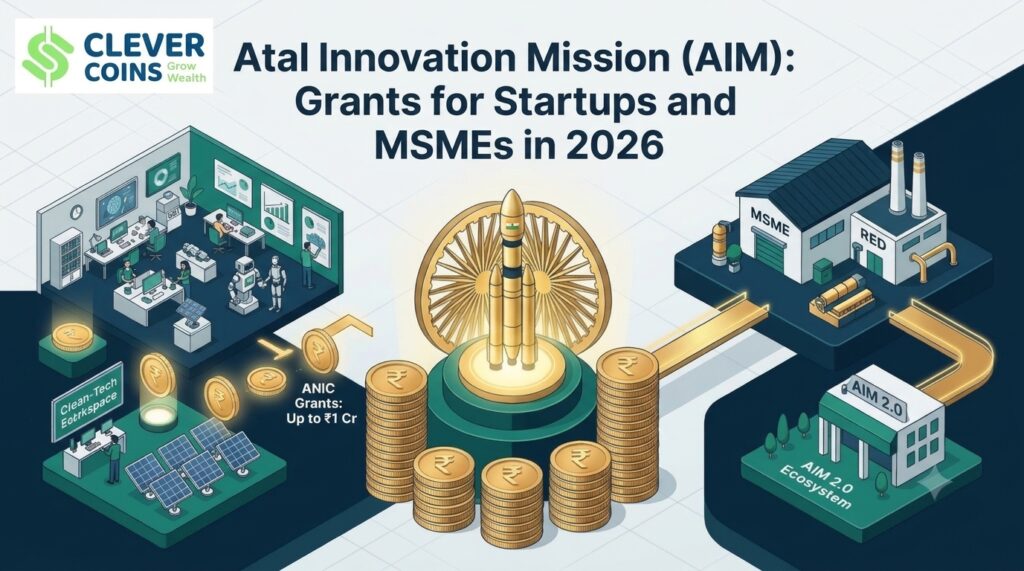
Total Funding Support: Up to ₹1 Crore per selected startup.
Structure of Funding:
Grant-in-Aid: Up to ₹80 Lakh (pure non-returnable grant).
Equity Component: Up to ₹20 Lakh (against 2% equity held by the implementing agency/government trust).
Project Duration: 12 to 24 months (as updated under recent ANIC 2.0 guidelines), released in three milestone-linked tranches.
Core Focus Sectors: Space technology & geospatial AI, electric & smart mobility, climate-smart agriculture, affordable healthcare & med-tech, waste management & circular economy, water recycling/desalination, and railway/road safety.
Key Requirement: You cannot apply with just a slide deck. Applicants must possess a working prototype or validated patent/peer-reviewed technology ready for productization and pilot deployment.
B. Aatmanirbhar Bharat ARISE–ANIC (Dedicated MSME & Startup Program)
Launched in partnership with ISRO and key central ministries (Ministry of Defence, Ministry of Food Processing Industries, Ministry of Health & Family Welfare, and Ministry of Housing & Urban Affairs), ARISE-ANIC (Applied Research and Innovation for Small Enterprises) specifically targets MSMEs and startups.
Total Funding Support: Grant-in-aid of up to ₹50 Lakh (and up to ₹1 crore in select ministry-co-funded problem statements).
Project Duration: 9 to 18 months to build a minimum usable commercial prototype and conduct field trials.
Why MSMEs Love ARISE-ANIC: Unlike traditional venture capital that ignores B2B industrial manufacturing, ARISE-ANIC positions Central Government Ministries and Public Sector Undertakings (PSUs) as potential first buyers. If your MSME solves a specific technical bottleneck—such as predictive railway maintenance, fog-vision sensors, or green propellants—you receive both R&D grant funding and direct procurement validation.
C. Atal Sectoral Innovation Launchpads (ASIL) — New Under AIM 2.0
Modeled on the massive success of Defence’s iDEX (Innovations for Defence Excellence) program, ASIL establishes 10 ministry-specific innovation launchpads across key sectors of the Indian economy.
How It Works: Central ministries float real-world operational problem statements. Selected startups and MSMEs receive co-development grants, access to government testing infrastructure, and streamlined procurement pathways to supply finished solutions at scale.
D. Research Sandbox & AIM-PRIME (Deep-Tech & Lab-to-Market Grants)
For founders commercializing academic research, biotechnology, semiconductors, or material sciences:
Research Sandbox (AIM 2.0): Provides patient capital and regulatory/testing sandboxes for deep-tech startups requiring longer R&D gestation periods before mass manufacturing.
AIM-PRIME (Program for Researchers on Innovation and Entrepreneurship): Executed in collaboration with the Bill & Melinda Gates Foundation and Venture Centre, helping science-based deep-tech startups transition from laboratory breakthroughs to investor-ready commercial ventures.
E. Atal Incubation Centres (AICs) & Established Incubation Centres (EICs)
While individual startups apply directly to ANIC/ARISE, startups can also access seed grants, subsidized lab infrastructure, prototyping equipment, and investor networks by enrolling as incubatees inside AIM-funded Atal Incubation Centres (AICs).
Grant to Institutions: AIM provides up to ₹10 Crore over 5 years to universities, R&D institutes, and corporate/PPP entities with at least 10,000 sq. ft. of built-up space to establish and scale world-class incubators.
Benefit to Startups & MSMEs: Incubated startups gain direct access to seed grants (often ₹10 lakh to ₹50 lakh routed via AIC seed funds and Startup India Seed Fund partnerships), cleanrooms, 3D printing/hardware labs, IP filing support, and curated angel/VC demo days.
F. Atal Community Innovation Centres (ACICs) & Community Innovator Fellowship
Focused on Tier-2, Tier-3, rural, and tribal regions:
Institutional Grant: Up to ₹2.5 Crore (with matching partner contribution) for centers with at least 4,000 sq. ft. of space.
Community Innovator Fellowship: A 1-year paid fellowship hosted at ACICs providing monthly stipends, seed prototyping support, and design-thinking mentorship to grassroots innovators solving local agricultural, handicraft, water, and rural livelihood problems.
3. Master Comparison Table: All AIM Grant Schemes in 2026
| AIM Program | Target Beneficiary | Maximum Grant / Funding | Equity Dilution | Project Duration | Application Mode |
| Atal New India Challenge (ANIC 2.0) | DPIIT Startups & Prototype Innovators | Up to ₹1 Crore (₹80L Grant + ₹20L Equity) | Up to 2% Equity (on ₹20L portion) | 12 – 24 Months (3 tranches) | Direct online via AIM Portal during open calls |
| Aatmanirbhar Bharat ARISE-ANIC | MSMEs, Startups & R&D Entities | Up to ₹50 Lakh (Grant-in-Aid) | 0% (Non-dilutive) | 9 – 18 Months | Direct online via AIM / Partner Ministry Calls |
| Atal Sectoral Innovation Launchpads (ASIL) | Startups & MSMEs in 10 Focus Sectors | Varies by Ministry Call (Milestone Grants + Procurement) | 0% (Grant & Contract based) | 12 – 24 Months | Through Ministry Launchpad Portals |
| Atal Incubation Centres (AIC / EIC) | Universities, Corporates & R&D Institutions | Up to ₹10 Crore (over 5 years) | 0% Grant (to host institution) | Up to 5 Years | Institutional RFP on AIM Portal |
| Atal Community Innovation Centres (ACIC) | Institutions in Underserved / Rural Regions | Up to ₹2.5 Crore (1:1 matching model) | 0% Grant | Up to 5 Years | Institutional Call on AIM Portal |
| Community Innovator Fellowship | Grassroots & Tier-2/3 Innovators | 1-Year Stipend + Prototyping Support | 0% (Non-dilutive) | 12 Months | Via designated host ACICs |
4. Financial Structure: Grant-in-Aid vs. Equity Component Explained
Understanding how AIM structures its money is critical for your cap table and financial planning:
1. Non-Returnable Grant-in-Aid (Up to ₹80 Lakh in ANIC / ₹50 Lakh in ARISE)
Zero Repayment Obligation: Unlike a bank loan or venture debt, a Grant-in-Aid does not have to be repaid—provided you utilize the funds strictly for approved project milestones and submit audited Utilization Certificates (UCs).
Zero Interest Cost: There is no EMI burden during your R&D and pilot testing phase.
2. Nominal Equity Component (Up to ₹20 Lakh in ANIC 2.0)
In ANIC 2.0, for winners receiving the full ₹1 crore package, up to ₹80 lakh is pure grant-in-aid and up to ₹20 lakh is structured as an equity investment against 2% equity.
Why Founders Welcome This: Giving up just 2% equity for ₹1 crore in total capital implies an effective non-dilutive blend that preserves 98% of your cap table—far superior to traditional seed rounds where founders often dilute 10% to 20% for a similar ₹1 crore cheque.
3. Tranche-Based Milestone Disbursement
AIM never transfers ₹50 lakh or ₹1 crore in a single lump sum on Day 1. Funds are released in three structured tranches:
Tranche 1 (Typically 30%–40%): Released upon signing the Grant Agreement, opening a dedicated no-lien/PFMS-mapped project bank account, and finalizing technical milestones.
Tranche 2 (Typically 30%–40%): Released after achieving intermediate prototype refinement/lab validation and submitting the first Utilization Certificate (UC) verified by a Chartered Accountant.
Tranche 3 (Balance 20%–30%): Released upon successful field pilot deployment, market readiness validation, and final project review.
5. Eligibility Criteria for Startups, MSMEs & Individual Innovators
Before investing weeks in drafting an AIM grant proposal, verify that your entity satisfies every mandatory eligibility rule:
Mandatory Entity & Ownership Rules
Indian Incorporation: The applicant must be registered in India as a Private Limited Company (under the Companies Act, 2013), a Limited Liability Partnership (LLP), or a Registered Partnership Firm. (Note: For ANIC 2.0 startup tracks, DPIIT Startup India recognition is mandatory; for ARISE-ANIC MSME tracks, a valid Udyam Registration Certificate is required).
Minimum 51% Indian Shareholding: At least 51% of the equity/stake in the applicant entity must be held by Indian citizens or Indian-owned entities. Subsidiaries of foreign corporations do not qualify.
Technology Readiness Level (TRL):
You must have moved beyond pure conceptual ideation.
Applicants must demonstrate a working prototype (TRL 4 to TRL 7), an existing patent, or peer-reviewed scientific research capable of being converted into a commercial product within 12–24 months.
Commercialization & Beachhead Market Plan:
You must clearly define your beachhead market (initial target customers), estimated Total Addressable Market (TAM), unit economics, and manufacturing/deployment partnerships.
Clean Compliance & No Double-Dipping:
The company and its promoters must have a clean legal and financial track record (no willful defaults or blacklisting).
You cannot claim duplicate grant funding from another central government scheme for the exact same cost component of the same project.
(Note for Individual Innovators & Academicians: While individuals and researchers can apply in early screening rounds, AIM mandates incorporating an eligible Indian company/LLP before Tranche 1 funds are disbursed.)
6. Eligible & Ineligible Expenditures: How You Can Spend AIM Grant Money
Every rupee spent from an AIM grant is audited against your sanctioned project budget. Knowing what is permitted—and what gets disallowed during Utilization Certificate (UC) audits—saves founders from costly compliance clawbacks.
Eligible Expenditures (Approved Uses)
Prototyping & Product Engineering: Raw materials, electronic components, sensors, 3D printing, PCB fabrication, tooling, and pilot batch assembly.
Testing, Certification & Regulatory Approvals: BIS certification, CDSCO medical device trials, ARAI automotive testing, NABL-accredited lab testing, and field pilot trials.
Market Assessment & Pilot Deployment: Primary customer validation studies, field pilot installation costs, and go-to-market user testing.
Specialized R&D Manpower: Salaries/stipends for dedicated project engineers, data scientists, and technical researchers hired specifically for the sanctioned project (subject to AIM salary caps).
Intellectual Property (IP) Protection: Patent filing and prosecution costs in India directly tied to the funded innovation.
Cloud Compute & Specialized Software: Project-specific simulation software licenses or cloud GPU credits required for model training/testing.
Ineligible Expenditures (Strictly Prohibited)
Real Estate & Land Acquisition: Buying land, constructing buildings, or paying long-term commercial office security deposits.
Repayment of Prior Loans: Paying off existing bank loans, founder loans, or past creditors.
Routine Digital Marketing & Ads: Running Google/Meta performance ads, influencer campaigns, or generic brand PR.
Founder Luxury & Routine Overheads: Luxury travel, unrelated administrative expenses, or paying exorbitant promoter salaries above approved project norms.
7. Step-by-Step Application & Selection Process
AIM grant calls are competitive and follow a rigorous, transparent 6-stage evaluation funnel:
Stage 1: Track Open Calls on Official Portals
AIM releases challenge cohorts phase-by-phase across specific sectors. Monitor:
Official AIM Portal:
aim.gov.inStartup India Portal:
startupindia.gov.inPartner Ministry Portals (for ARISE-ANIC and ASIL calls)
Stage 2: Online Application & Technical Proposal Submission
Complete the digital application form on the AIM portal during the active window. You will submit:
Executive summary of the problem statement and your proprietary technological solution.
Patent numbers, IP status, or peer-reviewed research references (without disclosing confidential trade secrets publicly).
Detailed itemized budget breakdown across the 12–24 month project timeline.
Beachhead market sizing, revenue model, and commercialization roadmap.
Stage 3: Initial Screening & Eligibility Check
AIM’s program management unit verifies incorporation status, 51% Indian shareholding, DPIIT/Udyam certificates, and completeness of financial disclosures.
Stage 4: Technical & Domain Jury Evaluation
Shortlisted applicants pitch before an Independent Expert Jury comprising domain scientists, industry veterans, venture capitalists, and representatives from the sponsoring central ministry. Expect deep technical questioning on:
Why your technology is 10x better/cheaper than imported alternatives.
Unit economics at scale (Bill of Materials cost vs. target selling price).
Supply chain and manufacturing readiness in India.
Stage 5: Financial Due Diligence & Sanction Letter
Finalists undergo financial and legal due diligence—verifying cap table accuracy, statutory tax filings, and absence of duplicate grants. Upon clearance, AIM issues the Formal Sanction Letter and Grant-in-Aid Agreement.
Stage 6: PFMS Onboarding & Tranche 1 Release
Your entity registers on the Public Financial Management System (PFMS) and links a dedicated project bank account so NITI Aayog / AIM can track fund utilization transparently in real time. Tranche 1 is credited directly via PFMS.
8. Essential Documentation Checklist
Keep this complete document folder ready before any ANIC or ARISE-ANIC call opens:
Corporate & Legal Identity:
Certificate of Incorporation (COI) / LLP Registration Certificate
Memorandum of Association (MOA) & Articles of Association (AOA) / LLP Agreement
Company PAN Card and TAN
Shareholding Pattern Certificate certified by a Practicing CA/CS (proving ≥51% Indian ownership)
Government Recognitions:
DPIIT Startup India Recognition Certificate (for startups)
Udyam Registration Certificate (for MSMEs)
Technical & IP Proof:
Patent Filing Receipt / Granted Patent Certificate / Provisional Application details
Prototype demonstration video link (2–3 minutes showing live working hardware/software)
Lab test reports, pilot letters of intent (LOIs) from prospective customers, or MoUs with manufacturing/academic partners
Financial & Tax Documents:
Audited Financial Statements (Balance Sheet & P&L) for the last 2–3 years (or since incorporation for younger startups)
Income Tax Returns (ITRs) and GST Registration Certificate + recent GST filing summaries
Bank Mandate Form & Cancelled Cheque for PFMS registration
Detailed Milestone-Wise Project Budget & Utilization Plan
9. Tax & Accounting Treatment of Government Grants (Crucial Compliance Rules)
One area where startups and MSMEs frequently stumble after winning an AIM grant is Income Tax, GST, and Accounting compliance. As financial and tax advisors at Clever Coins, here are the four rules every grant recipient must follow:
1. Income Tax Treatment (Section 2(24)(xviii) & ICDS VII)
Under Section 2(24)(xviii) of the Income Tax Act, 1961, subsidies, grants, cash incentives, and assistance received from the Central or State Government are generally included in the definition of “income,” except where the grant is taken into account for determining the actual cost of a depreciable asset under Section 43(1).
Revenue Grants (for R&D salaries, testing, prototyping consumables): Recognized as income in the Profit & Loss Account systematically over the periods in which you incur the related grant expenses (matching principle under AS-12 / Ind AS 20 and ICDS VII). Because your eligible R&D expenses offset the grant revenue in the same period, your net taxable profit impact is usually tax-neutral—provided your books are properly maintained!
Capital Grants (for purchasing specific lab machinery/equipment): Deducted from the gross cost of the asset for depreciation purposes (or treated as deferred capital grant income under Ind AS).
2. GST Implications on Grants
Pure Grants-in-Aid received from the Government without any direct reciprocal supply of goods or services to the grantor are not liable to GST (as there is no “supply” under Section 7 of the CGST Act).
Important Warning: If your funding comes through a procurement contract or R&D service agreement (such as certain ministry deliverables under ASIL) where you transfer IP or deliver goods/services in exchange for consideration, GST applies at applicable rates. Always get your Grant Agreement reviewed by a Chartered Accountant before raising invoices or receipts.
3. Treatment of Interest Earned on Unspent Grant Funds
Under Government of India General Financial Rules (GFR), any bank interest earned on unspent Grant-in-Aid sitting in your dedicated project account belongs to the Government of India. You cannot spend that interest on company expenses; it must either be refunded to the Consolidated Fund of India / AIM or adjusted against your next grant tranche as per Sanction Letter instructions.
4. Mandatory Utilization Certificate (UC) & Audited Statement of Expenditure
Before AIM releases Tranche 2 or Tranche 3, your statutory auditor / Chartered Accountant must issue a Utilization Certificate (GFR 12-A format) certifying that every rupee of the previous tranche was spent strictly on approved budget heads.
10. Proven Tips to Win an AIM Grant in 2026
With thousands of startups and MSMEs competing for each ANIC and ARISE-ANIC cohort, here is what separates funded winners from rejected applicants:
Lead With Unit Economics, Not Just Tech Jargon: AIM juries consist of seasoned commercial and technical leaders. Show clearly how your innovation cuts customer costs by 30%–50% or replaces an expensive import with a locally manufactured Indian alternative.
Secure a Customer Letter of Intent (LOI) Before Applying: Nothing validates product-market fit faster than a signed LOI from a hospital, municipal corporation, factory, PSU, or enterprise buyer stating they will pilot your product once built.
Show a Clear Path to Self-Sustainability: AIM wants to fund companies that will thrive after the ₹50 lakh–₹1 crore grant ends. Include a 3-year post-grant revenue projection and follow-on private VC/bank financing plan.
Build a Realistic, Audit-Proof Budget: Avoid inflating salaries or adding vague “miscellaneous” lines. Tie every budget line item directly to a specific engineering milestone and vendor quote.
Leverage Atal Incubation Centres (AICs) Early: If there is no active ANIC call open this month, apply to become an incubatee at a sector-aligned Atal Incubation Centre (AIC). AIC managers receive advance visibility into upcoming AIM 2.0 and ASIL ministry challenges and help refine your technical proposal before submission.
11. Frequently Asked Questions (FAQs)
1. Is Atal Innovation Mission (AIM) funding a loan or a grant?
AIM funding under ANIC and ARISE-ANIC is primarily a non-returnable Grant-in-Aid (up to ₹50 lakh in ARISE-ANIC and up to ₹80 lakh in ANIC 2.0). In ANIC 2.0, an additional ₹20 lakh (taking total support to ₹1 crore) is structured against a nominal 2% equity stake. You do not pay monthly EMIs or interest.
2. Can an existing MSME apply for AIM grants in 2026?
Yes. Through the Aatmanirbhar Bharat ARISE-ANIC program and Atal Sectoral Innovation Launchpads (ASIL), registered Indian MSMEs with Udyam Registration can apply for grants up to ₹50 lakh to develop innovative commercial products and technologies for central ministries and industrial markets.
3. Can a startup apply at the idea stage without a prototype?
For direct national grants like ANIC 2.0, a working prototype or validated patent/research proof is mandatory. However, if you are still at the early ideation/MVP stage, you can apply to join an Atal Incubation Centre (AIC) or Atal Community Innovation Centre (ACIC) for pre-incubation mentorship, prototyping lab access, and early seed grants.
4. How long does it take from application to receiving Tranche 1 funds?
From the close of an ANIC or ARISE-ANIC application window through jury evaluation, due diligence, PFMS registration, and Tranche 1 disbursement, the typical timeline is 3 to 5 months.
5. Can a startup apply for both an AIM Grant and a CGTMSE/CGSS collateral-free loan?
Yes. An AIM Grant-in-Aid is non-debt R&D/productization support, whereas CGTMSE and CGSS are credit guarantees for commercial bank loans. As long as there is no double-funding of the exact same expense line item, you can use an AIM grant to build and validate your product, and then raise a CGTMSE or CGSS bank loan to finance large-scale commercial working capital and manufacturing expansion.
Need Help Preparing Your AIM Grant Budget, Financial Projections, or Utilization Audits?
Winning a government grant is only half the battle—structuring an audit-proof project budget, maintaining PFMS & GFR accounting compliance, optimizing Section 2(24)(xviii) tax treatment, and issuing CA-certified Utilization Certificates ensure your tranches arrive smoothly without compliance roadblocks.
At Clever Coins (clevercoins.org), our team of Chartered Accountants, startup financial strategists, and MSME advisors helps Indian founders structure grant-ready financial models, navigate DPIIT and Udyam registrations, and stay 100% compliant from Tranche 1 to commercial scale.
Lorem ipsum dolor sit amet, consectetur adipiscing elit. Ut elit tellus, luctus nec ullamcorper mattis, pulvinar dapibus leo.
Related posts:
CGTMSE vs CGSS: Collateral-Free Loan Schemes for MSMEs & Startups in India (Complete Guide)
PMFME Scheme 2026: Complete Guide to 35% Capital Subsidy, Eligibility, Documents & Online Applic...
Procurement and Marketing Support Scheme: Reimbursement for MSME Trade Fairs – Complete Guide
ECLGS Extension 2025: Is Emergency Credit Line Still Available for MSMEs?
PM Gati Shakti Benefits for MSMEs: How India's National Master Plan Is Transforming Warehousing, Tra...
ZED Certification Scheme: How MSMEs Can Get Free Certification & Subsidy (Complete 2026 Guide)
NSC Interest Rate 2026-27: National Savings Certificate Returns, Tax Benefits & How to Invest
GST Invoice Management System (IMS) from October 2024: New Rules for MSMEs to Accept or Reject ITC
PM Kaushal Vikas Yojana 4.0 for MSME Employees: The Complete Guide to Free Skill Training, RPL Certi...
Credit Guarantee Scheme for Exporters (CGSE): New 2025 Scheme for MSME Exporters
Related posts:
 Self Reliant India (SRI) Fund: Rs 50,000 Cr Equity Infusion for MSMEs Explained
 Credit Guarantee Scheme for Exporters (CGSE): New 2025 Scheme for MSME Exporters
 Agri Infra Fund for Food Processing MSMEs: Complete Guide to 3% Interest Subvention, Eligibility, Benefits and Application Process
 GST on Corporate Guarantee to Subsidiary MSME: New Valuation Rule 2025 – Complete Guide to Rule 28(2), 1% GST Valuation and ITC