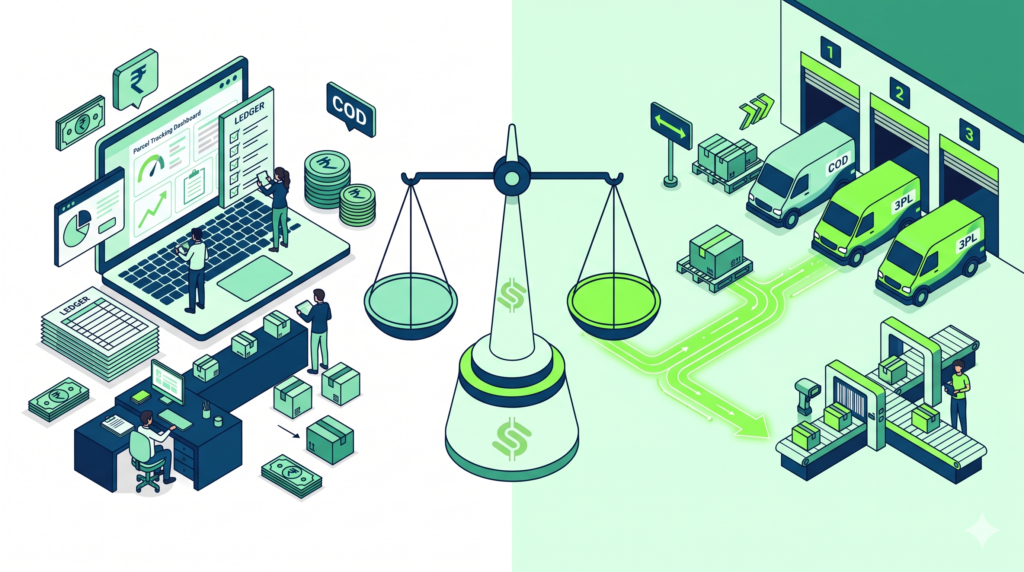
COD Management vs Outsourcing: What to Choose for Scalable E-Commerce Growth
Cash on Delivery (COD) remains one of the most powerful conversion drivers in emerging and high-growth digital markets, particularly across India, Southeast Asia, the Middle East, and Latin America. For millions of online shoppers, paying in cash or via UPI at the doorstep eliminates trust barriers, removes friction around digital payment failures, and encourages first-time purchases from new Direct-to-Consumer (D2C) brands. Yet behind the scenes, COD is an operational tightrope. Every cash order introduces working capital delays, reconciliation headaches, fraud exposure, and the single biggest margin killer in e-commerce: Return to Origin (RTO).
As order volumes climb from a few dozen parcels a day to several thousand, founders, finance heads, and operations leaders face a defining structural question: Should you build and run COD management in-house, or outsource it to specialized third-party providers?
Making the wrong call—or making the right call at the wrong stage of growth—can trap your liquidity in unremitted courier balances, inflate customer acquisition costs through unrecovered shipping fees, and overwhelm your finance and support teams. This guide breaks down every operational, financial, legal, and technological angle of COD management vs outsourcing so you can build a decision framework tailored to your margins, order volume, and growth trajectory.
Understanding the True Anatomy of Cash on Delivery (COD) Operations
Before comparing in-house management with outsourcing, it helps to map out everything that actually happens between the moment a customer clicks “Place Order — Cash on Delivery” and the day that cash safely lands in your corporate bank account. Many businesses treat COD as a simple payment toggle at checkout, when in reality it is a multi-stage financial and logistical lifecycle.
1. Pre-Dispatch Order Verification and Risk Scoring
Unlike prepaid orders where financial commitment happens upfront, a COD order is merely an expression of intent. Without verification, impulse buyers, bots, competitors, or customers entering incomplete addresses can trigger immediate shipping losses. Managing this stage requires automated or manual Non-Delivery Report (NDR) prevention—sending WhatsApp confirmations, running IVR calls, flagging high-risk pin codes, and verifying phone numbers before a shipping label is ever printed.
2. First-Mile Pickup and Multi-Carrier Allocation
Once verified, parcels must be assigned to the courier partner with the highest delivery success rate and fastest cash remittance cycle for that specific destination pin code. Choosing a courier solely on forward freight rates often backfires when a cheaper carrier suffers from a 35% RTO rate in Tier-3 cities.
3. In-Transit Tracking and NDR (Non-Delivery Report) Management
When a delivery agent fails to hand over a parcel—whether due to “customer unavailable,” “phone unreachable,” or “refused at doorstep”—the clock starts ticking. Effective COD management requires real-time NDR intervention within hours, contacting the buyer to reschedule delivery before the courier automatically initiates a return shipment.
4. Doorstep Cash / Digital Collection and Remittance
Upon successful delivery, the field executive collects physical currency or processes a QR/UPI payment. That money sits with the courier partner or aggregator before being batched and transferred to the seller—typically on a T+2 to T+7 business day cycle, minus shipping fees, COD handling charges, and applicable taxes.
5. Financial Reconciliation and Dispute Resolution
The final—and most frequently neglected—stage is matching every delivered AWB (Air Waybill) number against bank payouts, courier invoices, weight discrepancy deductions, and returned inventory. Without granular reconciliation, businesses routinely lose 1.5% to 4% of gross COD revenue to unremitted collections, phantom weight charges, and lost RTO parcels.
What Is In-House COD Management?
In-house COD management means your internal operations, customer support, and finance teams directly own and execute the entire Cash on Delivery lifecycle. You contract directly with individual logistics carriers (such as Blue Dart, Delhivery, DTDC, or regional couriers), manage order verification through your own staff or CRM tools, handle NDR follow-ups internally, and perform line-by-line financial reconciliation on your own accounting ledger.
Core Components of an In-House Setup
Direct Carrier Contracts: Negotiating rate cards, COD remittance schedules, and service-level agreements (SLAs) directly with multiple courier companies.
Internal Verification Desk: Employing customer experience executives or configuring internal automation workflows to call and message COD buyers prior to dispatch.
Dedicated NDR Recovery Team: Training support agents to proactively reach out to customers on failed delivery attempts and coordinate re-attempts with courier hubs.
Internal Finance & Ledger Reconciliation: Using ERP systems, accounting software, or custom spreadsheets to match AWB delivery statuses against bank UTR (Unique Transaction Reference) settlements and GST/tax deductions.
Advantages of In-House COD Management
Unfiltered Control Over Customer Experience: Your own trained brand representatives communicate with buyers during verification and delivery exceptions. You control the tone, script, and escalation rules—which is critical for high-ticket or luxury brands where customer perception directly impacts repeat purchases.
Zero Middleman Markups on Freight and COD Fees: By contracting directly with carriers rather than paying an aggregator or managed service margin, high-volume shippers can negotiate volume-based freight discounts and lower COD handling percentages (often saving ₹10–₹25 or 0.5%–1.5% per order at scale).
Deep Proprietary Data and Risk Intelligence: Keeping operations internal lets you build custom customer risk profiles based on historical return behavior, SKU-level RTO patterns, and repeat buyer reliability across your own ecosystem.
Immediate Visibility into Cash Flow Bottlenecks: When your finance team reconciles courier settlements directly, anomalies such as delayed remittances or sudden spikes in weight disputes are spotted immediately rather than buried inside consolidated third-party statements.
Disadvantages and Hidden Costs of In-House Management
High Fixed Overhead and Staffing Burden: Building a 7-day-a-week verification and NDR calling desk requires hiring, training, shift management, and telephony infrastructure—costs that remain fixed even during seasonal order dips.
Slower Multi-Carrier Onboarding and Tech Integration: Integrating APIs for five or six different courier partners, maintaining webhook reliability, and managing separate billing portals places a heavy engineering load on your tech team.
Reconciliation Nightmares at Scale: Matching tens of thousands of individual AWB remittances, partial returns, TDS/TCS deductions, and reverse logistics charges manually or semi-manually consumes dozens of accounting hours every week.
Limited Leverage at Low-to-Moderate Volumes: If you ship fewer than 5,000 COD orders per month, individual carriers rarely offer priority account management, faster remittance cycles, or aggressive rate discounts.
What Is COD Outsourcing?
COD outsourcing involves delegating part or all of your Cash on Delivery operations to external specialists. Depending on your business model, outsourcing takes three primary forms:
Logistics Aggregators & Shipping Platforms (e.g., Shiprocket, Pickrr, NimbusPost): Provide unified access to dozens of couriers through a single API, automated carrier allocation, basic NDR dashboards, and consolidated COD remittances (including early/daily remittance add-ons).
Specialized RTO & Checkout Optimization Suites (e.g., GoKwik, Shiprocket Engage, Razorpay Magic Checkout): Use network-wide buyer intelligence across thousands of merchants to score COD risk at checkout, block serial returners, automate WhatsApp/IVR verification, and convert COD orders into prepaid transactions via targeted incentives.
End-to-End 3PL / Fulfillment & Managed Operations Partners: Handle warehousing, packing, dispatch, courier management, NDR calling, and financial settlement under a unified SLA.
Advantages of COD Outsourcing
Network-Wide Buyer Intelligence: Specialized COD tech providers analyze hundreds of millions of transactions across thousands of stores. They can flag a high-risk buyer on your store even if that customer has never purchased from you before—something an in-house team simply cannot replicate.
Rapid Plug-and-Play Scalability: During peak sales events (such as Diwali, Black Friday, or end-of-season sales), outsourced partners absorb 3x to 5x order spikes effortlessly without forcing you to hire temporary staff.
Accelerated Working Capital (Early COD Remittance): Many outsourced platforms offer T+1 or T+2 daily COD remittance options (for a small financing fee), dramatically improving cash conversion cycles compared to standard T+7 or T+10 direct carrier payouts.
Consolidated Reporting and Automated Reconciliation: Instead of chasing six different courier portals for invoices and UTR numbers, you receive unified settlement dashboards and standardized tax invoices.
Disadvantages and Risks of COD Outsourcing
Per-Order Fee Erosion: Aggregators and COD SaaS platforms charge either a flat fee per order, a percentage of GMV (often 1% to 3%), or a markup on base freight rates. On thin-margin products, these fees compound quickly.
Loss of Direct Carrier Accountability: When an outsourced aggregator sits between you and the courier, resolving a lost high-value parcel or an operational hub delay requires raising a support ticket with the middleman, who then tickets the carrier—adding days to resolution times.
Generic Customer Communication: Automated or outsourced call centers rarely understand the nuances of your product catalog, sizing quirks, or brand voice, which can occasionally turn a recoverable NDR into a cancelled order.
Data Dependency and Switching Friction: Relying heavily on a proprietary checkout or COD scoring vendor means your historical buyer risk scores and workflow automations are locked inside their ecosystem if you ever decide to migrate.
Head-to-Head Comparison: In-House COD Management vs Outsourcing
To evaluate both models objectively, compare them across the eight operational dimensions that govern e-commerce profitability:
| Evaluation Factor | In-House COD Management | COD Outsourcing |
| Upfront Setup & Tech Effort | High (API integrations, CRM setup, telephony, SOPs) | Low (Plug-and-play Shopify/WooCommerce/custom APIs) |
| Cost Structure | High fixed costs (salaries, software); lower variable per-order freight cost at scale | Low fixed costs; higher variable per-order or % GMV fees |
| RTO Reduction Capability | Relies strictly on internal historical data and manual/CRM calling rigor | Leverages cross-merchant network data, AI risk scoring, and automated nudges |
| Cash Flow & Remittance Speed | Standard carrier cycles (typically T+5 to T+10 business days) | Flexible (standard T+3 to T+5, or paid T+1/T+2 early remittance) |
| Customer Experience Control | Full brand control over scripts, tone, and escalation paths | Standardized templates and third-party agents; less brand nuance |
| Financial Reconciliation | Complex (multiple carrier portals, separate invoices, manual UTR matching) | Streamlined (single consolidated ledger, unified invoicing) |
| Scalability During Peak Sales | Constrained by internal headcount and shift capacity | Virtually elastic; handles sudden volume surges seamlessly |
| Best Suited Order Volume | Established brands shipping 10,000+ COD orders/month with dedicated ops teams | Early-stage to mid-market brands (100 to 10,000 COD orders/month) |