GST 2.0 Reforms 2025: All Rate Changes Explained (Complete Guide)
If you bought a small car, an air conditioner, a tube of toothpaste, or a health insurance policy after 22nd September 2025, you paid less GST than you would have a day earlier. For millions of middle-class Indian households, that single date marked the biggest change to indirect taxes since GST itself was launched in July 2017.
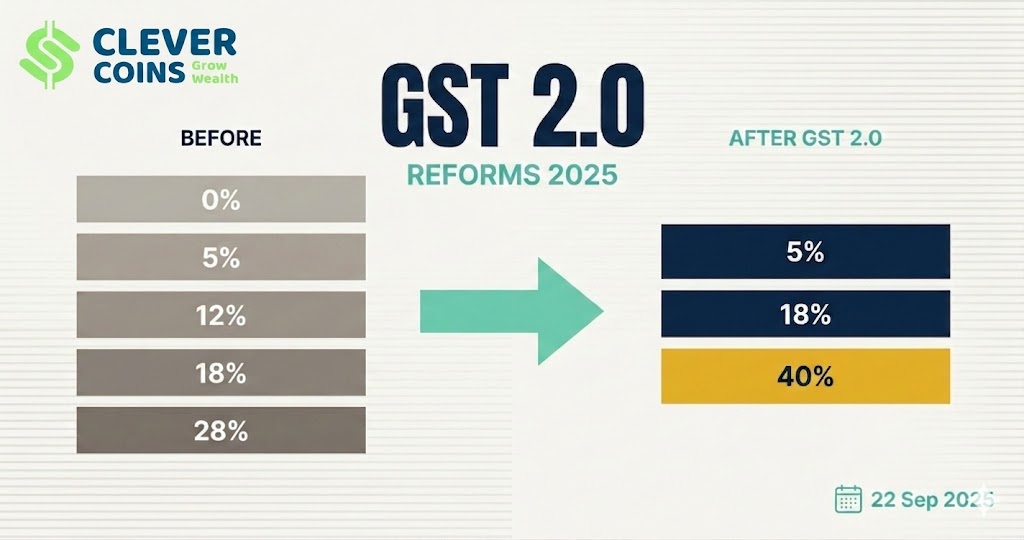
The change is called GST 2.0, and it is the most comprehensive overhaul of India’s goods and services tax regime in eight years. The old five-slab system (0%, 5%, 12%, 18%, 28%) is gone. In its place, we now have a cleaner three-tier structure of 5%, 18%, and 40%, alongside the nil-rated 0% slab and a couple of special rates. Over 175 items became cheaper overnight. Individual health and life insurance became completely tax-free. Luxury cars, aerated drinks, and online gaming moved into a new 40% demerit slab.
If you run a business, there is more to it than just lower prices. New compliance rules, inventory transition challenges, ITC reversal under Section 18(4), and a fresh provisional refund regime all came along for the ride. This guide walks you through every rate change, sector impact, and compliance action you need to know — without the jargon.
We are CleverCoins, a Mumbra, Thane-based tax consultancy that has been filing GST returns and guiding MSMEs through rate changes for over five years. Here is the complete picture.
What is GST 2.0? The 30-Second Summary
GST 2.0 is the informal name for the package of GST reforms approved at the 56th GST Council Meeting held in New Delhi on 3rd September 2025 and notified by CBIC on 17th September 2025. The reforms came into effect on 22nd September 2025 — the first day of Navratri — in what Finance Minister Nirmala Sitharaman described as the most significant reset of the GST framework since its inception.
The reforms rest on four pillars:
- Rate rationalisation — collapsing the 12% and 28% slabs into 5% and 18% respectively, and creating a new 40% slab for luxury and sin goods.
- Consumer relief — exempting individual health and life insurance, expanding the 0% category for daily essentials, and lowering rates on small cars, appliances, and personal care items.
- Fixing the inverted duty structure — especially in textiles, fertilisers, and select manufacturing inputs, to release working capital stuck in refunds.
- Ease of compliance — pre-filled returns, faster provisional refunds, simplified registration for small and e-commerce sellers, and the formal launch of the GST Appellate Tribunal (GSTAT).
Key Dates You Need to Remember
- 15 August 2025 — Prime Minister Narendra Modi announced upcoming next-generation GST reforms from the Red Fort on India’s 79th Independence Day.
- 3 September 2025 — The 56th GST Council Meeting approved the new rate structure under the chairpersonship of FM Nirmala Sitharaman.
- 17 September 2025 — CBIC issued notifications 09/2025-CTR to 17/2025-CTR and 13/2025-Central Tax, 14/2025-Central Tax formalising the changes.
- 22 September 2025 — New GST rates came into force across all goods and services except tobacco.
- 1 November 2025 — Phased measures on trade facilitation and specified-premises restaurant clarifications took effect.
- Tobacco transition — Currently continues at 28% + compensation cess. Will move to the 40% slab through a separate notification once GST compensation loan dues are fully repaid to states.
Old vs New: What Changed at a Glance
Before (Pre-22 Sep 2025) | After GST 2.0 | |
Number of slabs | 5 main slabs | 3 main slabs |
Slab rates | 0%, 5%, 12%, 18%, 28% | 0%, 5%, 18%, 40% |
Special rates | 3% (gold), 0.25% (rough diamonds), 28% + cess | 3% (gold), 0.25% (rough diamonds) — cess absorbed into 40% slab |
Items cheaper | — | 175+ items moved to lower slabs |
12% slab items | — | ~99% moved to 5% |
28% slab items | — | ~90% moved to 18% |
Average GST incidence | ~11.5% | Below 10% |
The direction of travel is simple: about 99% of items in the old 12% slab moved down to 5%, and about 90% of items in the 28% slab moved down to 18%. A small number of non-essential and harmful consumption items went the other way — upward into the new 40% slab.
What Became Completely Tax-Free (0% Slab)
This is where the biggest consumer wins sit. Several everyday items and two huge financial products are now 100% exempt from GST.
Food & Dairy | Education & Stationery | Healthcare & Insurance |
UHT milk, paneer (pre-packaged), pizza bread, roti, paratha, ready-to-eat chapatis | Notebooks, exercise books, pencils, erasers, maps, globes, charts, lab notebooks | 33 life-saving drugs, medical oxygen, individual health insurance, individual life insurance, ULIPs, family floaters, senior citizen plans |
Biggest win for households: The exemption on individual health and life insurance is the single most impactful consumer change in GST 2.0. Previously, an 18% GST meant a Rs. 25,000 health insurance premium carried Rs. 4,500 of tax. That is now zero. A middle-class family with separate health and life policies typically saves Rs. 8,000–Rs. 15,000 per year in premium costs.
What Moved to the 5% Slab
This is the largest category of rate reductions. Roughly 99% of items that were previously at 12% are now at 5%, along with several items from the 18% slab — particularly personal care products.
Category | Items | Earlier Rate |
Packaged Food | Butter, cheese, condensed milk, namkeens, bhujia, sauces, pasta, instant noodles, chocolates, coffee, cornflakes, biscuits, sugar confectionery | 12% → 5% |
Dry Fruits & Oils | Almonds, cashews, pistachios, other dry fruits, vegetable oils, ghee | 12% → 5% |
Beverages | Fruit juices, plant-based milk drinks, soya milk drinks | 12% or 18% → 5% |
Personal Care | Shampoo, soap, toothpaste, hair oil, toilet soap | 18% → 5% |
Footwear & Apparel | Footwear priced up to Rs. 2,500; low-priced apparel | 12% → 5% |
Agriculture | Tractors, agricultural machinery, irrigation equipment, fertiliser inputs, bio-pesticides | 12%/18% → 5% |
Medical Devices | Thermometers, medical glucometers, select diagnostic kits | 12%/18% → 5% |
Household Items | Sewing machines, pressure cookers, umbrellas, bicycles, small washing machines, household utensils | 12%/18% → 5% |
FMCG Sachets | Small sachets priced at Rs. 10 or less across various FMCG categories | 12%/18% → 5% |
For FMCG giants, this is a structural demand trigger. For small kirana stores and neighbourhood shops, it means every shelf will need new MRP labels — but also that volumes should pick up as consumers notice the savings on their monthly grocery receipts.
What Moved to the 18% Slab (from 28%)
This is where the auto sector and white-goods industry got their biggest relief in nearly a decade. Most items that were previously in the highest 28% slab now sit at 18% — a 10-percentage-point reduction that translates directly to lower sticker prices.
Category | Items | Earlier Rate |
Appliances | Air conditioners, refrigerators, large washing machines, dishwashers, televisions (all sizes), monitors, projectors | 28% → 18% |
Automobiles | Small cars (petrol engine < 1,200cc or diesel < 1,500cc, length < 4m), two-wheelers up to 350cc, three-wheelers, ambulances | 28% → 18% |
Construction | Cement, paints, tiles (select categories) | 28% → 18% |
Auto Parts | Auto components, tyres (passenger vehicles), automotive batteries | 28% → 18% |
Real-world impact: Auto dealers reported a surge in bookings within days of the announcement. Small car sales in the festive quarter saw their strongest momentum in years. For the construction sector, the cement rate cut is particularly meaningful — it reduces the per-square-foot cost of every home, shop, and godown being built in the country.
What Moved to the New 40% Demerit Slab
The new 40% slab replaces the old 28% + compensation cess structure. It is narrowly targeted at luxury goods, sin products, and categories the government considers socially harmful or non-essential.
Category | Items | Change |
Luxury Vehicles | Premium cars, luxury SUVs, yachts, private aircraft, motorcycles above 350cc | 28% + cess → 40% |
Beverages | Aerated beverages, caffeinated energy drinks, carbonated drinks with added sugar | 28% + cess → 40% |
Sin Goods | Pan masala, gutkha (non-tobacco products) | 28% + cess → 40% |
Entertainment | Casinos, race clubs, online gaming, betting | 28% → 40% |
Tobacco* | Cigarettes, tobacco products (will move to 40% later via notification) | Currently at 28% + compensation cess |
Tobacco special note: Tobacco products have not moved to 40% yet. They continue at the existing 28% + compensation cess until the compensation loan and interest obligations owed to states are fully discharged. The shift will happen later through a separate notification. For now, your cigarette pack pricing is unchanged
How Much Will You Actually Save? Real Examples
Here are concrete numbers for common purchases, assuming the full benefit of the rate cut is passed on to the consumer (which both the Council and CBIC have urged businesses to do):
Item (MRP before tax) | Old GST | New GST | You Save |
Air Conditioner (Rs. 40,000) | 28% = Rs. 11,200 | 18% = Rs. 7,200 | Rs. 4,000 |
Small Car (Rs. 6,00,000) | 28% = Rs. 1,68,000 | 18% = Rs. 1,08,000 | Rs. 60,000 |
Health Insurance (Rs. 25,000 premium) | 18% = Rs. 4,500 | 0% = Rs. 0 | Rs. 4,500 |
Cement (per bag, Rs. 400) | 28% = Rs. 112 | 18% = Rs. 72 | Rs. 40/bag |
Toothpaste (Rs. 200) | 18% = Rs. 36 | 5% = Rs. 10 | Rs. 26 |
A middle-class household buying an AC, a small car over five years, and carrying family health insurance could see total savings running into six figures — before even counting smaller daily purchases like toothpaste, biscuits, and shampoo.
Sector-by-Sector Impact
1. FMCG and Packaged Food
Almost every major FMCG brand has had to re-label existing inventory and update ERP systems. Rural and Tier-2/3 consumption is expected to see the biggest uplift — particularly in personal care, where the shift from 18% to 5% is dramatic.
2. Automobiles
The biggest beneficiary of GST 2.0. Small cars (engines below 1,200cc petrol or 1,500cc diesel, length under 4 metres), two-wheelers up to 350cc, three-wheelers, and ambulances all dropped from 28% to 18%. Luxury vehicles moved up to 40%, but that affects a much smaller buyer pool. Industry analysts expect a multi-quarter demand revival.
3. Electronics & White Goods
ACs, refrigerators, large washing machines, and televisions — the four appliances middle-class households aspire to — all dropped from 28% to 18%. Combined with festive discounts and easier EMI access, this has triggered one of the strongest white-goods buying seasons in recent memory.
4. Healthcare and Insurance
Individual health and life insurance policies — including ULIPs, family floaters, and senior citizen plans — are now completely GST-free. 33 life-saving drugs and medical oxygen have also been exempted. Hospitals benefit from lower input costs, and patients benefit from lower out-of-pocket premium expenditure.
5. Agriculture
Tractors, agricultural machinery, irrigation equipment, fertiliser inputs, and bio-pesticides have moved to 5%. This addresses long-standing inverted duty structure issues in the sector and is expected to support the government’s goal of doubling farmers’ income.
6. Textiles, Footwear & Apparel
Low-priced footwear (up to Rs. 2,500) and budget apparel moved to the 5% slab. The inverted duty structure in textiles — where inputs were taxed higher than finished goods — has been addressed, freeing up refund-locked working capital for garment exporters and weavers.
7. Construction & Real Estate
Cement dropping from 28% to 18% is a major input-cost win. Every ongoing construction project — residential, commercial, or infrastructure — benefits. Paints and select construction materials also saw reductions.
8. MSMEs & Small Business
Simplified registration for small and e-commerce sellers, provisional refund regime for faster cash flow, pre-filled return pilots, and reduced classification complexity (with fewer slabs) all add up to a materially easier compliance environment for small businesses — finally.
GST 2.0 Is Not Just About Rates — The Structural Reforms
The headline-grabbing rate changes are only half the story. GST 2.0 also introduced several structural reforms that matter more to businesses than to consumers.
Pre-filled GST returns
GSTR-3B will progressively be pre-filled with data from GSTR-1 and GSTR-2B, reducing manual data entry and reconciliation errors. Rollout is phased.
Faster refunds via provisional refund regime
Exporters and businesses with inverted duty structures can now access provisional refunds far faster than earlier, with final adjudication happening later. Working capital stuck in pending refunds has been a perennial pain point — this addresses it directly.
Simplified registration for small & e-commerce sellers
A dedicated simplified registration pathway for small sellers and e-commerce operators was introduced, lowering the initial compliance barrier for first-time entrepreneurs.
GSTAT becomes operational
The long-pending GST Appellate Tribunal (GSTAT) is now operational between September and December 2025, with a backlog window for pending appeals extended until 30 June 2026. The Principal Bench also acts as the National Appellate Authority for Advance Ruling (NAAAR).
Omission of Section 13(8)(b)
This technical change shifts the place of supply for intermediary services to the location of the recipient — ending years of litigation for the IT/BPO and consulting sectors who were facing GST on export intermediary services.
Post-sale discount and ITC reversal rule adjustments
Rules governing post-sale discounts and the related ITC reversals have been clarified and rationalised, reducing disputes and audit queries.
What Did NOT Change
- Petroleum products remain outside GST — petrol, diesel, crude oil, natural gas, and ATF continue under the old excise plus VAT system. This is a state revenue dependency issue.
- Gold remains at 3% GST.
- Rough diamonds remain at 0.25%.
- Tobacco continues at 28% plus compensation cess until compensation loan dues are settled.
- Online education services remain at 18% — a point criticised by the edtech sector.
- Most services continue at 18% (restaurants in 5-star premises, financial services, telecom, IT services, professional services).
What Businesses Must Do Now
If you run a business registered under GST, these are the non-negotiable action items:
- Update your ERP or accounting software with the new HSN-wise rate schedule. Most Tally, Zoho Books, and QuickBooks users already received patches in late September 2025 — but double-check your tax masters are correct.
- Re-label existing inventory held at old rates. The CBIC’s transition guidance allows some flexibility but requires clear disclosure to the customer.
- Handle ITC reversal correctly under Section 18(4) where rate cuts from 18% to 5% apply. If you were claiming higher ITC earlier, proportional reversal may be required for stock on hand.
- Revise your pricing strategy to pass on the benefit of rate cuts. Anti-profiteering provisions are not formally active, but the Council has strongly urged businesses to pass on the savings.
- Update invoice templates, e-invoices (if applicable), and e-way bills with correct GST rates.
- Communicate the changes to your sales team and customers clearly — especially if you sell big-ticket items where the savings are visible.
Common mistake to avoid: Some businesses are charging the old rate on inventory billed at old rates and the new rate on fresh supplies — that is incorrect. The rate applicable is based on the date of supply and invoice issue, not when the stock was purchased. Speak to your GST consultant if in doubt.
How CleverCoins Can Help You Transition
GST 2.0 is a consumer win but a compliance lift for businesses. Our team at CleverCoins has spent the last several weeks helping clients across the Mumbai Metropolitan Region handle:
- ERP and tax master reconfiguration for the new slab structure
- ITC reversal calculations and documentation under Section 18(4)
- Inventory transition audits and re-labelling compliance
- Provisional refund claims for exporters and inverted duty structure businesses
- Simplified registration for new e-commerce sellers taking advantage of the new regime
- GSTR-1, GSTR-3B, and GSTR-9 filing aligned with the new rates
If you are unsure how the changes apply to your specific HSN codes or your sector, or if you are facing an ITC mismatch from the transition, reach out to us at clevercoins.org. The first consultation is free.