GST on Food & Restaurants in India 2026: Every Rate, Every Rule, and What Your Bill Should Actually Look Like
You just had lunch at your favourite biryani place and the bill says ₹960. You scan it: food ₹800, GST ₹40, service charge ₹80, packaging ₹40. Fair enough? Maybe. But what if the restaurant billed you 12% instead of 5%? Or added GST on a service charge that should have been optional? Or your delivery app billed GST on the full order including delivery fee?
These aren’t hypothetical. They happen daily across thousands of restaurants in Thane, Mumbai, and across India. Most customers don’t notice. Most restaurant owners aren’t sure they’re billing correctly either.
At CleverCoins, we work with restaurant and dhaba owners across Mumbra and the wider MMR on GST registration, filing, and compliance. This guide is the complete 2026 picture — every restaurant GST rate, the ITC rules, the Zomato-Swiggy Section 9(5) rule, and the classic myths that keep restaurant owners paying more tax (or less) than they should.
The One Table You Need: GST Rates for Every Food Scenario
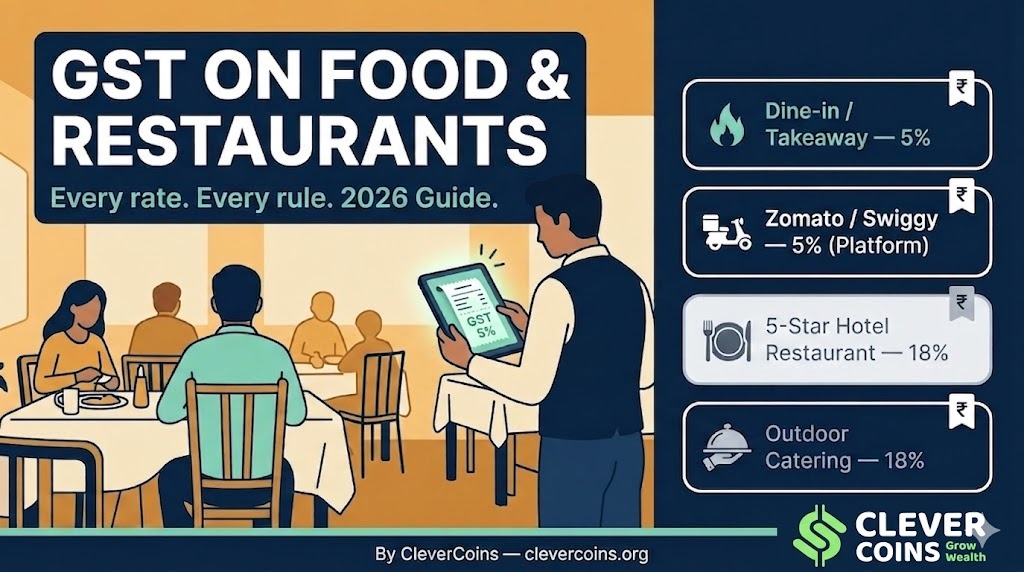
Here is every major scenario in one place. Whether you’re a customer checking your bill, a restaurant owner pricing your menu, or a cloud kitchen operator reconciling your Swiggy payouts — this is your 2026 reference.
Scenario | GST Rate | ITC for Biz | Notes |
Standalone restaurant — dine-in (AC or non-AC) | 5% | ✗ No | Since Apr 2019, AC / non-AC distinction removed. Both pay 5%. |
Standalone restaurant — takeaway / parcel | 5% | ✗ No | Same rate as dine-in. Packaging charge may attract 18% separately. |
Restaurant inside hotel (room tariff ≥ ₹7,500/night) | 18% | ✓ Yes | “Specified premises.” ITC available on inputs for these. |
Restaurant inside hotel (room tariff < ₹7,500/night) | 5% | ✗ No | Treated as standalone restaurant. No ITC. |
Outdoor catering services | 18% | ✓ Yes | Events, corporate catering, wedding catering. ITC allowed. |
Zomato / Swiggy food delivery order | 5% | Platform | Platform pays GST as deemed supplier under Sec 9(5). Restaurant does NOT collect this GST. |
Delivery charge (by Zomato/Swiggy platform) | 18% | ✓ Yes | Platform’s own delivery fee. Separate from food GST. |
Cloud kitchen / ghost kitchen | 5% | ✗ No | Treated as restaurant regardless of dine-in facility. |
Canteen / mess in office / factory | 5% | ✗ No | Employer running canteen: 5% if charged to employees. |
Railways / airline food services | 5% | ✗ No | IRCTC and in-flight meals both at 5%. No ITC. |
Alcohol (beer, wine, spirits) sold by restaurant | State VAT | N/A | NOT under GST. Billed under state excise/VAT. Bills must be bifurcated. |
The AC vs Non-AC Myth — Busted Once and For All
Important: This Rule Changed in 2019 — But Restaurants Still Get It Wrong Before April 1, 2019: Non-AC restaurants paid 5% GST; AC restaurants paid 12% GST. After April 1, 2019 (still in force in 2026): ALL standalone restaurants — whether they have AC or not — pay 5% GST. No ITC in either case. If your restaurant is charging you 12% GST in 2026 and it is not inside a hotel with ₹7,500+ room tariff, that is incorrect billing. You are being overcharged. Raise the issue — or call us at CleverCoins. The only valid 18% rate for restaurants is for: (a) specified-premises hotel restaurants, and (b) outdoor catering services. |
ITC Rules for Restaurant Owners — The Hard Truth
Input Tax Credit is the ability to reduce your GST liability by the tax you already paid on purchases. For most restaurant owners in India, the ITC situation is straightforward — and painful.
5% Scheme Restaurants (Most Restaurants)
- Cannot claim ITC on: raw ingredients, vegetables, spices, cooking oil, gas cylinders, packaging materials, disposable containers, restaurant equipment, furniture, rent, electricity, staff uniforms, repair services — none of it.
- The 5% you collect from customers is the final amount you deposit to the government. Your input costs are a pure business expense.
- This is exactly why restaurant margins are squeezed: you pay 18% GST on your commercial kitchen equipment, 18% on repair services, 18% on packaging supplies — and can recover none of it.
18% Scheme Restaurants (Hotel Restaurants, Caterers)
- Full ITC available on all business inputs and services.
- Net GST cost = 18% collected minus ITC on all input purchases. For a well-managed operation, effective tax outgo can be significantly below 18%.
- Must issue proper tax invoices; customers can also claim ITC on their bills (relevant for corporate events and catering).
Why Did the Government Remove ITC at 5%? When restaurants had ITC under the old regime (pre-2019), many were artificially inflating input claims and not passing the benefit to customers. The government removed ITC and simultaneously cut the rate from 12% to 5% for AC restaurants. Trade-off: rates are lower, but you absorb all input tax costs. For a high-volume restaurant with tight supplier discipline, this is often still a net win. For a small dhaba with mostly unregistered vendors, the ITC was never very useful anyway. |
GST on Food Products & Packaged Items Sold at Restaurants
If your restaurant sells packaged food items — bottled water, canned juices, branded namkeen, chocolates — those attract a different GST rate than the cooked food. Here’s the breakdown after the GST 2.0 rationalisation (effective September 2025):
Food Item / Category | GST Rate | Examples |
Fresh / raw / unprocessed — unbranded | NIL | Fresh fruits, vegetables, eggs, fresh fish & meat, milk, curd (unbranded) |
Basic staples — unbranded & unpackaged | NIL | Rice, wheat, flour, dal (loose/unbranded) |
Packaged & branded staples | 5% | Branded atta, rice, pulses in sealed packs, packaged curd & paneer |
Processed food — standard | 5% | Bread, biscuits (≤₹100/unit), namkeen, tea, coffee powder |
Packaged snacks & premium biscuits | 12% / 18% | Premium cookies, chocolates, wafers; varies by processing and branding |
Aerated drinks / carbonated beverages | 28% + Cess | Soft drinks, cola, energy drinks. High rate — bill separately. |
Mineral / packaged water (>20 litres) | NIL | Large water cans for coolers |
Mineral / packaged water (≤20 litres) | 18% | Bisleri, Kinley bottles served to customers |
Ice cream sold at restaurant / counter | 18% | Ice cream is manufacturer-excluded from composition scheme too |
The Zomato & Swiggy GST Rule: Section 9(5) Explained Simply
This is the most misunderstood GST rule in the food industry. Since January 1, 2022, food delivery aggregators (Zomato, Swiggy, and similar platforms) are treated as “deemed suppliers” for GST purposes on restaurant food orders. Here is exactly what this means:
Before January 2022
- Restaurant collected 5% GST from the customer.
- Restaurant filed the GST and deposited it with the government.
- Problem: Many small and unregistered restaurants didn’t file or deposit correctly. Revenue leaked.
After January 2022 — Section 9(5) in Force
- Zomato/Swiggy collect the 5% GST on food value directly from the customer.
- The platform deposits this with the government — the restaurant does NOT collect or deposit this GST.
- Even if the restaurant is unregistered, the platform still collects and deposits GST on their behalf.
- The platform’s own delivery charge attracts 18% GST separately — this is their service fee, not the food GST.
What This Means for Restaurant Owners For orders through Zomato/Swiggy: You do NOT collect GST. Do NOT issue a tax invoice for these orders. Do NOT deposit GST on platform sales. You must report these supplies in Table 3.1.1(ii) of your GSTR-3B — NOT in Table 3.1(a). This is a separate column specifically for Section 9(5) supplies. You CAN claim ITC on the 18% GST commission that Zomato/Swiggy charges you (if you’re on the regular 5% or 18% scheme and GST-registered). For your direct dine-in and takeaway customers: you still collect and deposit 5% GST the normal way. Your turnover reporting must split platform vs non-platform sales clearly. |
Common mistake: Restaurants list ALL their sales (including platform sales) in GSTR-3B Table 3.1(a) and pay GST on the full amount — essentially double-paying on platform orders. If this is you, speak to a GST practitioner about filing a rectification.
Cloud Kitchens & Ghost Kitchens — How GST Applies
A cloud kitchen has no dine-in facility and operates purely for delivery — often 100% through Zomato or Swiggy. Under GST, it is treated identically to a regular restaurant. Key points:
- GST rate: 5% on food value (no ITC) — same as any standalone restaurant.
- Since almost all orders flow through platforms: the platform collects and deposits the 5% GST under Section 9(5). The cloud kitchen’s main GST exposure is on any direct orders.
- The cloud kitchen CAN claim ITC on the 18% commission Zomato/Swiggy charges — this is an input service for the business.
- Packaging materials for a cloud kitchen attract 12% or 18% GST — but no ITC can be claimed on them against food GST (since the restaurant is on the 5% no-ITC scheme).
- Multiple brands from one cloud kitchen kitchen: each brand on the platform is the same GST entity. No separate GSTIN needed per brand.
Composition Scheme for Restaurants — Is It Worth It?
Restaurants with annual aggregate turnover below ₹1.5 crore can opt for the GST Composition Scheme under Section 10. The scheme gives you a simpler life — one quarterly return, no monthly GSTR-1 and GSTR-3B stress — but with some strict conditions.
Feature | Composition Scheme | Regular Scheme (5%) |
Tax Rate | 5% of turnover | 5% on each bill |
ITC | ✗ No | ✗ No |
Returns | CMP-08 (quarterly) + GSTR-4 (annual) | GSTR-1 (monthly/quarterly) + GSTR-3B (monthly) |
Tax Invoice | Bill of Supply only. Cannot show GST line. | Tax Invoice with GST line item |
Alcohol served? | ✗ Not allowed | ✓ Allowed |
B2B customers (claiming ITC) | Cannot benefit — no tax invoice issued | Can issue tax invoice for corporate clients |
Eligible for Zomato/Swiggy? | Yes — Section 9(5) still applies | Yes — Section 9(5) still applies |
Recommendation: If you are a small standalone dhaba or family restaurant with mostly individual (B2C) customers, under ₹1.5 crore turnover, and you do not serve alcohol — the Composition Scheme is almost always the right choice. Simpler filing, lower accounting cost, same effective tax rate.
Service Charge vs GST — They Are Not the Same Thing
This is perhaps the most common confusion on Indian restaurant bills. Service charge and GST are fundamentally different:
Service Charge | GST | |
What is it? | A tip-like charge retained by the restaurant / distributed to staff | A government tax on the supply of food services |
Who gets the money? | The restaurant / staff | The Government of India |
Is it mandatory? | NO. The CCPA ruling (2022) confirmed it is voluntary. You can ask to have it removed. | YES. Non-negotiable. Applicable on all taxable food services. |
Does GST apply on it? | Yes — if the restaurant charges service charge, GST is applied on the food + service charge combined. | N/A |
Typical rate | 5-10% of food value (discretionary) | 5% or 18% depending on restaurant type |
Practical tip for customers: If a restaurant adds a service charge and then calculates GST on the combined total (food + service charge), that is technically how it works. But if you ask the restaurant to remove the service charge, the GST base drops too — saving you money on both counts.
How to Read and Verify Your Restaurant Bill — A Real Example
Let’s say you dine at a standalone restaurant (non-hotel, AC) in Thane with friends. Food ordered: ₹2,000.
Bill Item | Amount | Notes |
Food & Beverages (food only) | ₹2,000 | Base food value |
Packaged water (2 × Bisleri 1L bottles) | ₹80 | Separate 18% GST on packaged water |
CGST @ 2.5% on food | ₹50 | Part of 5% split equally |
SGST @ 2.5% on food | ₹50 | Part of 5% split equally |
CGST @ 9% on packaged water | ₹7.20 | Part of 18% on bottles |
SGST @ 9% on packaged water | ₹7.20 | Part of 18% on bottles |
Service charge (optional — 10%) | ₹200 | Voluntary. You can ask for removal. |
TOTAL (with service charge) | ₹2,394.40 | |
TOTAL (without service charge) | ₹2,194.40 | Your right to demand this |
Notice: GST on food (₹100 total) is correct at 5%. The water bottles (₹14.40 total) are correctly taxed at 18%. If the bill showed 12% on food, that is ₹240 extra — charged incorrectly. Know your bill.
GST Return Filing for Restaurant Owners — Quick Reference
Form | Purpose | When | Due Date |
GSTR-1 | Outward supply details (regular scheme) | Monthly / Quarterly (QRMP) | 11th of following month |
GSTR-3B | Summary return + tax payment (regular scheme) | Monthly | 20th of following month |
GSTR-9 | Annual return (regular scheme, turnover > ₹2 cr) | Yearly | 31st December |
CMP-08 | Quarterly tax payment (composition scheme) | Quarterly | 18th of month after quarter |
GSTR-4 | Annual return (composition scheme) | Yearly | 30th June |
QRMP Scheme tip: If your restaurant has turnover up to ₹5 crore, you can file GSTR-1 quarterly (not monthly) while still filing GSTR-3B monthly. This reduces your annual filing count from 24 returns to 16 — a meaningful difference in time and CA fees.
Top 5 GST Mistakes Restaurant Owners Make — And How to Fix Them
- Charging 12% GST on AC food service (old rule, abolished in 2019). Fix: Move to 5%. Issue corrected bills. If you’ve been overcharging customers, issue credit notes for the open period.
- Reporting Zomato/Swiggy sales in GSTR-3B Table 3.1(a) and paying GST on them again. Fix: Platform orders go in Table 3.1.1(ii). Get your CA to reconcile and claim the excess payment.
- Not bifurcating alcohol and food GST on the bill. Fix: Alcohol is state VAT — it must appear on a separate bill or a clearly bifurcated section. Mixing them attracts GST notice.
- Claiming ITC on the no-ITC (5%) scheme. This is a common error during GSTR-3B filing that can trigger audit. Fix: If you’re on 5%, no ITC column should be filled for restaurant inputs.
- Not registering because “we are below threshold.” If turnover exceeds ₹20 lakh (₹10 lakh in special category states), registration is mandatory. Cloud kitchens often cross this threshold without realising it.
Frequently Asked Questions
- Do I pay GST on home delivery from a local restaurant (not Zomato/Swiggy)?
- Yes. If the restaurant delivers directly (own delivery boy, WhatsApp orders), they collect 5% GST on the food value. The delivery charge they add may attract 18% GST as a separate service. The restaurant must issue a proper tax invoice.
- Why does my Zomato bill show two GST lines?
- One line is the 5% food GST (collected by Zomato on behalf of the restaurant under Section 9(5)). The second line is 18% GST on Zomato’s delivery fee — their own service charge. Both are legitimate. You’re paying two separate taxes to two separate entities.
- I’m opening a restaurant. Should I register for GST immediately?
- If your projected turnover is above ₹20 lakh per year, GST registration is mandatory. If you’ll be listed on Zomato or Swiggy, register even if you’re below threshold — the platform needs your GSTIN for Section 9(5) compliance. CleverCoins can complete GST registration within 3–7 working days.
- Can my restaurant take benefit of the Composition Scheme if we serve alcohol?
- No. Restaurants serving alcoholic beverages are specifically excluded from the Composition Scheme. You must register under the regular scheme, bifurcate your food and alcohol billing, and charge 5% GST on food (state VAT on alcohol separately).
- Is GST applicable on water served free at the table?
- No. Water served complimentarily is not a separate supply — it’s included in the food service. However, if you charge separately for bottled water (packaged), that attracts 18% GST on its own.
- A corporate client wants a GST invoice for a catering order. Can a composition restaurant issue one?
- No. A composition restaurant issues Bills of Supply — not tax invoices. Your corporate client cannot claim ITC from a composition dealer’s bill. If you regularly cater to corporate clients who need ITC, consider shifting to the regular scheme.
Starting or Running a Restaurant? Get Your GST Right from Day One. At CleverCoins, we handle GST registration, return filing, GSTR-1 and 3B reconciliation, Section 9(5) Zomato-Swiggy reporting, and annual GSTR-9 for food businesses across Mumbra and the MMR. One wrong GST rate or one missed Section 9(5) entry can mean a GST notice — or overpaying tax for months. We fix it before it becomes a problem. 📞 Book a free 30-min consultation at clevercoins.org | WhatsApp us via @clevercoins_official |
Disclaimer: This blog reflects GST rules as of April 2026. Rates and exemptions are subject to CBIC notifications and GST Council decisions. Always verify current notifications before charging or claiming GST. Consult a qualified tax professional.