GST on Real Estate 2026: Rates, ITC Rules & Everything a Property Buyer in India Must Know
You’ve shortlisted a flat. The builder has quoted ₹75 lakh. You’re about to sign — and then someone mentions GST. Suddenly there’s an extra ₹3.75 lakh on the table that nobody warned you about. Sound familiar?
GST on real estate is one of the most searched and least understood topics in Indian personal finance. And honestly, the confusion is justified — the rules change based on whether the property is under construction or ready, whether it qualifies as affordable housing, whether you’re buying residential or commercial, and whether you’re a buyer, a builder, or a works-contract service provider.
At CleverCoins, we walk clients through real estate tax planning every month. This guide gives you the 2026 picture — the right rates, the ITC rules, the exemptions, and the calculations — without the CA jargon. Bookmark it before you sign anything.
The Quick Answer: When Does GST Actually Apply?
GST applies to real estate transactions where there is a supply of services or goods. In practical terms, this means:
- Under-construction properties — YES, GST applies. The sale is treated as a supply of service (works contract).
- Ready-to-move-in properties (OC or CC received) — NO GST. Once a builder has received the Occupancy Certificate or Completion Certificate, the sale is treated as a transfer of immovable property — outside GST’s scope.
- Resale properties from individuals — NO GST. A second-hand flat sale between two individuals does not attract GST regardless of price.
- Land sales — NO GST. The sale of land (without any structure) is constitutionally outside GST.
Rule of Thumb for Buyers If the builder has a CC or OC, no GST — just stamp duty and registration charges. If the project is still under construction when you book, GST applies on all payments made before the CC/OC date. Your home loan EMI does not attract GST, but the bank’s processing fee and service charges do (18%). |
GST Rates on Real Estate in 2026 — The Complete Rate Card
Here is every major scenario you will encounter, with the applicable rate and whether Input Tax Credit (ITC) is available for the builder.
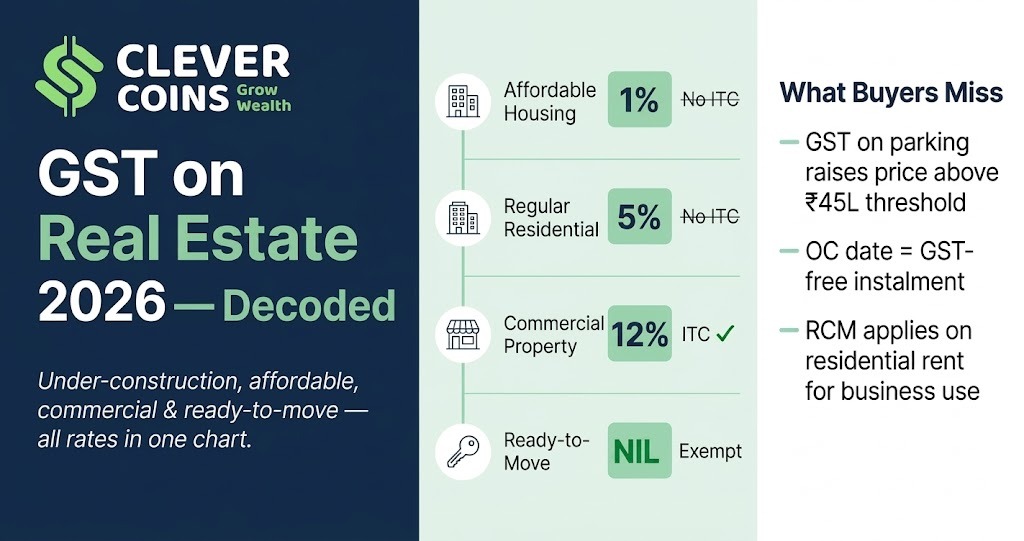
Property Type | GST Rate | ITC for Builder | Notes |
Affordable housing — under-construction | 1% | ✗ No | Metro: ≤60 sqm + ≤₹45L. Non-metro: ≤90 sqm + ≤₹45L |
Non-affordable residential — under-construction | 5% | ✗ No | All other under-construction flats above the affordable threshold |
Ready-to-move / OC-received residential | NIL | N/A | Completely exempt. Stamp duty + registration still apply separately |
Resale flat (individual seller) | NIL | N/A | No GST. Only stamp duty. Seller is not making a taxable supply. |
Under-construction commercial property | 12% | ✓ Yes | Office space, shops, co-working spaces — ITC is available to builder |
Renting commercial property | 18% | ✓ Yes | Shops, offices, warehouses. Registered tenants can claim ITC. |
Renting residential property for personal use | NIL | N/A | Fully exempt. Individual renting a flat to live in — no GST. |
Renting residential property for business use | 18% | RCM | Tenant (if GST-registered) pays under Reverse Charge Mechanism |
RWA / Society maintenance charges | 18% | Partial | Only if monthly charges exceed ₹7,500 per member AND annual turnover exceeds ₹20 lakh |
Sale of land (standalone) | NIL | N/A | Land sale is outside the scope of GST entirely |
What Exactly Is ‘Affordable Housing’ Under GST?
This is where most buyers get confused. The 1% GST rate is only available if a property meets both the area limit AND the price cap. Both conditions must be satisfied simultaneously. Failing even one moves the property to the 5% bracket.
Location Category | Max Carpet Area | Max Property Value | GST Rate |
Metro Cities (Delhi-NCR, Mumbai/MMR, Bengaluru, Chennai, Hyderabad, Kolkata) | 60 sq. m. | ₹45 Lakh | 1% (no ITC) |
Non-Metro Cities (all other cities and towns) | 90 sq. m. | ₹45 Lakh | 1% (no ITC) |
Any property exceeding the above limits | Exceeds limit | Above ₹45 Lakh | 5% (no ITC) |
Note for Mumbai buyers: Mumbra, Thane, Navi Mumbai, and all parts of the Mumbai Metropolitan Region (MMR) fall under the metro category — 60 sqm carpet area maximum for the 1% rate.
One more nuance: the ₹45 lakh price cap is the total consideration including parking charges, preferential location charges, club charges, and any other development charges. It is not just the basic sale price. Builders often quote a “base price” of ₹42 lakh and then add extras, pushing the effective consideration above ₹45 lakh — which triggers the 5% rate.
ITC Under GST in Real Estate — Who Gets It and Who Doesn’t
Input Tax Credit is the right to reduce your GST liability by the tax already paid on purchases. In real estate, the ITC rules are asymmetric — and this is what makes pricing complex.
Builders / Developers
- Residential projects (1% or 5%): NO ITC. The builder cannot claim credit on cement, steel, labour contracts, architect fees, or any other input. The tax on inputs is a cost.
- Commercial projects (12%): ITC IS available. The developer can offset the GST paid on materials and services against the 12% collected from buyers or tenants.
- Mixed-use projects: ITC must be apportioned. Only the commercial portion’s ITC is available; the residential portion’s ITC must be reversed.
Buyers / Investors
- Individual homebuyers: NEVER eligible for ITC. Residential property purchase is not a business input — no credit chain.
- Corporate / business buyers of commercial property: ITC IS available if the commercial property is used in furtherance of business (e.g., a company buying office space).
- Tenants renting commercial property: Can claim ITC on the 18% GST paid as rent, if they are GST-registered and the space is used for business.
- Tenants renting residential for business use (RCM): The registered tenant pays 18% GST under Reverse Charge Mechanism and can claim it back as ITC if eligible.
Why No ITC for Residential? (The Policy Reason) The Government removed ITC from residential real estate in April 2019 to close a major loophole — developers were claiming ITC but not passing the benefit to buyers. The trade-off: rates dropped from 12% to 5% and 8% to 1% simultaneously. Verdict for buyers: You pay GST on the construction value, and that’s a final cost. No credit. No offset. Price it in before signing. |
How to Calculate Your GST on a Property Purchase
GST is not charged on the entire property value. It applies only on the construction component. The government mandates a fixed formula: the value of land is treated as one-third (1/3) of the total consideration. GST is levied on the remaining two-thirds (2/3).
However, for affordable housing and most under-construction properties booked after April 2019, the rates of 1% and 5% are already “effective” rates applied directly on the total consideration (not on 2/3 of it). The 1/3 land deduction was absorbed into the rate simplification. Here’s the practical calculation:
Scenario | Property Value | GST Rate | GST Amount |
Affordable flat in Thane | ₹40,00,000 | 1% | ₹40,000 |
Non-affordable flat in Navi Mumbai | ₹75,00,000 | 5% | ₹3,75,000 |
Commercial office in Andheri | ₹1,20,00,000 | 12% | ₹14,40,000 |
Ready-to-move flat (OC received) | ₹90,00,000 | NIL | ₹0 |
Also remember: Stamp duty (typically 5-6% in Maharashtra) and registration charges (1%) are charged separately on the full market value — not reduced by GST. Your total transaction cost = Property value + GST + Stamp duty + Registration.
GST on Construction Materials — The 2025-26 Update
One of the biggest changes introduced under GST 2.0 reforms (effective September 2025) was the reduction of GST on key construction inputs. While builders under the residential scheme cannot claim ITC, lower material costs can still compress their overall project cost — and ideally, a competitive market passes some savings to buyers.
Material / Input | Old Rate | Current Rate (2026) |
Cement (OPC, PPC) | 28% | 18% ↓ |
Sand, gravel, granite (raw) | 5% | 5% / Nil |
Steel / iron for construction | 18% | 18% |
Bricks (fly ash / clay) | 12% | 6% ↓ |
Ready-mix concrete (RMC) | 18% | 12% ↓ |
Tiles, marble, granite (flooring) | 18% | 18% |
Labour / Works Contract (residential) | 18% | 18% |
Architect / consulting services | 18% | 18% |
Practical takeaway for buyers: Cement (the single largest cost input) now attracts 18% instead of 28% — a 10-percentage-point reduction. On a large residential project, this can translate to 3-5% lower construction cost for developers. Whether that saving reaches your quoted price depends on market competition, project type, and your negotiation.
GST on Works Contract in Real Estate
A works contract is a combination of goods and services — like hiring a contractor to build, renovate, or fit out a property. GST on works contracts is charged at the contractor level, not the end-buyer level. Here’s the quick matrix:
Works Contract Type | GST Rate | ITC |
Construction of new residential complex | 18% | Available to developer (sub-contractor level) |
Construction for government infrastructure (roads, dams, canals) | 12% | Yes |
Affordable housing construction services to promoter | 12% | Yes (at works contractor level) |
Repair / renovation / alteration | 18% | Yes |
Maintenance of existing building | 18% | Yes |
Bottom line: If you hire a contractor to renovate your home, you pay 18% GST on their invoice. You cannot claim that as ITC since your home is not a business asset. If you are a developer contracting out construction, the contractor charges you 18% GST but you can use that as ITC on your commercial projects (not residential).
Reverse Charge Mechanism (RCM) in Real Estate
Under RCM, the recipient of goods or services pays GST directly to the government instead of the supplier collecting it. In real estate, RCM is most commonly triggered in two situations:
- Unregistered contractor / supplier: If a builder purchases services (like labour or raw materials) from an unregistered vendor, the builder pays GST under RCM. This is a significant compliance point for small developers who work with informal contractors.
- Residential property rented for business use: If a GST-registered business rents a residential flat for its employees or directors, the business (tenant) pays 18% GST under RCM directly to the government — and can claim it back as ITC if the conditions are met.
- TDR / Development Rights: Transfer of Development Rights (TDR) or Floor Space Index (FSI) in commercial projects can trigger GST under RCM for the developer receiving those rights.
RCM is often missed by small builders and landlords. If you’re a developer using unregistered sub-contractors, or a business renting residential premises for staff housing, speak to a GST practitioner before assuming the transaction is clean.
GST on Housing Society Maintenance Charges
A very common source of confusion for flat owners in Thane, Navi Mumbai and the MMR: when does my RWA / housing society charge GST on maintenance?
- GST at 18% applies only if the monthly per-member maintenance contribution exceeds ₹7,500 AND the society’s annual turnover exceeds ₹20 lakh.
- If both conditions are met, 18% GST is charged on the entire maintenance amount — not just the amount above ₹7,500.
- Societies below ₹20 lakh annual turnover are fully exempt regardless of per-member charges.
- Societies can claim ITC on their own purchases (e.g., common area maintenance, repairs) to offset the GST collected.
Quick Check for Residents Monthly maintenance ≤ ₹7,500 per member: No GST charged. Monthly maintenance > ₹7,500 per member AND society turnover > ₹20 lakh/year: 18% GST on the entire maintenance bill. Maintenance billed separately for parking, gym, clubhouse: Each line item may attract GST separately if it qualifies. |
RERA-GST Integration: The 2025-26 Compliance Shift
One of the most significant regulatory developments in real estate GST compliance is the ongoing integration of RERA (Real Estate Regulatory Authority) databases with the GSTN portal. This initiative, rolling out in phases from late 2025, has real implications:
- Buyers can verify a project’s GST registration and return-filing status before making any payment — reducing fraud risk.
- Builders with RERA registration must ensure their GSTIN is active and returns are filed on time, or face cross-system flags.
- AI-based invoice matching on the GST portal now auto-flags mismatches between declared project revenue and RERA booking data.
- E-invoicing is mandatory for all B2B transactions in construction and real estate for businesses above ₹5 crore turnover — no exceptions.
For homebuyers, the practical upshot is greater protection: before you pay a builder, you can check their compliance status. For developers, this integration raises the compliance bar significantly.
Before You Buy: The 5-Point GST Checklist for Property Buyers
- Has the project received an OC or CC? If yes, zero GST. Request the certificate copy from the builder.
- Does the property qualify as affordable housing? Verify both the carpet area (60 sqm in MMR) AND the total consideration including all extras (must be ≤ ₹45 lakh).
- Is the builder GST-registered? Ask for their GSTIN. Verify it on the GST portal. Never pay GST cash without a proper GST invoice.
- Is GST quoted on the base price or total consideration? Some builders quote GST on the “agreement value” excluding extras. Get one fully loaded price quote to compare.
- Will any future payments fall after the OC date? If the project gets its OC before your last instalment, that instalment should be GST-free. Negotiate this into your agreement.
Frequently Asked Questions
- Do I pay GST on a resale flat?
- No. A resale transaction between individuals is not a supply under GST. You will only pay stamp duty and registration charges. The GST exemption applies even if the flat was originally bought under-construction and GST was paid at booking.
- My builder has quoted 12% GST — is that correct for a residential flat?
- For new projects after April 1, 2019: No. Residential under-construction flats should attract either 1% (affordable) or 5% (non-affordable). A 12% rate would only apply to commercial properties or projects still under the old pre-2019 regime (rare in 2026). Verify the RERA and GST registration, and consult a tax advisor.
- Can I claim GST refund if I cancel my flat booking?
- Yes. If you cancel an under-construction flat booking and the builder refunds the GST-inclusive amount, you need the builder to issue a credit note. The builder reverses the GST and you receive the refund from the builder — not directly from the government.
- Does GST apply to parking charges?
- Yes. Parking space sold as part of an under-construction property is included in the consideration for GST purposes. If the bundled price (flat + parking) exceeds ₹45 lakh, the 1% rate is lost and 5% applies to the full amount.
- I’m renting out my office space — what GST do I charge?
- If you are GST-registered, you charge 18% GST on commercial rental income. Your tenant (if registered) can claim this as ITC. If your rental income is below ₹20 lakh per year, you may not need to be GST-registered at all.
- What happens to GST if the builder delays possession beyond the CC date?
- Once the CC or OC is issued, any payments due after that date are GST-free, even if the instalment was originally linked to construction milestones. Buyers often continue paying GST out of habit — or builders collect it incorrectly. Review your payment schedule against the CC issue date and raise the dispute if needed.
Planning a Property Purchase in 2026? Let CleverCoins Run the Tax Numbers First. Whether you’re buying your first flat in Mumbra, investing in a commercial shop in Thane, or advising a builder client on GST compliance — we can help. Our real estate GST advisory covers: buyer tax planning, builder compliance review, ITC apportionment for mixed projects, and RERA-GST cross-check. 📞 Book a free consultation at clevercoins.org | Follow @clevercoins_official for daily property tax tips in Hinglish. |
Disclaimer: This blog reflects GST rules as of April 2026. GST law is subject to CBIC notifications and GST Council decisions. Property rates and thresholds may be amended. Consult a qualified tax professional before any property transaction.