GSTR-9 Annual Return 2025-26: The Complete Guide — Who Files, What Goes In, and How to Avoid a Notice
Every December, the same thing happens. Business owners who sailed through all their monthly GSTR-1s and GSTR-3Bs suddenly realise the annual return is due — and it is a completely different animal.
GSTR-9 is the GST department’s year-end reckoning. It asks you to consolidate an entire financial year of sales, purchases, ITC, reversals, and amendments into one comprehensive statement. Get it right, and your year is closed cleanly. Get it wrong — wrong ITC figures, missing HSN data, or unreported amendments — and you could be looking at a GST notice, a demand order, or a reconciliation nightmare during an audit.
At CleverCoins, we support businesses across Mumbra and the wider MMR with GSTR-9 and GSTR-9C filing every year. This guide covers everything for FY 2025-26: who must file, who is exempt, the full form structure, the latest 2025 notifications, what GSTR-9C is, late fee calculation, and the six mistakes that trigger scrutiny notices.
What Is GSTR-9 and Why Does It Exist?
GSTR-9 is the Annual Return that every regular GST-registered taxpayer must file for each financial year. It is a consolidated summary of all the monthly and quarterly returns filed during the year — primarily GSTR-1 (outward supplies) and GSTR-3B (tax payment) — reconciled against actual books of accounts.
Think of it as the GST equivalent of filing an annual ITR after doing monthly TDS — except that GSTR-9 also requires you to flag any discrepancies, report previous-year corrections, reconcile ITC, and pay any additional tax due before the return is filed.
|
Why GSTR-9 Matters Beyond Mere Compliance It is the only annual opportunity to report corrections to prior-period GST returns (within the permitted window). It flags differences between your GSTR-2B auto-populated ITC and what you actually claimed in GSTR-3B — a mismatch here is one of the top triggers for GST notices. For businesses above ₹5 crore, it feeds directly into GSTR-9C, which reconciles your GST data against your audited financial statements. Departments use GSTR-9 data for risk-based audit selection. A well-filed GSTR-9 is your strongest protection against a scrutiny notice under Section 61. |
Who Must File GSTR-9? — Applicability & Exemptions for FY 2025-26
The applicability rules changed in 2025 with CBIC Notification No. 15/2025-Central Tax. Here is the complete picture:
|
Taxpayer Category |
Must File GSTR-9? |
Notes |
|
Regular taxpayer — aggregate turnover > ₹2 crore |
✓ MANDATORY |
Core target group. File annually by 31st December. |
|
Regular taxpayer — aggregate turnover ≤ ₹2 crore |
Optional |
Exempted by CBIC Notification 15/2025. Voluntary filing allowed and recommended for loan applications and audit trails. |
|
Composition scheme registrant |
✗ NOT GSTR-9 |
Files GSTR-4 (annual) + CMP-08 (quarterly) instead. GSTR-9A is technically applicable but suspended. |
|
Input Service Distributor (ISD) |
✗ Not Required |
ISDs distribute ITC — they do not file GSTR-9. |
|
Casual Taxable Person |
✗ Not Required |
Short-term registrations for exhibitions, events, etc. |
|
Non-Resident Taxable Person |
✗ Not Required |
Foreign businesses operating temporarily in India. |
|
TDS Deductor (Section 51) |
✗ Not Required |
Government entities deducting TDS from contractor payments. |
|
E-commerce Operator collecting TCS (Section 52) |
GSTR-9B |
Files separate GSTR-9B reconciling their monthly GSTR-8 returns. |
|
One GSTIN = One GSTR-9 GSTR-9 is filed at the GSTIN level — not at the PAN level. If your business has 3 GSTIN registrations (e.g., GST registration in Maharashtra, Karnataka, and Delhi), you must file 3 separate GSTR-9 returns. Even if a GSTIN was registered only partway through the financial year, or was cancelled during the year, GSTR-9 is still required for the period it was active. Nil GSTR-9: If you had zero transactions during the year but the GSTIN was active, you must still file a nil GSTR-9. |
Types of GST Annual Returns — Know Which One Applies to You
|
Form |
Who Files |
Turnover Threshold |
Due Date |
|
GSTR-9 |
All regular taxpayers |
> ₹2 crore mandatory ≤ ₹2 crore optional |
31st December |
|
GSTR-9A |
Composition scheme taxpayers (suspended in practice) |
Suspended — file GSTR-4 |
30th June (GSTR-4) |
|
GSTR-9B |
E-commerce operators collecting TCS (who file GSTR-8) |
All ECOs filing GSTR-8 |
31st December |
|
GSTR-9C |
Self-certified reconciliation statement (all regular taxpayers above threshold) |
> ₹5 crore mandatory |
31st December (same as GSTR-9) |
GSTR-9 Due Dates — FY-Wise History and FY 2025-26 Deadline
The statutory due date for GSTR-9 is 31st December of the year following the financial year. The government has frequently extended this date — always check the latest CBIC notification before filing.
|
Financial Year |
Original Due Date |
Extended / Actual Date |
Notes |
|
FY 2022-23 |
31 Dec 2023 |
31 Dec 2023 |
Filed on original date |
|
FY 2023-24 |
31 Dec 2024 |
31 Mar 2025 |
Extended by CBIC |
|
FY 2024-25 |
31 Dec 2025 |
31 Dec 2025 |
Filed on original date |
|
FY 2025-26 |
31 Dec 2026 |
Watch CBIC notifications |
Statute date is 31 Dec 2026. Extension possible. |
Pro tip: Do not wait for the deadline. GSTR-9 reconciliation is time-consuming. Begin the process in October when the GST Portal enables filing — typically around 13-15 October after the FY ends.
GSTR-9 Form Structure: 6 Parts, 19 Tables — Decoded
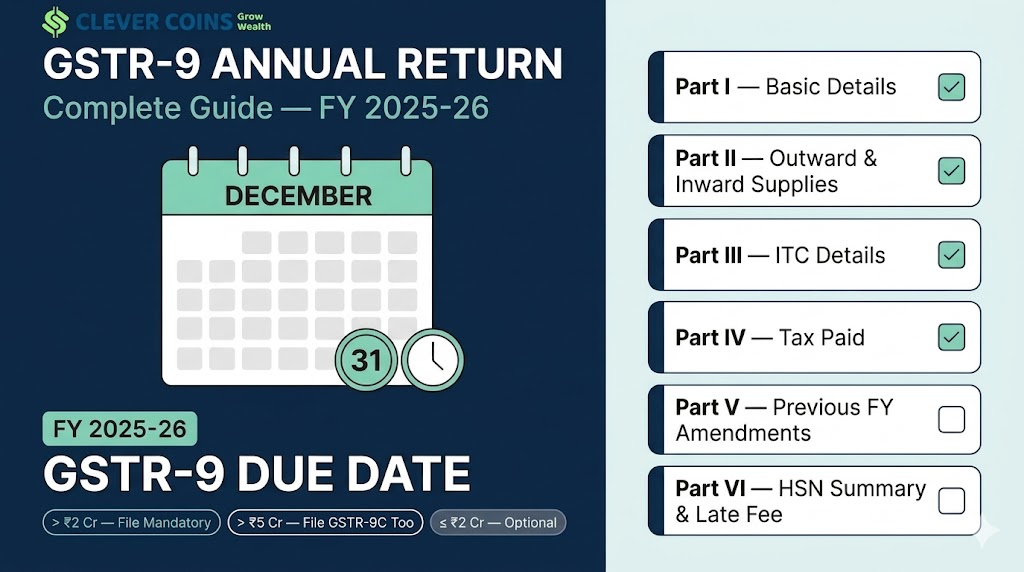
The GSTR-9 form has 6 parts. Much of the data is auto-populated from your previously filed GSTR-1 and GSTR-3B — but every field must be reviewed and corrected where needed before submission.
|
Part |
Tables |
What It Covers |
Data Source |
|
I |
1 – 3 |
Basic details: GSTIN, legal name, trade name, financial year, period of registration |
Auto-populated from GST portal registration |
|
II |
4 – 5 |
Details of outward and inward supplies declared in GSTR-1 and GSTR-3B during the year |
Auto-populated from GSTR-1 filed during the year |
|
III |
6 – 8 |
ITC availed (inputs, input services, capital goods), ITC reversed, ineligible ITC, and ITC reconciliation with GSTR-2B |
Mix of auto-pop (GSTR-2B) and manual entry |
|
IV |
9 |
Tax paid as declared in GSTR-3B during the year — CGST, SGST, IGST, cess |
Auto-populated from GSTR-3B |
|
V |
10 – 14 |
Transactions of previous FY reported in current FY returns — amendments to supplies and ITC made between Apr–Nov of the following FY |
Partially auto-pop; manual review required |
|
V |
15 – 16 |
Details of demands, refunds claimed, refunds pending, and excess reduction of output tax |
Manual entry — from your demand notices and refund records |
|
VI |
17 – 19 |
HSN-wise summary of outward supplies (Table 17), HSN-wise summary of inward supplies (Table 18), and Late Fee payable and paid (Table 19) |
Manual entry for HSN; auto-calculated for late fee |
Key clarification on Tables 10-14: These are NOT for entering the current year’s corrections in the current year’s GSTR-9. They capture amendments made between April 1 and September 30 (or the extended date of November 30) of the FOLLOWING financial year that relate to the current year’s transactions. If you amended a March 2025 invoice in your June 2025 GSTR-1, that amendment appears in Tables 10-11 of FY 2024-25’s GSTR-9.
The ITC Reconciliation — Table 8: The Most Critical Section
Table 8 is where most GSTR-9 errors occur — and where the GST department focuses most of its scrutiny. It reconciles the ITC that was auto-populated in GSTR-2B (what suppliers reported for you) against what you actually claimed in your GSTR-3B.
|
Table |
Label |
What It Means in Practice |
|
8A |
ITC as per GSTR-2B (auto-populated) |
Total ITC that all your suppliers reported on your behalf for the FY. This is your “maximum possible ITC” for the year. |
|
8B |
ITC claimed in GSTR-3B |
What you actually claimed across all your monthly GSTR-3B filings during the FY. |
|
8C |
ITC from prior FY claimed in current FY (till specified date) |
ITC pertaining to FY 2024-25 that was claimed for the first time in GSTR-3B of FY 2025-26 (within the permitted window). |
|
8D |
Balance ITC not yet claimed (8A minus 8B minus 8C) |
The gap — ITC visible in 2B that you didn’t claim. This is lapsed ITC. You cannot claim it after the permitted window. |
|
Table 8D = Money Left on the Table Table 8D shows ITC you were eligible for but never claimed. For most businesses, this number should be zero or very small. If Table 8D shows a significant positive number, it means: (a) your supplier filed GSTR-1 but you missed claiming in GSTR-3B, OR (b) you filed too late to match the GSTR-2B auto-population cut-off. New in FY 2025-26 (CBIC Notification 16/2025): The GSTR-9 format has been updated to enable IMS (Invoice Management System) based ITC auto-population. Under IMS, invoices that you ‘accepted’ on the portal auto-populate your GSTR-3B. Invoices you ‘rejected’ appear as eligible but unclaimed in Table 8D. Action: Before finalising GSTR-9, review Table 8D carefully. Any amount here is permanently lost unless it falls within the permitted ITC window. |
GSTR-9C: The Reconciliation Statement (Turnover > ₹5 Crore)
GSTR-9C is filed alongside GSTR-9 for businesses with aggregate turnover exceeding ₹5 crore. It reconciles the figures in your GSTR-9 with your audited annual financial statements, identifying any discrepancies between your tax filings and your books of accounts.
|
Feature |
GSTR-9 |
GSTR-9C |
|
Who files |
All regular taxpayers > ₹2 crore |
Regular taxpayers > ₹5 crore |
|
Purpose |
Consolidate annual GST return data |
Reconcile GSTR-9 with audited financial statements |
|
Certification required |
Self-filed by taxpayer |
Self-certified by taxpayer (CA/CMA certification abolished from FY 2020-21) |
|
Due date |
31st December |
31st December (same as GSTR-9) |
|
Late fee for delay |
₹200/day capped at 0.25% of turnover |
₹100/day (auto-calculated in new Table 17) |
|
Can it be amended? |
NO |
NO |
|
Additional tax payment |
Via DRC-03 if GSTR-9 shows higher liability than GSTR-3B |
Via DRC-03 for unreconciled differences identified in GSTR-9C |
Important 2025 update for GSTR-9C: A new Table 7D1 has been added that requires reporting of supplies made through e-commerce operators (where GST was paid by the platform under Section 9(5)). If your business sells through Zomato, Swiggy, or any other platform covered under Section 9(5), this must be declared separately in GSTR-9C for FY 2025-26 onwards.
GSTR-9 Late Fee & Penalties — The Exact Calculations
Late filing of GSTR-9 attracts a daily late fee under Section 47(2) of the CGST Act. The fee structure was rationalised under Notification 73/2022 and reaffirmed by the 55th GST Council in December 2024:
|
Annual Turnover Slab |
Late Fee Per Day |
Maximum Cap |
Example |
|
Up to ₹5 crore |
₹50 (₹25 CGST + ₹25 SGST) |
₹2,000 (₹1,000 each) |
1 month delay: ₹50 × 30 = ₹1,500 → ₹1,500 (below cap) |
|
₹5 crore to ₹20 crore |
₹100 (₹50 CGST + ₹50 SGST) |
0.04% of turnover |
1 month delay, ₹10 cr turnover: ₹3,000 → capped at ₹4,000 |
|
Above ₹20 crore |
₹200 (₹100 CGST + ₹100 SGST) |
0.50% of turnover (0.25% each) |
1 month delay, ₹50 cr turnover: ₹6,000 → capped at ₹2,50,000 |
Note: Circular 246/03/2025-GST (January 2025) clarified that late fee under Section 47(2) applies to the combined delay in filing both GSTR-9 and GSTR-9C. If GSTR-9 is filed on time but GSTR-9C is delayed, late fee continues to accrue on the GSTR-9C delay. The new auto-calculated Table 17 in GSTR-9C captures this automatically.
|
Cannot File? At Least Submit — Even If You Must Later Amend GSTR-9 cannot be amended after submission. This is a one-shot filing. However: If your GSTR-9 is late and you cannot complete full reconciliation in time, it is still better to file a best-effort return than to delay further and accumulate late fees. Any additional tax identified after GSTR-9 submission must be paid via Form DRC-03. GSTR-9 itself cannot be opened and revised once filed. CleverCoins recommendation: Start your GSTR-9 process by November. Complete reconciliation in November. File in December — well before the 31st. |
How to File GSTR-9: Step-by-Step Process
- Ensure all GSTR-1 and GSTR-3B returns for the financial year are filed and submitted. GSTR-9 cannot be initiated if any monthly return is pending.
- Log into the GST Portal (gst.gov.in) → Returns → Annual Return → Financial Year → GSTR-9.
- The portal auto-populates data from your filed returns. Download the auto-populated data and compare it with your accounting software / books of accounts.
- Reconcile Table 8 (ITC as per GSTR-2B vs ITC claimed in GSTR-3B). Investigate every rupee of difference in Table 8D.
- Review Part V — Tables 10-14 — for any amendments made in April–September of the following year relating to current FY invoices. Ensure they are captured correctly.
- Fill in HSN summary: Table 17 (outward supplies — mandatory for HSN codes that account for ≥10% of total outward supplies) and Table 18 (inward supplies).
- If GSTR-9 shows a higher tax liability than what you paid in GSTR-3B: Pay the differential via Form DRC-03 BEFORE submitting GSTR-9. You cannot pay additional tax through GSTR-9 itself.
- Preview the draft GSTR-9 PDF. Review with your CA or tax consultant. Submit and file. Remember: no amendments are possible after submission.
- If applicable (turnover > ₹5 crore): File GSTR-9C after GSTR-9 is submitted. Self-certify all differences and pay any additional liability via DRC-03.
Key CBIC Notifications for FY 2025-26 GSTR-9 Filing
|
Notification |
Date |
What Changed |
|
No. 13/2025-Central Tax |
2025 |
Amended CGST Rules — introduced new ITC reporting fields in GSTR-9 for more granular input vs input-service vs capital goods classification |
|
No. 15/2025-Central Tax |
2025 |
Exempted taxpayers with aggregate turnover ≤ ₹2 crore from mandatory GSTR-9 filing for FY 2024-25 onwards |
|
No. 16/2025-Central Tax |
2025 |
Updated GSTR-9 format to enable IMS (Invoice Management System) based ITC auto-population; added new reversal disclosure fields |
|
Circular 246/03/2025-GST |
30 Jan 2025 |
Clarified that late fee under Section 47(2) applies to delay in GSTR-9C as well as GSTR-9; new Table 17 in GSTR-9C captures this |
|
GSTR-9C: New Table 7D1 |
FY 2024-25 onwards |
New mandatory table for reporting supplies made through e-commerce operators under Section 9(5) — Zomato, Swiggy, etc. |
Top 6 GSTR-9 Mistakes That Lead to GST Notices
- Not reconciling Table 8 (GSTR-2B vs GSTR-3B ITC) before filing. The most common and most dangerous error. If GSTR-9 shows you claimed ITC that suppliers didn’t report, it flags immediately in GSTN’s auto-audit system.
- Entering previous-year amendments in the wrong tables. Tables 10-14 are for post-FY amendments — not for corrections within the FY. Many filers confuse this and report the same adjustment twice.
- Skipping or incorrectly filling the HSN summary (Tables 17 and 18). HSN codes for outward supplies accounting for ≥10% of total outward supplies are mandatory. Missing HSN data is one of the first things auditors check.
- Not paying additional tax via DRC-03 before submission. If your books show higher liability than your GSTR-3B filings, you must pay via DRC-03 before filing GSTR-9 — not after. Submitting GSTR-9 with an unresolved discrepancy without DRC-03 payment is a compliance failure.
- Confusing the turnover threshold for GSTR-9 vs GSTR-9C. A business with ₹3 crore turnover must file GSTR-9 but NOT GSTR-9C. A business with ₹6 crore must file both. Skipping GSTR-9C attracts a ₹25,000 general penalty plus daily late fee.
- Treating the ₹2 crore exemption as a permanent waiver. The CBIC notifies the exemption threshold every year. It was ₹2 crore for FY 2024-25. It may change for FY 2025-26. Always verify the current notification before assuming you’re exempt.
Frequently Asked Questions
- My turnover is ₹1.8 crore for FY 2025-26. Do I need to file GSTR-9?
- Based on CBIC Notification 15/2025, taxpayers with aggregate turnover up to ₹2 crore are exempted from mandatory GSTR-9 filing. However, you CAN voluntarily file it — which is recommended if you are applying for a bank loan, going through a statutory audit, or want a clean GST compliance record. Always confirm the notification for FY 2025-26 before assuming the exemption continues.
- Can I correct a mistake in GSTR-3B through GSTR-9?
- Not directly. GSTR-9 is not an amendment form — it is a reporting form. If you under-reported tax in GSTR-3B, you must pay the difference via Form DRC-03 before filing GSTR-9. The difference will show up as a discrepancy in GSTR-9, which you explain in the relevant table. GSTR-9 itself cannot be used to pay tax or recover over-claimed ITC.
- My CA says I need to file GSTR-9C. But my turnover is ₹4.2 crore — am I exempt?
- Yes, for FY 2025-26 you are exempt from GSTR-9C. GSTR-9C is mandatory only for taxpayers with aggregate turnover exceeding ₹5 crore. At ₹4.2 crore, you only need to file GSTR-9 (if you exceed the ₹2 crore GSTR-9 threshold). Your CA may be referring to GSTR-9C from an earlier year when the threshold was different.
- What is Form DRC-03 and when do I need to file it?
- DRC-03 is the voluntary tax payment form on the GST Portal — used to pay additional GST liability that was missed in earlier returns or identified during reconciliation. In the context of GSTR-9: if your annual return reveals a higher tax liability than what was paid in GSTR-3B during the year, you must use DRC-03 to pay the difference. It can also be used during audits, scrutiny notices, or investigations.
- Can GSTR-9 be revised after filing?
- No. Once GSTR-9 is filed on the GST Portal, it cannot be revised or amended. This is why it is critical to review the pre-filled data carefully and reconcile all discrepancies before clicking Submit and File. Any errors discovered after filing can only be rectified in future returns or flagged during departmental proceedings.
- I missed filing GSTR-9 for FY 2022-23. Can I still file it?
- The GSTN implemented a 3-year time limit for filing periodic returns (effective July 2025 onwards). For GSTR-9 (annual return), filing after an extended delay may attract late fees for every day past the original due date. Log into the portal to check if the filing is still enabled for that year. If it is, file immediately and pay the late fee. If the portal has locked the period, consult a GST practitioner about rectification options.
|
GSTR-9 Season Is December — Don’t Wait Until the Last Week. CleverCoins handles end-to-end GSTR-9 and GSTR-9C filing for businesses across Mumbra, Thane, and the MMR: GSTR-2B reconciliation, ITC verification, HSN summary preparation, DRC-03 payments, and GSTR-9C self-certification. We start your GSTR-9 preparation in October so you file by early December — not in a panic on December 30th. 📞 Book a consultation at clevercoins.org | Follow @clevercoins_official for daily GST updates in Hinglish. |
Disclaimer: This blog reflects GST laws, CBIC notifications, and GST Council decisions as of April 2026. Thresholds, due dates, and form formats are subject to annual notification updates. Verify current notifications before filing. Consult a qualified GST practitioner for filing assistance.