GSTR-9 Annual Return 2025-26: The Complete Guide — Who Files, What Goes In, and How to Avoid a Notice
Your statutory auditor has signed off on your books. Your GSTR-9 has been filed. You think the year is closed. And then your CA asks: “Have you filed GSTR-9C yet?”
If your turnover crossed ₹5 crore for FY 2025-26, GSTR-9C is not optional. It is a mandatory reconciliation statement that line-by-line compares every rupee in your audited financial statements against what you declared in your GSTR-9 annual return. Miss it, and you face a ₹25,000 general penalty plus daily late fees that compound silently until you file.
But beyond the penalty — GSTR-9C is actually the most powerful tool a business has to proactively close gaps in its GST compliance before the department finds them first. A well-prepared GSTR-9C with clear explanations for every difference is your best insurance against a GST notice, a demand, or a departmental audit.
This guide covers everything about GSTR-9C for FY 2025-26: what it is, who files it, the complete form structure, the reconciliation process table-by-table, what changed in 2025, the self-certification procedure, and the mistakes that bring scrutiny.
What Is GSTR-9C? The GST Audit Reconciliation Statement Explained
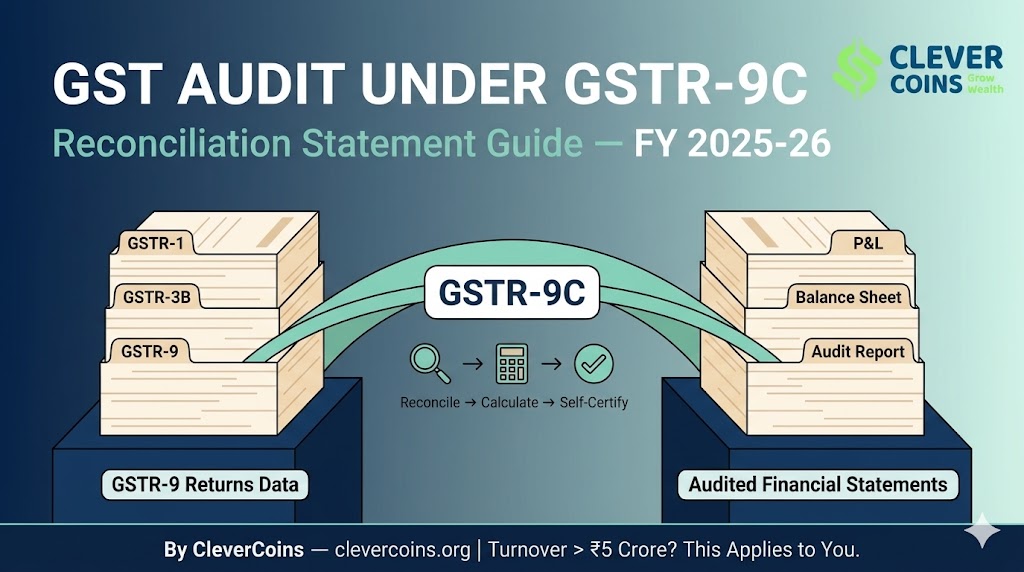
GSTR-9C is the annual reconciliation statement filed under Section 44 of the CGST Act, 2017 read with Rule 80(3) of the CGST Rules. It bridges two data sets that are prepared on different bases:
|
|
GSTR-9 (Annual Return) |
Audited Financial Statements |
|
Basis |
GST law — supply-by-supply reporting |
Accounting standards (Ind-AS / GAAP) — accrual basis |
|
Turnover definition |
Aggregate turnover as defined under GST — taxable + exempt + export + inter-state supplies |
Revenue as per P&L — including items that may not be GST supplies (e.g., dividend, sale of assets) |
|
ITC treatment |
ITC as claimed / reversed in GSTR-3B during the year |
Input costs as per purchase register and books |
|
Timing |
Returns filed month-by-month during the FY |
Annual — closed after year end, audited |
GSTR-9C is the form where you explain, quantify, and certify every difference between these two data sets. Where they match — great. Where they diverge — you explain why, and if there is additional tax liability, you pay it before filing.
|
GSTR-9C Is Not an Audit — It Is a Reconciliation A common confusion: GSTR-9C used to be called a GST audit form and was previously certified by a CA. Since FY 2020-21, the CA certification requirement was abolished. Today, GSTR-9C is a SELF-CERTIFIED reconciliation statement. The taxpayer (or their authorised signatory) prepares and certifies it. No CA or CMA signature is required for FY 2025-26. Exception: Some state-specific regulations or internal policies may still require CA review before self-certification. Always verify with your CA for your specific state and industry. What the CA still does: Helps prepare the reconciliation workings, identifies discrepancies, and advises on DRC-03 payments. They do not sign the form itself. |
Who Must File GSTR-9C? — Applicability for FY 2025-26
|
Category |
File GSTR-9C? |
Notes |
|
Regular taxpayer — aggregate turnover > ₹5 crore |
✓ MANDATORY |
Core applicability. Must file for each active GSTIN separately. |
|
Regular taxpayer — turnover ₹2–5 crore |
✗ Not Required |
Must file GSTR-9 (mandatory) but GSTR-9C is not required. |
|
Regular taxpayer — turnover ≤ ₹2 crore |
✗ Not Required |
GSTR-9 is optional; GSTR-9C is not applicable. |
|
Composition scheme registrant |
✗ Not Required |
Even if composition turnover exceeds ₹5 crore (rare). Composition dealers file GSTR-4, not GSTR-9C. |
|
E-commerce operator filing GSTR-8 (TCS collector) |
✗ Not Required |
Files GSTR-9B instead. |
|
Multiple GSTINs under one PAN |
Per GSTIN |
Separate GSTR-9C for EACH GSTIN. Audited financials are PAN-level — you provide a GSTIN-wise breakup. |
|
GSTIN cancelled during the year |
✓ YES |
Still required for the period the GSTIN was active if turnover exceeded ₹5 crore. |
Turnover calculation reminder: Aggregate turnover for GSTR-9C applicability is computed on an all-India, PAN-wide basis across all GSTINs — just like for GST registration and GSTR-9. Include taxable, exempt, nil-rated, and exported supplies. Exclude: taxes/cess, inward supplies on which RCM is paid, and value of supplies made on behalf of others as an agent.
GSTR-9 vs GSTR-9C: What’s the Difference?
Many businesses are confused about how GSTR-9 and GSTR-9C relate. Here is the definitive comparison:
|
Feature |
GSTR-9 |
GSTR-9C |
|
What it is |
Annual return — consolidates all monthly/quarterly returns |
Reconciliation statement — compares GSTR-9 with audited financials |
|
Turnover threshold |
> ₹2 crore (mandatory) ≤ ₹2 crore (optional) |
> ₹5 crore (mandatory) |
|
Filing sequence |
File FIRST — GSTR-9C cannot be filed before GSTR-9 |
File AFTER GSTR-9 is submitted on portal |
|
Certification |
Self-filed (no certification required) |
Self-certified by authorised signatory of taxpayer |
|
Can it be amended? |
NO |
NO |
|
Late fee (per day) |
₹200/day; capped at 0.50% of turnover |
₹200/day; capped at 0.50% of turnover. Calculated separately from GSTR-9 delay. |
|
Additional tax payment |
Via DRC-03 if higher liability found |
Via DRC-03 for all unreconciled differences that result in tax liability |
|
Data source |
GSTR-1, GSTR-3B, GSTR-2B for the FY |
Audited P&L + Balance Sheet + GSTR-9 |
GSTR-9C Form Structure: Part A and Part B — Decoded
GSTR-9C is divided into two main parts. Part A is the reconciliation statement (the data). Part B was the auditor’s certification (now replaced by self-certification). Here is the complete table-wise breakdown:
Part A: Reconciliation Statement
|
Part |
Tables |
What It Covers |
Key Action Required |
|
I |
1 – 3 |
Basic details: financial year, GSTIN, legal name, trade name, whether audit under any other law (Income Tax, Companies Act, etc.) |
Verify GSTIN and legal name match registration certificate |
|
II |
4 – 5Q |
Reconciliation of turnover: gross turnover as per books vs GSTR-9. Identify and explain differences using Table 5 adjustment rows. |
Prepare revenue reconciliation workbook. Explain every rupee of difference. |
|
III |
6 – 9 |
Reconciliation of tax paid: rate-wise comparison of tax liability as per books vs GSTR-9. Includes new Table 7D1 for e-commerce supplies. |
Cross-check with GSTR-3B payments. Pay any additional via DRC-03. |
|
IV |
10 – 14 |
Reconciliation of Input Tax Credit: ITC as per books vs ITC claimed in GSTR-9. Captures Rule 37/37A reversals, reclaims, and inadmissible credits. |
Most complex section. Review ITC register, GSTR-2B, and reversal records carefully. |
|
V |
15 – 16 |
Auditor’s recommendations on additional liability. Table 15: unreconciled differences with additional tax. Table 16: tax paid via DRC-03. |
Quantify unreconciled differences. Pay via DRC-03 before filing. |
|
New |
Table 17 |
Auto-calculated late fee (if GSTR-9C is filed after the due date). Captures daily late fee under Section 47(2). |
No manual action — portal auto-fills based on filing date. |
Part B: Certification
Part B contains the certification — previously signed by a CA or CMA. From FY 2020-21 onwards, this has been replaced by a self-certification declaration signed by the authorised signatory of the company or business. The declaration confirms that the reconciliation statement is true and correct to the best of the signatory’s knowledge and belief, and that the figures have been derived from the audited books of accounts.
Part II in Detail: Reconciliation of Turnover — The Most Common Differences
Part II (Tables 4 to 5Q) is where most of the work in GSTR-9C preparation lies. You start with gross turnover as per your audited P&L and make adjustments to arrive at the taxable turnover declared in GSTR-9. Here are the most common reconciling items you will encounter:
|
Reconciling Item |
Table Reference |
Explanation |
|
Unbilled revenue at year end |
5B |
Revenue accrued in books on 31 March but not yet invoiced. Not a GST supply until invoiced — so it reduces books turnover relative to GST. |
|
Unadjusted advances received |
5C |
Advances received and taxed under GST in a prior period may not yet be reflected as revenue in books. Creates a timing difference. |
|
Credit notes issued after year end (relating to current FY) |
5D |
Credit notes issued in April–September for current FY transactions reduce GST turnover but may not reduce books revenue in the same period. |
|
Trade discounts not reduced in GST turnover |
5E |
Some discounts are reflected in the books but not treated as deductions in GST invoices. Creates an upward adjustment. |
|
Non-GST supplies included in books |
5F |
Revenue from items not subject to GST (e.g., alcohol for human consumption, petroleum) is in the P&L but not in GSTR-9. |
|
Exempt and nil-rated supplies |
5G |
These appear in GSTR-9 as outward supplies but may be in a different line of the P&L (e.g., agricultural income). |
|
Non-taxable receipts (dividends, interest, asset sale) |
5H |
These are in the P&L but are not GST supplies — they reduce the adjustment from books to GSTR-9. |
|
Imports (not a supply — no GST output) |
5I |
CIF value of imports appears in books but there is no outward supply in GSTR-9 for this. |
|
Any other adjustment (catch-all) |
5O |
Anything that does not fit above — with a written explanation. Tables 5B–5N are optional per CBIC Notification 56/2019. |
After all adjustments, Table 5P shows the adjusted annual turnover — which should ideally match the taxable + exempt turnover declared in GSTR-9. Table 5Q captures the residual difference if any. Any unexplained positive difference in 5Q means additional GST may be payable.
Part III: Reconciliation of Tax Paid — Including New Table 7D1
Part III reconciles the tax actually paid in your GSTR-3B returns with the tax liability as derived from your adjusted turnover in Part II. The comparison is done rate-wise — 5%, 12%, 18%, 28% — for CGST, SGST, and IGST separately.
|
New in FY 2024-25 Onwards: Table 7D1 for E-Commerce Section 9(5) Supplies Table 7D1 is a new mandatory table that captures turnover from supplies made through e-commerce operators where the platform pays GST under Section 9(5). Who this affects: Any business that sells food, cabs, accommodation, or housekeeping services through Zomato, Swiggy, Ola, Uber, UrbanClap, or similar platforms. What to report: The value of supplies where GST was paid by the platform — not by you. This turnover must be separately disclosed and NOT included in your own tax liability. Why it matters: Before Table 7D1, many businesses were either double-reporting these supplies (paying GST on sales that Zomato/Swiggy already paid for) or not disclosing them at all. Both trigger scrutiny. |
The output of Part III is a rate-wise comparison between tax as per audited accounts and tax declared in GSTR-9. Any excess tax liability identified here (tax shown in books but not paid in returns) must be paid via DRC-03 before the GSTR-9C is submitted.
Part IV: Reconciliation of ITC — The Most Complex Section
Part IV (Tables 10-14) reconciles Input Tax Credit as per your audited books against ITC as claimed in GSTR-9. This is the hardest section of GSTR-9C and the one most likely to surface differences.
|
Table |
Label |
What to Do |
|
10 |
ITC as per audited accounts |
Enter total ITC as shown in your purchase register and books — including amounts claimed across GSTR-3B filings. |
|
11 |
ITC booked but inadmissible / not claimed |
ITC that appears in books but was intentionally not claimed — blocked credits (Section 17(5)), RCM paid but not eligible, etc. |
|
12A |
Net admissible ITC per books |
Table 10 minus Table 11. This is the ITC your books say you should have claimed. |
|
12B |
ITC as per GSTR-9 |
ITC reported in GSTR-9 Tables 6-8. Pulled from your filed returns. |
|
13 |
Difference (12A minus 12B) |
The gap between books ITC and claimed ITC. Positive: you claimed less than books (explain why). Negative: you claimed more than books — this is a red flag requiring reversal. |
|
14 |
Additional ITC liability |
Any ITC that must be reversed because books show less ITC than what was claimed. Pay via DRC-03. |
The most common ITC differences in GSTR-9C arise from: Rule 37 reversals (ITC reversed because supplier payment was not made within 180 days), Rule 37A reversals (ITC reversed because supplier did not file GSTR-3B), cross-year ITC claims, and blocked credits under Section 17(5) that were inadvertently claimed.
|
Rule 37 vs Rule 37A — Get This Right in Table 12 Rule 37: ITC reversed when a registered person fails to pay the supplier within 180 days of the invoice date. Once payment is made later, ITC can be reclaimed. Rule 37A: ITC reversed when the supplier fails to file their GSTR-3B for a period. Once the supplier files, ITC can be reclaimed. Critical: Reclaims under Rule 37 vs Rule 37A are reported in different tables in GSTR-9. Reclaims under Rule 37A go to Table 6H of GSTR-9 (and Table 12C of GSTR-9C). Reclaims for other reasons go to Table 6A1 of next year’s GSTR-9. A mismatch in this reporting is one of the first things a GST officer checks during a desk audit. |
Paying Additional Tax — Form DRC-03 and Its Role in GSTR-9C
If the GSTR-9C reconciliation reveals that additional GST is payable (whether on turnover or ITC), that liability cannot be paid through GSTR-9C itself. It must be paid separately via Form DRC-03 — the voluntary tax payment form on the GST Portal.
- Identify the differential: Total unreconciled tax liability from Part III (turnover differences) + Total ITC reversal from Part IV (ITC over-claim).
- Log into GST Portal → Services → User Services → Intimation of Voluntary Payment → Form DRC-03.
- Select the reason: ‘Reconciliation of GSTR-9C’ or ‘Voluntary payment during audit proceedings’.
- Pay the differential tax in cash (ITC cannot be used for DRC-03 payments related to additional liability detected during GSTR-9C reconciliation).
- Download the DRC-03 acknowledgement. This serves as proof of voluntary compliance.
- Enter the DRC-03 reference number and amount paid in Table 16 of GSTR-9C.
|
Why Voluntary Payment via DRC-03 Before GSTR-9C Is the Smart Move Paying via DRC-03 before the department detects the discrepancy qualifies as voluntary compliance under Section 73/74. This significantly reduces penalty exposure. Under Section 73 (genuine mistake): If you voluntarily pay before a show cause notice, the penalty is ZERO — only the tax + interest applies. Under Section 74 (deliberate evasion): If detected by the department first, penalty can reach 100% of tax due. The difference between voluntarily correcting via DRC-03 and waiting for a notice can be a penalty of zero vs. lakhs of rupees. File GSTR-9C promptly. Pay what you owe proactively. |
GSTR-9C Late Fee: The Separate Calculation Most Businesses Miss
Many businesses assume that if they file GSTR-9 on time, any late GSTR-9C delay is automatically covered. It is not. GSTR-9C attracts its own separate late fee under Circular 246/03/2025-GST (January 2025), calculated as follows:
|
Scenario |
GSTR-9C Late Fee Calculation |
Example |
|
Both GSTR-9 and GSTR-9C filed on time (by 31 Dec) |
₹0 |
No late fee for either. |
|
GSTR-9 filed late + GSTR-9C filed same late date |
GSTR-9: fee from 1 Jan to filing date. GSTR-9C: fee from LATER of (31 Dec or GSTR-9 filing date) to GSTR-9C date. |
GSTR-9 filed 5 Jan, GSTR-9C also 5 Jan: GSTR-9 fee = 5 days. GSTR-9C fee = 0. |
|
GSTR-9 filed on time, GSTR-9C filed 7 days late |
GSTR-9C fee: from 1 Jan to GSTR-9C filing date. |
7 days × ₹200 = ₹1,400 for GSTR-9C alone. |
|
GSTR-9 filed 5 Jan, GSTR-9C filed 7 Jan |
GSTR-9 fee: 5 days. GSTR-9C fee: from 5 Jan (GSTR-9 date) to 7 Jan = 2 days. |
Total fee: (5+2) × ₹200 = ₹1,400 combined. |
The maximum late fee cap for GSTR-9C is 0.50% of aggregate turnover in the state/UT. New Table 17 in GSTR-9C auto-calculates the late fee based on the portal’s filing timestamp — no manual calculation needed, but verify before submission.
General penalty for non-filing of GSTR-9C: ₹25,000 under Section 125 of the CGST Act, in addition to the daily late fee.
Documents You Need Before Starting GSTR-9C Preparation
GSTR-9C preparation requires documents from two sources: your GST portal data and your audited accounts. Gather all of the following before your first reconciliation session:
From the GST Portal
- Filed GSTR-9 (JSON or PDF) — the base for all Parts I, II, and III comparisons
- GSTR-2B summaries: April 2025 to March 2026 — for ITC reconciliation
- GSTR-1 HSN summary: downloaded from portal — for Tables 17 and 18 in GSTR-9
- GSTR-3B consolidated data: all monthly payments for the FY
- DRC-03 payment receipts (if any were made during the year)
From Your Audited Books and CA
- Audited financial statements: Profit & Loss account, Balance Sheet, Notes to Accounts
- Form 3CD (Tax Audit Report): especially Clauses 16 (income), 26 (GST), 28 (deductions), 34 (TDS), and 41 (MSME payments)
- Trial balance: GSTIN-wise and rate-wise breakup if available
- Sales register: segmented by taxable / exempt / nil-rated / export / SEZ / e-commerce
- Purchase register: including RCM, imports, and unregistered dealer purchases
- ITC ledger with all claims, reversals, and reclaims annotated against Rule 37/37A
- Revenue reconciliation workings: books P&L vs GSTR-1 vs GSTR-9
- Debit/credit note register with dates — especially for cross-year adjustments
Top 5 GSTR-9C Mistakes That Invite GST Department Scrutiny
- Including non-GST items in turnover without adjustment. Salary, depreciation, dividend, interest income, and proceeds from asset sales appear in the P&L but are not GST supplies. If Table 5 adjustments do not explain these, the residual difference in Table 5Q raises a red flag. Every rupee in 5Q must be explained.
- Wrong table for Rule 37/37A ITC reclaims. This is the single most common technical error in GSTR-9C filings. Rule 37A reclaims must go to Table 6H (not Table 6A1) of GSTR-9 — and correspondingly to Table 12C of GSTR-9C. Mixing these up creates a cascade of mismatches that can trigger a departmental scrutiny under Section 61.
- Missing Table 7D1 for platform (Zomato/Swiggy/Ola) supplies. If your business sold through any e-commerce operator under Section 9(5) during FY 2025-26, Table 7D1 is mandatory. Omitting it causes a mismatch between your GSTR-9C and the platform’s GSTR-8 filings — which the GSTN system cross-checks automatically.
- Omitting post-year-end credit notes from Part II adjustments. Credit notes issued in April–September 2026 for FY 2025-26 transactions reduce GST turnover but are reflected in FY 2026-27 books. Without a Table 5D adjustment, your GSTR-9C will show higher GST turnover than books — which looks like under-reporting.
- Filing GSTR-9C before DRC-03 payment. If Part V (Table 15) shows additional tax liability, that amount must be paid via DRC-03 before GSTR-9C is filed. Filing GSTR-9C with outstanding liability in Table 15 without a corresponding Table 16 (DRC-03 receipt) leaves the return incomplete — and the liability still exposed.
Frequently Asked Questions
- Do I need a CA to file GSTR-9C in FY 2025-26?
- No. From FY 2020-21 onwards, GSTR-9C is self-certified by the taxpayer’s authorised signatory — not by a CA or CMA. However, most businesses still engage their CA to prepare the reconciliation workings, identify differences, calculate DRC-03 liability, and advise on Table 5 adjustments. The CA does the preparation work; you sign the certification.
- My company has 3 GSTINs under one PAN — do I file 3 separate GSTR-9Cs?
- Yes. GSTR-9C is filed per GSTIN, not per PAN. If all three GSTINs have turnover above ₹5 crore individually, all three need separate GSTR-9C filings. Since your audited financial statements are at the PAN level, you will need a GSTIN-wise breakup of turnover, tax, and ITC — typically prepared by your accounts team or CA.
- What if I cannot reconcile a difference in Part II or Part III by the deadline?
- Do not leave Table 5Q (unreconciled turnover difference) or Table 8 (unreconciled tax difference) blank — any unexplained positive number here creates an automatic liability. If you cannot explain a difference, it is safer to pay the tax on that amount via DRC-03 (treating it as additional liability) and file on time. Paying voluntary tax under DRC-03 attracts zero penalty. Leaving it unexplained and getting caught later attracts 100% penalty.
- Can GSTR-9C be revised after submission?
- No. Like GSTR-9, GSTR-9C cannot be amended once filed. This is why meticulous preparation before submission is critical. Any errors discovered later can only be addressed through departmental proceedings, voluntary DRC-03 payment, or explanation in subsequent year’s returns where applicable.
- Our turnover was ₹4.8 crore in FY 2024-25 and jumped to ₹6.2 crore in FY 2025-26. Is this our first year for GSTR-9C?
- Yes. The ₹5 crore threshold is checked for each financial year independently. For FY 2024-25 (₹4.8 crore), GSTR-9C was not required. For FY 2025-26 (₹6.2 crore), GSTR-9C is mandatory — and this will be your first filing. Start preparation early since first-time GSTR-9C filers typically underestimate the time required to prepare the reconciliation workings.
- What is the maximum penalty for not filing GSTR-9C at all?
- Under Section 125 of the CGST Act, the general penalty for non-compliance (including non-filing of GSTR-9C) is ₹25,000. In addition, daily late fees of ₹200 per day continue to accrue with no annual cap (only the 0.50% of turnover cap applies). The department may also issue a best-judgment assessment under Section 62 if annual return compliance is grossly lacking — which carries further penalties.
|
GSTR-9C Due in December 2026 — Start Reconciliation in October. CleverCoins handles GSTR-9C preparation for businesses across Mumbra, Thane, and the MMR: full turnover reconciliation, ITC workings (Rule 37/37A tracking), DRC-03 computation, Table 7D1 e-commerce disclosure, and self-certification support. Our GSTR-9C clients avoid the December panic because we start in October — same month the portal opens for GSTR-9. 📞 Book a GSTR-9C consultation at clevercoins.org | Daily GST updates: @clevercoins_official |
Disclaimer: This blog reflects GST law and CBIC notifications as of April 2026. Form formats, thresholds, and late fee rules are subject to annual updates. Verify current notifications on gst.gov.in before filing. Consult a qualified GST practitioner for entity-specific advice.