Reverse Charge Mechanism (RCM) Under GST 2026: Who Pays, What Triggers It & How to Avoid a Notice
You pay a lawyer ₹25,000 for legal advice. He sends you a clean invoice — no GST mentioned. You think: great, no tax.
Wrong. You just triggered the Reverse Charge Mechanism. Now you owe the government 18% GST on that ₹25,000 — and you have to pay it from your own pocket, in cash, regardless of how much ITC you have sitting in your credit ledger. Miss it, and you face 18% interest per annum plus a penalty that can equal 100% of the tax amount.
This is not a rare edge case. Every business in India that uses transport services, hires lawyers, receives services from directors, pays security agencies, or rents commercial property from an unregistered landlord runs into RCM territory. Most small and mid-size businesses either don’t know about it or handle it wrong.
At CleverCoins, RCM compliance issues are among the top three reasons clients come to us after getting a GST notice. This 2026 guide covers everything: what RCM is, exactly what triggers it, the full notified services list, how to pay correctly, how to issue a self-invoice, and the ITC rules that make the whole thing — when handled right — largely tax-neutral.
What Is the Reverse Charge Mechanism (RCM)?
In the normal GST system — called the Forward Charge Mechanism — the supplier collects GST from the buyer and deposits it with the government. The flow looks like this:
- Supplier sells goods/services → charges GST on invoice → collects from buyer → deposits with government.
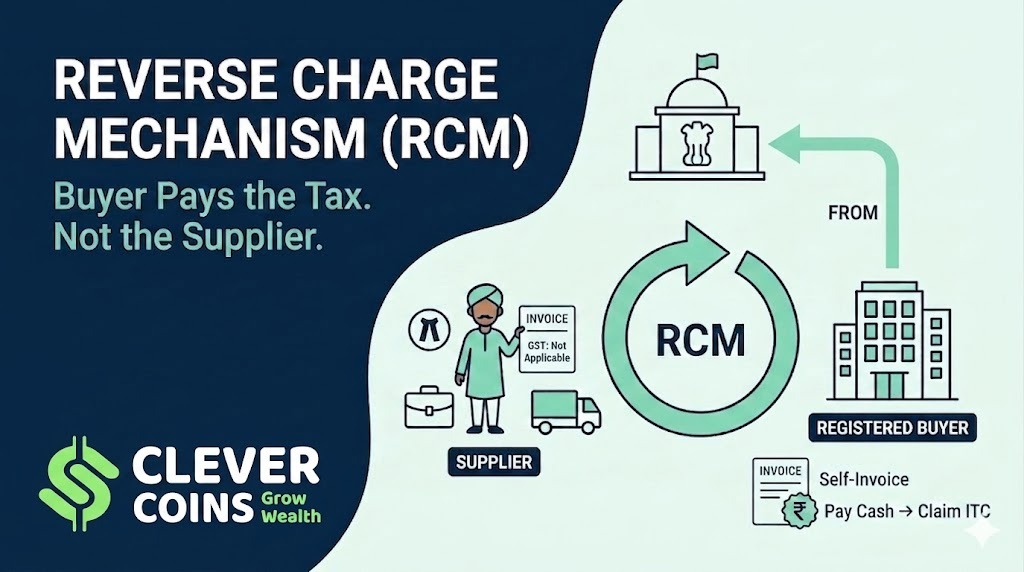
Under RCM, this flow is reversed. The supplier does not collect GST. Instead, the recipient (buyer) is directly responsible for calculating the applicable GST and depositing it with the government:
- Supplier sells goods/services → issues invoice with NO GST → buyer calculates GST → buyer deposits it with the government → buyer then claims ITC on it (if eligible).
|
Why Does RCM Exist? The government introduced RCM for transactions where it is practically difficult to collect tax from the supplier — either because the supplier is unregistered, part of an unorganised sector, or located outside India. Examples: A small transporter running one truck across India. An individual advocate with no GST registration. A foreign SaaS company billing your business in USD. In each case, chasing the supplier for GST collection is impractical. So the liability is shifted to the registered business recipient who is easier to track and audit. |
The Three Legal Bases for RCM — Section 9(3), 9(4), and 9(5)
RCM is not a single rule. It operates under three distinct provisions of the CGST Act, each covering a different category of transactions:
|
Section |
Trigger |
When It Applies |
Who Pays |
|
9(3) |
Notified goods and services |
Specific categories listed by CBIC notification — regardless of whether the supplier is registered or not |
The registered recipient of the supply |
|
9(4) |
Purchases from unregistered suppliers |
Currently restricted to specific notified categories and sectors (primarily real estate). NOT a blanket rule for all unregistered purchases. |
The registered buyer |
|
9(5) |
E-commerce operator deemed supplier |
Specific services (restaurant food, cabs, accommodation, housekeeping) delivered through an e-commerce platform |
The e-commerce operator (e.g. Zomato, Swiggy, Ola) |
The most important and wide-reaching of these is Section 9(3) — the notified services list. If your business uses any of the services in that list, RCM applies, period — regardless of whether your supplier is GST-registered or not.
Section 9(3) — The Full List of Notified RCM Services (2026)
Key Notification: No. 13/2017-Central Tax (Rate) dated 28 June 2017, amended 16 times up to December 2025. This is the primary notification governing service-side RCM. If you receive any of the following services, YOU must pay GST under RCM:
|
No. |
Service |
Supplier |
Recipient (who pays RCM) |
GST Rate |
|
1 |
Goods Transport Agency (GTA) — road freight |
Any GTA not opting forward charge at 12% |
Factory, society, co-op, company, firm, or registered person |
5% (no ITC) or 12% (with ITC) on GTA’s choice |
|
2 |
Legal services by individual advocate / firm of advocates |
Any advocate or law firm |
Any business entity |
18% |
|
3 |
Services by an arbitral tribunal |
Any arbitral tribunal |
Any business entity |
18% |
|
4 |
Director’s fees / remuneration to non-executive directors |
A director of a company / body corporate |
The company / body corporate |
18% |
|
5 |
Insurance agent services |
Any insurance agent |
Insurance company / NBFC |
18% |
|
6 |
Recovery agent services |
Any recovery agent |
Banks, NBFCs, financial institutions |
18% |
|
7 |
Renting of motor vehicles (non-body-corporate suppliers) |
Any unregistered or small operator |
Any registered person hiring the vehicle |
5% |
|
8 |
Security guard / manpower supply by non-body-corporate agencies |
Individuals / unincorporated suppliers |
Any registered business |
18% |
|
9 |
Services by author / music composer / photographer to publisher / music company |
Author, composer, photographer |
Publisher or music company |
12% |
|
10 |
Import of services (services received from outside India) |
Any overseas supplier |
Indian registered recipient (IGST under RCM) |
Applicable IGST rate |
|
11 |
Renting of commercial property by unregistered landlord to registered tenant |
Unregistered property owner |
Registered business tenant |
18% |
|
Important 2025 Update — Sponsorship Services Removed from RCM Effective January 16, 2025 (Notification No. 07/2025-Central Tax (Rate)): Sponsorship services have been removed from the RCM list. Before: If a business paid sponsorship fees to an individual or body, the recipient of sponsorship (the business) paid GST under RCM. After: Sponsorship service suppliers must now charge GST under forward charge. The sponsor no longer has an RCM liability. Action if this applies to you: Review your sponsorship agreements and ensure the service provider is billing you with GST from January 2025 onwards. |
Section 9(3) — Notified Goods Under RCM
Certain goods are also notified under Section 9(3). The list is narrower but still catches businesses in agriculture, textiles, and government transactions.
|
Good |
Supplier |
Recipient (pays RCM) |
|
Cashew nuts (raw / unprocessed) |
Agricultural / forest produce supplier |
Any registered buyer |
|
Bidi wrapper leaves (tendu patta) |
Forest dwellers / unregistered collectors |
Bidi manufacturer |
|
Tobacco leaves (raw) |
Tobacco farmers |
Tobacco product manufacturer |
|
Silk yarn |
Silkworm cocoon manufacturer |
Textile manufacturer |
|
Raw cotton |
Agricultural Produce Marketing Committee / board |
Any registered dealer / ginner |
|
Priority Sector Lending Certificates (PSLC) |
Any bank issuing PSLC |
Purchasing bank |
|
Used vehicles, seized goods, waste, scrap sold by Government |
Central / State Government or local authority |
Any registered purchaser |
Section 9(4) — Purchases from Unregistered Suppliers: Not What Most People Think
Section 9(4) is the most misunderstood provision in RCM. Here is the reality in 2026:
|
The Common Misconception Many business owners believe: “If I buy anything from an unregistered vendor, I must pay GST under RCM.” This was true briefly (July–September 2017) before the government suspended Section 9(4) in October 2017 due to an overwhelming compliance burden on small businesses. Current status in 2026: Section 9(4) applies only to specific notified classes of registered persons and specific notified categories of goods or services — NOT to all unregistered purchases. For most regular businesses: Buying stationery, furniture, services, or raw materials from your local unregistered vendor does NOT trigger RCM under Section 9(4). Where it IS active: Primarily in the real estate sector — registered builders/developers purchasing construction services from unregistered sub-contractors must pay RCM. |
Special Rule for Composition Scheme Registrants
There is one important carve-out: Section 10(4) of the CGST Act mandates that businesses registered under the Composition Scheme must pay GST under RCM on ALL inward supplies received from unregistered persons — without the restrictions that apply to regular taxpayers. If you run a composition restaurant, a composition trader, or any composition business, every purchase from an unregistered vendor triggers RCM. This is one of the less-known but significant compliance obligations for composition dealers.
How to Pay GST Under RCM — The Exact Step-by-Step Process
This is where most businesses go wrong. RCM payment has a specific and non-negotiable rule that catches many taxpayers off-guard:
|
The Golden Rule: RCM Must Be Paid in CASH — Not ITC Under Section 49(4) of the CGST Act: ITC in your electronic credit ledger CANNOT be used to pay RCM liability. Even if you have ₹5 lakh sitting in your ITC balance, your RCM GST must be paid by depositing fresh cash into your Electronic Cash Ledger via Form PMT-06. Only AFTER you pay the RCM in cash do you get to claim it back as ITC (in the same tax period, if eligible). Why this matters: Many businesses report RCM in GSTR-3B but attempt to offset it against their ITC balance — this is technically non-compliant and can attract demand notices. |
- Identify the RCM supply: Check if the service/good received falls under Section 9(3) notified list, OR if you are a composition dealer (Section 9(4) applies broadly).
- Issue a Self-Invoice (if needed): Required when the supplier is unregistered and cannot issue a GST invoice. Must be issued within 30 days of receiving the supply.
- Calculate the GST: Apply the applicable rate (18% for legal services, 5%/12% for GTA, 18% for commercial rent, etc.) on the taxable value of the supply.
- Deposit cash via PMT-06: Add funds to your Electronic Cash Ledger. Use this cash to settle your RCM liability. Do NOT touch your ITC balance for RCM payment.
- Declare in GSTR-3B: Report RCM paid in Table 3.1(d) — ‘Inward supplies liable to reverse charge’. Report ITC claimed in Table 4A.
- Claim ITC in the same period: You can reclaim the RCM paid as ITC in the same monthly GSTR-3B — making it tax-neutral for most eligible businesses.
Self-Invoice Under RCM: When You Must Issue One and What It Must Contain
A self-invoice (also called a self-generated invoice) is a document that the registered recipient creates to record an inward supply from an unregistered supplier where RCM applies. The unregistered supplier cannot issue a GST invoice — so you create one on their behalf.
When Is a Self-Invoice Required?
- You purchase goods or services from an unregistered supplier where Section 9(4) RCM applies (e.g., a builder buying sub-contract labour from an unregistered contractor).
- You pay for any goods/services from abroad (import of services) — the overseas supplier cannot issue an Indian GST invoice.
- NOT required for Section 9(3) services where the supplier is registered (like a registered GTA or an advocate) — they issue their own invoice; you use that as your basis.
What Must the Self-Invoice Contain?
- The words “Self-Invoice under RCM” prominently at the top
- Your own GSTIN as the issuing entity
- Supplier’s name and address (even if unregistered)
- Sequential invoice number and date
- Description of goods or services
- Taxable value of the supply
- Applicable GST rate and amount (CGST + SGST or IGST as applicable)
- Your own details as the recipient
Issue it within 30 days of receiving the supply. Missing the 30-day window can result in loss of ITC eligibility for that period — and since ITC under Section 16(4) has a time limit tied to the financial year of invoicing, a delayed self-invoice can permanently block the credit.
ITC on RCM Payments — Same Period Rule and Conditions
The good news about RCM: for most registered businesses, it is largely tax-neutral. You pay the GST in cash, then immediately claim it back as ITC in the same filing period. The net cash outflow after ITC recovery is zero — only the timing creates a temporary cash flow impact.
|
Condition |
Eligible for ITC? |
Notes |
|
RCM paid, supply used in business |
✓ YES |
Most common case. Tax-neutral overall. |
|
RCM paid in current period, ITC claimed in current period |
✓ YES |
Must be same period, not later. |
|
RCM paid but supply used for personal / non-business purpose |
✗ NO |
ITC blocked under Section 17(5). |
|
Composition scheme registrant pays RCM |
✗ NO |
Composition dealers cannot claim ITC at all — RCM is a pure cost. |
|
Business receives legal/GTA services used for exempt supplies |
✗ NO |
ITC blocked if the output supply is exempt from GST. |
|
Blocked credits under Section 17(5) (food, club membership, personal motor vehicle, etc.) |
✗ NO |
Even if RCM is paid, ITC is blocked for these specific items. |
Critical timing rule: ITC on RCM cannot be claimed in a future period. It must be claimed in the same GSTR-3B in which the RCM tax is declared and paid. If you pay RCM in February’s GSTR-3B, claim the ITC in February’s Table 4A — not in March.
Time of Supply Under RCM — When Does Your Liability Arise?
The time of supply determines which month’s GSTR-3B you must declare and pay RCM in. Getting this wrong leads to interest charges at 18% per annum for the delayed month.
|
Type |
Time of Supply (Earlier of…) |
Practical Example |
|
Services (Sec 13(3)) |
(a) Date of payment by recipient, OR (b) 60 days from the date of supplier’s invoice |
Invoice: 5 Jan 2026. Payment: 20 Feb 2026. 60-day mark: 5 Mar 2026. Earlier = 20 Feb → Feb GSTR-3B. |
|
Goods (Sec 12(3)) |
(a) Date of receipt of goods, OR (b) Date of payment, OR (c) Date immediately after 30 days from supplier’s invoice — whichever is earliest |
Receive goods 10 Jan, Pay 15 Feb. Invoice date 8 Jan → 30 days = 7 Feb. Earliest = 7 Feb → Feb GSTR-3B. |
|
Import of Services |
(a) Date of payment to overseas supplier, OR (b) Date of debit in bank account, OR (c) Date of receipt of invoice — whichever is earliest |
USD invoice received 1 Mar 2026. Paid on 15 Apr 2026. Earlier = 1 Mar → Mar GSTR-3B for IGST under RCM. |
How to Report RCM in GSTR-3B — Table-by-Table
Many taxpayers report RCM in the wrong table, or forget to report it at all. GSTN’s AI-based system now automatically cross-checks e-invoices, e-way bills, and GSTR-3B declarations. A mismatch triggers a Section 61 scrutiny notice.
|
GSTR-3B Table |
What Goes Here |
Details |
|
Table 3.1(d) |
Inward supplies on which RCM is payable |
Report the taxable value and tax (CGST + SGST or IGST) for ALL RCM supplies received during the month — GTA, advocates, directors, commercial rent, imports, etc. |
|
Table 3.1.1(ii) |
Section 9(5) e-commerce supplies |
This is for platforms like Zomato/Swiggy ONLY. Restaurant-specific. Do NOT mix Section 9(3) RCM here. |
|
Table 4A |
ITC on inward supplies under RCM |
Claim the ITC on RCM paid in the same period. Break into: IGST, CGST, SGST columns. Do this in the SAME month as the payment — not next month. |
|
GSTR-1 Table 4B |
Self-invoices for unregistered purchases |
If you issued self-invoices for Section 9(4) unregistered supplier purchases, report them here. For Section 9(3) services (GTA, advocate), primarily GSTR-3B Table 3.1(d) only. |
|
New in 2025-26: RCM Liability / ITC Statement on GST Portal The GST Portal has introduced a dedicated RCM Liability/ITC Statement — a new reporting tool that tracks all your RCM transactions across periods. What it does: Automatically reconciles RCM declared in Table 3.1(d) against ITC claimed in Table 4A. Flags unclaimed ITC or mismatches that could attract notices. What you should do: Log into your GST Portal → Returns → RCM Liability/ITC Statement. Review it every quarter. Any unmatched entry should be investigated and resolved before the annual GSTR-9 filing. |
Top 6 RCM Mistakes — and What They Cost You
- Paying RCM from ITC balance instead of cash. This is the most common error. ITC cannot be used for RCM payment. Cost: Demand notice for the full RCM amount + 18% interest + possible 100% penalty.
- Assuming Section 9(4) applies to all unregistered purchases. For most businesses, buying from an unregistered vendor today does NOT trigger RCM. Only composition dealers and specific real-estate sector transactions are covered. Cost: Either paying excess RCM unnecessarily, or (worse) missing actual 9(4) obligations in real estate.
- Not issuing a self-invoice for import of services. If you pay a foreign software company (SaaS), a foreign consultant, or any overseas service provider, you must self-invoice and pay IGST under RCM. Many tech companies skip this entirely. Cost: The entire IGST amount becomes due for all past periods — with interest.
- Claiming ITC in the wrong period. RCM ITC must be claimed in the same GSTR-3B in which the RCM tax is paid. Delaying to next month — even by one filing — technically makes it a wrong-period claim. Cost: ITC disallowance, demand, interest.
- Forgetting director’s fees under RCM. Non-executive director remuneration paid by a company is subject to RCM at 18%. Many companies skip this or treat it as pure salary (which is exempt — but only for executive / whole-time directors under employment contract). Cost: Full 18% demand on cumulative director fees.
- Not accounting for GTA reverse charge correctly. If your GTA hasn’t opted for forward charge at 12%, you must pay RCM. But many businesses pay the freight amount and move on. Cost: Full GTA GST liability uncollected, plus interest.
Penalties for Non-Compliance with RCM
|
Violation |
Interest / Penalty |
Legal Reference |
|
Late payment of RCM tax |
18% per annum from the due date |
Section 50 CGST Act |
|
Non-payment (oversight, not fraud) |
Tax + Interest + Penalty up to 10% of tax |
Section 73 CGST Act |
|
Deliberate evasion / fraud |
Tax + Interest + Penalty up to 100% of tax |
Section 74 CGST Act |
|
ITC claimed without paying RCM in cash |
ITC disallowed + recovery of full ITC amount + interest |
Section 16(2) + Section 49(4) |
|
Failure to maintain self-invoice records |
Loss of ITC eligibility for that supply |
Section 31(3)(f) CGST Act |
The 18% interest on delayed RCM adds up fast. A ₹1 lakh RCM liability missed for 12 months means ₹18,000 in interest alone — before the penalty is even calculated. For a GTA relationship paying ₹10 lakh per year in freight, that number becomes significant very quickly.
Frequently Asked Questions
- If my supplier is GST-registered, can RCM still apply to me?
- Yes. Under Section 9(3), the RCM obligation arises based on the NATURE of the supply — not the registration status of the supplier. A registered advocate, a registered GTA, a registered director — all trigger RCM in the recipient’s hands regardless of whether they are registered. Their invoice will mention ‘GST payable under Reverse Charge’.
- What does ‘GTA has opted for forward charge’ mean — and how do I verify?
- A Goods Transport Agency can choose to pay GST at 12% (with ITC) under forward charge, instead of placing the burden on you. If they opt for this, they charge you GST on their invoice and you pay nothing extra under RCM. Verify by asking your transporter for a declaration or checking their GST registration details on gst.gov.in. If they haven’t opted, RCM applies to you.
- I paid a lawyer ₹15,000. He didn’t mention GST. What do I do now?
- Legal services by an advocate to a business entity are squarely under Section 9(3) RCM. You owe 18% GST = ₹2,700. Issue a self-invoice (if the advocate is unregistered) or use the advocate’s invoice as your basis. Deposit ₹2,700 in cash via PMT-06. Declare in GSTR-3B Table 3.1(d). Claim back as ITC in Table 4A in the same period.
- We subscribe to AWS, Zoom, Canva, Slack — do these trigger RCM?
- Yes. All import of services from overseas entities — SaaS subscriptions, cloud services, digital tools, foreign consultant fees — trigger IGST under RCM. Many Indian businesses, especially startups and SMEs, are not compliant on this. Calculate IGST at 18% on your USD-billed subscriptions, self-invoice, and pay under RCM monthly. The ITC recovers it if used for business.
- Can I voluntarily pay more RCM than actually due? Will I get a refund?
- Yes, you can. If you overpay RCM (e.g., pay on a supply where RCM was not actually applicable), you can claim a refund with proper documentation and justification under Section 54 of the CGST Act. However, don’t do this as a strategy — it blocks cash unnecessarily and creates refund paperwork.
- Does RCM apply to a freelancer receiving payment from a foreign client?
- No — you have it backwards. RCM applies to the RECIPIENT of services. In this case, the Indian freelancer is the SUPPLIER of services to a foreign client. The foreign client may have local tax implications in their country, but no GST RCM obligation arises for the Indian freelancer for outbound services.
|
Getting a GST Notice About Unpaid RCM? CleverCoins Can Fix It. Whether you’ve missed RCM on GTA payments, director remuneration, legal fees, or import of SaaS services — we’ve resolved it all. CleverCoins handles RCM computation, back-period rectification in GSTR-3B, self-invoice preparation, and voluntary compliance to avoid penalty escalation. No judgment. No surprises. Just clean numbers and peace of mind. 📞 Book a free consultation at clevercoins.org | WhatsApp / Instagram: @clevercoins_official |
Disclaimer: This blog reflects GST laws and notifications as of April 2026. RCM notifications are amended periodically by CBIC. Always verify the current notification list before determining your RCM obligations. Consult a qualified GST practitioner for transaction-specific advice.