What is a Circuit Breaker in Stock Market?
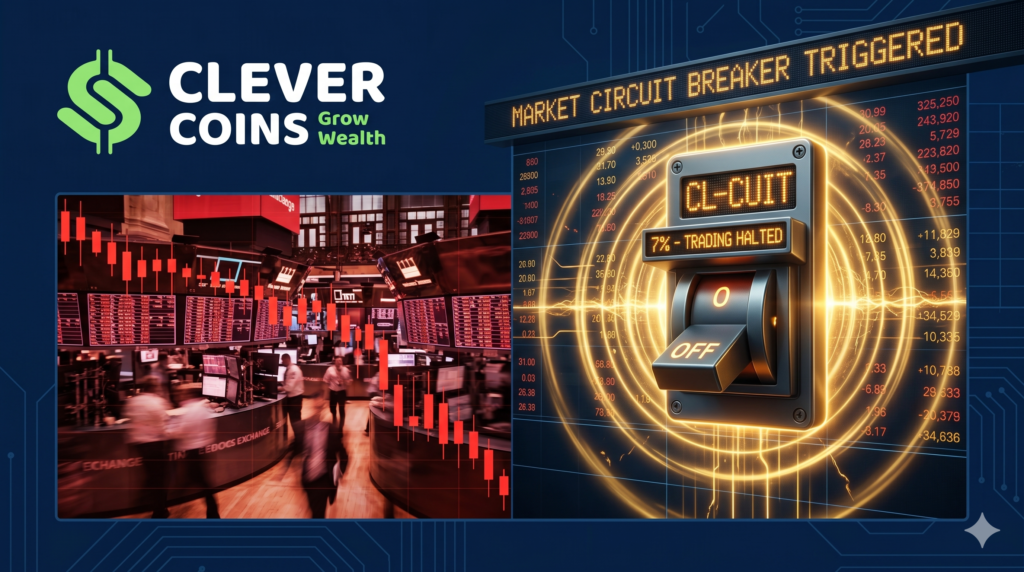
When Markets Need a Pause
Imagine waking up to find that the stock market — that titan of global commerce where trillions of dollars change hands every day — has simply… stopped. No trades. No quotes. A complete, enforced pause. For most people, this sounds like the plot of a financial thriller. But in reality, it happens, and it is by design.
Stock market circuit breakers are one of the most important — and least understood — safety mechanisms in modern financial markets. They are automatic triggers that temporarily halt or restrict trading when prices fall (or occasionally rise) too quickly within a short period. Like the circuit breaker in your home that cuts power when there is an electrical overload, a market circuit breaker is designed to prevent a financial system meltdown.
In this comprehensive guide, we cover everything you need to know about stock market circuit breakers: what they are, how they work, their historical origins, the specific rules in the United States and globally, real-world examples of when they have been triggered, their pros and cons, and critically — what you as an investor should do when one is activated.
|
Key Fact: On March 9, 2020, U.S. stock markets triggered a Level 1 circuit breaker within 4 minutes of the opening bell — the S&P 500 had fallen 7% almost instantly due to the COVID-19 pandemic and an oil price war. This was the first time a market-wide circuit breaker had been triggered since 1997. |
What is a Circuit Breaker in the Stock Market?
A stock market circuit breaker is an automatic regulatory mechanism that temporarily pauses trading on a stock exchange when prices drop (or in some cases, rise) by a predetermined percentage within a single trading session. These mechanisms are designed to:
- Prevent panic-driven, irrational mass selling from accelerating a market crash
- Give investors and institutions time to assess information and make rational decisions
- Allow financial systems, clearinghouses, and brokerages time to process extreme order volumes
- Restore a degree of calm and orderly market functioning during extreme volatility
- Prevent automated trading algorithms from amplifying price movements exponentially
Circuit breakers can apply at three levels: to entire markets or major indices (market-wide circuit breakers), to individual stocks (single-stock circuit breakers), and to specific trading venues or products (exchange-specific mechanisms).
|
Simple Definition: A circuit breaker in the stock market is like a mandatory timeout called during an extreme financial event. It says: everyone stop, take a breath, and then we will resume trading in an orderly fashion. |
The Three Levels of U.S. Market-Wide Circuit Breakers
In the United States, market-wide circuit breakers are calculated based on the percentage decline in the S&P 500 index from the prior day’s closing price. The Securities and Exchange Commission (SEC) established three distinct levels:
|
Level |
Decline Threshold |
Trading Halt Duration |
Time Restriction |
|
Level 1 |
7% decline |
15-minute halt |
Applies before 3:25 PM ET |
|
Level 2 |
13% decline |
15-minute halt |
Applies before 3:25 PM ET |
|
Level 3 |
20% decline |
Remainder of day |
Any time during session |
Level 1 (7% Decline): A 7% drop in the S&P 500 triggers a 15-minute trading halt on all U.S. equity exchanges. This is the most commonly triggered level and represents a significant but potentially recoverable single-day drop. After the 15-minute halt, trading resumes. This level only triggers one time per trading day.
Level 2 (13% Decline): A further decline to 13% below the prior close triggers another 15-minute halt. Like Level 1, this applies only if the decline occurs before 3:25 PM Eastern Time. This level also triggers only once per day.
Level 3 (20% Decline): A catastrophic decline of 20% or more triggers a complete halt of trading for the remainder of the trading day — regardless of what time it occurs. This is the nuclear option, reserved for the most severe market collapses in history.
|
Important Note: If Level 1 or Level 2 thresholds are breached at or after 3:25 PM Eastern Time, trading is NOT halted. The rationale is that with less than 35 minutes remaining in the trading session, a halt would be more disruptive than beneficial. Level 3 halts trading for the rest of the day regardless of timing. |
History and Origin of Circuit Breakers
The Birth of Circuit Breakers: Black Monday, October 19, 1987
The concept of stock market circuit breakers was born from one of the most catastrophic single-day market crashes in history. On October 19, 1987 — forever known as Black Monday — the Dow Jones Industrial Average plummeted 22.6% in a single trading session. This remains the largest single-day percentage decline in the history of the U.S. stock market.
The crash was accelerated by several factors: portfolio insurance strategies that automatically triggered massive sell orders as prices fell, overvalued markets after a five-year bull run, and the newly computerized trading systems of the era that amplified selling pressure exponentially. There were no brakes on the system.
In response, the Presidential Task Force on Market Mechanisms (the Brady Commission) was formed to study the crash. Its 1988 report recommended the implementation of circuit breakers — coordinated mechanisms across exchanges to impose temporary trading halts during extreme market movements.
Early Implementation (1988–1997)
The first circuit breakers were implemented in 1988 and were based on point declines in the Dow Jones Industrial Average rather than percentage declines. However, this created a major problem: as the Dow’s absolute level rose over the years, the same point decline represented a progressively smaller percentage drop. By the mid-1990s, the trigger thresholds had become largely meaningless relative to actual market volatility.
The 1997 Mini-Crash and First Activation
Circuit breakers were first triggered on October 27, 1997, during a global market sell-off sparked by the Asian financial crisis. The Dow fell 554 points that day, triggering the circuit breaker at the 350-point threshold. Trading halted for 30 minutes, resumed, and then halted again when the Dow fell an additional 200 points. The market closed early that day — a major event that highlighted the need to modernize the circuit breaker system.
Post-1997 Reforms
Following the 1997 experience, the SEC revised the circuit breaker rules to use percentage-based thresholds (10%, 20%, 30% of DJIA) rather than absolute point levels. However, these thresholds still proved too high — markets had to fall a dramatic amount before any halt was triggered. The rules were further revised after the Flash Crash of 2010.
The Flash Crash of May 6, 2010
On May 6, 2010, U.S. markets experienced a terrifying 9.8% intraday crash within minutes — the Dow Jones fell nearly 1,000 points in about 36 minutes before partially recovering. The Flash Crash exposed significant weaknesses in the existing circuit breaker framework and demonstrated how high-frequency and algorithmic trading could amplify volatility in ways the original 1988 rules had never anticipated.
This event prompted the SEC to introduce a new system: the Limit Up-Limit Down (LULD) mechanism for individual stocks, implemented in 2012, and the modernized S&P 500-based market-wide circuit breaker rules that remain in use today (implemented in 2013).
COVID-19 and the 2020 Activations
The most dramatic real-world test of modern circuit breakers came in March 2020, when the global COVID-19 pandemic triggered a historic market sell-off. Circuit breakers were triggered multiple times in a matter of weeks:
- March 9, 2020: Level 1 triggered (4 minutes after market open) — S&P 500 down 7%
- March 12, 2020: Level 1 triggered again — S&P 500 down 7%
- March 16, 2020: Level 1 triggered within minutes of open — S&P 500 down 7%+
- March 18, 2020: Level 1 triggered as COVID fears deepened
These activations marked the first market-wide circuit breaker triggers in 23 years and provided the first real-world test of the modernized 2013 rules. By most accounts, the halts served their intended purpose — providing breathing room during one of the fastest bear markets in history.
Individual Stock Circuit Breakers: Limit Up-Limit Down (LULD)
While market-wide circuit breakers address broad index-level crashes, individual stocks also have their own protection mechanisms. In the United States, the Limit Up-Limit Down (LULD) mechanism — adopted by SEC Rule 201 and implemented in 2012-2013 — prevents individual security prices from moving outside defined price bands.
How LULD Works
Under LULD, a stock’s reference price is calculated as the average of trades over the preceding five-minute window. If a stock’s price moves more than a specified percentage away from this reference price, a trading pause is triggered for that individual security.
LULD Price Bands
- Tier 1 (S&P 500 and Russell 1000 stocks, selected ETFs): 5% price band (double during opening/closing periods)
- Tier 2 (Other NMS stocks over $3.00): 10% price band
- Tier 2 (Stocks between $0.75 and $3.00): 20% price band
- Tier 2 (Stocks under $0.75): Lesser of 75% or $0.15
When a stock’s price touches the band limit (either up or down), trading enters a 15-second limit state. If it cannot trade back within the band within 15 seconds, a 5-minute trading pause is initiated.
|
Real-World Example: During the Flash Crash of May 6, 2010, shares of Accenture briefly traded at $0.01 — falling from $40+ to a penny in seconds. The LULD mechanism, had it existed then, would have immediately halted trading and prevented this absurd pricing aberration. |
Circuit Breaker Rules in India (NSE and BSE)
India operates one of the most structured circuit breaker systems in the world, overseen by the Securities and Exchange Board of India (SEBI). The rules apply to both the National Stock Exchange (NSE) and the Bombay Stock Exchange (BSE).
Market-Wide Index Circuit Breakers in India
India’s market-wide circuit breakers are triggered based on movements in either the BSE Sensex or the NSE Nifty 50, whichever is breached first. There are three levels:
10% Movement: Trading on all equity and equity derivative markets halts. If triggered before 1:00 PM, halt is 45 minutes. Between 1:00 PM and 2:30 PM, halt is 15 minutes. After 2:30 PM, no halt is imposed.
15% Movement: If triggered before 1:00 PM, halt is 1 hour 45 minutes. Between 1:00 PM and 2:00 PM, halt is 45 minutes. After 2:00 PM, trading is halted for the rest of the day.
20% Movement: Trading halts for the remainder of the day, regardless of the time.
Individual Stock Circuit Breakers in India
In India, individual stocks also have dynamic price bands applied daily. These bands are set at +/- 2%, 5%, 10%, or 20% depending on the stock. Most actively traded large-cap stocks are in the 20% band. Stocks that hit their upper or lower circuit limit simply stop trading at that price — no orders can be executed beyond that threshold for the rest of the session.
|
India Specific: The term ‘upper circuit’ and ‘lower circuit’ are widely used in Indian investing terminology. When a stock hits its upper circuit, it means buyers greatly outnumber sellers and the price has hit its maximum permitted increase for the day. A lower circuit means the reverse — overwhelming sellers driving the price to its daily floor. |
Global Circuit Breaker Rules: A Comparative Overview
|
Country / Market |
Exchange |
Threshold |
Halt Duration |
|
United States |
NYSE / NASDAQ |
7%, 13%, 20% |
15 min / Full day |
|
India |
NSE / BSE |
10%, 15%, 20% |
45 min / 1.75 hr / Day |
|
European Union |
Euronext |
Varies by stock |
2–5 minutes |
|
China |
Shanghai / Shenzhen |
±5% (individual) |
30 min / Full day |
|
Japan |
Tokyo Stock Exchange |
Dynamic price limits |
Automatic suspension |
|
South Korea |
KRX |
8%, 15%, 20% |
20 min per level |
|
Brazil |
B3 (Bovespa) |
10%, 15% |
30 min / 1 hour |
|
United Kingdom |
London Stock Exchange |
Dynamic bands |
5 min auction |
|
Hong Kong |
HKEX |
Individual stock limits |
5 min cooling off |
While the specific mechanisms vary significantly across global exchanges, the underlying principle is universal: impose a mandatory pause during extreme volatility to restore orderly market functioning.
Types of Circuit Breakers
- Market-Wide Circuit Breakers
These are triggered by broad index movements and halt trading across an entire exchange or market. Examples include the S&P 500-based rules in the U.S. and the Nifty/Sensex-based rules in India. They represent the most powerful circuit breaker tool available.
- Individual Stock Circuit Breakers
Applied to single securities, these prevent extreme intraday price moves for individual companies. The U.S. LULD mechanism and India’s individual stock price bands are examples. These are triggered far more frequently than market-wide circuit breakers.
- Futures Market Circuit Breakers
Futures markets, including those operated by the CME Group, have their own circuit breaker rules. For S&P 500 futures, for instance, a 5% decline triggers a halt in overnight futures trading. This is particularly important because futures markets trade nearly 24 hours and can signal extreme stress before regular equity markets open.
- Options Market Restrictions
Options markets also have volatility controls. During extreme market events, options exchanges may restrict trading in certain contracts or widen bid-ask spreads to manage risk. These are less formalized than equity circuit breakers but serve a similar stabilizing function.
- Cryptocurrency Circuit Breakers
While traditional circuit breakers do not apply to cryptocurrency markets (which trade 24/7/365 with no central exchange), some individual crypto platforms have implemented their own volatility controls. Futures exchanges like CME that offer Bitcoin futures contracts do apply circuit breaker rules consistent with their broader futures market rules.
Why Circuit Breakers Are Necessary: The Arguments For
- Preventing Panic-Driven Cascades
Without circuit breakers, a sharp market decline can trigger automated stop-loss orders and margin calls in a chain reaction. Each falling price triggers more selling, which triggers more falling prices. Circuit breakers interrupt this cascade, giving the market time to find rational equilibrium.
- Managing High-Frequency and Algorithmic Trading Risks
Modern markets are dominated by algorithmic and high-frequency trading systems that can execute millions of trades per second. During extreme volatility, these systems can amplify price moves in ways that are entirely disconnected from fundamental value. Circuit breakers impose a human-paced timeout on machine-speed chaos.
- Allowing Information Dissemination
Sometimes market crashes are triggered by news — an unexpected economic report, a geopolitical event, a major corporate announcement. A circuit breaker gives investors, journalists, and market analysts time to absorb and interpret the news before trading resumes, leading to more informed price discovery.
- Protecting Retail Investors
Institutional investors have sophisticated risk management tools, direct market access, and teams of analysts. Individual retail investors often lack these resources. Circuit breakers provide a level of protection to retail investors by preventing the most extreme price dislocations from decimating their portfolios before they can react.
- System Stability
During extreme market events, trading systems, clearinghouses, and brokerages can become overloaded. The 1987 crash famously overwhelmed paper-based settlement systems. Modern circuit breakers give financial infrastructure time to process backlogs and maintain systemic stability.
Criticisms and Limitations of Circuit Breakers
- The Magnet Effect
One well-documented criticism of circuit breakers is the ‘magnet effect’ — the tendency for prices to accelerate toward a circuit breaker threshold once it comes within reach, as traders rush to execute orders before a halt. This can actually accelerate the very decline the circuit breaker is meant to slow.
- Artificial Interference in Price Discovery
Markets are supposed to be efficient pricing mechanisms that constantly incorporate new information. Critics argue that circuit breakers artificially interrupt this process, potentially creating larger gaps between price levels when markets reopen.
- Post-Halt Selling Pressure
When circuit breaker halts end and trading resumes, the accumulated selling pressure can sometimes cause an immediate further decline — the opposite of the intended calming effect. This was observed during some of the 2020 COVID halt resumptions.
- Not Effective in All Scenarios
Circuit breakers address speed-of-decline issues but cannot address the underlying economic causes of a market crash. A fundamentally bad piece of economic news or a systemic banking crisis will eventually be fully reflected in prices regardless of how many pauses are imposed.
- Global Market Coordination Challenges
In an era of globally interconnected markets, halting one country’s exchange does not halt selling in other markets. When U.S. circuit breakers halted NYSE trading in March 2020, selling continued in futures markets and overseas exchanges, creating complications when U.S. markets reopened.
|
Academic Research Note: Studies on the effectiveness of circuit breakers yield mixed results. Some research (Lauterbach & Ben-Zion, 1993; Kim & Yang, 2004) finds that they reduce volatility and improve price discovery. Other research suggests that circuit breakers may delay rather than prevent price declines and can increase volatility around the halt period. The consensus is that they are imperfect but necessary tools. |
What Happens to Your Trades During a Circuit Breaker?
This is one of the most practical and important questions for retail investors. Here is what actually happens to your orders when a circuit breaker triggers:
Pending Orders
All pending orders (buy or sell orders that have not yet been executed) remain in your brokerage system during the halt. They are not automatically canceled. However, they will not be executed until trading resumes.
Limit Orders
Your limit orders remain queued and will execute when trading resumes — but only if the market price is at or better than your specified limit price when the market reopens. Given that resumption prices can gap significantly from pre-halt prices, your limit order may or may not execute.
Market Orders
This is a critical point: market orders placed during or immediately after a circuit breaker are particularly risky. When trading resumes, the opening price could be significantly different from the pre-halt price. A market order to sell could execute at a much lower price than expected if the market gaps down further on resumption.
Stop-Loss Orders
Stop-loss orders can be particularly problematic during circuit breaker events. If your stop-loss triggers during the halt itself, it becomes a market order that executes at the opening price when trading resumes — which could be substantially lower than your stop price (known as slippage).
|
Investor Tip: During extreme market volatility and circuit breaker events, consider converting market orders to limit orders to maintain control over your execution price. The small premium of using limit orders is worth the protection against catastrophic slippage. |
Investment Strategies During Circuit Breaker Events
- Do Not Panic Sell
The single most important thing most investors can do when a circuit breaker triggers is nothing. Do not rush to sell everything. The halt is designed to be temporary. Long-term investors who have a diversified, high-quality portfolio should generally ride out circuit breaker events rather than locking in losses at the worst possible moment.
- Use the Halt as Research Time
The trading pause is actually an opportunity. Use the time to read the news, understand what triggered the drop, and assess whether the underlying investment thesis for your holdings has fundamentally changed. Most circuit breaker events are caused by external shocks, not permanent impairment of business value.
- Identify Buying Opportunities
For long-term investors, extreme market dislocations are historically among the best buying opportunities available. Investors who deployed capital during the March 2020 COVID circuit breaker events — buying quality stocks at 30-40% discounts — saw extraordinary returns over the following 12-24 months.
- Review Your Asset Allocation
A circuit breaker event is a signal to review whether your portfolio’s asset allocation is still aligned with your risk tolerance. If the halt has revealed that your portfolio is more volatile than you can emotionally or financially handle, the recovery period is an opportunity to gradually rebalance toward a more defensive allocation.
- Avoid Leveraged Positions During Halts
If you hold leveraged positions (margin loans, leveraged ETFs), circuit breaker events are particularly dangerous. Margin calls can be triggered by the sharp declines that precede circuit breakers, and resumption prices can compound losses further. Deleveraging before or during extreme market stress is a prudent risk management move.
- Watch for False Signals
Not every circuit breaker event leads to a prolonged bear market. The 1997 circuit breaker event was followed by a market recovery within days. The COVID circuit breakers in March 2020 preceded one of the fastest bull market recoveries in history. Context and fundamental analysis matter far more than the fact of a circuit breaker trigger alone.
Circuit Breakers vs. Trading Halts: Understanding the Difference
While related, circuit breakers and trading halts are not identical. It is important to understand the distinction:
Circuit Breakers: Automatically triggered by price movements hitting predetermined thresholds. Apply market-wide or to individual stocks based on percentage declines. Are purely mechanical and do not require human intervention to activate.
Regulatory Trading Halts: Initiated by exchanges or regulators — not automatically triggered. Can be called for pending news announcements (earnings, mergers, major corporate events), regulatory investigations, or technical issues. Applied to individual securities. Can last from minutes to days. Examples: A halt pending a major merger announcement, or a halt due to a cybersecurity breach at a company.
Exchange Outages: Sometimes exchanges experience technical failures that halt trading — these are not circuit breakers and are not triggered by price action. The NYSE technical glitch of July 2015 and various exchange outages at other global markets fall into this category.
The Future of Circuit Breakers
As financial markets continue to evolve — with the growth of algorithmic trading, cryptocurrencies, decentralized finance, and 24-hour global trading — the circuit breaker framework will need to evolve as well.
AI and Machine Learning Integration
Future circuit breaker systems may incorporate artificial intelligence to provide more nuanced, context-aware responses to market volatility — distinguishing between rational price discovery during a legitimate fundamental shock and irrational panic-driven volatility that warrants intervention.
Global Coordination
As markets become more interconnected, there is growing discussion among international regulators about better coordination of circuit breaker mechanisms across global exchanges to prevent the whack-a-mole problem where halting one market simply shifts volatility to another.
Cryptocurrency Market Safeguards
The extreme volatility seen in cryptocurrency markets — Bitcoin has dropped 20% or more in a single day numerous times — has prompted increasing calls for volatility controls in digital asset markets. Regulated crypto futures products already carry circuit breaker rules, but spot crypto markets remain largely unregulated in this regard.
Dynamic and Adaptive Thresholds
Some researchers have proposed replacing fixed percentage thresholds with dynamic thresholds that adjust based on current market volatility conditions, time of day, and other market microstructure factors. A 7% decline on a historically low-volatility day has very different implications than a 7% decline during a period of elevated market stress.
Frequently Asked Questions About Circuit Breakers
Q: Can a circuit breaker trigger on a day when the market is rising? In the U.S., the standard market-wide circuit breakers only apply to declines. However, some individual exchanges and foreign markets have rules that apply to both extreme upward and downward moves.
Q: How many times have U.S. circuit breakers been triggered? Market-wide circuit breakers in the U.S. have been triggered a handful of times — notably in 1997, and then four times during March 2020 during the COVID-19 panic.
Q: Do circuit breakers apply to pre-market and after-hours trading? No. U.S. market-wide circuit breakers apply only during regular trading hours (9:30 AM to 4:00 PM ET). However, CME futures markets have their own separate circuit breaker rules that apply to overnight futures trading.
Q: What is the difference between a circuit breaker and a limit up/limit down? A circuit breaker is a market-wide pause based on index movements. Limit Up-Limit Down (LULD) applies to individual securities and prevents trading outside defined price bands for single stocks.
Q: Do circuit breakers apply to bonds and other asset classes? Market-wide equity circuit breakers apply to equities and equity-related derivatives. Fixed income markets (bonds) operate under different rules. Commodity markets and futures exchanges have their own circuit breaker frameworks.
Conclusion: The Safety Net Beneath the Market
Stock market circuit breakers represent one of the most important — if relatively invisible — safety mechanisms in the global financial system. Born from the trauma of Black Monday in 1987, refined through the Flash Crash of 2010, and battle-tested during the COVID-19 panic of 2020, these mechanisms have evolved into a sophisticated, multi-layered system designed to protect markets from their own worst impulses.
For the individual investor, understanding circuit breakers is not merely academic. Knowing why markets halt, what to expect when they do, and how to respond strategically can mean the difference between making rational, wealth-building decisions during market crises and making panic-driven mistakes that permanently impair your financial future.
Markets will always face crises. Economies cycle. Pandemics emerge. Geopolitical shocks occur. The circuit breaker will not prevent these events, but it provides a brief, invaluable moment of enforced calm — a reminder that even the most powerful financial machine on earth sometimes needs to pause, breathe, and restart.
|
Disclaimer: This article is for educational and informational purposes only. It does not constitute financial, investment, or legal advice. All investment decisions should be made in consultation with a qualified financial advisor. Past market behavior does not guarantee future results. |