EPF Registration & Compliance Guide — Everything Indian Employers and Employees Must Know in 2026
India’s Most Important Retirement Safety Net — And Every Employer’s Obligation
For over 70 years, the Employees’ Provident Fund has been the cornerstone of India’s formal sector social security system. Enacted in 1952, the EPF Act created a compulsory savings mechanism that has since grown into the world’s largest social security organisation by number of accounts — with over 6 crore active members and ₹24 lakh crore in corpus managed by the Employees’ Provident Fund Organisation (EPFO) as of 2024.
Yet despite its scale and importance, EPF compliance remains one of the most misunderstood and frequently defaulted-upon statutory obligations among Indian employers — particularly small businesses, MSMEs, startups, and businesses crossing the 20-employee threshold for the first time. Questions abound: When must I register? What exactly do I contribute? How do I calculate EPF on different salary structures? What is UAN? What are the withdrawal rules? What happens if I miss the deposit deadline?
This comprehensive 2025 guide by CleverCoins answers every question about EPF — from the legal foundations and registration process to contribution calculations, UAN management, withdrawal procedures, penalty provisions, and best practices for building a fully compliant EPF programme. Whether you are an employer setting up EPF for the first time, an HR professional managing payroll for a growing team, or an employee who wants to understand your own provident fund entitlements, this guide is your complete EPF reference.
What is the Employees’ Provident Fund (EPF)? — Legal Framework & Purpose
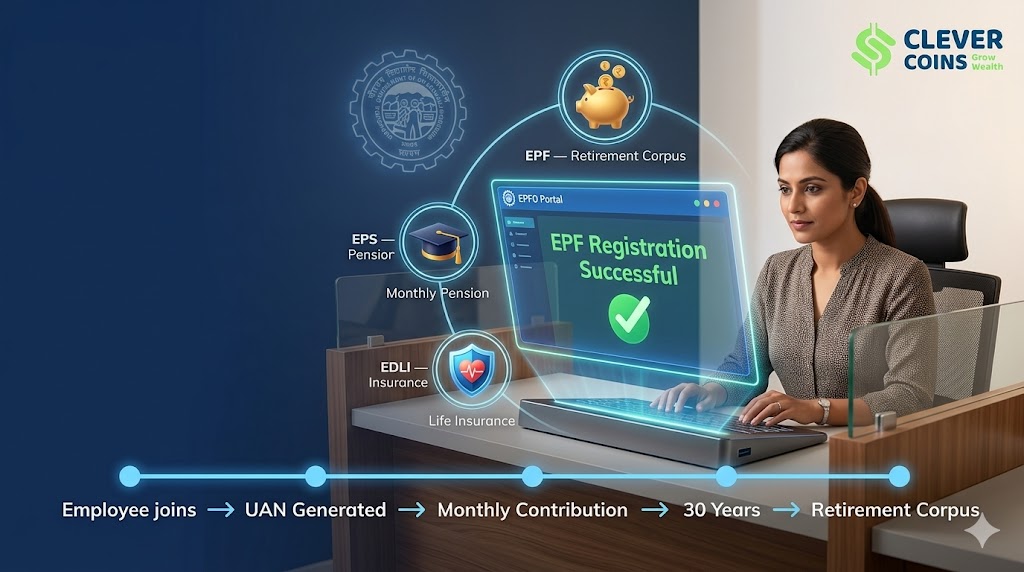
The Employees’ Provident Fund and Miscellaneous Provisions Act, 1952 (EPF Act) is a central labour law that establishes a mandatory retirement savings mechanism for employees in factories and establishments. The law created three distinct schemes administered by the EPFO:
Scheme | Full Name | Purpose | Who Benefits |
EPF | Employees’ Provident Fund Scheme, 1952 | Long-term retirement savings — lump sum at retirement/exit | Employee only — the accumulated corpus |
EPS | Employees’ Pension Scheme, 1995 | Monthly pension after age 58 / on disability or death | Employee + family (widow, children pension) |
EDLI | Employees’ Deposit Linked Insurance Scheme, 1976 | Life insurance — lump sum to family on employee’s death during service | Employee’s nominated family members |
🏛️ EPFO at a Glance — Key Statistics (2024) • Established: 1952 under the EPF Act • Administered by: Employees’ Provident Fund Organisation (EPFO), under Ministry of Labour & Employment • Corpus under management: Over ₹24 lakh crore (one of the world’s largest pension fund managers) • Active EPF members: Over 6 crore • EPF establishments registered: Over 7 lakh • Annual new UAN generated: 1.5+ crore • Portal: epfindia.gov.in and Unified Member Portal (member.epfindia.gov.in) • Mobile App: UMANG (Unified Mobile Application for New-age Governance) |
EPF Applicability — Which Businesses Must Register?
The EPF Act is applicable to specific categories of establishments based on their nature of work and employee headcount. Understanding applicability is the first step for any employer.
Primary Applicability — 20-Employee Threshold
EPF registration is mandatory for every factory engaged in any industry listed in Schedule I of the EPF Act, and every establishment employing 20 or more persons. The 20-employee threshold is calculated on any single day during the year — it does not need to be maintained throughout the year.
Category | Threshold | Timing of Registration | Key Note |
Factories (any scheduled industry) | 10 or more workers (in some industries — check Schedule I) | Within 30 days of crossing threshold | Some industries like mines, oil fields have lower thresholds |
Establishments in scheduled industries | 20 or more employees | Within 30 days of crossing threshold | Includes IT, banking, insurance, trading, hospitality |
Other establishments notified by Central Government | 20 or more employees | Within 30 days of notification or reaching threshold | EPFO may notify specific industries regardless of size |
Voluntary coverage (Section 1(4)) | Even 1 employee — voluntary | Anytime by employer’s choice | Once covered voluntarily, same obligations as mandatory apply |
Post-coverage headcount drop | Below 20 after registration | No deregistration available | Once covered, always covered — headcount drop irrelevant |
⚠️ The 30-Day Registration Window Once your establishment reaches 20 employees — on any single day — you have exactly 30 days to register with EPFO. Missing this window creates a retrospective liability: EPFO can demand contributions from the date you first became liable (not from your actual registration date), plus interest at 12% per annum, plus penal damages of up to 25% of the unpaid contribution amount. For a business that delayed registration by 6 months with 20 employees, this can amount to lakhs in penalties. |
Who Among Your Employees Must Be Enrolled in EPF?
Once your establishment is registered, all eligible employees must be enrolled. But not all workers qualify — here are the detailed rules:
Employee Category | EPF Enrollment Required? | Wage Condition | Notes |
New employee — never been EPF member | Yes — mandatory | All salary levels | Employer and employee must contribute from Day 1 of employment |
Employee who was previously EPF member | Yes — must transfer/link existing UAN | All salary levels | If previously earning above ₹15,000, they must still be enrolled |
Existing member earning above ₹15,000 basic+DA | Yes — enrollment mandatory, but higher pension opt-out available | Basic+DA above ₹15,000 | EPF on actual wages mandatory; EPS capped at ₹15,000 salary ceiling |
Apprentices under Apprentices Act 1961 | No — explicitly exempt | Any | Apprentices are legally excluded from EPF coverage |
International workers from SSA countries | Special international worker provisions apply | Any | Social Security Agreement (SSA) countries have bilateral exemption rules |
Contract workers engaged through contractor | Yes — contractor is primary responsible party; principal employer jointly liable | Up to actual wages | Principal employer must verify contractor compliance |
Part-time employees | Yes — if establishment is covered | Part-time wages | PF calculated on actual wages earned |
Casual or daily wage workers | Yes — if establishment is covered and wages are regular | Actual daily/weekly wages | Regularity of work determines coverage |
EPF Contribution Rates — The Complete Breakdown
Understanding EPF contributions requires understanding three separate schemes that operate simultaneously. The employer’s 12% contribution is split between EPF and EPS in a specific ratio, while the employee’s full 12% goes into EPF.
Standard Contribution Structure
Contribution | Who Pays | Rate | Goes Into | Monthly Cap (₹15,000 wage basis) |
Employee EPF | Employee | 12% of Basic+DA | EPF account | ₹1,800 per month |
Employer EPF | Employer | 3.67% of Basic+DA | EPF account | ₹550 per month |
Employer EPS | Employer | 8.33% of Basic+DA | Pension account | ₹1,250 per month (max on ₹15,000 ceiling) |
EDLI (Insurance) | Employer | 0.50% of Basic+DA | Insurance fund | ₹75 per month |
EPF Admin Charges | Employer | 0.50% (min ₹75/month) | Admin expenses | ₹75 per month minimum |
Total Employer Cost | Employer | 12% + 0.50% + 0.50% = 13% | Multiple funds | ₹1,950 per month |
Total Employee Cost | Employee | 12% | EPF only | ₹1,800 per month |
Total Combined | Both | 24% + admin | EPF + EPS + EDLI | ₹3,750+ per month |
📐 Understanding the ₹15,000 Salary Ceiling for EPS While EPF contributions can be made on the actual basic + DA (no upper limit), the Employees’ Pension Scheme (EPS) contribution is capped at a salary ceiling of ₹15,000 per month. This means: • For an employee with Basic+DA of ₹25,000: Employer EPF = 3.67% × ₹25,000 = ₹917.50; Employer EPS = 8.33% × ₹15,000 = ₹1,250 (capped, not 8.33% × ₹25,000) • The EPS cap ensures maximum pension liability is controlled • Higher pension option: Employees and employers can jointly opt to contribute to EPS on the actual higher salary — but this requires a formal joint declaration and EPFO approval. This was a significant issue following the Supreme Court’s judgment in 2022 regarding higher pension. |
Reduced Rate for Smaller Establishments
For establishments with fewer than 20 employees, or those in specified industries (beedi, jute, bricks, coir, gaur gum factories), the employer’s EPF contribution rate is 10% (instead of 12%), and the employee’s contribution matches at 10% also. This reduced rate is designed to ease the financial burden on smaller or labour-intensive businesses.
Contribution Calculation Example — Three Salary Profiles
Employee | Monthly Basic+DA | Employee EPF (12%) | Employer EPF (3.67%) | Employer EPS (8.33%) | EDLI (0.5%) | Admin (0.5%) | Total Monthly Cost |
Junior Staff | ₹10,000 | ₹1,200 | ₹367 | ₹833 | ₹50 | ₹75(min) | ₹2,525 |
Mid-Level | ₹20,000 | ₹2,400 | ₹734 | ₹1,250 | ₹100 | ₹100 | ₹4,584 |
Senior (₹15K cap) | ₹40,000 | ₹4,800 | ₹1,468 | ₹1,250 | ₹200 | ₹200 | ₹7,918 |
High Earner | ₹70,000 | ₹8,400 | ₹2,569 | ₹1,250 | ₹350 | ₹350 | ₹12,919 |
Note: In the senior and high earner examples above, EPS is capped at ₹1,250 (8.33% of ₹15,000) regardless of actual Basic+DA, unless the higher pension option has been elected jointly.
EPF Registration Process — Complete Step-by-Step Guide (2025)
EPF registration is fully online through the EPFO Unified Shram Suvidha Platform. Here is the complete process for a new employer:
Documents Required for EPF Employer Registration
- PAN card of the establishment (proprietorship PAN / company PAN / LLP PAN)
- Aadhaar card of the authorised signatory / proprietor / managing director
- Certificate of Incorporation / Partnership Deed / GST Registration Certificate / MSME Registration Certificate
- Address proof of the principal place of business (electricity bill / rent agreement / property tax receipt)
- Bank account details: Account number and IFSC code of the establishment’s primary account
- Digital Signature Certificate (DSC) of the authorised signatory — mandatory for companies and LLPs
- List of employees with: Name, Father’s name, Date of birth, Aadhaar number, UAN (if existing), date of joining, and monthly wages (basic + DA)
- Details of licences / registration certificates (Factory licence, Shops & Establishment registration, Trade licence, etc.)
Step-by-Step EPF Registration on Shram Suvidha Portal
- Visit the Shram Suvidha Portal: Go to shramsuvidha.gov.in → Click ‘Register Here’ → Select ‘Establishment’.
- Create Login Credentials: Enter name, email, and mobile number. Verify with OTP. Note your login ID and temporary password.
- Fill the Registration Form: Log in and click ‘Registration for EPFO-ESIC’. Select ‘Only EPFO’ or ‘Both EPFO & ESIC’ as applicable. Fill: establishment name, address, PAN, nature of business, date of incorporation, and owner/director details.
- Enter Employee Details: Add employees with name, Aadhaar, date of joining, and monthly wages. For each employee who already has a UAN, link your establishment to their existing UAN rather than creating a new one.
- Upload Documents: Upload all required documents in PDF format (max 1 MB each).
- DSC / eSign: Attach your Digital Signature Certificate for company / LLP. For proprietorship or partnership, Aadhaar OTP authentication is also accepted.
- Submit: Review all details carefully and submit. An acknowledgement number is generated immediately.
- EPF Registration Code Issued: After verification by EPFO (typically 3–7 working days), a 22-digit PF Code Number is assigned to your establishment. Format: <Region Code>/<Type>/<Establishment Code>/<Extension Code>, e.g., MH/BAN/12345678/000.
- Employee UAN Generation: For each new employee without an existing UAN, a Universal Account Number (UAN) is automatically generated by the EPFO system upon submission of employee details.
- Activate UANs: Employees must activate their UAN by visiting member.epfindia.gov.in using their UAN, Aadhaar, and mobile number linked to Aadhaar.
🔵 What is UAN — Universal Account Number The UAN (Universal Account Number) is a 12-digit number allotted to every EPF member by EPFO. It remains the same for the employee throughout their career — regardless of how many times they change jobs or employers. Think of it as the EPF equivalent of a PAN card for provident fund purposes. Key UAN features: • Portability: Employee carries the same UAN to every employer • Online Access: Employees can check balance, download passbook, and file claims using UAN • KYC Seeding: Aadhaar, PAN, and bank account must be linked to UAN for online claims to work • Employer’s role: Activate/link UAN for every new employee within 1 month of joining |
Monthly EPF Compliance — What Employers Must Do Every Month
EPF compliance is a recurring monthly obligation. Missing any step or deadline triggers penalties. Here is the complete monthly compliance framework:
Task | Frequency | Due Date | Mode / Portal |
Calculate EPF contributions for all eligible employees | Monthly | During payroll processing | Payroll software / manual calculation |
Deduct employee EPF contribution (12% of Basic+DA) from salary | Monthly | On salary payment date | Payroll deduction |
Add employer EPF, EPS, EDLI, and admin charge amounts | Monthly | By 15th of following month | Internal payroll processing |
Generate ECR (Electronic Challan cum Return) on EPFO portal | Monthly | By 15th — submit ECR with challan | EPFO Unified Portal — ECR upload |
Deposit combined contributions (employer + employee) | Monthly | By 15th of the following month | Online payment via net banking / NEFT after challan generation |
Add new employees to EPFO portal | As applicable | Within 1 month of joining | EPFO employer portal — member addition |
Update exiting employees — mark as ‘left the establishment’ | As applicable | On or before last working day | EPFO employer portal — member exit |
File annual return (Form 3A and 6A) | Annual | By 30 April every year | EPFO portal (being replaced by monthly ECR data) |
KYC verification of new employees’ UAN | As applicable | Within 30 days of UAN generation | KYC approved via employer DSC on EPFO portal |
Respond to EPFO notices and assessments | As applicable | Within stipulated notice period | Written response to respective EPFO regional office |
✅ ECR Filing — The Most Important Monthly Task The Electronic Challan cum Return (ECR) is the monthly electronic return that contains the wage and contribution details of every employee covered under EPF. It is the core monthly compliance deliverable — replacing paper returns completely. ECR upload steps: 1. Download ECR file template from EPFO portal 2. Fill in employee-wise wage and contribution data (from payroll) 3. Upload ECR on epfindia.gov.in → ‘ECR/Return Filing’ section 4. Verify the auto-computed contributions 5. Generate challan from the ECR 6. Pay challan online through net banking 7. Payment confirmation = compliance done for the month |
EPF Interest Rate 2025 — How Your Employees’ Money Grows
The EPF interest rate is declared annually by the Central Board of Trustees (CBT) of EPFO, subject to government approval. The interest is credited annually to each member’s EPF account on the balance standing at the end of each month.
Financial Year | EPF Interest Rate | Comparison: PPF Rate | Comparison: SBI 5-Year FD |
2019-20 | 8.50% | 7.10% | 6.70% |
2020-21 | 8.50% | 7.10% | 5.40% |
2021-22 | 8.10% | 7.10% | 5.50% |
2022-23 | 8.15% | 7.10% | 6.50% |
2023-24 | 8.25% | 7.10% | 7.00% |
2024-25 | 8.25% (tentative) | 7.10% | 7.25% |
The EPF interest rate has consistently been higher than the PPF rate by 1%+ — and significantly higher than bank fixed deposits in most recent years. Importantly, EPF interest is fully tax-free up to a threshold (see Tax section below), making the effective post-tax return even more attractive.
💰 EPF Corpus Accumulation — Real Numbers An employee earning ₹30,000 basic per month contributing 12% EPF for 30 years: • Total employee contribution: ₹1,296,000 (₹3,600 × 12 months × 30 years) • Total employer EPF contribution (3.67%): ₹3,96,360 • Interest at 8.25% compounded annually for 30 years • Approximate EPF corpus at retirement: ₹1.15 crore to ₹1.30 crore This does not include the EPS pension component, which provides a monthly pension of approximately ₹5,000–₹10,000 depending on service and pensionable salary. EPF is genuinely one of India’s most powerful retirement wealth-building instruments for salaried employees. |
EPF Withdrawal Rules — When and How Employees Can Access Their Funds
EPF is a long-term retirement savings scheme, and withdrawal rules are designed to protect the fund until retirement. However, the rules have been progressively liberalised to allow access in genuine financial need situations.
- Full Withdrawal — On Retirement or Permanent Emigration
- Full EPF corpus (EPF + EPS portion as lump sum) is available upon: retirement (age 58+), full and permanent disability, permanent emigration from India, or death of the member.
- For resignation/job change: Full withdrawal allowed only if the member has been unemployed for 2 months or more after leaving the last job.
- Form 19 (EPF withdrawal) + Form 10C (EPS withdrawal) required for full claims.
- EPF Advance (Partial Withdrawal) — For Specific Purposes
Employees can make partial withdrawals (advances) from their EPF balance without leaving their job — for specific approved purposes under Paragraph 68 of the EPF Scheme:
Purpose | Minimum Service Required | Maximum Withdrawal Amount | Form to Use |
Medical treatment (self/family) | None — available anytime | 6 months basic wages + DA, or employee’s share + interest — whichever is lower | Form 31 |
Marriage (self/children/siblings) | 7 years of service | 50% of employee’s own share + interest | Form 31 |
Education (self or children post-matric) | 7 years of service | 50% of employee’s own share + interest | Form 31 |
Purchase of house / plot | 5 years of service | 24 months basic wages + DA for plot; 36 months for house construction | Form 31 / Composite Claim |
Home loan repayment | 10 years of service | 36 months basic wages + DA, or total outstanding loan — lower of the two | Form 31 |
House renovation | 5 years of service | 12 months basic wages + DA | Form 31 |
Within 1 year of retirement (age 54+) | None | Up to 90% of total EPF balance | Form 31 / Composite Claim |
COVID-19 Special Advance | None (special provision) | Up to 75% of EPF balance or 3 months wages — whichever is lower | Online claim — withdrawn 2021 |
- EPF Transfer — When Changing Jobs
When an employee changes jobs, their EPF balance does NOT need to be withdrawn. The correct process is to transfer the existing EPF balance to the new employer’s EPF account using the same UAN. This preserves the retirement corpus and the seniority for EPS pension calculation.
- Transfer is done online using Form 13 on the EPFO Unified Portal.
- Alternatively, the new employer can initiate the transfer on behalf of the employee.
- Transfer is processed within 20 working days typically.
- Employees should always transfer — not withdraw — EPF when changing jobs. Withdrawal triggers TDS (if service < 5 years) and permanently breaks the retirement savings chain.
💜 The Job-Change EPF Trap — Don’t Withdraw, Transfer One of the most financially damaging habits of Indian employees is withdrawing EPF every time they change jobs. Let us see what this costs: An employee who changes jobs 4 times in 20 years and withdraws EPF each time may accumulate only ₹15–20 lakh at retirement. The same employee who transfers every time and lets EPF compound for 30 years can accumulate ₹1+ crore from the same contributions. Each withdrawal also triggers TDS at 10% (if service < 5 years) and breaks the compounding chain permanently. ALWAYS transfer; NEVER withdraw unless absolutely necessary. |
EPF and Income Tax — Complete Tax Treatment Guide
EPF enjoys a special EEE (Exempt-Exempt-Exempt) tax status — making it one of India’s most tax-efficient savings instruments. However, there are important nuances and recent changes that employers and employees must know:
Stage | Tax Treatment | Condition | Recent Change (Budget 2021) |
Employee EPF Contribution | 80C deduction — up to ₹1.5 lakh/year total (shared with other 80C investments) | Old tax regime only; new regime does not have 80C | No change |
Employer EPF Contribution | Exempt from employee’s taxable income — NOT treated as perquisite | Up to 12% of salary; any excess is taxable as perquisite | No change |
EPF Interest — on employee contribution | Fully tax-free up to employee contribution of ₹2.5 lakh/year | For the portion of employee contribution up to ₹2.5L/year | Budget 2021: Interest taxable on employee contributions exceeding ₹2.5 lakh/year |
EPF Interest — on employer contribution | Interest on employer EPF contribution exceeding ₹7.5 lakh/year is taxable | Rare — only high-salary employees affected | Budget 2021: New rule |
EPF Withdrawal — after 5 years continuous service | Fully exempt — no TDS, no income tax | Continuous service with same or different employers (if transferred) | No change |
EPF Withdrawal — before 5 years service | Taxable as salary income; TDS @ 10% (if PAN given) or 30% (no PAN) | Service counted including previous employer if transferred | No change — premature withdrawal always taxable |
EPS Pension | Taxable as salary — subject to standard deduction | All monthly pension receipts | No change |
📌 The ₹2.5 Lakh EPF Contribution Tax Rule — Who Is Affected? Since FY 2021-22, interest on EPF contribution exceeding ₹2.5 lakh per year has become taxable. To put this in perspective: ₹2.5 lakh/year = ₹20,833/month EPF contribution by employee 12% EPF means: ₹20,833 = 12% × ₹1,73,611/month basic+DA This means the rule primarily affects ONLY employees with basic+DA above ₹1.74 lakh per month — a very small proportion of the Indian workforce. For the vast majority of employees (earning basic+DA below ₹1.73 lakh/month), EPF interest remains fully tax-free. This is not a concern for most MSMEs and small business employees. |
EPS — Employees’ Pension Scheme: Your Monthly Pension After Retirement
The Employees’ Pension Scheme (EPS) is the pension component of the EPF framework. While EPF is a lump-sum corpus, EPS provides a monthly pension for life after retirement. Every EPF member is simultaneously an EPS member — contributions are made from the employer’s 12% (split as 8.33% to EPS and 3.67% to EPF).
EPS Pension Calculation Formula
📐 EPS Monthly Pension Formula Monthly EPS Pension = (Pensionable Salary × Pensionable Service) ÷ 70 Where: • Pensionable Salary = Average monthly salary drawn in the last 60 months before exit (capped at ₹15,000 unless higher pension option was chosen) • Pensionable Service = Number of years of EPS contribution (after September 16, 1995) • 70 = Fixed divisor Example: Employee with ₹15,000 pensionable salary and 30 years of EPS service: Monthly Pension = (15,000 × 30) ÷ 70 = ₹6,428.57 per month Bonus: Past service (pre-1995) and a past service benefit table from EPFO is added to the above formula for employees who were members before September 1995. Minimum EPS Pension: ₹1,000 per month (guaranteed by government, even for lower service) |
Key EPS Rules
- Minimum 10 years of EPS membership required to be eligible for a monthly pension.
- If service is less than 10 years: Only a Scheme Certificate is issued. The EPS amount is returned as a lump sum at exit.
- Pension starts at age 58. Early pension (reduced) is available from age 50 at a reduced rate.
- Disability Pension: Available regardless of age or service period — if the member suffers permanent total disablement.
- Family Pension: On the death of an EPF member, widow/er and children receive monthly pension (widow gets full pension; children get 25% each, for up to 2 children).
EDLI — Employees’ Deposit Linked Insurance: Life Cover for Every EPF Member
The Employees’ Deposit Linked Insurance Scheme (EDLI) provides free life insurance coverage to every EPF member. In the event of an EPF member’s death while in active service, their nominee receives a lump-sum insurance payment — funded entirely by the employer’s 0.5% EDLI contribution.
Parameter | Details |
Maximum EDLI Insurance Amount | ₹7,00,000 (Revised upward — previously ₹6 lakh) |
Minimum Guaranteed Benefit | ₹2,50,000 (Regardless of EPF balance) |
Calculation Basis | 30 × last drawn monthly wages (basic+DA) + 50% of average balance in EPF over 12 months, subject to maximum |
Eligibility | Active EPF member (must be in service at time of death) |
Who Can Claim | Nominated family members (as per EPF nomination Form 2); if no nomination, legal heirs |
Cost to Employee | Zero — entirely funded by employer’s 0.5% contribution |
Claim Form | Form 5 IF (EDLI claim) |
EPFO Role | EDLI is managed and paid by EPFO from the central EDLI fund |
✅ EDLI — The Hidden Employee Benefit That Most People Don’t Know About Most employees — and even many employers — are unaware that every active EPF member automatically has life insurance of up to ₹7,00,000 under EDLI, at zero cost to the employee. In the event of an employee’s death while in service, the family receives this insurance as a lump sum in addition to the full EPF corpus and any EPS benefits. Employers should proactively communicate this benefit to employees. Ensuring EPF nominations are current (Form 2) is critical — without a valid nomination, EDLI claims can be delayed or disputed. |
EPF Penalties for Non-Compliance — Financial & Criminal Consequences
EPFO has significantly strengthened enforcement in recent years, using data analytics to identify defaulting employers through bank transaction data, income tax filings, and GST records. Non-compliance is increasingly hard to hide and increasingly expensive:
Violation | Financial Penalty | Interest Rate | Criminal Liability |
Non-registration despite threshold crossed | Retrospective contributions from date of applicability + penal damages 5%–25% | 12% p.a. from due date | Yes — imprisonment up to 3 years; fine up to ₹10,000 |
Late deposit of monthly contributions | Penal damages: 5% (delay up to 2 months), 10% (2–4 months), 15% (4–6 months), 25% (beyond 6 months) | 12% p.a. simple interest | No criminal liability for inadvertent delay |
Not enrolling eligible employees | All unpaid contributions + interest + penal damages | 12% p.a. | Yes — same as non-registration |
Non-maintenance of EPF registers / muster roll | Fine up to ₹5,000 per default | N/A | Yes — cognizable offence |
Providing false information or accounts | Full recovery + penalty up to 3× the evaded amount | 12% p.a. | Yes — imprisonment up to 1 year; fine up to ₹4,000 |
Obstruction of EPFO inspector | Fine up to ₹5,000 | N/A | Yes — imprisonment up to 1 year |
Default in making TDS deduction on premature EPF withdrawal | Employer responsible for TDS default under Section 201 of Income Tax Act | N/A | Income Tax Act provisions apply |
🔴 EPFO Enforcement Mechanisms — Modern and Data-Driven EPFO’s enforcement has become significantly more sophisticated: • Cross-verification: EPFO matches employee data from ESIC, Income Tax, and bank records to identify unregistered employers and under-reporting. • Attachment orders: EPFO can attach and sell employer assets (including bank accounts) for recovery of dues without court intervention. • Section 7A proceedings: An authorised officer can determine EPF liability and issue demand orders — covering years of unpaid contributions plus penal damages in a single assessment. • Prosecution: EPFO has been actively prosecuting wilful defaulters, with multiple cases of imprisonment in recent years. Do not assume that being a small business means EPFO won’t find you. The digital footprint of every formal business (GST, Income Tax, payroll) makes detection increasingly certain. |
UAN & KYC Management — Critical Employer Responsibilities
Beyond registration and monthly deposits, EPF compliance requires active management of employee UAN accounts. Here is what employers must ensure:
KYC Documents to Be Seeded with UAN
- Aadhaar: Mandatory — links employee’s identity to UAN; required for online claims.
- PAN: Required for TDS compliance on withdrawal; without PAN, TDS is deducted at 30% (highest rate).
- Bank Account: Required for direct credit of EPF claims and withdrawals.
- KYC approval by employer: Some KYC documents (especially bank account and PAN) require digital approval by the employer through the EPFO employer portal using DSC.
Managing Employee Entries and Exits
Every employee entry (new hire) and exit (resignation, termination, retirement) must be updated in the EPFO portal:
- New hire: Check if employee already has a UAN (via Aadhaar + mobile verification). If yes, link establishment to existing UAN. If no, generate new UAN.
- Exit: Mark the employee’s date of exit (date of leaving) in the EPFO portal within the same ECR period. This ensures the employee can claim EPF after their mandatory 2-month waiting period.
- Joint Declaration: If there are any discrepancies in the employee’s details (name, DOB, father’s name) between EPFO records and Aadhaar, a joint declaration (signed by employer and employee) must be submitted to EPFO for correction. Uncorrected discrepancies block online claims.
Common UAN Issues Employers Must Resolve Proactively
Issue | Consequence | Resolution |
Duplicate UANs | Employee cannot transfer or claim; creates EPFO dispute | File merger request via EPFO helpdesk or regional office |
Aadhaar name mismatch | Online claims blocked; employee needs physical claim process | Submit joint declaration + Aadhaar correction |
Bank account not linked | Claim payment delayed; EPFO cannot credit funds electronically | Employee links bank on member portal; employer approves via KYC |
PAN not seeded | 30% TDS on withdrawal (vs 10% with PAN) for premature cases | Employee submits PAN on member portal; employer approves |
Employee exit not updated | Monthly contribution shows mismatch; EPFO flags employer | Update exit date in ECR and employer portal immediately |
UAN not activated by employee | Employee cannot access passbook, file claims, or do KYC | Inform employee to activate via member portal with OTP |
Contribution period mismatch | ECR shows contributions but member passbook shows gaps | Reconcile ECR data; file correction/grievance on EPFO portal |
Higher Pension Option Under EPS — The Supreme Court Ruling Explained
One of the most significant EPF-related developments in recent years is the Supreme Court’s ruling in the Employees’ Provident Fund Organisation vs Sunil Kumar B case (2022), which upheld the right of certain employees to contribute to EPS on their actual higher wages (beyond the ₹15,000 ceiling) — potentially leading to a significantly higher monthly pension.
⚖️ Higher Pension — Key Facts • WHO CAN OPT: Employees who were EPF members as on November 1, 1995, and continued contributing through employer, and where the employer and employee jointly contributed to EPS on actual wages exceeding ₹5,000/6,500 before August 2014. • HOW TO APPLY: Joint application by employer and employee through the EPFO portal — deadline for eligible employees to apply was extended multiple times; check EPFO current status. • BENEFIT: Instead of pension calculated on ₹15,000 (giving approximately ₹6,428 for 30 years of service), the pension would be calculated on actual salary — potentially ₹25,000–₹50,000+, giving a pension of ₹10,000–₹21,000+ per month. • EMPLOYER’S ROLE: Employer must file the joint application and pay the differential contribution (the difference between what was contributed at the ₹5K/6.5K/15K ceiling and what should have been contributed on actual wages) with interest. • CAUTION: The financial liability for employers can be substantial. Carefully assess before filing. |
10 Critical EPF Compliance Mistakes Indian Employers Make
- Calculating EPF on Basic Salary When Special Allowances Were Created to Artificially Reduce PF Base: Post the Supreme Court’s Surya Roshni judgment, EPFO can challenge establishments that inflate special allowances to minimise the PF contribution base. Any allowance that is a ‘basic wage’ in substance — paid universally, not based on individual skill or performance — must be included in the PF calculation base.
- Not Registering Within 30 Days of Crossing 20 Employees: The 30-day window is non-negotiable. Delay creates retrospective liability, interest, and penal damages from the date applicability was triggered — not from the date of actual registration.
- Creating New UANs for Employees Who Already Have One: If an employee already has a UAN from a previous employer, creating a new UAN creates a duplicate — which blocks their ability to transfer or claim. Always verify existing UAN via Aadhaar before creating a new one.
- Not Approving Employee KYC Through DSC: Employees can link Aadhaar, PAN, and bank account on the EPFO portal — but for claims to process, the employer must digitally approve the KYC through their DSC. Unapproved KYC = blocked claims = grievance against the employer.
- Not Updating Employee Exits in the Portal: When employees leave, their exit date must be updated in the EPFO portal. If not updated, subsequent ECR filings show them as active employees with 0 contribution — generating automatic mismatch notices from EPFO.
- Including All Employees in EPF Calculation When Some Are Excluded: Apprentices under the Apprentices Act are explicitly excluded. Including them unnecessarily inflates contribution liability. Conversely, misclassifying regular workers as ‘apprentices’ to exclude them is a common evasion that EPFO inspectors specifically look for.
- Not Handling the ₹15,000 Salary Ceiling Correctly for EPS: Many payroll teams apply the full 12% to EPS on the actual basic salary without capping EPS at ₹15,000 — creating over-contribution to EPS (which cannot be individually withdrawn). Ensure EPS is always capped unless the higher pension option has been formally elected.
- Overlooking EDLI Nomination Compliance: Employers are obligated to ensure every employee has a valid EPF nomination (Form 2) updated on the EPFO portal. Without it, EDLI claims and EPF death claims are significantly delayed for the deceased employee’s family.
- Not Processing EPF Transfers for New Employees Who Change Jobs: When you hire an experienced employee, ask them about their existing EPF and facilitate the transfer from their previous employer. An employee who withdraws EPF every time they join you loses their retirement savings — and the employer who could have helped but didn’t shares moral responsibility for this outcome.
- Missing the Connection Between EPF Wages and the New Labour Code 50% Rule: When the Code on Wages takes effect, at least 50% of CTC must be ‘wages’ — which directly forms the EPF calculation base. Businesses that have structured salaries with high special allowances to minimise PF will face a sudden significant increase in EPF costs. Begin planning now.
Real Case Study: Setting Up EPF for a 30-Person IT Startup
CodeForge Technologies Pvt. Ltd. is a Bengaluru-based software startup that hired its 20th employee in March 2023. Here is how their EPF compliance was structured with guidance from CleverCoins:
Month | Action Required | What Was Done | Outcome |
March 2023 | 20th employee joined — EPF threshold crossed | Registered on Shram Suvidha within 15 days; PF code obtained | Zero penalty; compliant from Day 1 |
March 2023 | UAN generation for all 20 employees | Verified 8 employees had existing UANs from previous jobs; linked to new PF code; 12 new UANs generated | No duplicate UANs created |
April 2023 | First ECR filing | Payroll software (Keka HR) configured with PF code; ECR auto-generated and uploaded; challan paid by 13th | Filed and deposited by 15th |
June 2023 | 3 employees’ salary increments pushed Basic+DA above ₹15,000 | Continued full 12% EPF on actual wages; EPS capped at ₹1,250; payroll updated | Correct contribution on higher wages |
August 2023 | 2 employees resigned | Exit dates updated in EPFO portal within 5 days; employees guided to file PF transfer Form 13 to new employers | No default; no claims blocked |
November 2023 | 1 employee filed EPF advance for medical emergency | Form 31 processed online; approved by CleverCoins through employer DSC within 48 hours | Employee received advance in 7 days |
March 2024 | 30 employees — Annual EPF audit by CleverCoins | All ECRs reconciled with payroll data; all KYC verified; 2 nomination gaps identified and rectified | Fully audit-ready |
Ongoing | Monthly ECR, deposit by 13th, exit updates as needed | Automated via Keka + CleverCoins compliance team | Zero EPFO notices in first year |
CodeForge’s EPF compliance setup cost: ₹18,000/year (CleverCoins advisory fee). EPF employer contribution: approximately ₹1.56 lakh/month for 30 employees. Total monthly payroll EPF + ESIC + PT compliance managed in under 2 hours per month by their single HR executive using Keka HR, with CleverCoins handling all EPFO portal work. Zero EPFO notices received in the first 14 months — compared to the industry experience of 1–2 notices per year for non-optimised setups.
✅ CleverCoins EPF Registration & Compliance Service CleverCoins provides a comprehensive EPF compliance package: EPF Employer Registration, UAN Generation & KYC Management, Monthly ECR Filing, Challan Deposits, Employee Transfer & Exit Management, Annual Compliance Audits, EPF Claim Assistance, and EPFO Notice Response. Visit clevercoins.org for a free compliance health check for your business. |
Conclusion: EPF is More Than Compliance — It is Your Employees’ Retirement Future
After reading this comprehensive guide, one truth should be unmistakably clear: EPF is not just a compliance requirement that adds 13% to your payroll cost. It is the most powerful, secure, and tax-efficient retirement savings mechanism available to every Indian salaried worker — and it is an employer’s fundamental commitment to the financial security of the people who build their business.
For employers: EPF compliance is non-negotiable, increasingly enforced, and straightforward to manage with the right systems. The cost of compliance is predictable and manageable. The cost of non-compliance — penal damages, interest, criminal prosecution, and the human cost of employees who reach retirement without savings — is catastrophically higher.
For employees: Understand your UAN, keep your KYC updated, never withdraw EPF when changing jobs, and check your EPF balance at least annually. Your retirement corpus is being built brick by brick with every monthly contribution — protect it by transferring, not withdrawing.
At CleverCoins, we believe that every Indian employee deserves the retirement security that EPF promises, and every Indian employer deserves the compliance clarity that good advisory support provides. We offer end-to-end EPF and ESIC compliance management — from Day 1 registration to monthly filing to retirement claim assistance — so that you can build your business with confidence and your employees can plan their futures with security.
🌐 About CleverCoins CleverCoins (clevercoins.org) is India’s trusted tax consultancy and business compliance partner for MSMEs, startups, and growing businesses. Our services cover GST registration and return filing, EPF and ESIC compliance, Professional Tax, income tax planning, Labour Law advisory, POSH compliance, and complete payroll management. One trusted partner for all your compliance needs — so you can focus on growth. |