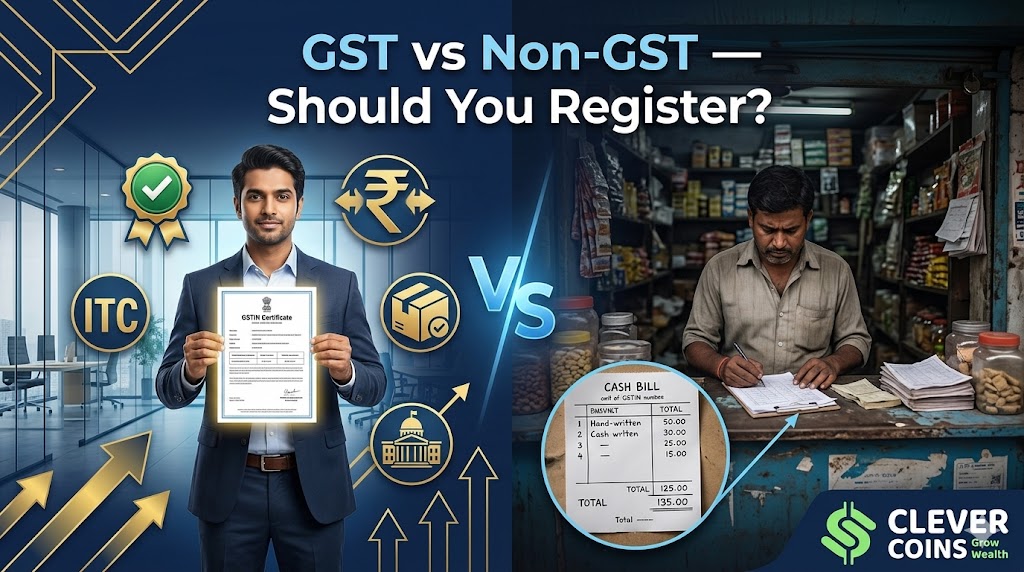
GST vs Non-GST Business – Should You Register? The Ultimate Decision Guide for Indian Entrepreneurs (2026)
The GST Question Every Business Owner in India is Asking
Every day, thousands of small business owners, freelancers, traders, and startup founders across India face the same critical question: Do I need to register for GST? Should I register even if I am not required to? What happens if I don’t? What do I gain — or lose — by becoming a GST-registered business?
Since GST was implemented in India on 1 July 2017 as a unified indirect tax replacing a maze of central and state levies, it has fundamentally changed how businesses operate, invoice, and compete. Being GST-registered is no longer just about tax compliance — it is about business identity, market access, client trust, working capital efficiency, and long-term competitiveness.
Yet the decision is not black-and-white. For some businesses, voluntary GST registration is a powerful strategic move that opens doors to larger clients, enables input tax credit recovery, and enhances brand credibility. For others — particularly micro-businesses, hyperlocal service providers, and exempt-category traders — registering for GST may impose compliance costs and cash flow burdens that outweigh the benefits.
This comprehensive guide by CleverCoins examines every angle of the GST vs Non-GST decision — from legal requirements and threshold limits to strategic advantages, penalties, real examples, and sector-specific recommendations — so you can make the most informed choice for your business in 2025.
Understanding GST — A Quick Refresher for Business Owners
The Goods and Services Tax (GST) is India’s comprehensive indirect tax on the supply of goods and services. It replaced over 17 central and state taxes including Central Excise Duty, Service Tax, VAT, CST, Entry Tax, and Octroi — simplifying the entire indirect tax structure into one unified framework.
GST follows a destination-based, multi-stage tax system. It is levied at every stage of the supply chain but only on the value addition at each stage. The tax paid on purchases (input tax) is available as a credit against the tax collected on sales (output tax), ensuring there is no cascading effect — no tax-on-tax.
|
GST Type |
Full Form |
Applicable On |
Who Collects |
|
CGST |
Central Goods and Services Tax |
Intra-state supply of goods and services |
Central Government |
|
SGST |
State Goods and Services Tax |
Intra-state supply of goods and services |
State Government |
|
IGST |
Integrated Goods and Services Tax |
Inter-state supply + Imports |
Central Government |
|
UTGST |
Union Territory GST |
Supplies in Union Territories (no state legislature) |
UT Administration |
|
📌 How GST Works — Simple Example Manufacturer sells goods to Wholesaler for ₹1,00,000 + 18% GST = ₹18,000 GST collected. Wholesaler sells to Retailer for ₹1,20,000 + 18% = ₹21,600 GST collected. Wholesaler pays only ₹3,600 (₹21,600 minus ₹18,000 input credit). Retailer sells to Consumer for ₹1,50,000 + 18% = ₹27,000 GST collected. Retailer pays only ₹5,400 (₹27,000 minus ₹21,600 input credit). The consumer bears the full ₹27,000. Every registered business in the chain recovered its input taxes — that is GST’s design. |
Who MUST Register for GST? — Mandatory Registration Rules
GST registration is legally mandatory for businesses that meet any of the following criteria. Failing to register when required is a serious offence that attracts heavy penalties.
- Turnover-Based Mandatory Registration — Threshold Limits
|
Business Type |
State Category |
GST Threshold (Goods) |
GST Threshold (Services) |
|
Regular Businesses |
Normal States & UTs |
₹40 lakh per year |
₹20 lakh per year |
|
Regular Businesses |
Special Category States* |
₹20 lakh per year |
₹10 lakh per year |
|
E-commerce operators |
All States |
No threshold — mandatory regardless of turnover |
No threshold |
|
E-commerce sellers (through platforms) |
All States |
No threshold — mandatory regardless of turnover |
No threshold |
|
Casual Taxable Persons |
All States |
No threshold |
No threshold |
|
Non-Resident Taxable Persons |
All States |
No threshold |
No threshold |
* Special Category States: Jammu & Kashmir, Himachal Pradesh, Uttarakhand, Arunachal Pradesh, Assam, Manipur, Meghalaya, Mizoram, Nagaland, Sikkim, Tripura.
- Business Activity-Based Mandatory Registration (Regardless of Turnover)
- Businesses making inter-state supplies of goods (selling to customers in another state).
- E-commerce operators (platforms like Amazon, Flipkart, Meesho, Swiggy, etc.).
- E-commerce sellers supplying goods or services through e-commerce operators.
- Casual taxable persons — businesses making taxable supplies in a state where they are not normally resident.
- Non-resident taxable persons making taxable supplies in India.
- Persons required to deduct TDS under GST (notified categories of government/PSU buyers).
- Persons required to collect TCS under GST (e-commerce operators).
- Agents of a supplier making supplies on behalf of the principal.
- Input Service Distributors (ISDs) — businesses distributing input tax credit among branches.
- Persons supplying goods or services through an e-commerce platform, even if their turnover is below the threshold.
- Every supplier of OIDAR (Online Information and Database Access and Retrieval) services to unregistered persons in India.
|
🚨 Critical Compliance Warning If your business falls under any of the mandatory registration categories above and you are NOT registered, you are operating illegally under the GST Act. Penalties include: • Tax amount due + 10% of tax (minimum ₹10,000) for non-fraudulent non-registration. • Tax amount due + 100% of tax for fraudulent intent to evade GST. • Prosecution under GST Act for large-scale evasion. Do not assume that because you have not received a notice, you are safe. GST authorities increasingly use data analytics (e-way bills, GSTR reconciliation, bank data) to identify non-compliant businesses. |
Who is Exempt From GST? — Non-GST Business Categories
Not all businesses are required to register for GST, even if they are commercially active. The following categories are either exempt from GST or fall below the registration threshold:
Exempt Supplies Under GST
Certain goods and services are completely exempt from GST — meaning no GST is charged on them at any stage, and businesses selling only these goods/services are not required to register (unless their overall turnover, including non-exempt supplies, crosses the threshold):
- Agricultural produce (fresh fruits, vegetables, grains, milk, eggs) — directly from farmer to consumer
- Educational services by government schools and recognised private schools/colleges up to Higher Secondary level
- Healthcare services by clinical establishments, authorised medical practitioners, and paramedics
- Religious services and charitable activities by entities registered under Section 12AA of Income Tax Act
- Public transportation — metro rail, local trains (non-AC), local buses
- Residential rental (renting residential property for residential use)
- Interest on loans, saving accounts, and other financial instrument income
- Services by way of funeral, burial, cremation, and mortuary
- Supply of books (non-educational) is 0% GST but not exempt; this is zero-rated, not exempt
Businesses Below the Threshold Limit
Businesses whose aggregate annual turnover is below ₹40 lakh (goods in normal states) or ₹20 lakh (services in normal states) are not legally required to register for GST. These include:
- Local kirana stores and neighbourhood retail shops selling to end consumers within the state.
- Small artisans and craftspeople selling locally.
- Home bakers, tiffin service providers, and food vendors below the turnover threshold.
- Small service providers (tutors, local plumbers, electricians, tailors) with annual billing below ₹20 lakh.
- Freelancers and consultants with annual income below ₹20 lakh who do not make inter-state supplies.
|
⚠️ The Threshold Trap — Watch Your Turnover Carefully Many small business owners are unaware that the ₹40 lakh / ₹20 lakh threshold applies to AGGREGATE turnover — which includes ALL supplies (taxable, exempt, nil-rated, and zero-rated) from ALL business verticals under the same PAN. If you run a shop selling both exempt items (vegetables) and taxable items (packaged goods), ALL your sales count toward the threshold. Cross the limit in any financial year and registration becomes mandatory within 30 days. |
GST vs Non-GST Business — Head-to-Head Comparison
This is the core of the decision. Understanding exactly what you gain and lose by being GST-registered (versus staying unregistered) is essential before making the call:
|
Parameter |
GST-Registered Business |
Non-GST Business (Below Threshold) |
|
Legal Status |
Fully compliant with GST law; GSTIN issued |
Compliant if below threshold; non-compliant if threshold crossed |
|
Invoicing |
Must issue GST-compliant tax invoices with GSTIN |
Issues regular bills/invoices; no GST component |
|
Input Tax Credit (ITC) |
Can claim ITC on all business purchases — reduces tax cost |
Cannot claim ITC; full purchase price is a cost |
|
Inter-State Sales |
Freely allowed — IGST applicable |
Not allowed for goods; restricted for services |
|
B2B Customer Access |
GST-registered businesses prefer GST vendors for ITC |
Rejected by many large corporate / B2B clients |
|
Government Tenders |
Almost universally required to have GSTIN |
Ineligible for most government tenders |
|
E-Commerce Selling |
Mandatory for selling on Amazon, Flipkart, Meesho, etc. |
Cannot sell on e-commerce platforms |
|
Export of Goods/Services |
Zero-rated; eligible for refund of input taxes paid |
Cannot export with tax benefits |
|
Brand Credibility |
Higher trust and professionalism with clients |
Perceived as smaller/informal by corporate clients |
|
Compliance Burden |
Monthly/quarterly return filing (GSTR-1, GSTR-3B, etc.) |
Zero GST compliance burden |
|
Working Capital |
May face short-term cash flow pressure (GST collected held) |
Better immediate cash flow — no GST outflow |
|
Composition Scheme |
Eligible (if turnover below ₹1.5 crore for goods / ₹50L for services) |
Not applicable |
|
Pricing Flexibility |
Slightly complex — must show GST separately on B2B invoices |
Simpler pricing — single all-inclusive price |
|
Audit & Scrutiny Risk |
Subject to GST audit and assessment |
Below threshold: lower GST scrutiny risk |
Advantages of GST Registration — Why You Should Register (Even Voluntarily)
- Input Tax Credit (ITC) — Your Biggest Financial Advantage
ITC is the most powerful financial benefit of GST registration. As a registered business, every rupee of GST you pay on business purchases — raw materials, office rent, equipment, advertising, software subscriptions, professional services — becomes a credit against your output GST liability.
Example: If you are a manufacturer paying ₹5 lakh GST on raw materials and ₹3 lakh on machinery, and you collect ₹12 lakh GST from customers, your net GST payable is only ₹4 lakh (₹12L − ₹8L ITC). Without registration, that ₹8 lakh is a dead cost embedded in your business expenses.
|
📊 ITC Savings Example for a Digital Agency A digital marketing agency with ₹60 lakh annual revenue (18% GST = ₹10.8 lakh collected) and the following purchases: • Software (Adobe, SEMrush, hosting): ₹3 lakh + GST ₹54,000 • Office rent (commercial): ₹4.8 lakh + GST ₹86,400 • Laptop & equipment: ₹2 lakh + GST ₹36,000 • Advertising spend: ₹5 lakh + GST ₹90,000 Total ITC available: ₹2,66,400 Without GST registration: ₹2,66,400 is an additional business cost every year. With GST registration: Net GST payable = ₹10,80,000 − ₹2,66,400 = ₹8,13,600 (saves ₹2.66 lakh). |
- Access to B2B and Corporate Clients — The ITC Chain Advantage
This is the strategic business advantage that most small business owners underestimate. Large corporates, listed companies, MNCs, and PSUs want to buy from GST-registered vendors — because they can claim ITC on those purchases. If your business is not GST-registered, corporate buyers cannot claim ITC on their payments to you. To compensate, they will either demand a lower price (equivalent to the GST amount) or simply choose a registered competitor over you.
In practical terms, a non-GST freelancer, consultant, or vendor in the B2B space effectively has an 18% price disadvantage against registered competitors when pitching to corporate clients. GST registration eliminates this disadvantage entirely.
- E-Commerce Platform Access — Non-Negotiable for Online Sellers
If you want to sell on Amazon India, Flipkart, Meesho, Myntra, Nykaa, Snapdeal, or any other e-commerce marketplace, GST registration is non-negotiable. All major e-commerce operators in India are required by law to collect TCS (Tax Collected at Source) from sellers — and this is only possible if the seller is GST-registered.
For any business with ambitions in India’s booming e-commerce sector — which is projected to reach $350 billion by 2030 — GST registration is a prerequisite, not an option.
- Government Contracts and Tenders
Central and state government procurement portals (GeM — Government e-Marketplace, and state e-procurement portals) require GSTIN for vendor registration. Defence procurement, PSU vendor panels, municipal corporation tenders, and most large government works contracts all mandate GST registration. For any MSME or startup targeting the government market — which spends over ₹40 lakh crore annually — GST registration is the entry ticket.
- Export Benefits — Zero-Rating and Refunds
Exports of goods and services are zero-rated under GST — meaning GST rate is effectively 0% on exports. But to claim the benefit (either paying 0% GST on export invoices via LUT, or claiming refund of GST paid on inputs used in exported goods/services), the exporter must be GST-registered.
For any business exporting goods or providing services to foreign clients (including IT services, BPO, design, consulting), GST registration enables substantial tax refunds that represent a direct improvement in profit margins.
- Business Credibility and Professionalisation
In today’s market, having a GSTIN on your invoice signals that your business is serious, formal, and compliant. For startups and growing businesses pitching to investors, applying for bank loans, or building enterprise client relationships, a GST registration certificate is a fundamental credibility marker alongside your company incorporation certificate and PAN.
|
✅ Real-World Example: How GST Registration Transformed a Pune Freelancer’s Business Priya, a UX designer in Pune, was billing ₹18 lakh/year to local startups without GST registration. She was consistently rejected by MNC clients who needed GST-compliant invoices. She registered voluntarily in April 2023. Within 6 months, she had signed 3 corporate clients at ₹2-5 lakh per project each — pushing her billing to ₹38 lakh. Her ITC recovery on laptop, software, and co-working space was ₹87,000/year. The compliance cost? ₹12,000/year for a CA to file returns. Net gain: ₹20 lakh in additional revenue + ₹75,000 net ITC benefit. Registration transformed her from a freelancer into a recognised professional services firm. |
Disadvantages of GST Registration — The Real Compliance Costs
- Compliance Burden — Returns, Reconciliation, and Record Keeping
GST compliance is not trivial. A registered business must file multiple returns every month or quarter, maintain detailed records of every invoice issued and received, and reconcile purchase data with supplier GSTR-1 filings. Here is what compliance looks like practically:
|
Return |
Frequency |
Purpose |
Due Date |
|
GSTR-1 |
Monthly (turnover > ₹5 Cr) / Quarterly (QRMP scheme) |
Details of outward supplies (sales invoices) |
11th of next month / 13th of month after quarter |
|
GSTR-3B |
Monthly / Quarterly (QRMP scheme) |
Summary return + tax payment |
20th of next month / 22nd or 24th of next month |
|
GSTR-9 |
Annually |
Annual return reconciling all monthly filings |
31st December of following FY |
|
GSTR-9C |
Annually (turnover > ₹5 Cr) |
GST audit reconciliation statement |
31st December of following FY |
|
IFF (Optional) |
Monthly (for QRMP filers) |
Invoice furnishing facility for B2B invoices |
13th of next month |
Missing GST return deadlines attracts late fees of ₹25/day per return (for nil returns: ₹20/day) and interest at 18% per annum on tax due. For small businesses without dedicated accounting staff, this compliance load requires outsourcing to a CA or GST consultant — typically costing ₹1,000–₹5,000 per month depending on the volume of transactions.
- Working Capital Pressure on Small Businesses
GST-registered businesses must collect GST from their customers and deposit it with the government by the 20th of the following month. If your customers pay late (a common problem in B2B transactions), you may end up paying GST to the government from your own funds before you have actually received the money from the client. This working capital pressure can be particularly challenging for small businesses with tight cash flows.
- Pricing Complexity for B2C Businesses
For businesses selling primarily to individual consumers (B2C), adding GST to prices can create a perception of higher prices compared to non-registered competitors. A non-GST competitor selling a product for ₹1,000 vs a GST-registered business charging ₹1,180 (₹1,000 + 18% GST) — the registered business appears more expensive to price-conscious consumers, even though the underlying business economics may be similar.
- Accounting and Software Investment
GST-registered businesses need proper accounting software that generates GST-compliant invoices, tracks ITC, and enables return filing. Options like Tally, Zoho Books, Vyapar, or ClearTax cost ₹3,000–₹15,000/year. While this is a reasonable investment for a growing business, it represents an additional cost that non-registered businesses avoid.
Voluntary GST Registration — Should You Register Even If You Don’t Have To?
This is one of the most important and frequently misunderstood aspects of GST for small businesses. The GST Act specifically allows businesses whose turnover is below the mandatory threshold to voluntarily apply for GST registration. The question is: when does voluntary registration make business sense?
Register Voluntarily IF:
|
✅ Register Voluntarily — Situations Favouring Registration |
❌ Stay Unregistered — Situations Where It May Not Help |
|
Your primary customers are GST-registered businesses (B2B model) who need ITC from you |
You sell entirely to end consumers (B2C) who do not need ITC |
|
You plan to sell on e-commerce platforms (Amazon, Flipkart, etc.) even at small scale |
Your sales are purely local, cash-based, and to individuals in one state |
|
You are bidding for government contracts or GeM portal listings |
You operate in a completely exempt category (agriculture, basic healthcare, religious services) |
|
You export goods or provide services to foreign clients |
Your monthly compliance cost would exceed your ITC benefit (very low purchase GST) |
|
Your business involves significant purchase costs with GST (raw materials, equipment, software) |
You are a micro-business or sole proprietor focused only on local hyperlocal sales |
|
You want to enhance business credibility for funding, partnerships, or enterprise sales |
You are in the Composition scheme’s sweet spot — simple B2C with low margins |
|
Your turnover is growing rapidly and likely to cross the threshold in 1–2 years |
Your turnover has remained stable well below ₹20L for years with no expansion plans |
|
Your business involves inter-state sales of goods |
Your purchases are primarily from unregistered or exempt suppliers (no ITC benefit anyway) |
|
💡 The Golden Rule for Voluntary Registration Voluntarily register for GST if the value of ITC you can claim + new business revenue from GST-enabled client access + e-commerce potential EXCEEDS the annual compliance cost (CA/software fees + time). For most growing businesses billing above ₹10–12 lakh/year with B2B clients or e-commerce ambitions, voluntary registration almost always pays off. |
The Composition Scheme — A Middle Path for Small Businesses
The GST Composition Scheme is designed for small businesses that want to be GST-registered without the full compliance burden of regular GST registration. If you qualify, it offers a dramatically simplified compliance structure with a flat, low tax rate and quarterly return filing.
|
Category |
Turnover Limit |
Composition GST Rate |
Returns Required |
|
Manufacturers (goods) |
Up to ₹1.5 crore |
1% of turnover (0.5% CGST + 0.5% SGST) |
CMP-08 (quarterly) + GSTR-4 (annual) |
|
Traders / Dealers (goods) |
Up to ₹1.5 crore |
1% of turnover |
CMP-08 (quarterly) + GSTR-4 (annual) |
|
Restaurants (not serving alcohol) |
Up to ₹1.5 crore |
5% of turnover |
CMP-08 (quarterly) + GSTR-4 (annual) |
|
Service providers (SBCS scheme) |
Up to ₹50 lakh |
6% of turnover (3% CGST + 3% SGST) |
CMP-08 (quarterly) + GSTR-4 (annual) |
Key restrictions under the Composition Scheme:
- Cannot collect GST from customers — the tax is paid from the business’s own margin.
- Cannot claim Input Tax Credit on purchases.
- Cannot make inter-state supplies (intra-state only).
- Cannot supply goods through e-commerce operators.
- Must display ‘Composition Taxable Person, not eligible to collect tax on supplies’ on all invoices and premises.
|
✅ Is the Composition Scheme Right for You? The Composition Scheme is ideal for small retailers, restaurants, and local manufacturers who sell primarily to individual consumers (B2C), have minimal business purchases, and want GST compliance without the complexity of monthly returns. It is NOT suitable for B2B businesses, exporters, inter-state sellers, or businesses with high input tax to recover. |
GST Registration Decision by Business Type — Sector-Specific Guide
|
Business Type |
Should You Register? |
Key Reason |
|
Freelancer / Consultant (B2B clients, ₹10L+) |
YES — Strongly Recommended |
Corporate clients need ITC; registers eligibility for larger contracts |
|
Freelancer (B2C tutoring, local services, <₹20L) |
OPTIONAL — Evaluate |
No B2B benefit; register only if targeting corporate clients or e-commerce |
|
E-commerce seller (Amazon, Flipkart, Meesho) |
YES — MANDATORY |
E-commerce platforms require GSTIN; no threshold exemption |
|
Retail shop / Kirana (local, <₹40L) |
OPTIONAL — Composition Scheme |
Composition gives compliance ease; avoid if purely local B2C and cash-based |
|
Manufacturer (regular, >₹40L) |
YES — MANDATORY |
Above threshold; ITC on raw material is critical for margins |
|
Exporter of goods or services |
YES — MANDATORY |
Zero-rating and IGST refund benefits only available to registered businesses |
|
Startup / Tech Company |
YES — Register Immediately |
Investor due diligence, SaaS clients, inter-state sales all require GSTIN |
|
Restaurant / Food Business (<₹1.5 Cr) |
YES — Composition Scheme |
5% flat rate, simple compliance; Zomato/Swiggy require GSTIN |
|
Doctor / Healthcare Professional |
GENERALLY NOT REQUIRED |
Healthcare services largely exempt from GST |
|
Real Estate Developer |
YES — MANDATORY |
Under-construction property supply is taxable; registration mandatory |
|
GST Exempt Business (agriculture, education) |
NOT REQUIRED |
Supplies are exempt; no GST liability; still can register voluntarily if desired |
|
MSME with government clients |
YES — Register Immediately |
GeM portal and government contracts universally require GSTIN |
Penalties for Operating Without GST Registration (When Mandatory)
One of the most misunderstood aspects of GST compliance is the severity of penalties for non-registration. Many small business owners assume they can delay registration or that the consequences are minor. The reality is very different:
|
Offence |
Penalty |
Additional Consequences |
|
Non-registration when mandatory (non-fraudulent) |
Higher of 10% of tax due OR ₹10,000 |
Business may be asked to deposit all unpaid tax from date of liability |
|
Non-registration with fraudulent intent |
100% of tax amount due |
Prosecution and arrest provisions apply for tax > ₹5 crore |
|
Collecting GST without registration |
100% of amount collected + full tax |
Treated as fraudulent activity |
|
Continuing to trade after cancellation order |
₹25,000 per offence |
Additional prosecution possible |
|
Failure to display GSTIN at place of business |
Up to ₹25,000 |
Compliance notice from GST officer |
Beyond direct penalties, GST authorities also have powers to:
- Seize goods and block e-way bills if GST liability is not settled.
- Attach bank accounts for recovery of unpaid GST dues.
- Cancel registration of fraudulently registered businesses.
- Share data with Income Tax authorities, triggering IT scrutiny alongside GST proceedings.
How to Register for GST — Step-by-Step Process
Documents Required
- PAN card of the business owner / company / LLP
- Aadhaar card of the applicant (for Aadhaar authentication)
- Proof of business registration: Partnership deed, Certificate of Incorporation, LLP agreement, etc.
- Address proof of principal place of business: Electricity bill, rent agreement, ownership documents
- Bank account details: Cancelled cheque or bank passbook first page with account number and IFSC
- Authorised signatory details: PAN, Aadhaar, photograph
- Digital Signature Certificate (DSC) for companies and LLPs; EVC (OTP) for proprietorships and partnerships
GST Registration — Step-by-Step Online Process
- Visit the GST Portal: Go to www.gst.gov.in and click ‘Register Now’ under ‘Taxpayers’.
- Part A — Temporary Reference Number: Enter PAN, mobile number, email ID. Verify with OTPs sent to mobile and email. A Temporary Reference Number (TRN) is generated.
- Part B — Fill Application: Log in with TRN. Fill complete business details: legal name, trade name, business constitution, principal and additional places of business, bank account details, uploaded documents.
- Aadhaar Authentication: Complete Aadhaar OTP authentication for faster processing (approves within 3 working days vs up to 7 days for physical verification).
- Submit Application: Submit with DSC (for companies/LLPs) or EVC OTP (for proprietorship/partnership).
- Application Reference Number (ARN): An ARN is generated upon submission. Track your application status using this ARN on the GST portal.
- GSTIN Issued: Upon successful verification (typically 3–7 working days), your GSTIN (15-digit Goods and Services Tax Identification Number) is issued. Your GST Registration Certificate (Form REG-06) is available for download from the GST portal.
|
🚀 CleverCoins GST Registration Service Confused about the GST registration process? Unsure which business category, HSN codes, or SAC codes apply to you? CleverCoins offers end-to-end GST registration assistance — from document preparation and application filing to GSTIN receipt. Our team has helped hundreds of MSMEs, freelancers, and startups get GST-registered accurately in 3-5 working days. Visit clevercoins.org to get started. |
Real-World Decision Scenarios — Should These Businesses Register?
Scenario 1: Rajan — IT Freelancer, Bengaluru (₹15 Lakh Annual Revenue)
Rajan is a full-stack developer billing ₹15 lakh/year to 4 clients: 2 local startups, 1 MNC, and 1 US-based SaaS company. Should he register?
Analysis: The MNC client needs ITC. The US client = export of service = zero-rated. Inter-state sales to the MNC may technically require registration regardless of turnover. Rajan’s purchases include MacBook (₹1.8L + GST), software subscriptions (₹60,000 + GST), co-working space (₹96,000 + GST) — all with claimable ITC.
|
✅ Verdict: Register Immediately The MNC client alone justifies registration for ITC access. The US export service makes him eligible for zero-rating benefits. His total ITC would be approximately ₹65,000/year — against compliance costs of ₹15,000/year. Net annual benefit: ₹50,000+ in tax savings, plus access to enterprise clients. No-brainer. |
Scenario 2: Meena — Home Baker, Jaipur (₹8 Lakh Annual Revenue)
Meena runs a home bakery selling custom cakes and desserts to individuals in Jaipur. All sales are local, B2C, cash or UPI. Annual revenue: ₹8 lakh.
Analysis: Well below ₹40 lakh goods threshold. All customers are individuals who do not need ITC. No inter-state sales. No e-commerce platform. Purchases are largely from local vegetable markets (exempt) and grocery stores (some GST but small amounts).
|
⚠️ Verdict: Not Required — But Monitor Turnover Registration is not mandatory and offers limited benefit. However, if Meena plans to sell on Swiggy Instamart or Zomato, she will need to register. If turnover grows beyond ₹40 lakh, registration will become mandatory. She should track turnover carefully and register voluntarily when she approaches ₹30 lakh to avoid the month-end scramble. |
Scenario 3: Shah Traders — Textile Wholesaler, Surat (₹1.2 Crore Annual Sales)
Shah Traders is a textile wholesaler in Surat selling to retailers across Gujarat and Maharashtra. Annual turnover ₹1.2 crore. Some sales are inter-state.
Analysis: Exceeds ₹40 lakh goods threshold. Inter-state sales alone make registration mandatory regardless of threshold. Without registration, cross-state sales are technically illegal under GST law.
|
🚨 Verdict: Mandatory — Register Immediately Shah Traders is operating illegally without GST registration. The combination of exceeding the threshold AND making inter-state supplies creates dual mandatory obligations. Every day of non-registration adds to penalty liability. With ₹1.2 crore turnover, the potential penalty for non-registration (10% of GST due) could be ₹2–5 lakh+. Register immediately via CleverCoins. |
Your GST Registration Decision Checklist — 10 Questions
Answer these 10 questions to determine if you should register for GST:
- Has my annual turnover (ALL supplies, all states) crossed ₹40 lakh (goods) or ₹20 lakh (services) in the current or last financial year? → YES = Mandatory.
- Am I selling on any e-commerce platform (Amazon, Flipkart, Meesho, Swiggy, Zomato, etc.)? → YES = Mandatory.
- Do I supply goods to customers in other states? → YES = Mandatory.
- Are my primary customers GST-registered businesses who need ITC? → YES = Voluntary Registration strongly recommended.
- Do I want to bid for government contracts or register on GeM portal? → YES = Register immediately.
- Do I export goods or provide services to foreign clients? → YES = Register for zero-rating and refund benefits.
- Is my annual business purchase cost significant with GST component? → YES = Register to recover ITC.
- Is my turnover growing at more than 30% per year and likely to cross the threshold within 12–18 months? → YES = Register now for smooth operations.
- Do I operate in a completely exempt category (agriculture, basic healthcare, education) with zero non-exempt supplies? → YES to all = Registration may not be required.
- Do I sell only to local individual consumers with no expansion plans and turnover well below ₹20 lakh? → YES = Registration optional but evaluate periodically.
|
🎯 Score Interpretation Questions 1–3: Any YES = Mandatory registration. No option. Questions 4–8: Each YES adds significant business benefit. Two or more YES answers = Voluntarily register now. Questions 9–10: Both YES = Registration not immediately required but keep monitoring. |
Conclusion: The GST Registration Decision is a Business Strategy Decision
By now, it should be clear that the decision to register or not register for GST is not just a tax compliance question — it is a fundamental business strategy question that affects your client access, market competitiveness, cash flow, growth potential, and long-term scalability.
If you are above the threshold or involved in inter-state trade, e-commerce, or exports — registration is legally mandatory, and avoiding it is not a risk worth taking in today’s data-driven GST enforcement environment.
If you are below the threshold, the decision comes down to your business model. B2B businesses targeting corporate clients, startups seeking to scale, e-commerce aspirants, and export-oriented businesses should register voluntarily without hesitation. The ITC recovery, client access, and market credibility advantages far outweigh the compliance costs.
Only purely local B2C micro-businesses with very limited growth ambitions, operating entirely in exempt or near-exempt categories with stable turnover well below the threshold, have a genuine argument for staying unregistered.
At CleverCoins, we do not believe in a one-size-fits-all approach to GST. We analyse your specific business — turnover, client profile, industry sector, supply chain, and growth plans — and give you a clear, personalised recommendation. Whether you need to register immediately, register voluntarily, opt for the Composition Scheme, or plan for threshold compliance, our team guides you through every step.
GST registration, when done right, is not a burden — it is a business enabler. Let CleverCoins help you do it right.
|
🌐 About CleverCoins CleverCoins (clevercoins.org) is a leading Indian GST consultancy and financial education platform helping MSMEs, startups, traders, freelancers, and service providers with GST registration, GST return filing, income tax planning, and business compliance. Our mission: make tax compliance effortless and business growth unstoppable for every Indian entrepreneur. |