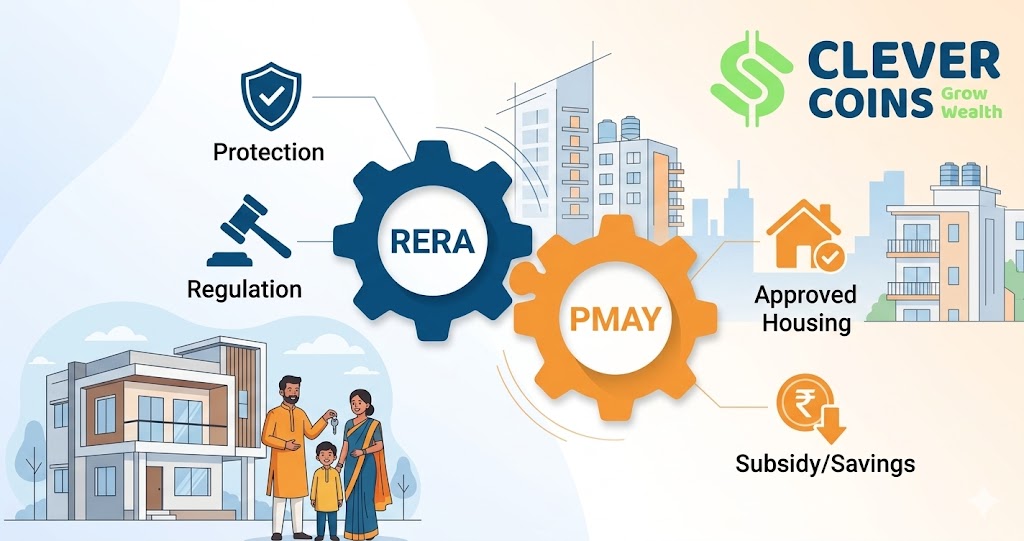
India’s real estate sector has been reshaped by two landmark government initiatives — the Real Estate (Regulation and Development) Act, 2016 (RERA) and the Pradhan Mantri Awas Yojana (PMAY). While RERA ensures transparency, accountability, and protection for homebuyers, PMAY makes homeownership financially accessible for millions of Indians through subsidies and incentives. Together, these two frameworks form the backbone of India’s modern housing ecosystem.
This comprehensive guide explains what RERA and PMAY are, how each works individually, and — most importantly — how they complement and reinforce each other to create a safer, more affordable housing market in India.
What is RERA? A Deep Dive
The Real Estate (Regulation and Development) Act, 2016 — commonly known as RERA — was a watershed moment for Indian real estate. Before RERA, the sector was largely unregulated, leading to widespread fraud, project delays, and financial losses for homebuyers. RERA was enacted to fundamentally change this.
Key Objectives of RERA
- Establish a regulatory authority in each state to oversee real estate projects
- Mandate registration of all real estate projects and agents
- Ensure timely delivery of housing projects
- Promote transparency by requiring builders to disclose complete project information
- Protect the financial interests of homebuyers
- Create a fast-track dispute resolution mechanism
Core Provisions of RERA
- Mandatory project registration: All residential and commercial projects with more than 500 sq. meters or 8 units must be registered with the state RERA authority before any sale or advertisement.
- Escrow Account: Builders must deposit 70% of funds collected from buyers into a designated escrow account, to be used only for construction and land cost. This prevents fund diversion.
- Carpet Area Disclosure: Pricing must be based on carpet area (the actual usable space inside walls), not super built-up area, preventing misleading pricing.
- Defect Liability: Builders are liable to repair structural defects for 5 years after possession.
- Delay Penalty: If a builder delays possession, they must pay interest to buyers at the same rate that buyers pay them.
- Agent Registration: All real estate agents must be registered with RERA, bringing accountability to the brokerage side.
How RERA Benefits Homebuyers
- Full transparency on project status, approvals, and construction progress through online RERA portals
- Legal recourse through RERA tribunals without lengthy court battles
- Protection against arbitrary changes to the project plan
- Right to refund with interest in case of project cancellation or significant delay
- Assurance that the project has all necessary legal clearances before marketing begins
What is PMAY? A Complete Overview
Pradhan Mantri Awas Yojana (PMAY) was launched by the Government of India in June 2015 under the mission “Housing for All by 2022.” This flagship housing scheme aims to provide affordable housing to urban and rural poor, middle-income groups, and economically weaker sections of society.
Two Wings of PMAY
- PMAY-Urban (PMAY-U): Targets people living in urban areas including slum dwellers, EWS (Economically Weaker Section), LIG (Low-Income Group), MIG-I (Middle-Income Group I), and MIG-II (Middle-Income Group II).
- PMAY-Gramin (PMAY-G): Also known as PMAY-Rural, it targets beneficiaries living in rural areas and provides direct financial assistance for constructing pucca houses.
PMAY Credit Linked Subsidy Scheme (CLSS)
The Credit Linked Subsidy Scheme (CLSS) under PMAY is the flagship financial benefit that has made homeownership possible for millions. It provides interest subsidy on home loan EMIs, reducing the overall loan burden significantly.
Category | Annual Income | Loan Amount (Subsidy) | Subsidy Rate | Max Subsidy |
EWS | Up to ₹3 LPA | ₹6 Lakh | 6.5% | ₹2.67 Lakh |
LIG | ₹3–6 LPA | ₹6 Lakh | 6.5% | ₹2.67 Lakh |
MIG-I | ₹6–12 LPA | ₹9 Lakh | 4% | ₹2.35 Lakh |
MIG-II | ₹12–18 LPA | ₹12 Lakh | 3% | ₹2.30 Lakh |
Eligibility Criteria for PMAY
- The beneficiary family must not own a pucca house anywhere in India
- The beneficiary or any family member must not have availed benefits under any central government housing scheme
- The property must be co-owned by the female head of the family (mandatory for EWS/LIG)
- The property must be in a statutory town/city for PMAY-Urban
RERA vs PMAY – Key Differences at a Glance
Parameter | RERA | PMAY |
Primary Goal | Regulation & consumer protection | Affordable housing & financial assistance |
Enacted By | Parliament (Central), implemented by States | Central Government Ministry of Housing |
Year | 2016 | 2015 |
Benefit Type | Legal protection, transparency | Financial subsidy on home loan |
Applicability | All real estate projects | Specific income groups |
Governing Body | State RERA Authority | Ministry of Housing & Urban Affairs |
Dispute Resolution | RERA Tribunal | District/State Housing Boards |
Focus Area | Buyer rights, builder accountability | First-time homebuyers, affordable housing |
How RERA and PMAY Work Together – The Synergy Explained
While RERA and PMAY operate through different mechanisms and are governed by different authorities, they work in powerful synergy to address India’s housing challenges from two critical angles: RERA makes buying safe, and PMAY makes buying affordable. Here is how they complement each other:
1. Trust + Affordability = More Homebuyers
PMAY’s financial subsidies make housing financially accessible to middle and lower-income groups. However, financial accessibility alone is not enough if buyers cannot trust the real estate market. RERA provides that trust by ensuring projects are legally registered, transparently managed, and delivered on time. Together, they remove both the financial and psychological barriers to homeownership.
2. RERA Registration as a Safety Gate for PMAY Beneficiaries
Many banking institutions and housing finance companies that disburse PMAY-CLSS loans now insist that the property being purchased is RERA-registered. This is an informal but increasingly common practice that protects PMAY beneficiaries from investing their subsidized loans into fraudulent or delayed projects. A RERA-registered project gives banks confidence to process PMAY loan applications faster.
3. Escrow Protection Ensures Subsidy Funds Are Used Properly
When a PMAY beneficiary avails the CLSS subsidy, the loan amount is disbursed to the builder. RERA’s escrow account mandate ensures that 70% of these funds go directly into the project’s construction account. This means PMAY funds are far less likely to be misused, diverted, or siphoned off — a critical protection for first-time homebuyers who may not have financial buffers.
4. Transparent Project Information Helps PMAY Applicants Make Informed Choices
RERA mandates that builders upload complete project information — floor plans, approvals, timeline, financial statements — on state RERA portals. PMAY applicants, many of whom are first-time buyers with limited market experience, can use this publicly available data to evaluate whether a project is reliable before applying for their subsidy-linked loan.
5. Timely Possession Protects PMAY EMI Commitments
PMAY beneficiaries commit to home loan EMIs stretched over 15-20 years. A project delay under a pre-RERA scenario could mean paying both rent and EMI for years. RERA’s strict timelines and penalties for delay directly protect PMAY beneficiaries from this double financial burden, making their loan repayment journey smoother.
6. Combined Impact on Housing for All Mission
PMAY’s target of Housing for All required not just financial mechanisms but also a trustworthy market infrastructure. RERA created that infrastructure. State governments, PMAY-implementing agencies, and housing finance companies all benefit from RERA’s framework when channeling PMAY funds, as it reduces default risk, fraud risk, and project failure risk simultaneously.
RERA and PMAY – State-Level Implementation
Both RERA and PMAY are central government initiatives, but they are implemented at the state level with varying degrees of effectiveness. Here is a snapshot of notable state implementations:
State | RERA Status | PMAY Progress |
Maharashtra | MahaRERA – among the most active in India | Major PMAY-Urban beneficiary; lakhs of units sanctioned |
Gujarat | GujRERA – strong online portal | One of top performers in PMAY implementation |
Delhi/NCR | RERA Haryana, UP-RERA active | PMAY-Urban extensively utilized in NCR region |
Tamil Nadu | TNRERA – well-established | PMAY-Gramin & Urban both actively implemented |
Uttar Pradesh | UP-RERA among most active by case volume | Largest state beneficiary of PMAY Urban |
Rajasthan | RERA Rajasthan operational | Significant PMAY rural beneficiary |
Step-by-Step Guide: How to Use RERA and PMAY Together
Step 1: Check Your PMAY Eligibility
- Verify your annual household income (EWS/LIG/MIG-I/MIG-II)
- Confirm you do not own a pucca house anywhere in India
- Check that no family member has taken benefit under a prior government housing scheme
Step 2: Identify a RERA-Registered Project
- Visit your state’s RERA portal (e.g., maharera.mahaonline.gov.in for Maharashtra)
- Search for projects by builder name, location, or project name
- Download the RERA certificate and cross-check the registration number
- Review project approvals, carpet area details, and possession timeline
Step 3: Apply for PMAY-CLSS Through an Approved Bank or HFC
- Approach a PMAY-empaneled bank or Housing Finance Company (HFC) such as SBI, LIC HFL, HDFC, PNB Housing
- Submit PMAY application along with RERA registration details of the property
- The bank verifies RERA status before processing the CLSS subsidy disbursement
Step 4: Track Your Project on RERA Portal
- After booking, regularly monitor construction progress on the RERA portal
- Ensure builder updates are current and match physical progress
- Raise a complaint on RERA portal if you suspect delay or discrepancy
Step 5: Take Possession and Verify Completion Certificate
- Do not accept possession without Occupancy Certificate (OC) or Completion Certificate (CC)
- RERA mandates that the builder must provide these certificates before handover
- Cross-check that the delivered carpet area matches what was promised
Common Misconceptions About RERA and PMAY
Misconception 1: RERA and PMAY are the same
These are two entirely different government initiatives. RERA is a regulatory law that governs how real estate projects are built and sold. PMAY is a welfare scheme that provides financial subsidies to homebuyers. They serve different purposes but can be used together.
Misconception 2: Only poor people can use PMAY
PMAY covers households earning up to Rs. 18 lakhs per year under the MIG-II category. A large segment of the urban middle class qualifies for PMAY benefits and can save significant amounts through the CLSS subsidy.
Misconception 3: RERA-registered projects are delay-free
RERA registration does not guarantee no delay; it guarantees accountability for delays. If a RERA-registered project is delayed, the buyer has legal recourse through the RERA tribunal to seek compensation or a refund.
Misconception 4: PMAY subsidy is a direct cash transfer
PMAY-CLSS is an interest subsidy credited to the loan account, not a direct cash payment. The subsidy amount is calculated upfront and deducted from the principal loan amount at the time of disbursement, reducing your effective EMI.
Impact of RERA and PMAY on Indian Real Estate – Data and Statistics
- Over 1.25 lakh real estate projects registered under RERA across India (as of 2024)
- More than 1.18 crore houses sanctioned under PMAY-Urban since 2015
- Over 75 lakh PMAY homes completed and delivered
- CLSS subsidy of Rs. 1.5+ lakh crore released to beneficiaries under PMAY
- RERA tribunals have resolved over 1 lakh complaints filed by homebuyers
- MahaRERA alone has registered over 45,000 projects and resolved 25,000+ complaints
- Average home loan interest effectively reduced by 2-3% for MIG categories under PMAY-CLSS
Challenges in RERA and PMAY Implementation
Challenges in RERA
- Inconsistent implementation across states — some states have strong RERA authorities while others are weak
- Delays in RERA tribunal hearings in states with high complaint volumes
- Some legacy projects and plotted developments remain outside RERA’s purview
- Lack of awareness among buyers in Tier-2 and Tier-3 cities
Challenges in PMAY
- Last-mile connectivity issues in rural areas under PMAY-G
- Lack of awareness among eligible beneficiaries, especially in semi-urban areas
- Delays in subsidy credit due to documentation issues at bank level
- PMAY-Urban Extended deadline pressure affecting project completion quality
Future of RERA and PMAY in India
The government has extended PMAY deadlines and expanded its scope multiple times, indicating a long-term commitment to affordable housing. RERA, meanwhile, continues to evolve with stricter penalties and faster digital dispute resolution. Future developments expected include:
- Integration of RERA and PMAY databases for seamless verification
- Digital RERA certificates linked to loan disbursement systems of banks
- Expansion of PMAY to cover more income groups and urban rental housing
- Strengthening of RERA at district level for Tier-2 and Tier-3 city coverage
- Introduction of unified real estate portals combining RERA, PMAY, and stamp duty data
Conclusion
RERA and PMAY are not competing frameworks — they are complementary pillars of India’s housing reform. RERA makes the real estate market trustworthy, and PMAY makes it financially accessible. For a first-time homebuyer in India, understanding and leveraging both is not just smart — it is essential.
By ensuring your property is RERA-registered and your purchase qualifies for PMAY subsidies, you protect yourself legally, reduce your financial burden, and make one of the most important investments of your life with confidence. India’s dream of Housing for All depends on buyers, builders, banks, and policymakers using both these tools together — and the results so far show that the combination is working.