Why Capital Gains Tax on Property Matters in 2026
Selling a property in India is not just a financial transaction — it is a tax event. Whether you are selling a flat, plot, commercial space, or agricultural land, the profit you earn — called Capital Gains — is subject to income tax. And with significant changes introduced in Union Budget 2024 (effective FY 2024-25 onwards) that continue to shape FY 2025-26 (AY 2026-27), understanding how capital gains tax works on property has never been more critical.
Many property sellers in India either overpay their capital gains tax due to ignorance or land in trouble with the Income Tax Department due to incorrect reporting. This comprehensive guide by CleverCoins covers everything — from the basics of capital gains, LTCG and STCG rates, the impact of the Budget 2024 changes, to powerful exemptions under Section 54, Section 54F, and Section 54EC that can legally reduce or even eliminate your tax liability.
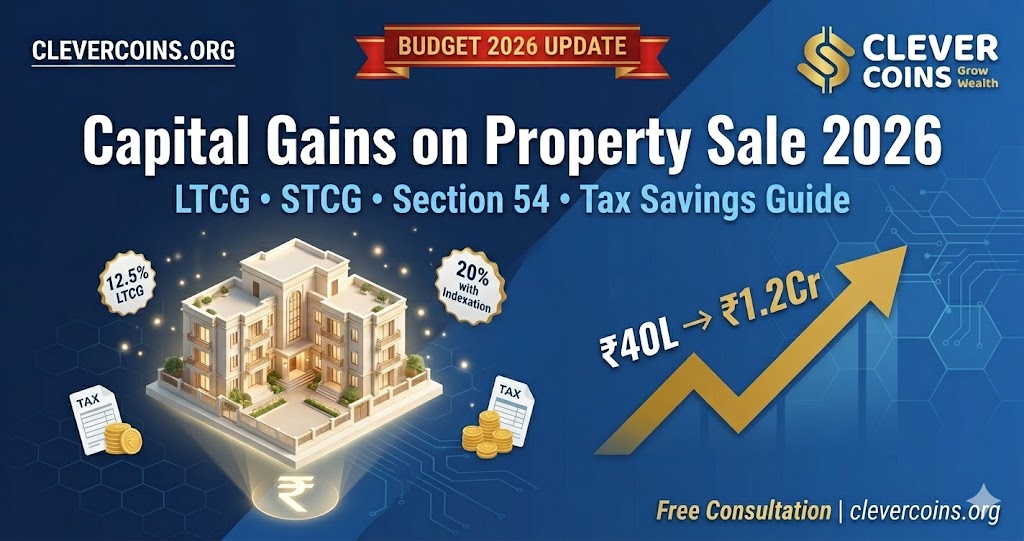
💡 Key Budget 2024 Change: LTCG on property sale is now taxed at 12.5% WITHOUT indexation benefit (if held for more than 24 months). Taxpayers can optionally choose 20% WITH indexation for properties acquired before 23rd July 2024. This guide explains both scenarios in detail. |
What Are Capital Gains on Property?
Capital Gains are the profit earned from the sale (transfer) of a capital asset. When you sell a property at a price higher than what you originally paid (plus associated costs), the difference is treated as Capital Gains and is taxable under the Income Tax Act, 1961.
The formula is simple:
Capital Gains = Sale Consideration − (Cost of Acquisition + Cost of Improvement + Cost of Transfer) For LTCG (pre-July 2024): Indexed Cost replaces actual cost |
Types of Capital Gains
Capital Gains on property are classified into two types based on the holding period:
Type | Short-Term Capital Gain (STCG) | Long-Term Capital Gain (LTCG) |
Holding Period | 24 months or less | More than 24 months |
Tax Rate | Slab rate (as per ITR) | 12.5% without indexation OR 20% with indexation (pre-July 2024) |
Indexation Benefit | Not available | Available for property acquired before 23 July 2024 |
Exemptions Available | Limited (Section 54B for agricultural land) | Section 54, 54F, 54EC available |
Reporting | Schedule CG in ITR | Schedule CG in ITR |
📌 Important: The holding period of 24 months applies to immovable property (land and building). For other capital assets, the period differs. This blog focuses exclusively on immovable property transactions. |
Budget 2024 Changes: What Changed for Property Sellers?
The Union Budget presented on 23rd July 2024 brought landmark changes to capital gains taxation on property that every seller must understand for FY 2025-26 (AY 2026-27):
1. LTCG Rate Reduced from 20% to 12.5%
The LTCG tax rate on property has been reduced from 20% to 12.5%. However, this comes at the cost of removing the indexation benefit for properties acquired on or after 23rd July 2024.
2. Indexation Benefit Restricted
For properties acquired BEFORE 23rd July 2024, taxpayers have a one-time option to choose between:
- Pay LTCG at 12.5% WITHOUT indexation, OR
- Pay LTCG at 20% WITH indexation benefit (using Cost Inflation Index)
The taxpayer must calculate tax under BOTH options and choose the one that results in lower tax liability.
3. Holding Period Unchanged
The holding period of 24 months for property to qualify as a long-term capital asset remains unchanged.
4. Surcharge & Cess Remain Applicable
The 10% surcharge (for income above ₹50 lakh) and 4% Health & Education Cess continue to apply on top of the LTCG tax rate.
Scenario | Old Regime (Pre-Budget 2024) | New Regime (Post 23 July 2024) |
LTCG Rate | 20% with indexation | 12.5% without indexation |
Indexation for Pre-July 2024 property | Always available | Optional — choose lower of both |
Indexation for Post-July 2024 property | N/A | NOT available |
STCG Rate | Slab rate | Slab rate (unchanged) |
⚠️ CleverCoins Advisory: If you purchased property before July 2024, always compute tax under BOTH options before filing your ITR. In many cases, the 20% with indexation option still results in lower tax — especially for older properties with significant price appreciation. |
Understanding Indexation and Cost Inflation Index (CII)
Indexation is a benefit that adjusts the original cost of a property for inflation using the Cost Inflation Index (CII) notified by the Income Tax Department each year. This effectively increases your cost of acquisition, reducing the taxable capital gain.
Indexed Cost of Acquisition Formula:
Indexed Cost = Actual Cost × (CII of Year of Sale ÷ CII of Year of Purchase) |
Cost Inflation Index (CII) Table — Key Reference Years
Financial Year | CII Value | Notes |
2001-02 | 100 | Base Year |
2010-11 | 167 | Reference |
2015-16 | 254 | Reference |
2020-21 | 301 | Reference |
2022-23 | 331 | Reference |
2023-24 | 348 | Reference |
2024-25 | 363 | Latest notified |
2025-26 | TBD — Expected ~374 | To be notified by CBDT |
📌 Base Year Note: If property was acquired before 1st April 2001, the taxpayer can use the Fair Market Value (FMV) as on 1st April 2001 as the cost of acquisition for indexation purposes. |
Capital Gains Calculation — Detailed Examples
Example 1: LTCG — Property Acquired Before July 2024 (With vs Without Indexation)
Mr. Verma bought a flat in 2012-13 for ₹40 lakh (CII: 200). He sells it in 2025-26 for ₹1.20 crore (CII: ~374).
Option A: 12.5% WITHOUT Indexation | Option B: 20% WITH Indexation |
Sale Price: ₹1,20,00,000 | Sale Price: ₹1,20,00,000 |
Cost: ₹40,00,000 | Indexed Cost = 40L × (374/200) = ₹74,80,000 |
Capital Gain: ₹80,00,000 | Capital Gain: ₹45,20,000 |
Tax @ 12.5%: ₹10,00,000 | Tax @ 20%: ₹9,04,000 |
Better Option? | ✅ Option B (₹9.04L) is better here by ~₹96,000 |
Example 2: LTCG — Property Acquired After July 2024
Ms. Kapoor buys a plot in August 2024 for ₹60 lakh. She sells it in 2027 for ₹95 lakh.
- No indexation available (acquired after 23 July 2024)
- Capital Gain = ₹95L − ₹60L = ₹35,00,000
- LTCG Tax @ 12.5% = ₹4,37,500
- Add: 4% Cess = ₹17,500. Total Tax = ₹4,55,000
Example 3: Short-Term Capital Gain
Mr. Shah buys a house in June 2024 for ₹80 lakh and sells it in November 2025 (held < 24 months) for ₹1.00 crore.
- STCG = ₹1 crore − ₹80 lakh = ₹20,00,000
- Taxed at slab rate. If Mr. Shah is in the 30% bracket: Tax = ₹6,00,000
- Plus 4% Cess = ₹24,000. Total = ₹6,24,000
This shows why holding property for more than 24 months significantly reduces the tax burden.
Sale Consideration vs Stamp Duty Value: Section 50C
Under Section 50C, if the actual sale consideration of a property is LESS than the Stamp Duty Value (SDV) adopted by the state government, the SDV is deemed to be the full value of consideration for computing capital gains.
Budget 2021 amendment: If the SDV does not exceed 110% of the actual sale consideration, the actual consideration is used. The safe harbour threshold is 10%.
⚠️ Example: You sell a property for ₹90 lakh. The SDV is ₹1.00 crore. Since SDV exceeds 110% of ₹90L (i.e., ₹99L), and ₹1 crore > ₹99L, capital gains must be computed on ₹1 crore, not ₹90 lakh. |
Allowable Deductions While Computing Capital Gains
You can deduct the following costs from the sale consideration to arrive at net capital gains:
Deductible Cost | Details |
Cost of Acquisition | Original purchase price (indexed for LTCG with old regime) |
Cost of Improvement | Capital expenditure on improvements (indexed; only for LTCG) |
Cost of Transfer | Brokerage, commission, legal fees, stamp duty paid on sale |
Registration Charges | Paid at the time of purchase — included in acquisition cost |
Home Loan Interest (Sec 24) | If claimed as deduction earlier, cannot be added to cost of acquisition again |
💡 Important Restriction: If you have claimed deduction on home loan principal under Section 80C in earlier years, the cost of acquisition must be reduced by such amount for computing capital gains. This prevents double benefit. |
How to Save Capital Gains Tax — Key Exemptions Under IT Act
The Income Tax Act provides several powerful exemptions that can legally reduce or completely eliminate your capital gains tax liability on property sale. Here are the major ones:
1. Section 54 — Exemption on LTCG from Residential House Property
Parameter | Details |
Applicable Asset Sold | Residential house property (land + building) |
Eligible Taxpayer | Individual or HUF only |
Investment Required | Purchase of one new residential house in India |
Time Limit — Purchase | 1 year before OR 2 years after the date of sale |
Time Limit — Construction | Within 3 years of the date of sale |
Exemption Amount | Lower of: LTCG amount OR investment in new property |
Cap on Investment | Max ₹10 crore (Budget 2023 amendment) — excess not eligible |
Lock-in Period | New property cannot be sold for 3 years; else gains are taxable |
2. Section 54F — Exemption on LTCG from Any Capital Asset (Other Than Residential House)
Parameter | Details |
Applicable Asset Sold | Any long-term capital asset EXCEPT residential house (e.g., plot, commercial property) |
Eligible Taxpayer | Individual or HUF only |
Investment Required | Full net consideration must be invested in ONE new residential house |
Time Limit | Same as Section 54 (1 year before / 2 years after / 3 years for construction) |
Proportionate Exemption | If partial investment: Exemption = LTCG × (Amount Invested ÷ Net Consideration) |
Condition | Taxpayer must NOT own more than 1 residential house at the time of sale (other than the new one) |
Cap on Investment | Max ₹10 crore (Budget 2023) |
3. Section 54EC — Exemption by Investing in Specified Bonds
Parameter | Details |
Applicable Asset Sold | Any long-term immovable property (land or building or both) |
Investment Required | NHAI or REC bonds (Section 54EC bonds) |
Time Limit | Within 6 months from the date of transfer |
Maximum Investment | ₹50 lakh in a financial year (₹1 crore across two FYs if sale straddles year-end) |
Lock-in Period | 5 years from date of acquisition of bonds |
Exemption Amount | Lower of: LTCG OR amount invested in bonds (capped at ₹50L) |
Interest on Bonds | Taxable as income from other sources at slab rate |
4. Section 54B — Exemption on LTCG from Agricultural Land
- Applicable when agricultural land (urban or rural) is sold and the proceeds are reinvested in another agricultural land
- Available to Individual and HUF taxpayers
- New agricultural land must be purchased within 2 years from the date of sale
- New land must not be sold within 3 years
- Exemption = Lower of LTCG or investment in new agricultural land
Capital Gains Account Scheme (CGAS) — An Important Safety Net
If you are unable to invest in a new property or bonds before the ITR filing due date, you can park the capital gains amount in a designated Capital Gains Account under the Capital Gains Account Scheme (CGAS) with any nationalised bank. The investment from CGAS can then be made within the stipulated time limit (Section 54/54F/54EC) to claim exemption.
⚠️ Caution: Amount deposited in CGAS but NOT utilised for the specified purpose within the time limit becomes taxable as capital gains in the year the time limit expires. |
Quick Comparison: All Capital Gains Exemption Sections
Section | Asset Sold | Invest In | Time Limit | Max Limit |
54 | Residential house | New residential house | 1yr before / 2yr after / 3yr (construction) | ₹10 crore |
54F | Any LTCA (not res. house) | New residential house | Same as Section 54 | ₹10 crore |
54EC | Any immovable property (LT) | NHAI / REC bonds | Within 6 months of sale | ₹50 lakh/yr |
54B | Agricultural land | New agricultural land | Within 2 years of sale | No limit |
Advance Tax on Capital Gains — Avoid Interest Under Section 234C
Capital gains from property sale are subject to Advance Tax if the total tax liability exceeds ₹10,000 in a financial year. Here is how it works:
Due Date | Advance Tax Instalment | Notes for Capital Gains |
15th June | 15% of tax | Capital gains before 15 June — include in this instalment |
15th September | 45% of tax | Capital gains before 15 Sep — include proportionally |
15th December | 75% of tax | Adjust all gains up to 15 Dec here |
15th March | 100% of tax | All remaining capital gains tax to be paid |
For capital gains arising after 15th March, the entire tax can be paid as advance tax by 31st March of the same FY without interest under Section 234C.
How to Report Capital Gains in Income Tax Return (ITR)
Capital gains from property sale must be reported in Schedule CG of the ITR. The correct ITR form depends on your income profile:
ITR Form | Who Should Use It? |
ITR-2 | Individuals/HUF with capital gains (no business income) |
ITR-3 | Individuals/HUF with capital gains AND business/professional income |
- Report sale consideration, cost of acquisition, cost of improvement, and cost of transfer in Schedule CG
- Claim exemption under Section 54/54F/54EC in Schedule CG itself
- Disclose CGAS deposit details if applicable
- Reconcile with Form 26AS / AIS to ensure TDS deducted by buyer is reflected
- File ITR before 31st July (or extended deadline) of the relevant AY
Capital Gains Tax for NRIs Selling Property in India
Non-Resident Indians (NRIs) selling property in India face an additional layer of complexity:
- Buyer is required to deduct TDS at 12.5% (LTCG) or 30% (STCG) under Section 195 — much higher than the 1% applicable under Sec 194-IA for resident-to-resident sales
- NRIs can apply for a Lower TDS Certificate (Form 13) from the Income Tax Officer if the actual tax liability is lower
- Exemptions under Section 54, 54F, and 54EC are available to NRIs as well
- Sale proceeds must be repatriated through an NRO account; repatriation limit is USD 1 million per financial year
- FEMA regulations apply in addition to income tax provisions
💡 NRI Tip: NRI sellers should engage a tax consultant well before the property sale to plan TDS deduction, apply for Form 13 if needed, and ensure FEMA-compliant repatriation of sale proceeds. |
TDS Applicable on Property Sale — Section 194-IA vs Section 195
Aspect | Resident Seller (Sec 194-IA) | NRI Seller (Sec 195) |
TDS Rate (LTCG) | 1% of consideration | 12.5% of sale value |
TDS Rate (STCG) | 1% of consideration | 30% of sale value |
Threshold | ₹50 lakh and above | No threshold — any value |
Lower TDS Certificate | Not applicable | Available via Form 13 |
Form to be filed | Form 26QB by buyer | Form 27Q by buyer |
Common Mistakes to Avoid When Reporting Capital Gains on Property
- Not accounting for improvement costs (renovation, interiors) that can reduce taxable gain
- Missing the Section 54EC bond investment deadline of 6 months — no extension is permitted
- Investing in CGAS and then forgetting to withdraw and reinvest within time limit
- Claiming Section 54 exemption when already owning more than one house (conditions not met)
- Not filing ITR to claim refund of excess TDS deducted by buyer
- Reporting wrong cost of acquisition — especially for inherited or gifted properties
- Not disclosing property sale in ITR even if tax is NIL due to exemptions
- Missing advance tax deadlines leading to interest under Section 234B/234C
- Using wrong ITR form (ITR-1 instead of ITR-2) which doesn’t have Schedule CG
Capital Gains on Inherited or Gifted Property
Inherited Property:
When a property is received through inheritance, the cost to the previous owner is considered the cost of acquisition for the current owner. If the property was acquired before 1st April 2001, Fair Market Value (FMV) as of 1st April 2001 can be used as the cost.
Holding period also includes the period the previous owner held the property — so an inherited property held for years by the deceased will qualify as long-term from day one of inheritance.
Gifted Property:
Similarly, for gifted properties, the original cost to the donor is the cost of acquisition for the recipient. The holding period of the donor is also included to determine STCG vs LTCG classification.
How CleverCoins Helps You Save Maximum on Capital Gains Tax
Capital gains tax planning for property is not a last-minute affair — it requires careful advance planning. CleverCoins offers end-to-end capital gains tax services including:
- Detailed calculation of LTCG under both indexation and non-indexation options
- Assessment of eligibility and optimisation under Section 54, 54F, and 54EC
- Guidance on CGAS account for parking gains safely before reinvestment
- ITR-2/ITR-3 preparation with complete Schedule CG reporting
- Advance tax computation and reminder scheduling
- Capital gains advisory for NRIs selling Indian property (Form 13, Section 195, repatriation)
- Notice handling and Income Tax Department correspondence
📞 Get a FREE Capital Gains Tax Consultation at CleverCoins | www.clevercoins.org | We help you keep more of what you earn. |
Conclusion
Selling property in India triggers one of the most complex areas of income tax — Capital Gains. With the landmark Budget 2024 changes, the introduction of the 12.5% LTCG rate, the removal of indexation for newer properties, and powerful exemptions still available under Sections 54, 54F, and 54EC, every property seller must approach this with knowledge and advance planning.
Whether you are an individual, HUF, or NRI, the correct computation, timely ITR filing, proper use of exemptions, and advance tax payment can save you lakhs of rupees. CleverCoins is your trusted partner every step of the way — making Indian taxation simple, transparent, and stress-free.
Disclaimer: This blog is for informational purposes only, updated as of June 2026. Tax laws are subject to change. Please consult a qualified tax professional for personalised advice.