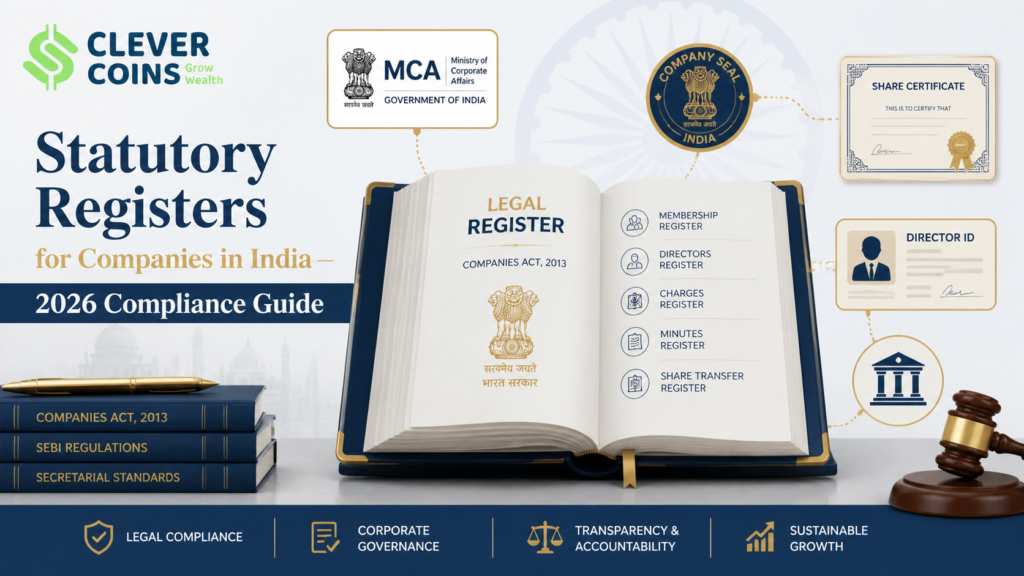
In 2026, with the Ministry of Corporate Affairs (MCA) intensifying its compliance scrutiny and digital audits, it has become more critical than ever for businesses to maintain these registers accurately and make them available for inspection whenever required. Failure to comply can lead to heavy penalties, director disqualification, and even criminal prosecution.
This comprehensive guide breaks down everything you need to know about statutory registers for companies in India — what they are, which ones are mandatory, where and how to maintain them, and the penalties for non-compliance.
What Are Statutory Registers?
Statutory registers are official records that every company incorporated under the Companies Act, 2013 is legally required to maintain. These registers contain crucial information about a company’s shareholders, directors, charges, loans, contracts, investments, and other vital corporate activities.
Unlike operational records (such as accounting ledgers or HR files), statutory registers are specifically mandated by law. They must be:
- Maintained at the Registered Office of the company (or another approved location)
- Updated within prescribed time limits after every relevant transaction
- Made available for inspection by members, creditors, and government authorities
- Preserved for the period specified under the Companies Act, 2013
These registers serve as a source of truth for regulators, investors, and stakeholders. They ensure accountability and transparency in corporate operations across India.
Legal Basis: Companies Act, 2013
The obligation to maintain statutory registers primarily derives from the Companies Act, 2013 and the Companies (Management and Administration) Rules, 2014. Key sections include:
Section / Rule | Subject Matter |
Section 88 | Register of Members, Debenture Holders & Other Security Holders |
Section 85 | Index of Members and Debenture Holders |
Section 170 | Register of Directors and Key Managerial Personnel (KMP) |
Section 184 | Register of Contracts/Arrangements with Related Parties |
Section 186 | Register of Investments |
Section 187 | Register of Monies/Securities |
Section 189 | Register of Contracts in which Directors have Interest |
Section 85 & Rule 3 | Index of Members |
Section 85 & Rule 7 | Foreign Register (for global companies) |
Chapter VI (Sections 77-87) | Charges — Registration and Satisfaction |
Section 160, Rule 16 | Register of Director Shareholdings |
Section 143 | Auditor’s Right to inspect registers |
Section 91 | Power to Close Register of Members / Security Holders |
Types of Statutory Registers: Detailed Breakdown
Below is a detailed overview of all the statutory registers that a company must maintain in India as of 2026:
1. Register of Members (Section 88)
This is arguably the most fundamental statutory register. It contains the complete record of all shareholders of the company.
Key Information Recorded:
- Name, address, and occupation of each member
- Date of becoming a member / date of cessation
- Number and class of shares held
- Amount paid or agreed to be paid on shares
- Folio number and distinctive share numbers
For companies having share capital, this register must be maintained in Form MGT-1. For companies without share capital, it is maintained in Form MGT-2. Any company must update the register within 7 days of the AGM if any changes are made.
2. Register of Debenture Holders / Other Security Holders (Section 88)
Similar to the Register of Members, this register records details of all debenture holders and holders of other securities (bonds, warrants, etc.).
Key Contents:
- Name and address of each debenture/security holder
- Date of becoming a holder and date of cessation
- Amount of debentures/securities held
- Date of transfer and details of consideration paid
3. Register of Charges (Section 81)
Every company must maintain a Register of Charges, recording all mortgages, charges, and encumbrances on the company’s assets.
This register is maintained in Form CHG-7 and must include:
- Date of creation of the charge
- Short particulars of the property charged
- Amount secured by the charge
- Name of the charge-holder (lender/bank/creditor)
- Date of satisfaction of the charge (when loan is repaid)
Filing Obligation: Every charge must be registered with the Registrar of Companies (ROC) within 30 days of its creation. Late registration attracts additional fees. As of 2026, the penalty for non-registration can go up to ₹25 lakhs for the company and ₹1 lakh per day for continuing default by officers.
4. Register of Directors and Key Managerial Personnel (Section 170)
This register maintains a record of all Directors and Key Managerial Personnel (KMPs) of the company, along with their shareholding in the company and its holding, subsidiary, and associate companies.
Maintained in Form MBP-4, it must include:
- Name and address of each director/KMP
- Date of appointment and cessation
- DIN (Director Identification Number)
- Details of shares/debentures held by the director in the company or related entities
- Details of offices held in other companies
5. Register of Contracts / Arrangements (Section 189)
All contracts in which directors are directly or indirectly interested must be recorded in this register, maintained in Form MBP-4.
Contents Include:
- Name of the director/partner/relative with interest
- Nature of concern or interest
- Date of the contract/arrangement
- The value of the transaction
Every director must disclose their interest in writing (Form MBP-1) to be placed in the register. This prevents conflicts of interest and ensures transparency in related-party transactions.
6. Register of Loans and Investments (Section 186)
Companies making loans, giving guarantees, providing securities, or making investments must maintain a register of all such transactions.
Details Required:
- Name of the entity in which loan/investment is made
- Nature and purpose of the loan/investment
- Amount involved (in Indian Rupees)
- Date of the transaction
- Terms and conditions, rate of interest
Threshold: Section 186 applies when a company’s aggregate of loans, guarantees, securities, and investments exceeds 60% of its paid-up capital plus free reserves, or 100% of free reserves — whichever is higher. Board approval is mandatory for such transactions in 2026.
7. Register of Related Party Transactions (Section 184)
Every company must maintain a register where directors disclose their directorships, partnerships, or substantial interests in other companies, firms, or body corporates.
All related-party transactions must be reported to the Board at every meeting. This register is central to compliance with Section 177 (Audit Committee oversight) and Section 188 (Related Party Transactions) in 2026.
8. Register of Transfer and Transmission of Shares
This register records all transfers and transmissions of shares. While not a single standalone section, it is mandated under the Articles of Association and the Companies Act, 2013.
It includes:
- Date of lodgement of the transfer form
- Name and address of the transferor and transferee
- Number and class of shares transferred
- Date of registration of the transfer
- Reasons for rejection (if any)
9. Register of Renewed and Duplicate Share Certificates
When share certificates are renewed (after subdivision, consolidation, or defacement) or duplicate certificates are issued (on loss of original), entries must be made in this register, maintained in Form SH-2.
It records the old certificate number, new certificate number, reason for renewal/duplication, and the date of issue.
10. Register of Sweat Equity Shares
Companies that issue Sweat Equity Shares (shares issued to employees or directors at a discount or for consideration other than cash) must maintain a separate register in Form SH-3. This register tracks employee stock options, director shares, and performance-linked equity grants.
11. Register of Employee Stock Options (ESOP Register)
Where a company has introduced an ESOP plan, a separate register must be maintained in Form SH-6. This applies particularly to listed companies and startups that offer equity to employees.
ESOP Register includes details of grant date, exercise price, vesting schedule, and forfeiture particulars.
12. Register of Shares / Securities Bought Back
Companies undertaking buyback of shares (under Section 68) must maintain a register in Form SH-10 recording the details of shares or securities bought back. This must include the date, price per share, total amount paid, and method of buy-back (open market/tender offer).
13. Minutes Books (Board and General Meetings)
Every company must maintain Minutes Books under Section 118. These record the proceedings of:
- Board of Directors Meetings (including Committee Meetings)
- Annual General Meetings (AGM)
- Extraordinary General Meetings (EGM)
- Class Meetings
Minutes must be signed by the Chairperson within 30 days of each meeting. They serve as legal evidence of decisions taken. Digital signatures are permissible in 2026 for private companies using video conferencing.
14. Directors’ Attendance Register
A register must be maintained recording the attendance of directors and KMPs at every Board and Committee meeting. This is critical evidence for quorum compliance and for SEBI reporting in listed companies.
15. Where Must Statutory Registers Be Maintained?
Under Section 94 of the Companies Act, 2013, statutory registers must be kept at:
- The Registered Office of the company — this is the default requirement
- Any other place in India where more than one-tenth of the members reside, subject to prior approval via a Special Resolution passed at the General Meeting and prior intimation to the ROC in Form MGT-3
Important 2026 Update: The MCA has encouraged and in many cases mandated digital maintenance of certain registers, especially for companies with more than 1,000 members. Companies may maintain electronic registers using software/tools certified by MCA, provided the data is accessible at the registered office at all times.
16. Right of Inspection of Statutory Registers
Statutory registers are not purely internal documents — various stakeholders have the legal right to inspect them:
Who Can Inspect | Register | Inspection Fee (2026) |
Any Member | Register of Members | Free / Nominal (as per AOA) |
Any Member | Register of Debenture Holders | Free |
Any Person (public) | Register of Charges | Free (ROC public records) |
Any Director | Minutes Books | Free |
Any Member | Register of Directors | Free |
Creditors / Debenture Holders | Register of Charges | Free |
Registrar / NCLT | All Statutory Registers | No fee — statutory right |
SEBI (Listed Companies) | All Registers | No fee — regulatory right |
The registers must be made available during business hours for a minimum of 2 hours each business day. A company can charge a fee not exceeding ₹10 per page for providing extracts/copies, as per Rule 14 of the Companies (Management and Administration) Rules, 2014.
17. Penalties for Non-Compliance: 2026 Update
The Companies (Amendment) Act, 2019 and subsequent MCA notifications have significantly increased penalties for non-maintenance of statutory registers. Here is an updated penalty schedule for 2026:
Violation | Penalty on Company | Penalty on Officers |
Failure to maintain Register of Members (Sec 88) | ₹50,000 + ₹1,000/day of default | ₹50,000 + ₹1,000/day of default |
Failure to maintain Register of Charges (Sec 81) | Up to ₹25,00,000 | Up to ₹1,00,000/day |
Failure to allow inspection (Sec 94) | ₹1,00,000 + ₹5,000/day of default | ₹25,000 + ₹5,000/day |
Non-disclosure by Director (Sec 189) | ₹25,000 per default | ₹25,000 per default |
Late filing of charge (Sec 77) | Additional fees + adjudication by ROC | Prosecution risk |
Non-maintenance of Minutes (Sec 118) | ₹25,000 | ₹5,000 each officer in default |
Non-compliance by OPC/Small Co. | Reduced penalty (50% of above) | Reduced penalty (50% of above) |
Important: In addition to financial penalties, officers in default (including directors, company secretary, CFO) may face prosecution under Section 447 (Fraud) if non-maintenance is found to be intentional or fraudulent. This can lead to imprisonment of up to 10 years and fines up to ₹50 crores in the most serious cases.
18. Digital Maintenance of Statutory Registers in 2026
The MCA has progressively digitised corporate compliance infrastructure. In 2026, the following digital provisions apply:
- Electronic Registers: Companies may maintain registers in electronic form (Section 120), provided the data is stored in India and accessible at the registered office.
- Authenticity: Electronic registers must be authenticated using a Digital Signature Certificate (DSC) of the authorised officer (usually the Company Secretary or Director).
- Backup: A physical printout of the register must be available at the registered office at all times for inspection purposes.
- MCA21 v3 Portal: As of 2025-2026, the MCA21 Version 3 portal requires companies to upload updated statutory data at the time of filing Forms such as MGT-7, DIR-12, and MBP-4.
- XBRL Filing: Companies with turnover above ₹500 crore or having more than 500 shareholders must file financial data in XBRL format, which is linked to statutory register data.
19.Role of Company Secretary in Maintaining Statutory Registers
For companies required to appoint a whole-time Company Secretary (CS) — primarily companies with paid-up share capital of ₹10 crore or more as of 2026 — the CS bears primary responsibility for:
- Ensuring timely updation of all statutory registers
- Authenticating entries with their digital or physical signature
- Filing relevant forms with the ROC in a timely manner
- Providing certified extracts to members, creditors, or regulators on request
- Advising the Board on compliance obligations at every Board Meeting
- Maintaining minutes and the attendance register
For companies not required to appoint a whole-time CS, a Practising Company Secretary (PCS) or the Director (usually CFO or MD) takes on this responsibility. Outsourcing to a CS firm is a common and compliant practice in 2026.
20.Annual Compliance Checklist for Statutory Registers (2026)
Here is a handy checklist that every company should follow each year:
Task | Frequency | Deadline / Trigger |
Update Register of Members after share transfer | As and when it occurs | Within 7 days of Board approval |
File charge creation with ROC (Form CHG-1) | As and when charge is created | Within 30 days of creation |
File DIR-12 for director changes | As and when change occurs | Within 30 days of change |
Update Register of Contracts (Form MBP-4) | Every Board Meeting | Before/During the Board Meeting |
Record minutes of Board Meetings | Every Board Meeting | Within 30 days of meeting |
Record minutes of General Meetings (AGM/EGM) | Every GM | Within 30 days of meeting |
Close Register of Members (if applicable) | Annual / as needed | As per Board resolution |
File Annual Return (MGT-7) | Annual | Within 60 days of AGM |
Issue annual disclosure (MBP-1) by directors | Annual (first Board Meeting) | First Board Meeting of FY |
Update Register of KMPs | As and when change occurs | Within 15 days of change |
21. Statutory Registers for Small Companies and OPCs
Recognising the compliance burden on smaller entities, the MCA has provided certain relaxations for Small Companies and One Person Companies (OPCs) in 2026:
Requirement | Large Companies | Small Companies / OPCs |
Whole-time Company Secretary | Mandatory (if paid-up capital ≥ ₹10 Cr) | Not mandatory (CS services may be outsourced) |
Number of Board Meetings per year | Minimum 4 | Minimum 2 (held every 90 days) |
Annual Return certification by CS | Mandatory | Self-certification by Director allowed |
Penalty for default | Full penalty as per Act | 50% of penalty applicable |
Cash Flow Statement in financials | Mandatory | Not mandatory |
Internal Audit | Based on turnover/borrowing thresholds | Generally not required |
As of 2026, a Small Company is defined as a company with a paid-up share capital not exceeding ₹4 crore and a turnover not exceeding ₹40 crore in the most recent financial year. OPCs are those with a single member and a paid-up capital not exceeding ₹50 lakhs.
22. Common Mistakes Companies Make with Statutory Registers
- Not updating the register promptly after a share transfer — many companies delay this beyond the 7-day window, exposing themselves to penalty.
- Missing director disclosures (Form MBP-1) at the first Board meeting of each financial year, leading to lapses in the Register of Contracts.
- Maintaining registers at a location other than the registered office without filing Form MGT-3 or passing a Special Resolution.
- Storing registers in soft copies only (e.g., cloud storage) without a physical printout or an MCA-approved electronic format with DSC.
- Confusing the Register of Charges with loan documentation — the register must be updated even for informal security arrangements or pledges.
- Failing to close the Register of Members before declaring a dividend or conducting an AGM, leading to disputes over eligibility.
- Not preserving old or closed registers — Companies Act requires registers to be preserved permanently or for a specific period even after closure.
23. How Long Must Statutory Registers Be Preserved?
Under the Companies Act, 2013 and applicable rules:
Register | Preservation Period |
Register of Members | Permanently (as long as company exists) |
Register of Charges | Permanently |
Register of Directors / KMPs | Permanently |
Minutes Books (Board & GM) | Permanently |
Register of Contracts | 8 years from the date of entry |
Register of Loans & Investments | 8 years from the date of entry |
Transfer and Transmission Register | Permanently (part of Member Register) |
Register of ESOP | 3 years after full exercise / expiry |
Buyback Register (SH-10) | 8 years from completion of buyback |
24. Statutory Registers and Company Audits
The Statutory Auditor has a right under Section 143 of the Companies Act, 2013 to inspect all statutory registers at any time during business hours. Additionally, the Secretarial Auditor (a Practising Company Secretary) is mandated for:
- Listed companies
- Public companies with paid-up capital of ₹10 crore or more
- Public companies with turnover of ₹250 crore or more
- Companies with outstanding loans/borrowings from banks or public financial institutions of ₹100 crore or more
The Secretarial Audit Report (Form MR-3), filed with the Annual Report, specifically includes verification of statutory register maintenance. Any non-compliance is highlighted and becomes a part of the company’s public filing, significantly impacting its reputation and investor confidence.
25. Best Practices for Maintaining Statutory Registers in 2026
- Use dedicated company law compliance software (like Cleartax CS, LexComply, or similar MCA-integrated tools) to maintain and update registers digitally.
- Appoint a dedicated Company Secretary or hire a CS firm on a retainer basis to handle updates and filings.
- Conduct an internal compliance audit of all statutory registers every quarter — not just at year-end.
- Keep a compliance calendar for all ROC deadlines (charge registration, director changes, annual filings).
- Store physical registers in a fireproof cabinet at the registered office with restricted access.
- Maintain a digital backup (DSC-authenticated) on a secure cloud/server in India, as required under Section 120.
- Ensure all directors submit Form MBP-1 (disclosure of interest) at the first Board Meeting of every financial year.
- Document the close of registers (when applicable) by recording the Board resolution and ROC intimation.
26. Conclusion
Statutory registers are not merely paperwork — they are the legal foundation of a well-governed company. In 2026, with MCA intensifying compliance enforcement, digital audit trails, and SEBI tightening disclosure norms for listed entities, the maintenance of statutory registers has become even more critical.
Whether you are a startup, a private limited company, or a large public corporation, investing in proper statutory register maintenance is investing in your company’s legal integrity, investor trust, and long-term sustainability.
When in doubt, always consult a qualified Company Secretary or corporate law professional to ensure your registers are compliant, up-to-date, and legally defensible.