Why the P/B Ratio Still Matters in 2026
In a world overflowing with stock market indicators, ratios, and analytical tools, one metric has stood the test of time since the era of Benjamin Graham — the Price to Book Value Ratio, commonly known as the P/B Ratio. Whether you are a seasoned portfolio manager or a first-time retail investor, understanding the P/B ratio can fundamentally change how you evaluate stocks and uncover hidden investment opportunities.
At CleverCoins, we believe that financial literacy is the foundation of wealth creation. That is why we have put together this exhaustive, easy-to-understand guide that covers every aspect of the P/B ratio — from its basic definition to its most nuanced real-world applications.
“The stock market is filled with individuals who know the price of everything, but the value of nothing.” — Phillip Fisher
By the end of this guide, you will know exactly what the P/B ratio is, how to calculate it, how to interpret it across different industries, what its limitations are, and — most importantly — how to use it as part of a disciplined investing strategy.
What Is the Price to Book Value (P/B) Ratio?
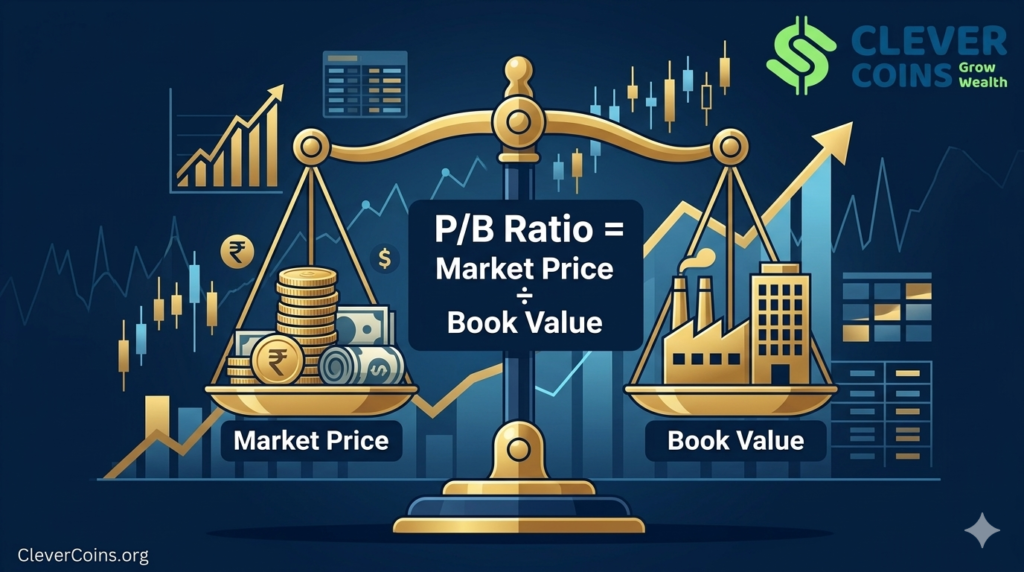
The Price to Book Value Ratio (P/B Ratio) is a financial metric used to compare a company’s current market price per share to its book value per share. In simpler terms, it tells you how much investors are willing to pay for each rupee (or dollar) of a company’s net assets.
The ratio essentially answers the question: If this company were to be liquidated today — if all its assets were sold and all liabilities paid off — how much would shareholders receive compared to what the stock market currently values it at?
The Simple Definition
Think of book value as the ‘accounting value’ of a company — what its balance sheet says it is worth. The market price, on the other hand, reflects what investors collectively believe the company is worth based on future earnings potential, brand strength, management quality, and other intangible factors.
When the market price significantly exceeds the book value, the P/B ratio is high. When the market price is close to or below the book value, the P/B ratio is low — and this can signal an undervalued stock.
Quick Snapshot: P/B Ratio at a Glance
Metric | Description | Example |
P/B Ratio | Market Price ÷ Book Value per Share | ₹200 ÷ ₹100 = 2.0x |
P/B < 1 | Stock trades below book value | Potentially undervalued |
P/B = 1 | Stock trades at book value | Fairly valued (in theory) |
P/B > 1 | Market values company above assets | Growth premium or overvalued |
P/B Ratio Formula: How to Calculate It
The formula for the Price to Book Value Ratio is straightforward:
P/B Ratio = Market Price per Share ÷ Book Value per Share
Or alternatively at the company level:
P/B Ratio = Market Capitalisation ÷ Total Book Value (Net Assets)
Step 1: Find the Market Price per Share
The current market price per share is readily available on any stock exchange platform such as NSE, BSE, NYSE, or NASDAQ. It reflects the real-time price at which buyers and sellers are transacting.
Step 2: Calculate Book Value per Share
Book Value per Share is derived from the company’s balance sheet using the following formula:
Book Value per Share = (Total Assets − Total Liabilities) ÷ Total Outstanding Shares
In other words:
- Total Assets include fixed assets (land, machinery, equipment), current assets (cash, receivables, inventory), and investments.
- Total Liabilities include long-term debt, short-term borrowings, and other obligations.
- The difference is the shareholders’ equity — what belongs to the owners after all debts are settled.
- Dividing by the number of outstanding shares gives the book value per share.
Worked Example: P/B Ratio Calculation
Let us walk through a practical example using a fictional company, ABC Financials Ltd:
Item | Value |
Total Assets | ₹50,00,00,000 |
Total Liabilities | ₹20,00,00,000 |
Shareholders’ Equity | ₹30,00,00,000 |
Total Outstanding Shares | 1,00,00,000 |
Book Value per Share | ₹30 |
Current Market Price per Share | ₹75 |
P/B Ratio | 2.5x |
In this example, investors are willing to pay ₹2.50 for every ₹1 of the company’s net assets. Whether this is justified depends on the company’s return on equity, growth prospects, and industry benchmarks.
How to Interpret the P/B Ratio: What Do the Numbers Mean?
The P/B ratio does not exist in a vacuum. Interpretation depends on multiple factors including the industry, economic cycle, and company-specific circumstances. Here is a comprehensive breakdown:
P/B Ratio Below 1 (P/B < 1)
When a stock trades below its book value, it means the market values the company at less than the value of its net assets. This can indicate:
- The company is genuinely undervalued and represents a bargain buy.
- The market anticipates future losses that will erode assets.
- The company is in a distressed financial state.
- The industry is cyclically depressed (e.g., during a recession).
- Assets may be overstated on the balance sheet (inflated goodwill, outdated inventory).
Value investors like Benjamin Graham specifically looked for stocks with P/B ratios below 1, treating them as potential ‘net-net’ opportunities. However, caution is needed — a low P/B may also be a ‘value trap’ if the business is fundamentally broken.
P/B Ratio Equal to 1 (P/B = 1)
A P/B ratio of exactly 1 suggests the market is pricing the company precisely at its net asset value. This is rare in practice and typically implies a lack of growth expectations or a very stable, asset-heavy business.
P/B Ratio Between 1 and 3 (P/B = 1x to 3x)
This range is generally considered the ‘sweet spot’ for many industries, particularly banking and financial services. It suggests the market assigns a modest premium to the company’s assets, reflecting some confidence in management’s ability to generate returns above the cost of capital.
P/B Ratio Above 3 (P/B > 3)
High P/B ratios — especially above 5x or 10x — are common among technology, pharmaceutical, and consumer brand companies where intangible assets (patents, brand equity, intellectual property) dominate. These companies derive value not from physical assets but from their earning power and competitive moats.
Examples: Companies like Infosys, TCS, and major FMCG brands often trade at high P/B ratios because the market assigns significant value to their intellectual capital and brand.
P/B Ratio Benchmarks Across Industries
One of the most critical insights about the P/B ratio is that it is highly industry-specific. Never compare a bank’s P/B ratio with a software company’s — they operate in completely different asset structures. Here are indicative benchmarks:
Industry | Typical P/B Range | Reason |
Banking & Financial Services | 0.8x – 2.5x | Asset-heavy; book value is meaningful |
Information Technology | 4x – 15x | Intangible-heavy; high ROE companies |
FMCG / Consumer Goods | 5x – 20x | Strong brand equity commands premium |
Pharmaceuticals | 3x – 10x | R&D investments drive intangible value |
Real Estate | 0.5x – 2.0x | Asset values fluctuate with market cycles |
Manufacturing / Capital Goods | 1x – 3x | Moderate asset base, cyclical returns |
Steel / Metals / Mining | 0.5x – 1.5x | Cyclical; often trades close to book |
Utilities | 1x – 2.5x | Regulated returns; stable asset base |
Always benchmark the P/B ratio against sector peers and the company’s own historical P/B range rather than applying a universal standard.
P/B Ratio vs. P/E Ratio: Key Differences
Investors frequently compare the P/B ratio with the Price to Earnings (P/E) ratio. While both measure valuation, they focus on different dimensions of a business:
Parameter | P/B Ratio | P/E Ratio |
Measures | Market price vs. net assets | Market price vs. earnings |
Based On | Balance Sheet | Income Statement |
Best For | Asset-heavy companies (banks, manufacturing) | Profitable companies with steady earnings |
Limitation | Ignores earning power | Distorted by one-time items, losses |
Works When | Company has significant tangible assets | Company has positive, stable earnings |
Pro Tip: Using P/B and P/E together gives a more complete picture. A company with a low P/B and a low P/E but a high Return on Equity (ROE) is often a compelling value investment candidate.
The Critical Link Between P/B Ratio and Return on Equity (ROE)
No discussion of the P/B ratio is complete without understanding its relationship with Return on Equity (ROE). ROE measures how efficiently a company uses shareholders’ equity to generate profit:
ROE = Net Profit ÷ Shareholders’ Equity × 100
The Gordon Growth Model and financial theory suggest that:
Justified P/B = (ROE − g) ÷ (Cost of Equity − g)
Where ‘g’ is the sustainable growth rate. In simpler terms:
- A company with a high ROE deserves a high P/B ratio because it generates superior returns on every rupee of equity.
- A company with a low ROE trading at a high P/B is likely overvalued.
- A company with a high ROE trading at a low P/B may be significantly undervalued.
This P/B-ROE matrix is one of the most powerful tools in value investing:
P/B vs. ROE | High ROE | Low ROE |
Low P/B | IDEAL: Undervalued quality stock | Possible value trap |
High P/B | Justified growth premium | AVOID: Overvalued, poor returns |
Advantages of Using the P/B Ratio
- Stability: Unlike earnings (P/E), book value is less susceptible to short-term fluctuations and accounting adjustments.
- Applicable to Loss-Making Companies: The P/B ratio works even when a company has negative earnings, making it useful for banks, startups, or cyclical companies during downturns.
- Tangible Floor Valuation: For asset-heavy businesses, book value provides a realistic ‘floor’ valuation — the minimum worth in a liquidation scenario.
- Comparability: Enables apple-to-apple comparisons within the same industry.
- Historical Perspective: Comparing current P/B with historical averages reveals whether a stock is expensive or cheap relative to its own past.
- Useful in Banking Analysis: Banks are most naturally analyzed through P/B ratios since their core business revolves around managing assets and liabilities.
Limitations and Pitfalls of the P/B Ratio
While the P/B ratio is a powerful tool, it comes with significant limitations that every investor must understand:
1. Intangible Assets Are Excluded
Book value as reported on the balance sheet typically excludes internally generated intangible assets such as brand value, customer loyalty, intellectual property, and human capital. This makes the P/B ratio almost meaningless for tech giants like Google, Apple, or Indian IT majors, whose greatest assets are not reflected in their balance sheets.
2. Accounting Policies Distort Book Value
Different depreciation methods, inventory valuation techniques (FIFO vs. LIFO vs. Weighted Average), and asset write-down policies can significantly alter book value, making cross-company comparisons unreliable.
3. Does Not Reflect Earning Power
A company might have substantial assets but generate poor returns on those assets. The P/B ratio on its own says nothing about how efficiently those assets are being deployed.
4. Irrelevant for Service-Based Businesses
Companies in consulting, software, media, or financial services (beyond banking) carry minimal physical assets. The P/B ratio has little diagnostic value for such businesses.
5. Goodwill Can Inflate Book Value
When companies make acquisitions, goodwill (the premium paid over fair value) is recorded as an asset. If this goodwill is later impaired or written off, book value collapses — making historical P/B comparisons misleading.
6. Does Not Account for Debt Structure
Two companies with identical book values but very different debt loads have vastly different risk profiles. The P/B ratio does not differentiate between them.
P/B Ratio in Value Investing: Benjamin Graham’s Approach
The P/B ratio is deeply rooted in the value investing philosophy pioneered by Benjamin Graham, widely regarded as the father of security analysis and the mentor of Warren Buffett.
In his landmark book ‘The Intelligent Investor’ (1949), Graham recommended purchasing stocks trading at significant discounts to their book value — specifically those with P/B ratios below 1.5x — as a margin of safety against analytical errors and market volatility.
Graham’s ‘Net-Net’ Strategy involved buying companies whose market capitalisation was below their net current asset value (current assets minus all liabilities), effectively acquiring businesses for less than their liquidation value. This ultra-conservative approach generated extraordinary returns in the mid-20th century.
Modern value investors have evolved Graham’s framework to include qualitative factors, recognising that a low P/B combined with a high ROE, strong cash flows, and competitive advantages is superior to simply buying the cheapest stocks by book value.
Warren Buffett’s refinement: ‘It’s far better to buy a wonderful company at a fair price than a fair company at a wonderful price.’
How to Use the P/B Ratio in Your Investment Process: A Step-by-Step Approach
- Screen for Stocks: Use financial screeners (Screener.in, Moneycontrol, NSE tools) to filter stocks by P/B ratio within your target sector.
- Compare Within Sector: Always benchmark against sector peers. A P/B of 1.5x in banking could be attractive; the same ratio in IT would be extremely cheap.
- Analyse Historical P/B: Compare the current P/B with the company’s own 5-year or 10-year P/B average to gauge whether the stock is historically cheap or expensive.
- Cross-check with ROE: Pair P/B with ROE. High ROE + Low P/B = strong buy candidate. Low ROE + High P/B = red flag.
- Examine Balance Sheet Quality: Investigate what drives book value. Are assets current and productive? Or are they obsolete fixed assets or inflated goodwill?
- Review Cash Flows: Strong free cash flow generation validates that assets are productive and the P/B discount is not due to poor business quality.
- Check Dividend History: Companies paying consistent dividends at low P/B multiples often represent some of the best value investing opportunities.
- Use P/B Alongside Other Metrics: Combine P/B with P/E, EV/EBITDA, Debt-to-Equity, and Price-to-Cash-Flow for a holistic valuation framework.
Real-World Case Studies: P/B Ratio in Indian & Global Markets
Case Study 1: Indian Public Sector Banks (PSBs) — Classic Low P/B Scenario
Between 2018 and 2020, many Indian Public Sector Banks (State Bank of India, Bank of Baroda, Punjab National Bank) traded at P/B ratios of 0.3x to 0.7x due to massive Non-Performing Asset (NPA) crises. This appeared to offer extraordinary value on a P/B basis. However, investors who understood the limitations of P/B recognised that the low ratio reflected genuine balance sheet stress — anticipated loan write-offs that would further erode book value. This is a classic example of a potential ‘value trap.’
By 2022-2024, after significant NPA resolution and improved profitability, many of these banks re-rated to 1x-1.5x P/B, rewarding patient investors handsomely. The lesson: a low P/B in banking is attractive only when NPAs are under control and ROE is improving.
Case Study 2: TCS and Infosys — High P/B in IT
India’s leading IT companies have consistently traded at P/B ratios of 8x to 15x. Does this mean they are overvalued? Not necessarily. Their P/B ratios are justified by consistently high ROEs (25%-40%), asset-light business models, strong free cash flow generation, and global competitive positioning. The P/B ratio must always be contextualised with ROE and business quality.
Case Study 3: Berkshire Hathaway’s Buyback Policy
Warren Buffett’s Berkshire Hathaway has historically initiated share buybacks when the company’s P/B ratio falls below 1.2x, considering it a signal that the stock is trading below its intrinsic value. This disciplined use of P/B as a buyback trigger is one of the most famous examples of the ratio being used in corporate capital allocation decisions.
Special Focus: P/B Ratio in Banking Sector Analysis
The banking sector deserves special mention because P/B ratio analysis is most naturally applicable here. Banks are fundamentally asset and liability businesses where balance sheet quality directly drives value creation. Key considerations when using P/B for banks include:
- Net Interest Margin (NIM): Higher NIM supports a higher P/B.
- Gross NPA and Net NPA Ratios: Lower NPAs support premium P/B multiples.
- Capital Adequacy Ratio (CAR): Well-capitalized banks deserve higher P/B.
- Return on Assets (ROA): ROA above 1% in Indian banking context is considered healthy.
- Provision Coverage Ratio (PCR): Higher PCR indicates conservative accounting and better quality book value.
For Indian banking stocks, a P/B of 1x-2x for PSBs and 2x-4x for private sector banks with healthy fundamentals is generally considered reasonable, though these ranges shift with the economic cycle.
Advanced Techniques: Adjusted Book Value and Tangible Book Value
Tangible Book Value (TBV)
Many sophisticated analysts prefer Tangible Book Value — which strips out goodwill and intangible assets — to get a more conservative, ‘hard asset’ valuation:
Tangible Book Value per Share = (Total Equity − Intangibles − Goodwill) ÷ Shares Outstanding
The Price to Tangible Book Value (P/TBV) is especially relevant for banks and financial institutions where asset quality and liquidation value are paramount.
Adjusted Book Value
Adjusted book value accounts for the fair market value of assets and liabilities rather than their historical cost. This is particularly relevant in real estate, where land and property values may differ dramatically from their historical cost recorded on the balance sheet.
Price to Book Growth (PBG Ratio)
Similar to the PEG ratio (P/E adjusted for growth), the PBG ratio adjusts P/B for the company’s expected book value growth rate, providing a more dynamic valuation framework for growth-oriented investors.
Frequently Asked Questions (FAQs)
Q1. What is a good P/B ratio for stocks?
There is no universal ‘good’ P/B ratio — it depends entirely on the industry and business model. For banks, a P/B of 1x-2.5x is generally considered reasonable. For IT companies, 6x-12x may be normal. Always compare within the same sector and against the company’s historical range.
Q2. Is a lower P/B ratio always better?
Not necessarily. A very low P/B ratio can indicate a bargain, or it can be a ‘value trap’ — a company whose assets are impaired, whose earnings are declining, or which faces structural challenges. Always investigate why the P/B is low before concluding it is cheap.
Q3. Can the P/B ratio be negative?
Yes. If a company’s total liabilities exceed its total assets (i.e., it has negative shareholders’ equity), the book value per share becomes negative, rendering the P/B ratio meaningless. This often occurs with heavily indebted companies or those that have incurred large cumulative losses.
Q4. How is P/B ratio different from P/E ratio?
P/B ratio compares market price to net assets (balance sheet focus), while P/E ratio compares market price to earnings (income statement focus). P/B is useful for asset-heavy companies and works even when earnings are negative, while P/E requires positive earnings to be meaningful.
Q5. Which sectors are best analyzed using the P/B ratio?
The P/B ratio is most meaningful for banking, financial services, insurance (BFSI), real estate, manufacturing, and capital-intensive industries. It is less useful for technology, pharmaceutical, media, and service-based companies where intangible assets dominate.
Q6. What does it mean when a company trades at P/B below 1?
It means the market is pricing the company at less than its accounting net worth. This could indicate undervaluation (a potential opportunity), financial distress, anticipated future losses, or overstated assets. Deep investigation is required before drawing conclusions.
Q7. How do I find the book value per share of an Indian company?
Book value per share is disclosed in the company’s annual report, quarterly results, and on financial data platforms like Moneycontrol, NSE India, BSE India, Screener.in, and Tickertape. Most stock research platforms display P/B ratio directly.
Q8. Should I buy a stock just because it has a low P/B ratio?
No. The P/B ratio is one input in a multi-factor valuation framework. Before buying a low P/B stock, examine ROE, debt levels, management quality, earnings trajectory, competitive position, and industry outlook. A low P/B combined with improving fundamentals is the ideal scenario.
Q9. How does inflation affect book value and P/B ratio?
High inflation can cause the replacement cost of physical assets to diverge significantly from their historical cost (book value). In inflationary environments, book value may understate the true economic value of a company’s assets, making P/B appear artificially high. Conversely, asset write-downs in deflationary periods can inflate P/B ratios.
Q10. What is the difference between market capitalisation and book value?
Market capitalisation (market cap) is the total market value of all outstanding shares (share price × total shares). Book value is the accounting value of shareholders’ equity from the balance sheet. The P/B ratio simply divides one by the other. A market cap greater than book value means investors expect the company to generate returns above its cost of equity.
Conclusion: Mastering the P/B Ratio for Smarter Investing
The Price to Book Value Ratio remains one of the most enduring and useful tools in the value investor’s arsenal — not because it tells you everything about a company, but because it grounds valuation in the tangible reality of what a business actually owns versus what the market thinks it is worth.
Like any financial metric, its power is multiplied when used in conjunction with other indicators — particularly ROE, P/E ratio, debt levels, and cash flow analysis. The greatest investors in the world have consistently used asset-based valuation as a sanity check against the market’s occasional excesses of optimism and pessimism.
At CleverCoins, we help individuals and businesses navigate the complexities of financial decision-making with clarity and confidence. Whether you are evaluating stocks for your personal portfolio or conducting due diligence for a corporate acquisition, understanding the P/B ratio is a foundational skill that will serve you well throughout your investing journey.
Start with the balance sheet. Understand what you own. Then decide what you would pay for it. That is the essence of investing.