The Cash Flow Challenge Every Indian Business Faces
Imagine you have delivered goods worth Rs. 50 lakhs to a large corporate buyer. Your invoice is raised, the goods are accepted, and everything is in order — except for one critical detail: the payment is due 90 days from now. Meanwhile, your suppliers expect payment within 30 days, your employees need their salaries, and a promising new order requires raw material procurement immediately.
This cash flow gap is not a sign of business failure. It is, in fact, one of the most common and crippling challenges faced by Micro, Small, and Medium Enterprises (MSMEs) across India. According to data from the Ministry of MSME, over 63 million MSMEs in India struggle with delayed payments from larger buyers — a problem that collectively locks up trillions of rupees in unpaid invoices at any given time.
Invoice discounting is a powerful financial solution specifically designed to solve this problem. In this comprehensive guide, we will explain exactly what invoice discounting is, how it works step by step, how it compares to related instruments, what the costs are in India, and everything you need to know to make an informed decision for your business in 2026.
What is Invoice Discounting? A Clear Definition
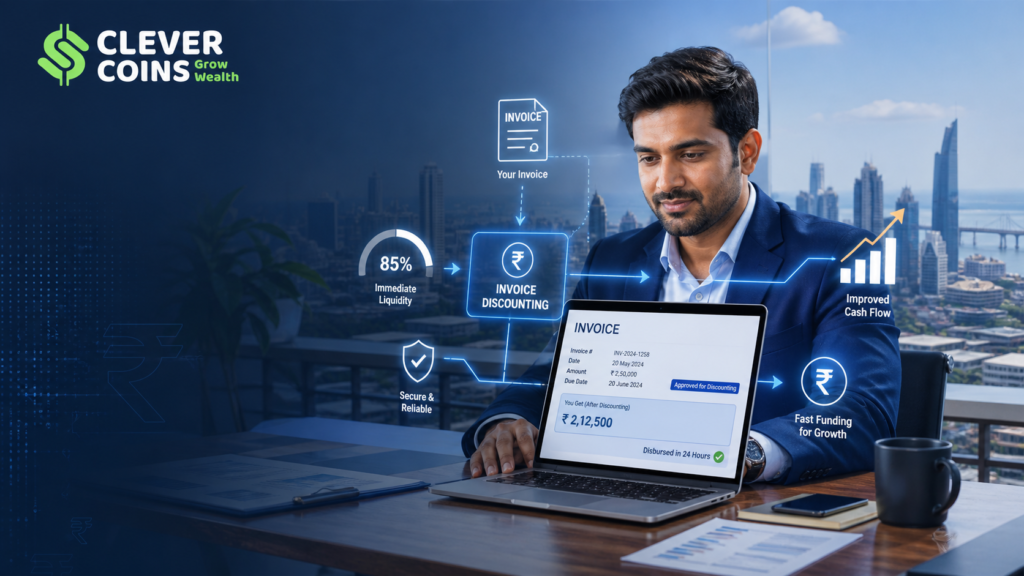
Invoice discounting is a short-term borrowing arrangement where a business uses its unpaid sales invoices as collateral to obtain immediate working capital from a financial institution — typically a bank, Non-Banking Financial Company (NBFC), or a fintech lending platform. In simple terms, instead of waiting 30, 60, or 90 days for your buyer to pay, you receive a significant portion of the invoice value upfront — usually between 70% and 90% — from a lender. Once your buyer pays the invoice on the due date, the lender releases the remaining amount to you after deducting interest and fees.
The key distinction of invoice discounting compared to invoice factoring is confidentiality. In invoice discounting, the arrangement is typically kept confidential — your buyer may never know you have used their invoice as collateral. You retain full control of your sales ledger and continue to collect payments from your buyers directly. This makes it particularly attractive for businesses that want to protect their buyer relationships while accessing immediate liquidity.
|
Key Fact 2026: The Reserve Bank of India (RBI) has been actively promoting invoice discounting through its Trade Receivables Discounting System (TReDS) to ease working capital constraints for MSMEs. As of early 2026, TReDS platforms have collectively facilitated over Rs. 1.5 lakh crore in invoice financing transactions. |
How Invoice Discounting Works: A Step-by-Step Process
Understanding the mechanics of invoice discounting is essential before you decide to use it. Here is a detailed breakdown of the entire process in the Indian context:
Step 1 – Raise an Invoice: Your business (the seller/exporter) supplies goods or services to a buyer (usually a corporate or government entity) and raises a standard GST invoice. The invoice will have a credit period — typically 30, 60, or 90 days.
Step 2 – Submit Invoice to Lender: You approach a bank, NBFC, or TReDS-registered platform and submit the invoice along with supporting documentation (purchase orders, delivery receipts, GST filings, etc.). The lender conducts due diligence on both the invoice and the creditworthiness of your buyer (not just you).
Step 3 – Approval and Advance Disbursement: Once approved, the lender advances between 70% and 90% of the invoice value directly to your bank account. For example, if your invoice is for Rs. 10 lakhs and the advance rate is 85%, you receive Rs. 8.5 lakhs immediately — often within 24 to 48 hours on digital platforms.
Step 4 – Buyer Pays on Due Date: On the invoice due date, your buyer pays the full invoice amount. In a confidential invoice discounting arrangement, this payment is made directly to you. In a disclosed arrangement or via TReDS, payment may go to a designated escrow or trust account.
Step 5 – Settlement with Lender: You repay the advanced amount to the lender along with applicable interest and platform fees. The remaining balance (the retained portion minus charges) is credited to your account.
Practical Example with Indian Rupees (2026)
|
PARAMETER |
AMOUNT / DETAIL |
|
Invoice Value |
Rs. 25,00,000 (25 Lakhs) |
|
Advance Rate |
85% |
|
Amount Disbursed to You |
Rs. 21,25,000 |
|
Invoice Tenor |
60 Days |
|
Annualised Discount Rate |
14% per annum (indicative) |
|
Interest for 60 Days |
Rs. 21,25,000 x 14% x 60/365 = Rs. 48,904 |
|
Platform/Processing Fee |
Rs. 10,000 (indicative) |
|
Total Cost |
Rs. 58,904 |
|
Net Amount Received (After Charges) |
Rs. 21,25,000 – Rs. 58,904 = Rs. 20,66,096 (net advance) |
|
Balance Released After Buyer Pays |
Rs. 3,75,000 – Rs. 58,904 = Rs. 3,16,096 |
|
Effective Annualised Cost |
~14–16% p.a. (varies by platform & creditworthiness) |
Types of Invoice Discounting Available in India
Invoice discounting in India is not a one-size-fits-all product. Depending on your business needs, buyer profile, and risk appetite, you can choose from several variants:
1. Confidential Invoice Discounting
This is the most commonly used form. The arrangement between you and the lender remains undisclosed to your buyer. You continue managing your debtor ledger, sending reminders, and collecting payments as usual. The lender’s involvement is invisible to your buyer. This is ideal for businesses that have strong buyer relationships and worry that disclosure might affect commercial terms.
2. Disclosed (Notified) Invoice Discounting
In this arrangement, the buyer is formally notified that the invoice has been assigned to the lender. The buyer is instructed to pay directly into a designated account controlled by the lender. While less common in traditional banking, many TReDS transactions are inherently disclosed in nature.
3. Selective (Spot) Invoice Discounting
Instead of committing your entire debtor book, you choose specific invoices to discount — selectively, based on your immediate cash flow needs. This is highly flexible and is particularly popular on fintech and NBFC platforms. You pay fees only on the invoices you choose to discount.
4. Whole-Ledger Invoice Discounting (Facility-Based)
A pre-approved revolving credit facility is set up against your entire debtor ledger. Whenever you raise new invoices that meet the lender’s criteria, funds become available automatically or with minimal re-approval. This is suitable for businesses with high and consistent invoice volumes.
5. TReDS-Based Invoice Discounting
The Trade Receivables Discounting System (TReDS) is a regulated electronic platform mandated by the RBI under the Payment and Settlement Systems Act, 2007. It is designed specifically to help MSMEs get their invoices discounted by multiple financiers, including banks and NBFCs, in a competitive, transparent, and digital manner.
|
RBI Mandate 2026: Companies with a turnover exceeding Rs. 500 crore are mandated to register on the TReDS platform. As of 2026, RBI has licensed three TReDS platforms in India: M1xchange (Mynd Solutions), RXIL (NSE-SIDBI joint venture), and A.TReDS (Axis Bank-mjunction). Each offers MSME sellers access to competitive discounting rates from multiple financiers. |
Invoice Discounting vs Invoice Factoring: Key Differences
Many business owners confuse invoice discounting with invoice factoring. While both use receivables to generate cash, they are fundamentally different in several ways:
|
FEATURE |
INVOICE DISCOUNTING vs INVOICE FACTORING |
|
Control of Ledger |
Discounting: Seller retains | Factoring: Factor takes over |
|
Buyer Awareness |
Discounting: Confidential (usually) | Factoring: Buyer notified |
|
Collection Responsibility |
Discounting: Seller collects | Factoring: Factor collects |
|
Credit Risk |
Discounting: Seller bears | Factoring (Non-Recourse): Factor bears |
|
Cost |
Discounting: Lower fees | Factoring: Higher fees (includes credit risk) |
|
Eligibility |
Discounting: Requires stronger financials | Factoring: More flexible |
|
Best For |
Discounting: Established businesses | Factoring: Growing/early-stage |
Who Can Use Invoice Discounting in India?
Invoice discounting in India is available to a wide range of entities. However, lenders have specific eligibility criteria. Here is a general overview as of 2026:
Eligible Entities
- Proprietorships, Partnership Firms, LLPs, Private Limited Companies, and Public Limited Companies
- Manufacturers, traders, and service providers who raise B2B (business-to-business) invoices
- MSMEs registered on Udyam Portal (mandatory for TReDS)
- Export businesses with confirmed foreign buyer invoices (for export invoice discounting)
General Eligibility Criteria (May Vary by Lender)
- Minimum business vintage: 1 to 2 years
- Annual turnover: Typically Rs. 20 lakhs to Rs. 500 crore (varies widely by platform)
- GST registration: Mandatory in most cases
- Creditworthy buyers: Lenders assess the buyer’s repayment ability more than the seller’s
- Clean banking history and no major defaults
Key Players in India’s Invoice Discounting Ecosystem (2026)
India’s invoice discounting market has matured significantly, with multiple types of institutions offering this product:
|
CATEGORY |
EXAMPLES |
|
Public Sector Banks |
State Bank of India (SBI), Bank of Baroda, Union Bank of India |
|
Private Sector Banks |
HDFC Bank, ICICI Bank, Axis Bank, Kotak Mahindra Bank |
|
NBFCs |
Bajaj Finserv, Tata Capital, Aditya Birla Finance, KredX |
|
Fintech Platforms |
KredX, M1xchange, FlexiLoans, Lendingkart, Drip Capital (exports) |
|
TReDS Platforms |
M1xchange, RXIL, A.TReDS (all RBI-licensed) |
|
SIDBI |
Refinances NBFCs and TReDS for MSME invoice discounting |
Key Benefits of Invoice Discounting for Indian Businesses
1. Immediate Liquidity
The most obvious benefit — you convert receivables into cash within 24 to 72 hours, dramatically improving your working capital position without waiting for the credit period to expire.
2. No New Debt on Balance Sheet
Invoice discounting is technically an advance against existing assets (your receivables), not a new term loan. This means it does not significantly increase your debt-to-equity ratio, keeping your balance sheet healthier for future fundraising.
3. Buyer-Driven Credit Assessment
For MSMEs that lack long credit histories or strong collateral, invoice discounting allows them to leverage the creditworthiness of their large corporate buyers. A small vendor supplying to Reliance Industries or Tata Steel can access competitive rates based on the buyer’s credit profile.
4. Flexible and Scalable
As your business grows and your invoice volumes increase, your access to working capital automatically scales. Unlike a fixed overdraft limit, invoice discounting grows with your revenue.
5. GST and TDS Compliant
Invoice discounting transactions in India are structured to be fully compliant with GST regulations (interest on loans is exempt from GST, though platform fees may attract 18% GST) and TDS requirements under the Income Tax Act, 1961.
6. Supports the Government’s MSME Growth Agenda
The RBI, SIDBI, and the Ministry of MSME have all actively encouraged invoice discounting through policy support, TReDS mandates, and subsidised rates for smaller businesses under schemes like the Emergency Credit Line Guarantee Scheme (ECLGS) and the Credit Guarantee Fund Trust for Micro and Small Enterprises (CGTMSE).
Risks and Limitations to Consider
While invoice discounting is an excellent tool, it is not without risks and limitations that every business owner must understand:
- Recourse Risk: In recourse facilities (most common in India), if your buyer fails to pay, you are still liable to repay the lender. This means buyer default risk sits with you.
- Cost Can Add Up: At annualised rates of 12–18%, frequent use of invoice discounting can become expensive if your business is consistently cash-flow negative for structural reasons.
- Over-Reliance Risk: Businesses that routinely discount all invoices may mask deeper issues with their working capital cycle rather than addressing root causes.
- Concentration Risk: Lenders may cap the percentage of invoices from a single buyer that they will discount to manage their own exposure.
- Documentation Requirements: Lenders require comprehensive documentation including GST returns, audited financials, buyer details, and contract copies — which can be burdensome for smaller businesses.
Cost Structure of Invoice Discounting in India (2026)
Understanding the all-in cost of invoice discounting is critical for calculating its true impact on your profitability. Here is the typical cost structure in India as of 2026:
|
COST COMPONENT |
TYPICAL RANGE (INDIA 2026) |
|
Discount Rate (Interest) |
10% – 18% per annum (depending on buyer credit & platform) |
|
Processing / Platform Fee |
0.25% – 1% of invoice value per transaction |
|
GST on Fees |
18% GST on platform/processing fees (interest is exempt) |
|
Stamp Duty |
Applicable as per state law on assignment agreement |
|
Annual Maintenance Fee |
Rs. 5,000 – Rs. 50,000 p.a. for facility-based arrangements |
|
Penal Interest (if delayed) |
2% – 5% additional on overdue amounts |
|
TReDS Platform Fee (Buyers) |
Typically borne by the buyer on TReDS |
|
Pro Tip 2026: On TReDS platforms, multiple financiers bid on your invoices, creating a competitive market that often results in lower discount rates compared to single-lender negotiations. MSMEs with blue-chip buyers often achieve rates as low as 9–11% p.a. on TReDS. |
Regulatory Framework in India (2026)
Invoice discounting in India operates within a robust regulatory framework. Key regulations and guidelines as of 2026 include:
- Reserve Bank of India (RBI): Governs banks and NBFCs engaged in invoice discounting. Key guidelines include the Master Direction on Factoring Regulation, 2022 (updated) and the TReDS framework.
- The Factoring Regulation Act, 2011 (Amended 2021): Allows all NBFCs (not just those specifically registered as factors) to engage in factoring/discounting activities. This amendment significantly expanded the ecosystem.
- SARFAESI Act, 2002: Provides lenders the ability to enforce security interests over receivables in case of default.
- GST Framework: Clarity on the GST treatment of discounting transactions — interest income is exempt; fee income attracts 18% GST.
- MSME Development Act, 2006 (and 2024 Amendments): Mandates 45-day payment cycles to MSMEs from buyers, with interest accruing at 3x bank rate on delayed payments — making invoice discounting an essential bridge.
- TReDS Circular 2022 (Updated 2025): Enhanced requirements for corporates with >Rs. 500 crore turnover to mandatorily onboard TReDS and enable MSME vendor discounting.
How to Apply for Invoice Discounting in India: A Practical Guide
If you are convinced that invoice discounting is right for your business, here is how to proceed in 2026:
- Assess Your Eligibility: Review your invoice volumes, buyer profiles, and business vintage. Identify your top 5 buyers by invoice value — these will be your best candidates for discounting.
- Gather Documentation: Prepare 2 years of audited financials, last 12 months of bank statements, GST returns (GSTR-1 and GSTR-3B), a list of buyers, and sample invoices and purchase orders.
- Choose Your Platform: Compare TReDS platforms (best for MSMEs with large buyers), NBFC fintech platforms (faster, more flexible), and bank facilities (cheaper but slower).
- Submit Application: Complete the online or physical application. Digital platforms like M1xchange and KredX can approve within 24–48 hours.
- Approval and Limit Setting: The lender will approve an invoice discounting limit — either invoice-specific or as a revolving facility. Limits typically range from Rs. 10 lakhs to Rs. 50 crore.
- Start Discounting: Upload invoices to the platform or submit to the bank. Funds are typically disbursed within 24–72 hours of invoice verification.
Invoice Discounting vs Other Working Capital Products
|
PRODUCT |
KEY DISTINCTION vs INVOICE DISCOUNTING |
|
Bank Overdraft |
General purpose; not linked to specific invoices; requires collateral |
|
Cash Credit (CC) |
Revolving facility; usually requires stock/property as primary security |
|
Term Loan |
Fixed repayment schedule; not suitable for short-term invoice gaps |
|
Invoice Factoring |
Factor takes control of collection; buyer-disclosed; higher cost |
|
Purchase Order Finance |
Finance raised against POs, not invoices; pre-delivery |
|
Supply Chain Finance |
Buyer-initiated; seller gets early payment at buyer’s credit cost |
GST Implications of Invoice Discounting in India (2026)
Invoice discounting has specific GST implications that businesses must be aware of to remain compliant:
- Interest Income: The discount/interest charged by the lender on the advance is treated as interest income and is exempt from GST under Entry 27 of the GST Exemption Notification.
- Processing/Platform Fees: Any fees charged by the platform or lender for processing, documentation, or technology services attract 18% GST. You can claim Input Tax Credit (ITC) on this GST if you are a registered GST taxpayer.
- Underlying Invoice: The sale transaction itself (your invoice to the buyer) is a standard supply of goods or services and must follow normal GST rules. Invoice discounting does not alter the GST liability on the original supply.
- E-Invoice Compliance: For businesses with turnover above Rs. 5 crore (as of 2024–25 GST notification), e-invoicing is mandatory. Invoices submitted for discounting must be valid e-invoices with an IRN and QR code.
Real-World Case Study: How Invoice Discounting Helped an Indian MSME
|
Case Study: Rajesh Engineering Works, Pune – Manufacturing Supplier to Tier-1 Auto Companies (Illustrative) |
Rajesh Engineering Works is a Pune-based precision parts manufacturer supplying to three major Tier-1 automotive suppliers. Their monthly invoice generation was approximately Rs. 80 lakhs, but the credit period was 75 days. Their monthly operating costs — salaries, raw materials, utilities — were approximately Rs. 60 lakhs due every 30 days. This left a persistent cash gap of Rs. 60 lakhs every month.
After registering on M1xchange (TReDS), they began discounting invoices worth Rs. 50 to 60 lakhs per month. With their buyers being large, creditworthy auto companies, they consistently achieved discount rates of 10.5% to 11.5% per annum. At an average of 11% per annum on a 75-day tenor, the cost per Rs. 50 lakh invoice was approximately Rs. 1.13 lakhs — a small fraction of the value unlocked.
Within six months of using invoice discounting, Rajesh Engineering Works eliminated their informal borrowing (which cost them 24% per annum), improved their supplier payment timeliness, negotiated early payment discounts from their own suppliers (saving 2% on Rs. 40 lakhs of monthly purchases = Rs. 80,000 monthly saving), and grew revenue by 30% by accepting new orders they previously had to decline due to cash constraints.
Invoice Discounting: Future Trends in India (2026 and Beyond)
- ONDC Integration: The Open Network for Digital Commerce (ONDC) is being explored as a framework for MSME invoice financing, potentially bringing millions of smaller businesses into the formal invoice discounting ecosystem.
- AI-Based Credit Assessment: Fintech platforms are deploying AI and machine learning to assess buyer creditworthiness using GST data, bank transaction patterns, and supply chain data — enabling faster approvals and better pricing.
- Account Aggregator Framework: The RBI’s Account Aggregator (AA) framework is revolutionising financial data sharing, enabling lenders to access real-time GST data, bank statements, and ERP data for near-instant invoice verification.
- Export Invoice Discounting Growth: With India targeting USD 2 trillion in exports by 2030, export invoice discounting through ECGC-backed products and fintech platforms is expected to grow significantly.
- GSTN-TReDS Integration: The government is working on deeper integration between the GSTN and TReDS platforms to enable automatic invoice verification, reducing fraud and speeding up the discounting process.
Conclusion: Is Invoice Discounting Right for Your Business?
Invoice discounting is one of the most powerful working capital tools available to Indian businesses in 2026 — particularly for MSMEs that supply to large, creditworthy buyers. It solves a fundamental structural problem: the mismatch between when you incur costs and when you receive payment.
If your business has consistent invoice volumes, reliable buyers with reasonable credit profiles, and a genuine need to bridge payment gaps, invoice discounting should be a serious consideration. The growth of TReDS platforms, the regulatory push by RBI, and the explosion of fintech lending solutions mean that access to invoice discounting has never been more democratised, faster, or more competitive.
As with any financial product, the key is to understand the costs, choose the right platform, and use it strategically — not as a permanent crutch, but as a smart lever to unlock the growth potential that is already embedded in your unpaid invoices.
|
Start exploring TReDS registration at www.treds.co.in or consult your bank’s trade finance desk to understand which invoice discounting solution best fits your business profile in 2026. |