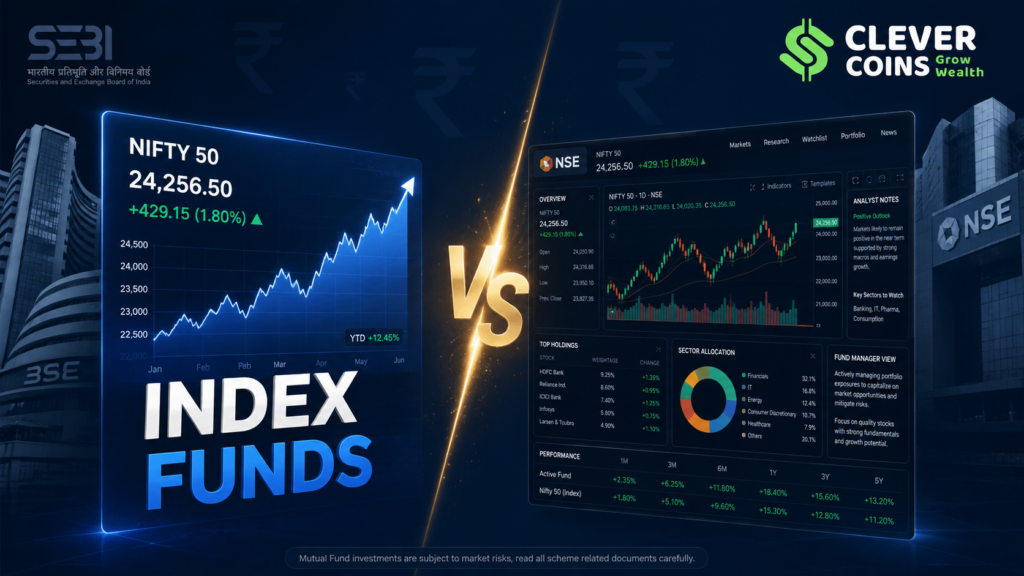
1. The Great Debate of Indian Investing
For decades, investors have been caught between two philosophies: should you trust a smart fund manager to beat the market, or simply ride the market through an index fund? This is not just an academic debate — it is a question that directly affects crores of Indian rupees in household wealth. In 2026, with SEBI regulations tightening, expense ratios becoming more transparent, and data finally catching up with performance, this comparison is more relevant than ever.
Whether you have Rs. 500 to invest through a SIP or Rs. 50 lakh to deploy in a lump sum, the choice between index funds and active funds will fundamentally shape your long-term wealth creation journey. This comprehensive guide breaks down every angle — costs, performance, taxation, regulation, suitability — so you can make a truly informed decision.
2. Understanding the Basics
2.1 What Are Index Funds?
Index funds are passively managed mutual fund schemes that replicate the composition of a market index — such as NIFTY 50, SENSEX, NIFTY Next 50, or NIFTY Midcap 150. The fund manager’s job is not to pick stocks but to mirror the index as closely as possible. The result is a fund that goes up when the index goes up and down when it falls.
In India, popular index funds track the NIFTY 50, BSE SENSEX, NIFTY Next 50, NIFTY Midcap 150, NIFTY Smallcap 250, and even international indices like the S&P 500 or NASDAQ 100 (through Fund of Funds structures regulated by SEBI).
Key Characteristics of Index Funds Passively managed — no stock picking by fund manager Very low Total Expense Ratio (TER): typically 0.05% to 0.30% per year Transparent — you always know what stocks are held and in what proportion Minimal tracking error (difference between fund return and index return) High diversification within the index universe Lower portfolio turnover = lower transaction costs |
2.2 What Are Active Funds?
Actively managed funds employ a dedicated fund manager and a research team whose goal is to outperform a benchmark index by selecting stocks, timing the market, and rotating sectors strategically. The fund manager uses fundamental and technical analysis, macro-economic research, and qualitative judgment to make investment decisions.
Key Characteristics of Active Funds Actively managed — stock selection is the core value proposition Higher TER: typically 0.50% to 1.50% per year (direct plans); 1.00% to 2.25% (regular plans) Less transparent — exact allocation may change frequently Performance depends heavily on the fund manager’s skill and consistency Potential to generate alpha (returns above the benchmark) Higher portfolio turnover = higher transaction costs |
3. The Cost Factor: A Silent Wealth Killer
One of the most critical — and often underestimated — differences between index and active funds is cost. The Total Expense Ratio (TER) is deducted daily from the fund’s NAV, meaning it is an ongoing drag on your wealth creation. SEBI has set maximum TER slabs for all mutual funds in India. As per the latest SEBI circular applicable in 2026:
AUM Slab | Max TER – Index/ETF (Direct) | Max TER – Active Fund (Direct) |
Up to Rs. 500 Crore | 0.30% | 1.05% |
Rs. 500 Cr – Rs. 750 Cr | 0.25% | 0.95% |
Rs. 750 Cr – Rs. 2,000 Cr | 0.20% | 0.85% |
Rs. 2,000 Cr – Rs. 5,000 Cr | 0.15% | 0.75% |
Above Rs. 5,000 Crore | 0.10% | 0.65% |
Actual Market Average (2026) | ~0.10% – 0.20% | ~0.50% – 1.00% |
To understand the real-world impact, consider this: If you invest Rs. 10,00,000 (10 lakh) and both funds earn 12% gross return per year, the cost difference compounds dramatically over time.
Time Period | Index Fund (0.15% TER) | Active Fund (0.85% TER) | Difference |
5 Years | Rs. 17,52,000 | Rs. 16,89,000 | Rs. 63,000 |
10 Years | Rs. 30,66,000 | Rs. 28,50,000 | Rs. 2,16,000 |
20 Years | Rs. 93,94,000 | Rs. 81,25,000 | Rs. 12,69,000 |
30 Years | Rs. 2,87,73,000 | Rs. 2,30,41,000 | Rs. 57,32,000 |
The difference of less than 1% in annual expenses translates into a staggering Rs. 57 lakh gap over 30 years on a Rs. 10 lakh investment — money that stays in your pocket with an index fund.
4. Performance: What Does the Data Actually Say?
4.1 Indian Market Data (2016–2025)
The S&P Indices Versus Active (SPIVA) India scorecard — a globally respected benchmark for this comparison — has consistently shown that the majority of actively managed large-cap funds in India fail to beat their benchmark over longer time horizons.
Category | % Active Funds Underperforming (5 Yr) | % Active Funds Underperforming (10 Yr) |
Large Cap Funds | 72% | 83% |
Mid Cap Funds | 55% | 65% |
Small Cap Funds | 48% | 60% |
ELSS Funds | 65% | 71% |
Multi Cap Funds | 60% | 68% |
These numbers reveal a sobering truth: most active fund managers, even after charging substantial fees, fail to beat a simple index fund over the long run. The few who do outperform in one period often fail to sustain that edge consistently.
4.2 Why Do Active Funds Struggle to Beat the Index?
- Market Efficiency: As Indian markets mature and institutional participation grows, stock mispricings are harder to exploit.
- Cost Drag: Every rupee paid as management fee is a rupee that cannot compound.
- Survivor Bias: Many underperforming active funds are merged or wound up, making historical averages look better than reality.
- Fund Manager Risk: Talented managers move between AMCs, taking their edge with them.
- Herding Behaviour: Large active funds often hold near-index portfolios due to risk constraints, but still charge active fees.
- SEBI Categorisation Rules: Since 2017, SEBI’s fund categorisation norms restrict how much active funds can deviate from benchmark universe, limiting true active management.
4.3 When Active Funds DO Win
It is not all one-sided. There are specific scenarios and categories where active management has historically added value in the Indian context:
- Mid-Cap and Small-Cap Segments: Markets are less efficient and analyst coverage is sparse, giving skilled managers an edge.
- Sectoral and Thematic Funds: Concentrated bets in specific themes can deliver outsized returns during cycle peaks.
- Debt Funds: Active duration management and credit selection can significantly improve risk-adjusted returns.
- Tax Efficiency Strategies: Active managers can employ tax-loss harvesting and dividend strategies more tactically.
- Flexi-Cap Funds: True multi-cap mandates allow managers to capitalise on market opportunities across market caps.
5. Taxation: The Indian Investor’s Crucial Consideration (2026)
Both index funds and active funds (when classified as equity-oriented schemes) are taxed identically under the Income Tax Act as per Union Budget 2024 provisions, which continue to apply in 2026:
Tax Parameter | 2026 Rate / Rule |
Short-Term Capital Gains (STCG) – holding < 1 year | 20% (increased from 15% in Budget 2024) |
Long-Term Capital Gains (LTCG) – holding > 1 year | 12.5% on gains exceeding Rs. 1.25 lakh/year (increased from 10% in Budget 2024) |
LTCG Exemption Threshold | Rs. 1,25,000 per financial year (per investor) |
STT on Equity Fund Redemption | 0.001% on redemption amount |
Indexation Benefit on Equity Funds | NOT available for equity funds |
Debt Funds Taxation (post April 2023) | Taxed as per income tax slab (both STCG and LTCG) – no separate LTCG rate |
International Fund of Funds | Treated as debt fund for tax: slab rate applies |
TDS on Dividend Distribution | 10% TDS if dividend exceeds Rs. 5,000/year |
Tax on ELSS (Active or Index) | 3-year lock-in; LTCG tax applies post lock-in |
Important Note for 2026: The distinction in taxation between index funds and active equity funds is NIL for equity-oriented schemes. Both are taxed at the same rate. However, for international index funds (tracking S&P 500, NASDAQ), the fund structure may classify them as non-equity, attracting slab-rate taxation — this is a key consideration before investing in such funds.
6. SEBI Regulations & Investor Protections in 2026
SEBI (Securities and Exchange Board of India) has been proactive in creating a level-playing field and protecting mutual fund investors. Key regulations impacting this comparison in 2026 include:
6.1 Direct vs Regular Plans
Since January 2013, SEBI has mandated separate direct plans for all mutual fund schemes. Direct plans have no distributor commission, resulting in significantly lower TER. Over time, this difference — typically 0.50% to 1.00% per year — compounds to lakhs of rupees. For index funds, the gap between direct and regular plans is smaller but still meaningful.
6.2 SEBI’s Categorisation and Rationalisation Circular
SEBI’s 2017 circular (and subsequent amendments up to 2025) classifies mutual funds into 36 categories (10 equity, 16 debt, 6 hybrid, 2 solution-oriented, 2 others). Each AMC can offer only ONE fund per category. This prevents fund houses from launching multiple overlapping schemes and forces genuine differentiation. Index funds and ETFs fall under a separate passive category.
6.3 Benchmark Disclosure Norms
As of 2025 SEBI norms, all active funds must disclose their performance against a Total Return Index (TRI) benchmark — not just a Price Return Index. TRI includes dividend reinvestment, making benchmarks more rigorous. This has made it even harder for active funds to show genuine outperformance. Index funds, by definition, closely track their TRI benchmark.
6.4 Expense Ratio Disclosure
SEBI requires daily NAV publication and monthly expense ratio disclosures on the AMFI website. As of 2026, AMCs must also publish portfolio overlap percentages and tracking errors for index funds on a monthly basis, improving transparency for investors.
6.5 Risk-o-Meter
SEBI’s enhanced Risk-o-Meter (effective January 2021, updated 2024) mandates funds to disclose risk on a six-level scale: Low, Low to Moderate, Moderate, Moderately High, High, and Very High. NIFTY 50 index funds are typically rated ‘Very High’ due to equity exposure, similar to large-cap active funds. Investors must assess this alongside their own risk profile.
7. Head-to-Head: Comprehensive Comparison Table
Parameter | Index Funds | Active Funds |
Management Style | Passive (replicates index) | Active (fund manager picks stocks) |
Expense Ratio (Direct, 2026) | 0.05% – 0.30% | 0.50% – 1.50% |
Expense Ratio (Regular, 2026) | 0.20% – 0.50% | 1.00% – 2.25% |
Fund Manager Dependency | Minimal — manager change doesn’t affect strategy | High — strategy depends on manager |
Portfolio Transparency | 100% transparent — mirrors index | Partial — disclosed monthly with 30-day lag |
Tracking Error | Low (0.01% – 0.30%) | Not applicable |
Alpha Generation Potential | None — returns match index minus costs | High potential, but rarely consistent |
Long-Term Performance (10+ yr) | Beats majority of active peers after costs | Only ~17–28% funds beat index consistently |
Minimum SIP Amount | Rs. 100 – Rs. 500 | Rs. 100 – Rs. 1,000 |
Liquidity | High (T+2 settlement for mutual funds; real-time for ETFs) | High (T+2 settlement) |
Diversification | As per index composition | Depends on fund mandate |
Tax Treatment (Equity) | Identical — STCG 20%, LTCG 12.5% | Identical — STCG 20%, LTCG 12.5% |
Suitable Investor Profile | Long-term, cost-conscious, passive investors | Investors seeking alpha, willing to pay for expertise |
Ideal Investment Horizon | 7+ years | 5+ years (large cap), 7+ years (mid/small cap) |
Risk of Underperformance | Only market risk — cannot underperform index (except tracking error) | Both market risk AND manager risk |
AMC Choices in India (2026) | 50+ index fund schemes across AMCs | 300+ active equity fund schemes |
ETF Option Available? | Yes — NSE/BSE listed ETFs available | No equivalent ETF structure for active funds |
8. Who Should Choose Index Funds? Who Should Choose Active Funds?
8.1 Index Funds Are Ideal For:
- First-time investors who want simplicity and low costs
- Investors with a long-term horizon of 10–30 years (retirement, children’s education)
- Those who cannot consistently monitor active fund performance
- Cost-conscious investors who understand the compounding impact of expense ratios
- NRIs and foreign investors seeking tax-efficient, low-maintenance India exposure
- Investors who want to avoid fund manager risk and style drift
- Those building a core-satellite portfolio (index as the core)
- Investors following systematic investment plans (SIP) of Rs. 500 to Rs. 5,000/month
- EPFO/pension-style investors focused on capital preservation and market returns
8.2 Active Funds May Be Suitable For:
- Experienced investors who can track fund manager consistency over 5–7 year cycles
- Those comfortable with mid-cap and small-cap fund categories where markets are less efficient
- Investors using ELSS for tax-saving under Section 80C (active ELSS has outperformed peers historically)
- High-net-worth individuals (HNI) with portfolio sizes above Rs. 50 lakh who can diversify across multiple active funds
- Investors with specific thematic or sector views (IT, pharma, infrastructure)
- Those who believe in a particular fund manager’s long-term track record (e.g., consistent 10-year performance)
- Investors seeking value or contra strategies not replicated by mainstream indices
9. Popular Index Funds & Active Funds in India (2026)
9.1 Top Index Funds by AUM (2026)
Fund Name | Benchmark Index | Approx. TER (Direct) |
HDFC NIFTY 50 Index Fund | NIFTY 50 TRI | 0.10% |
UTI NIFTY 50 Index Fund | NIFTY 50 TRI | 0.10% |
Nippon India NIFTY 50 Index Fund | NIFTY 50 TRI | 0.10% |
Motilal Oswal NIFTY Next 50 Index Fund | NIFTY Next 50 TRI | 0.15% |
Mirae Asset NIFTY Midcap 150 Index Fund | NIFTY Midcap 150 TRI | 0.17% |
ICICI Pru NIFTY Smallcap 250 Index Fund | NIFTY Smallcap 250 TRI | 0.19% |
Motilal Oswal S&P 500 Index FoF | S&P 500 (USD) | 0.50% (approx) |
SBI SENSEX Index Fund | BSE SENSEX TRI | 0.10% |
9.2 Consistent Active Funds by Category (Illustrative — Always Verify Before Investing)
Category | Notable Consistent Performers | Key Strength |
Large Cap | Axis Bluechip, Mirae Asset Large Cap | Low volatility, steady returns |
Flexi Cap | Parag Parikh Flexi Cap, HDFC Flexi Cap | Wide mandate, international exposure |
Mid Cap | Kotak Emerging Equity, HDFC Mid-Cap Opportunities | Market cycle management |
Small Cap | Nippon India Small Cap, SBI Small Cap | Long-term compounders |
ELSS | Mirae Asset Tax Saver, Quant Tax Plan | Tax savings + growth |
Value | ICICI Pru Value Discovery, Templeton India Value | Contrarian investing |
Disclaimer: Past performance is not indicative of future results. Always read the Scheme Information Document (SID) and consult a SEBI-registered investment advisor before investing.
10. How to Invest in Index Funds and Active Funds in India (2026)
Step-by-Step Process:
- Complete KYC: Submit PAN, Aadhaar, bank details and face verification through any SEBI-registered KYC Registration Agency (KRA). This is a one-time process.
- Choose a Platform: Invest directly through the AMC website, SEBI-registered MF distributors, or platforms like Zerodha Coin, Groww, Paytm Money, INDmoney, or MFCentral for consolidating all investments.
- Choose Direct Plans: Always opt for Direct Plans (lower expense ratio). Regular plans include distributor commission and should only be chosen if you value ongoing advisor service.
- Start a SIP: Set up a Systematic Investment Plan (SIP) starting from as low as Rs. 100/month for index funds. SIP averages out your cost through rupee-cost averaging.
- Monitor & Review Annually: For index funds, check tracking error every 6 months. For active funds, review 3-year rolling returns vs benchmark every year. Replace underperformers after 2 consecutive years of sustained underperformance.
- Rebalance Annually: Every year, review your asset allocation. If equity has grown beyond your target (e.g., from 60% to 75%), rebalance by switching or directing new investments to debt/gold.
11. The Core-Satellite Strategy: Combining Both for Best Results
One of the most practical approaches for Indian investors in 2026 is to not choose between index and active funds — but to combine them intelligently using the Core-Satellite model:
The Core-Satellite Approach Explained Allocate 60–70% of your equity portfolio to index funds (the Core). This ensures low-cost, reliable market participation that cannot dramatically underperform. Allocate the remaining 30–40% to carefully selected active funds (the Satellites) in segments where you believe active management adds value — typically mid-cap, small-cap, or specific sectors. This approach captures the best of both worlds: cost efficiency from the core and potential alpha from the satellites. |
Sample Portfolio Allocation for Rs. 10,000/month SIP:
Fund Type & Name | Monthly SIP Allocation |
CORE: NIFTY 50 Index Fund (e.g., UTI NIFTY 50) | Rs. 3,500 (35%) |
CORE: NIFTY Next 50 Index Fund | Rs. 2,000 (20%) |
CORE: NIFTY Midcap 150 Index Fund | Rs. 1,500 (15%) |
SATELLITE: Mid Cap Active Fund (top-rated) | Rs. 1,500 (15%) |
SATELLITE: Small Cap Active Fund (top-rated) | Rs. 1,000 (10%) |
SATELLITE: ELSS Active Fund (80C benefit) | Rs. 500 (5%) |
TOTAL | Rs. 10,000 (100%) |
12. The Final Verdict: Which Wins for Indian Investors in 2026?
OUR VERDICT For the vast majority of Indian retail investors, Index Funds WIN the long game. The data is consistent, the logic is sound, and the cost advantage is undeniable. Over a 10–20 year horizon, a simple NIFTY 50 + NIFTY Next 50 index fund combination will outperform 70–80% of active large-cap funds — simply because costs compound just as powerfully as returns. However, dismissing active funds entirely would be premature. In mid-cap and small-cap segments, skilled active managers still add value. Use index funds as your portfolio bedrock and active funds as selective additions in inefficient market segments. |