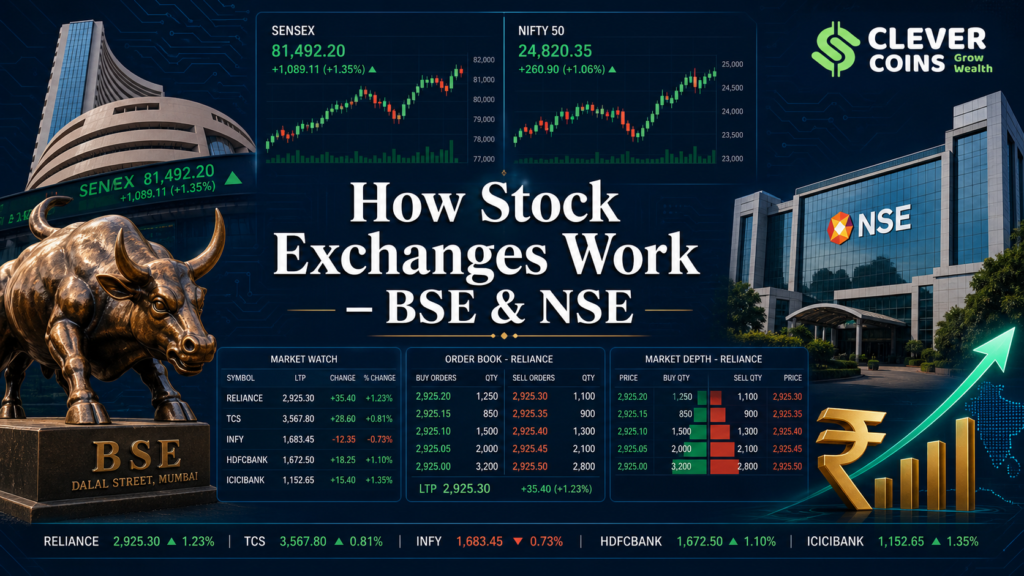
India’s capital market is one of the fastest-growing in the world. Whether you are a seasoned investor or just starting out, understanding how stock exchanges work is the foundation of smart investing. In this comprehensive guide, we explain how BSE (Bombay Stock Exchange) and NSE (National Stock Exchange) function, how trades happen, how your money moves, and how SEBI protects you as an investor in 2026.
🔑 Key Takeaways • BSE is Asia’s oldest stock exchange, founded in 1875. • NSE introduced screen-based electronic trading in India in 1994. • SEBI regulates both exchanges to protect investors. • India follows T+1 settlement for most equity trades since 2023. • Sensex (BSE) and Nifty 50 (NSE) are India’s benchmark indices. |
1. What is a Stock Exchange?
A stock exchange is a regulated marketplace where buyers and sellers come together to trade financial instruments — primarily shares, bonds, derivatives, and ETFs. In India, stock exchanges are regulated by SEBI (Securities and Exchange Board of India) under the Securities Contracts (Regulation) Act, 1956.
Think of a stock exchange as a super-organised bazaar. Instead of vegetables or clothes, what is being bought and sold here is ownership in companies. When you buy shares of Reliance Industries on NSE, you are buying a tiny ownership stake in one of India’s largest conglomerates.
As of 2026, India has two major national-level stock exchanges:
Attribute | BSE vs NSE |
Full Name | Bombay Stock Exchange (BSE) | National Stock Exchange (NSE) |
Founded | 1875 | 1992 (trading since 1994) |
Location | Dalal Street, Mumbai | Bandra-Kurla Complex, Mumbai |
Benchmark Index | Sensex (30 stocks) | Nifty 50 (50 stocks) |
Listed Companies (2026) | 5,300+ | 2,100+ |
Market Regulator | SEBI | SEBI |
Trading Platform | BOLT System | NEAT System |
2. History of BSE and NSE
2.1 BSE – Bombay Stock Exchange
The Bombay Stock Exchange, established in 1875 under the name ‘The Native Share & Stock Brokers’ Association,’ is Asia’s oldest stock exchange and the world’s 10th largest by market capitalisation as of 2026. BSE was the first exchange in India to receive permanent recognition from the government under the Securities Contracts (Regulation) Act, 1956.
For nearly a century, trading at BSE was done via the open outcry system — brokers would physically gather on the trading floor and shout orders to each other. This was replaced in 1995 when BSE introduced its BOLT (BSE Online Trading) system, moving everything online.
2.2 NSE – National Stock Exchange
NSE was incorporated in 1992 and began trading operations in 1994, making it a relatively young exchange. However, NSE quickly revolutionised Indian capital markets by introducing screen-based electronic trading from day one — eliminating the need for physical presence on a trading floor.
NSE’s NEAT (National Exchange for Automated Trading) system brought transparency, speed, and efficiency. Within a decade of its founding, NSE overtook BSE in trading volumes and today handles nearly 90% of India’s equity derivatives trading.
3. How Does a Stock Exchange Work?
The functioning of a stock exchange involves multiple layers: regulators, exchanges, clearing corporations, depositories, brokers, and investors. Here is a step-by-step breakdown:
Step 1: Company Lists on the Exchange (IPO / Listing)
Before shares are traded on an exchange, a company must go public through an Initial Public Offering (IPO). The company files a Draft Red Herring Prospectus (DRHP) with SEBI, which reviews it and approves the listing. After the IPO, shares are listed on BSE or NSE (or both), and investors can then buy and sell them freely.
In 2026, SEBI has streamlined the IPO process with mandatory UPI-based application systems (ASBA) and T+6 listing timelines (6 days after IPO closes). Many large IPOs like those from Hyundai India, Ola Electric, and others in 2024-25 raised thousands of crores on Indian exchanges.
Step 2: Placing an Order – The Trading Mechanism
When you place a buy or sell order via your stockbroker’s app (like Zerodha, Upstox, Angel One, or a bank broker), your order reaches the exchange’s trading engine in milliseconds through an API connection called the FIX protocol.
Stock exchanges use an Order Matching System (OMS) — the BOLT system on BSE and NEAT on NSE — which matches buy and sell orders based on price-time priority:
- Price Priority: The best price gets matched first (highest buy bid is matched with lowest sell ask).
- Time Priority: If two orders are at the same price, the one placed first gets matched first.
📊 Order Types Available on BSE & NSE (2026) Market Order – Executed immediately at current market price Limit Order – Executed only at your specified price or better Stop-Loss Order (SL) – Triggers when price falls to a set level Stop-Loss Market (SL-M) – Triggers at market price once SL level is hit After-Market Orders (AMO) – Placed after market hours, executed next morning Bracket Order & Cover Order – Used for intraday trading with pre-set targets |
Step 3: Market Segments
Both BSE and NSE operate multiple market segments:
Segment | Description |
Equity / Cash Market (EQ) | Buying and selling actual shares |
Futures & Options (F&O) | Derivatives contracts; NSE dominates with 90%+ volume |
Currency Derivatives | Trading in USD/INR, EUR/INR pairs |
Debt Market | Government securities and bonds |
SME Platform | BSE SME & NSE Emerge for small companies |
ETF / Index Funds | Exchange-Traded Funds listed on both exchanges |
Mutual Fund Units | Closed-ended MF units traded on exchange |
Step 4: Clearing and Settlement – T+1 Explained
After a trade is matched, it goes through clearing and settlement. As of 2023, India moved to a T+1 (Trade plus 1 day) settlement cycle for all equity shares — one of the fastest in the world.
Here is what T+1 means: If you buy shares of Tata Motors on Monday, by Tuesday evening, the shares will be credited to your Demat account and the money will be debited. The reverse applies when you sell.
The clearing is done by two main entities:
- NSCCL (NSE Clearing Corporation Ltd) – Clears and settles all NSE trades.
- ICCL (Indian Clearing Corporation Ltd) – Clears and settles BSE trades.
These clearing corporations act as the Central Counterparty (CCP) — they guarantee trade settlement even if one party defaults.
Step 5: Depositories – Where Your Shares Live
In India, shares are held in electronic (dematerialised) form in a Demat account. Two depositories manage this:
Depository | Key Details |
NSDL (National Securities Depository Ltd) | Promoted by NSE, IDBI, UTI. Holds majority of institutional holdings. |
CDSL (Central Depository Services Ltd) | Promoted by BSE, banks. More retail investor accounts (40+ crore in 2026). |
When you open a Demat account with a broker, the broker is a Depository Participant (DP) — an intermediary between you and NSDL/CDSL. Your shares sit safely with the depository in electronic form.
4. Market Timings – BSE & NSE 2026
Session | Timing (IST) | Purpose |
Pre-Open Session | 9:00 AM – 9:15 AM | Price discovery, order collection |
Normal Market Session | 9:15 AM – 3:30 PM | Live trading for all segments |
Post-Closing Session | 3:40 PM – 4:00 PM | Closing price transactions |
After-Market Orders (AMO) | After 4:00 PM | Queued for next day open |
Currency Derivatives | 9:00 AM – 5:00 PM | Extended hours for currency |
Commodity (MCX link) | 9:00 AM – 11:30 PM | Till late for commodities |
Note: Both BSE and NSE are closed on weekends (Saturday & Sunday) and on national holidays declared by SEBI/Ministry of Finance. In 2026, NSE and BSE will have approximately 12–14 market holidays including Holi, Ram Navami, Good Friday, Diwali Muhurat, etc.
5. Key Indices – Sensex & Nifty 50
A stock market index is a statistical measure that reflects the composite value of a group of selected stocks. It tells you how the overall market is performing.
5.1 Sensex – BSE Sensex
The S&P BSE Sensex (Sensitive Index) is India’s oldest and most widely followed index. It comprises 30 financially strong and well-established companies listed on BSE.
Parameter | Details |
Full Name | S&P BSE Sensex |
Launched | 1986 (Base Year: 1978-79, Base Value: 100) |
No. of Stocks | 30 (Large Cap) |
Exchange | BSE |
Value as of Early 2026 | ~₹80,000 – ₹85,000 points (approx.) |
Calculation Method | Free-Float Market Capitalisation |
Review Frequency | Semi-annual by the Index Committee |
Top Sensex constituents include Reliance Industries, TCS, Infosys, HDFC Bank, ICICI Bank, Larsen & Toubro, Hindustan Unilever, Bajaj Finance, and others.
5.2 Nifty 50 – NSE
The Nifty 50 is the flagship index of NSE, comprising 50 diversified large-cap stocks across 13 sectors. It is managed by NSE Indices Limited (formerly IISL).
Parameter | Details |
Full Name | CNX Nifty / Nifty 50 |
Launched | 1996 (Base Year: November 1995, Base Value: 1000) |
No. of Stocks | 50 (Large Cap, Multi-Sector) |
Exchange | NSE |
Value as of Early 2026 | ~₹23,000 – ₹25,000 points (approx.) |
Calculation Method | Free-Float Market Capitalisation |
Derivative Products | Nifty Futures & Options (most traded in India) |
Other popular indices include: Nifty Bank, Nifty IT, Nifty Midcap 150, Nifty Smallcap 250, BSE Midcap, BSE Smallcap, Nifty Next 50, and sectoral indices like Nifty Pharma, Nifty Auto, etc.
6. SEBI – The Regulator of Stock Exchanges
SEBI (Securities and Exchange Board of India) was established in 1988 and given statutory powers under the SEBI Act, 1992. SEBI is the apex regulatory body for Indian capital markets. Its three key functions are:
- Protection of investor interests
- Promotion and development of the securities market
- Regulation of the securities market
🛡️ Key SEBI Regulations Impacting Investors (2026) ✔ Insider Trading: SEBI (Prohibition of Insider Trading) Regulations, 2015 – prohibits trading based on unpublished price-sensitive information (UPSI). ✔ Takeover Code: SEBI (SAST) Regulations, 2011 – regulates open offers when an acquirer buys 25%+ of a listed company. ✔ Mutual Funds: SEBI (Mutual Funds) Regulations, 1996 – governs AMCs, NAV reporting, and investor protections. ✔ F&O Margin Rules: Enhanced peak margin requirements introduced from 2020-21, now fully implemented. ✔ Investor Grievances: SEBI SCORES portal + SMART ODR (2023) for online dispute resolution. ✔ ESG Disclosures: SEBI mandates Business Responsibility and Sustainability Report (BRSR) for top 1,000 listed companies. |
7. How to Start Investing on BSE / NSE – Step by Step
Here is a simple 5-step process to start investing in Indian stock markets in 2026:
Step 1 – Open a Demat + Trading Account
Choose a SEBI-registered stockbroker. Popular options in 2026 include Zerodha, Upstox, Angel One, ICICI Direct, HDFC Securities, Groww, and others. You need to complete KYC using PAN card, Aadhaar, and bank account details.
Step 2 – Link Your Bank Account
Connect your savings bank account to your trading account. Funds will be deducted from this account for purchases and credited back when you sell.
Step 3 – Research Stocks
Study company fundamentals, annual reports, quarterly results, management quality, industry outlook, and valuations before investing. Tools like BSE India website (bseindia.com) and NSE India website (nseindia.com) provide free company filings.
Step 4 – Place Your First Order
Log in to your broker app, search for the stock symbol (e.g., RELIANCE, TCS, INFY), select BSE or NSE, choose order type (Market or Limit), and place the order during market hours (9:15 AM – 3:30 PM).
Step 5 – Monitor and Review
Check your portfolio regularly. Review whether companies you invested in are meeting their financial targets. Rebalance your portfolio annually based on life goals and risk appetite.
💡 Pro Tip from CleverCoins For tax-efficient investing, hold equity shares for more than 12 months to qualify for Long Term Capital Gains (LTCG) tax at 12.5% (above ₹1.25 lakh exemption limit as per Finance Act 2024-25). Short Term Capital Gains (STCG) on listed equity shares sold within 12 months is taxed at 20% effective FY 2024-25. Always maintain proper records of your buy/sell transactions for ITR filing. |
8. Types of Market Participants
Participant Type | Description | Role |
Retail Investors | Individual investors trading small quantities | ₹1 lakh to ₹50 lakh portfolio |
HNI / HNW Investors | High Net Worth Individuals | Portfolio above ₹50 lakh |
FIIs/FPIs | Foreign Portfolio Investors | Major price movers in largecaps |
DIIs | Domestic Institutional Investors (MFs, LIC) | Provide market stability |
SEBI-Reg. Brokers | Execute trades for clients | Member of BSE/NSE |
Algo/HFT Firms | Automated high-frequency traders | Use co-location servers |
Market Makers | Provide liquidity in illiquid stocks | Earn bid-ask spread |
9. Stock Exchange Fees & Charges (2026)
When you trade on BSE or NSE, multiple charges apply. Here is a breakdown of all charges you need to know:
Charge | Rate (2026) | Collected By |
Brokerage | 0% to 0.5% | Charged by broker |
STT (Securities Transaction Tax) | 0.1% on delivery (buy+sell); 0.025% on intraday sell | Central Govt – levied by exchange |
Exchange Transaction Charges | NSE: 0.00297% | BSE: 0.00375% | Revenue for exchanges |
SEBI Turnover Fees | ₹10 per crore turnover | SEBI regulatory fee |
GST on Brokerage | 18% | On brokerage + transaction charges |
Stamp Duty | 0.015% on buy (delivery); 0.003% buy (intraday/F&O) | State Govt via exchange |
DP Charges (Demat Debit) | ₹13 to ₹25 per scrip per day on sale | Depository + DP fee |
Note: These charges are updated as per SEBI Circular and Finance Act 2024-25. Always check your broker’s charge sheet for exact rates.
10. Circuit Breakers & Market-Wide Halt
To prevent panic crashes, SEBI and stock exchanges have market-wide circuit breakers (trading halts). As of 2026, the following circuit breaker rules apply on both BSE and NSE:
Trigger Level | Action Taken |
10% movement in Nifty/Sensex | 45-minute trading halt (if before 1 PM); 15-min (1–2:30 PM); no halt after 2:30 PM |
15% movement | 1 hour 45 min halt (if before 1 PM); 45-min (1–2:00 PM); remainder of day after 2 PM |
20% movement | Trading suspended for the entire day |
Additionally, individual stocks have their own Upper Circuit (UC) and Lower Circuit (LC) limits — typically set at 2%, 5%, 10%, or 20% depending on the stock category. F&O stocks generally have no circuit limits but have price bands in the pre-open session.
11. IPO Market – Primary Market vs Secondary Market
It is important to understand the distinction between how shares first enter the market (Primary Market) and how they are subsequently traded (Secondary Market):
Parameter | Primary Market |
Definition | Company raises fresh capital by issuing new shares |
Mechanism | IPO, FPO, Rights Issue, OFS |
Price Setting | Book Building / Fixed Price method |
Regulator Review | SEBI approves DRHP before listing |
Capital Goes To | The company (fundraising) |
Examples (2026) | Hyundai India IPO, Bajaj Housing Finance IPO |
12. Tax Implications for Stock Market Investors in India (FY 2025-26)
Understanding tax on stock market gains is crucial. Here is a complete tax summary as per Finance Act 2024-25 applicable for FY 2025-26:
Income Type | Condition | Tax Rate (FY 2025-26) |
LTCG on Equity Shares | Held > 12 months; gains above ₹1.25 lakh | 12.5% (no indexation) |
STCG on Equity Shares | Held < 12 months (listed equity via STT) | 20% |
LTCG on Debt Funds/Bonds | Held > 24 months | 12.5% without indexation (post July 2024) |
STCG on Debt Instruments | Held < 24 months | Added to income, taxed at slab rate |
Intraday Trading Gains | Speculative business income | Added to income, taxed at slab rate |
F&O Profits | Non-speculative business income | Slab rate; audit if turnover > ₹10 crore |
Dividend Income | Listed company dividends | Taxed at slab rate (TDS @ 10% if > ₹5,000) |
💡 CleverCoins Tax Filing Note If you have income from F&O trading, intraday profits, or significant LTCG/STCG from stock markets, you must file ITR-3 (for business income) or ITR-2 (for capital gains without business income). CleverCoins provides expert ITR filing services for investors and traders across India. Contact us at clevercoins.org. |
13. Recent Developments in BSE & NSE (2025-2026)
- BSE crossed 200 crore Demat accounts milestone in 2025, reflecting massive retail investor growth.
- NSE launched Nifty Next 50 derivatives and new sectoral indices for EV and renewable energy.
- SEBI introduced stricter F&O regulations in 2024 including higher contract sizes and lot sizes to reduce retail speculation.
- T+0 (same-day settlement) optional beta was launched by NSE and BSE in limited stocks in 2024-25.
- SEBI’s SCORES 2.0 portal streamlined investor complaint resolution with 21-day mandatory resolution timelines.
- NSE SME (NSE Emerge) saw record IPO listings in 2025 as MSMEs increasingly opted for public listing.
- SEBI mandated additional disclosures for algo traders and introduced social media influencer guidelines for stock tips.
Conclusion
BSE and NSE are the twin pillars of India’s capital market ecosystem. Understanding how they work — from order placement to T+1 settlement, from SEBI regulations to tax implications — empowers you to invest with confidence and clarity.
Whether you are buying your first stock, planning for retirement through equity SIPs, or trading derivatives, the knowledge of exchange mechanisms is invaluable. India’s stock markets in 2026 are more accessible, transparent, and investor-friendly than ever before.
At CleverCoins, we help you not just understand markets but also handle the tax side of your investments — from ITR filing for capital gains to GST compliance for your business. Reach us at clevercoins.org.
📞 Need Help with Capital Gains Tax Filing? CleverCoins offers expert ITR-2 and ITR-3 filing for stock market investors and F&O traders. ✔ LTCG / STCG calculation and reporting ✔ F&O profit/loss tax treatment ✔ Tax-loss harvesting advisory ✔ Advance tax computation for traders Visit: clevercoins.org | Mumbra, Thane | Pan-India Remote Services |