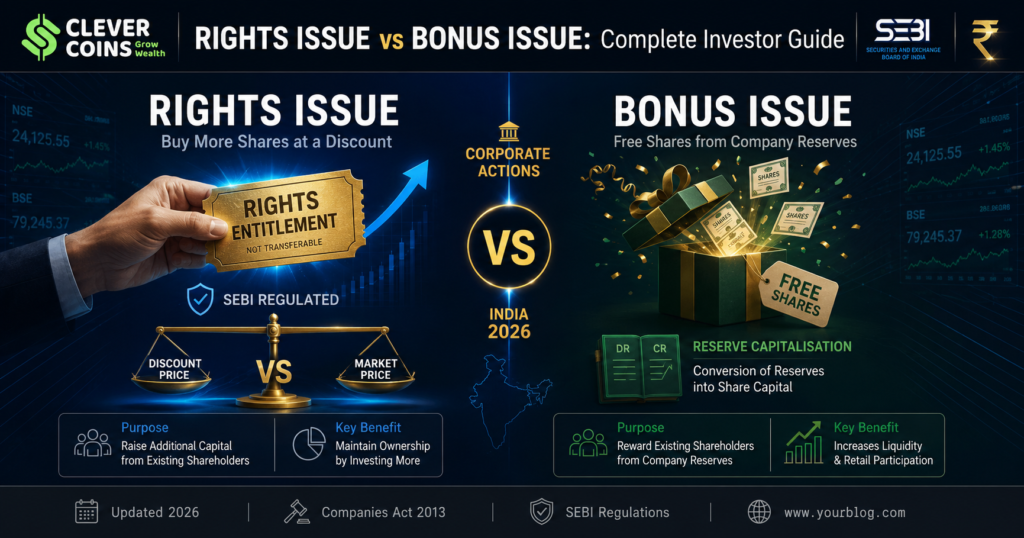
Corporate Actions That Every Investor Must Understand
Every year, hundreds of listed companies in India announce either a Rights Issue or a Bonus Issue. These are two of the most common and significant corporate actions that directly affect your shareholding, wealth, and tax liability. Yet, a large number of retail investors — even those with years of market experience — remain confused about the two.
Are they the same? Which one is better for you as an investor? Should you subscribe to a Rights Issue? What happens to your Bonus shares under LTCG (Long-Term Capital Gain) rules? How does the Companies Act, 2013, and SEBI’s latest 2026 regulations govern these actions?
This comprehensive guide, updated as per SEBI Regulations, ICDR (Issue of Capital and Disclosure Requirements) Regulations 2018 (as amended), and the Companies Act, 2013, will answer every question you have — with real-world examples in Indian Rupees.
What Is a Rights Issue?
A Rights Issue is a corporate action through which a listed company offers additional shares to its existing shareholders at a price that is typically lower than the current market price — in proportion to their existing shareholding. The keyword here is ‘right’ — the company is giving its existing shareholders the first right to buy new shares before it offers them to anyone else.
Think of it as the company saying: ‘We need to raise more capital. Before we go to the public, we want to give our loyal shareholders the first opportunity to invest more at a discounted price.’
Legal Framework Governing Rights Issue in India (2026)
- Companies Act, 2013 — Section 62(1)(a): mandates that a company must offer new shares to existing shareholders on a pro-rata basis before issuing them to outsiders.
- SEBI ICDR Regulations, 2018 (amended 2024-25): governs the process, timelines, disclosures, and pricing for listed companies.
- SEBI (LODR) Regulations, 2015: requires timely intimation to stock exchanges (NSE/BSE) of the Board’s decision, record date, and offer details.
- SEBI Circular — Rights Entitlement (RE) Trading: since 2020, SEBI mandated that Rights Entitlements (REs) be credited to shareholders’ demat accounts and traded on the stock exchange. This continues in 2026.
How a Rights Issue Works — Step-by-Step
- Board of Directors approves the Rights Issue and fixes the ratio, price, and record date.
- Company files a Letter of Offer with SEBI.
- SEBI reviews and issues observations (typically within 30 days).
- Record Date is announced — shareholders on record as of this date are eligible.
- Rights Entitlements (REs) are credited to eligible shareholders’ demat accounts.
- Application forms (ASBA — Application Supported by Blocked Amount) are made available.
- Shareholders can: (a) Subscribe fully, (b) Subscribe partially, (c) Renounce their REs to someone else by selling on the exchange, or (d) Let the REs lapse (they get nothing but lose the opportunity).
- Issue closes and shares are allotted within the SEBI-mandated timeline.
Rights Issue — Practical Example (2026)
Example: XYZ Ltd. announces a 1:4 Rights Issue at Rs. 200 per share. CMP = Rs. 320.
- You hold 400 shares of XYZ Ltd.
- Rights Entitlement: 400 ÷ 4 = 100 new shares at Rs. 200 each.
- Total cost to subscribe fully: 100 × Rs. 200 = Rs. 20,000
- Market value of 100 shares at CMP: 100 × Rs. 320 = Rs. 32,000
- Immediate notional gain per share = Rs. 120 (subject to market movement)
- Post-issue holding: 400 + 100 = 500 shares in XYZ Ltd.
📌 Note: If you do not subscribe and do not sell your Rights Entitlements (REs), they will lapse. You are neither penalised nor compensated — but you miss the opportunity.
SEBI’s Rights Entitlement (RE) — The 2020+ Revolution
One of the most investor-friendly reforms introduced by SEBI is the dematerialisation and tradability of Rights Entitlements. Since October 2020, Rights Entitlements are credited as separate securities (with a separate ISIN) to the demat accounts of eligible shareholders.
- If you do not want to subscribe, you can SELL your REs on NSE or BSE during the trading window.
- If you want to buy more than your entitlement, you can BUY REs from the market.
- REs have a separate market price and are traded like regular shares during the offer period.
- This ensures zero value destruction for shareholders who choose not to participate.
What Is a Bonus Issue?
A Bonus Issue (also known as a Scrip Dividend or Capitalisation Issue) is a corporate action where a company issues additional free shares to its existing shareholders in a fixed ratio — without any cost to the shareholder. The company uses its accumulated reserves (free reserves, securities premium, or capital redemption reserve) to issue these shares.
Think of it as the company saying: ‘We have built up strong reserves over the years. Instead of paying a dividend, we want to reward our shareholders with additional free shares.’
Legal Framework Governing Bonus Issue in India (2026)
- Companies Act, 2013 — Section 63: permits companies to issue bonus shares from free reserves, securities premium, or capital redemption reserve.
- SEBI (LODR) Regulations, 2015 — Regulation 42: requires companies to notify exchanges of the record date for bonus shares at least 7 working days in advance (15 days for listed debt securities).
- SEBI Circular (2022): clarified that bonus shares must be credited to shareholders’ demat accounts within 2 working days from the record date for listed companies — a significantly tightened timeline from the earlier 15 days.
- Companies (Share Capital and Debentures) Rules, 2014 — Rule 14: sets out conditions including that the company must not have defaulted on payment of statutory dues, and the Articles of Association must permit it.
Conditions for Issuing Bonus Shares (SEBI + Companies Act 2013)
- Company must have sufficient free reserves, securities premium, or capital redemption reserve.
- Bonus shares cannot be issued in lieu of dividends.
- Company must not have any outstanding fully or partly convertible debentures at the time of issue (as per SEBI ICDR).
- All partly paid-up shares must be made fully paid-up before bonus issuance.
- Bonus shares must rank pari passu (equal in all respects) with existing shares.
- The company must not have defaulted on the payment of statutory dues (PF, ESIC, gratuity, etc.).
How a Bonus Issue Works — Step-by-Step
- Board of Directors recommends the bonus ratio (e.g., 1:1, 2:1, 1:2).
- Shareholders approve it via Ordinary Resolution in General Meeting (or by postal ballot).
- Record Date is announced (minimum 7 working days advance notice to exchanges).
- All shareholders on the record date receive bonus shares in proportion to their holding.
- Bonus shares are credited to demat accounts within 2 working days of the record date.
- The share price adjusts on the ex-date (typically falls proportionately to the bonus ratio).
Bonus Issue — Practical Example (2026)
Example: ABC Ltd. announces a 1:1 Bonus Issue. CMP before bonus = Rs. 500.
- You hold 200 shares of ABC Ltd. (bought at Rs. 300 average).
- Bonus Ratio: 1:1 — one free share for every one share held.
- You receive: 200 additional free shares.
- Total shares after bonus: 200 + 200 = 400 shares.
- CMP after ex-bonus date (theoretical): Rs. 500 ÷ 2 = Rs. 250 per share.
- Total portfolio value: 400 × Rs. 250 = Rs. 1,00,000 (same as before: 200 × Rs. 500).
- Your cost of acquisition of bonus shares: Rs. 0 (zero cost).
📌 Note: Your total wealth does not change on the ex-date. However, the lower price per share can improve liquidity and attract more retail investors — which may push the price higher over time.
Rights Issue vs Bonus Issue: Head-to-Head Comparison (2026)
|
Parameter |
Rights Issue |
Bonus Issue |
|
Definition |
Offer of new shares to existing shareholders at a discounted price |
Free additional shares given to existing shareholders from reserves |
|
Cost to Shareholder |
Shareholder pays (discounted price) |
Absolutely FREE — no cost |
|
Purpose |
Raise fresh capital for the company |
Reward shareholders; capitalise reserves |
|
Share Capital |
Increases (new shares issued + cash inflow) |
Increases shares but no new cash inflow |
|
Cash Impact on Company |
Positive — company receives funds |
No cash impact — accounting entry only |
|
Ratio (Common Examples) |
1:2, 1:4, 1:5 (1 share per X held) |
1:1, 1:2, 2:1 (X free shares per 1 held) |
|
Share Price After |
Falls (dilution effect) |
Falls proportionately (split effect) |
|
Investor Choice |
Yes — can subscribe, sell RE, or lapse |
No — automatic; no choice needed |
|
Rights Entitlement |
Tradeable on NSE/BSE (since 2020) |
Not applicable |
|
Governing Law |
Sec 62 Companies Act + SEBI ICDR Regs |
Sec 63 Companies Act + SEBI LODR Regs |
|
Credit to Demat |
Post allotment (after issue closes) |
Within 2 working days of record date |
|
Reserves Used |
No reserves used; fresh capital raised |
Free reserves / securities premium used |
|
EPS Impact |
Dilutes EPS (more shares, more capital) |
Dilutes EPS (more shares, same profit) |
|
Suitable For |
Companies needing growth capital |
Companies with strong reserves; reward signal |
Tax Implications — Rights Issue vs Bonus Issue (India 2026)
Understanding tax treatment is crucial for calculating actual post-tax returns. The tax rules for Rights Issue and Bonus Issue are significantly different, especially after amendments introduced by the Finance Act 2024 (applicable in FY 2025-26 and continuing in 2026).
Tax on Rights Issue Shares
- Cost of Acquisition: the price you pay to subscribe to the Rights Issue (e.g., Rs. 200 per share in the XYZ example above).
- Holding Period: calculated from the date of allotment of rights shares.
- Short-Term Capital Gain (STCG): if sold within 12 months — taxed at 20% (revised upward from 15% by Finance Act 2024, effective July 23, 2024, continuing in 2026).
- Long-Term Capital Gain (LTCG): if held for 12+ months — taxed at 12.5% on gains exceeding Rs. 1.25 lakh per financial year (revised from 10% and Rs. 1 lakh threshold per Finance Act 2024).
- Securities Transaction Tax (STT):1% on delivery-based equity transactions continues to apply.
Tax on Rights Entitlements (REs) Sold on Exchange
When you sell your Rights Entitlements (REs) on the stock exchange instead of subscribing:
- Cost of Acquisition of REs: as per the CBDT (Central Board of Direct Taxes) clarification, the cost of REs sold is NIL (zero) since they were received as a benefit.
- Entire proceeds: the full amount received on selling REs is treated as Short-Term Capital Gain (taxable at 20% in 2026), since REs typically have a holding period of less than 12 months.
📌 Note: Always consult a Chartered Accountant (CA) or SEBI-registered tax advisor for your specific situation, as tax rules are subject to annual Budget amendments.
Tax on Bonus Shares — The Critical Rules (2026)
Bonus shares have unique and important tax rules that every investor must know:
- Cost of Acquisition of Bonus Shares: ZERO (Rs. 0) — as per Section 55(2)(aa) of the Income Tax Act, 1961. This means any price you receive on selling bonus shares is effectively your capital gain.
- Holding Period for Bonus Shares: calculated from the date bonus shares are allotted to your demat account (not from the original purchase date of the underlying shares).
- STCG on Bonus Shares: if sold within 12 months of allotment — 20% tax on the full sale price (since cost = Rs. 0).
- LTCG on Bonus Shares: if held for 12+ months from allotment date — 12.5% on gains exceeding Rs. 1.25 lakh per FY.
Tax Comparison Table — Rights vs Bonus Shares (FY 2025-26 / 2026)
|
Tax Aspect |
Rights Issue Shares |
Bonus Shares |
|
Cost of Acquisition |
Issue price paid (e.g., Rs. 200) |
ZERO (Rs. 0) — Sec 55(2)(aa) |
|
Holding Period Start |
Date of allotment |
Date of allotment of bonus shares |
|
STCG Tax Rate |
20% on profit (< 12 months) |
20% on full sale price (< 12 months) |
|
LTCG Tax Rate |
12.5% on gains > Rs. 1.25L/yr (≥12 months) |
12.5% on full sale price > Rs. 1.25L/yr |
|
LTCG Exemption |
Rs. 1.25 lakh per FY (aggregate equity LTCG) |
Rs. 1.25 lakh per FY (aggregate equity LTCG) |
|
STT |
0.1% on delivery sale |
0.1% on delivery sale |
|
Dividend Treatment |
Taxed at applicable income slab |
Taxed at applicable income slab |
Effect on Key Financial Metrics of the Company
Both corporate actions significantly alter a company’s financial ratios. Understanding this helps investors re-evaluate their positions post-action.
Effect of Rights Issue on Company Financials
|
Financial Metric |
Before Rights Issue |
After Rights Issue |
Direction |
|
Share Capital |
Base Amount |
Increases (new shares × face value) |
↑ Increases |
|
Securities Premium |
Base Amount |
Increases (difference) |
↑ Increases |
|
Total Equity / Net Worth |
Base Amount |
Increases (cash inflow) |
↑ Increases |
|
EPS (Earnings Per Share) |
Higher |
Dilutes (more shares, same profit short-term) |
↓ Dilutes |
|
Book Value Per Share |
Higher |
May increase if price > book value |
Varies |
|
Debt-to-Equity Ratio |
Higher |
Improves (equity increases) |
↓ Improves |
|
Share Price |
CMP |
Falls (dilution) |
↓ Falls |
Effect of Bonus Issue on Company Financials
|
Financial Metric |
Before Bonus Issue |
After Bonus Issue |
Direction |
|
Share Capital |
Base Amount |
Increases (new bonus shares) |
↑ Increases |
|
Free Reserves |
Higher |
Decreases (capitalised into share capital) |
↓ Decreases |
|
Total Equity / Net Worth |
Base Amount |
No change (accounting reclassification only) |
→ Same |
|
EPS (Earnings Per Share) |
Higher |
Dilutes (more shares, same profit) |
↓ Dilutes |
|
Book Value Per Share |
Higher |
Falls proportionately |
↓ Falls |
|
Debt-to-Equity Ratio |
Base |
No change (equity total unchanged) |
→ Same |
|
Share Price |
CMP |
Falls proportionately on ex-date |
↓ Falls proportionately |
Rights Issue vs Bonus Issue: Which Is Better for the Investor?
This is the question every investor asks. The honest answer is: it depends on the context, your financial position, and the company’s fundamentals. Let’s analyse from multiple perspectives.
When a Bonus Issue Is Better for the Investor
- When the company has strong fundamentals and the bonus is a signal of consistent profitability and accumulated reserves.
- When you have no additional cash to invest but want your shareholding to grow.
- When the lower share price post-bonus improves market liquidity and brings in more buyers.
- When you plan to hold for the long term and benefit from LTCG treatment after 12 months.
- Historical evidence: Several Nifty 50 companies (e.g., Wipro — famous for multiple bonuses) have created massive long-term wealth through bonus issuances.
When a Rights Issue Is Better for the Investor
- When the company has a clear, well-defined capital use plan (e.g., debt repayment, capacity expansion) that will drive future earnings.
- When the Rights Issue price is significantly below the market price — offering a meaningful discount.
- When you believe in the company’s long-term story and want to average down your cost.
- When the Rights Entitlement (RE) market price offers a good arbitrage opportunity.
- When the company has strong management credibility and the funds raised will be well-deployed.
When a Rights Issue Is a RED FLAG
- Company is in financial distress and needs funds urgently to service debt — check the Letter of Offer carefully.
- Promoters are not subscribing to their own entitlement (check promoter subscription data filed with SEBI).
- The Rights Issue price is close to the current market price — limited incentive to subscribe.
- Company has a history of poor capital allocation or fund diversion.
- Issue is being done to fund related-party transactions or acquisitions at inflated valuations.
Notable Recent Examples from Indian Markets (2023–2025)
Notable Bonus Issues (2023–2025)
|
Company |
Bonus Ratio |
Announcement Year |
Sector |
|
Hindustan Aeronautics (HAL) |
1:1 (1 bonus for 1 held) |
2024 |
Defence / PSU |
|
Tata Elxsi |
1:1 |
2023 |
IT Services |
|
Motherson Sumi Wiring |
1:1 |
2024 |
Auto Ancillary |
|
Polycab India |
1:1 |
2023 |
Cables & Wires |
|
KPIT Technologies |
1:1 |
2024 |
Auto Tech / IT |
📌 Note: Past bonus issuances do not guarantee future price appreciation. Always analyse the company’s fundamentals independently.
Notable Rights Issues (2023–2025)
|
Company |
Rights Ratio |
Issue Price |
Year |
|
Vodafone Idea (Vi) |
Various tranches |
Rs. 11 per share (approx.) |
2024 |
|
Future Retail (resolved) |
N/A (insolvency proceedings) |
N/A |
2023 |
|
Yes Bank (FPO-linked) |
Market driven |
Market price |
2024 |
📌 Note: The Vodafone Idea Rights Issue is a classic example where thorough due diligence was essential — the company was raising capital to survive, not to grow aggressively. Always read the Letter of Offer.
Investor Checklist: Before Acting on a Rights Issue or Bonus Issue
Checklist for Rights Issue
- Read the Letter of Offer filed with SEBI — available on SEBI’s EDIFAR/SCORES portal and BSE/NSE.
- Check the stated purpose of funds and evaluate its merit.
- Check promoter subscription — are promoters applying for their full entitlement?
- Compare the Rights Issue price with the current market price — is the discount meaningful?
- Evaluate the company’s debt levels, cash flow, and earnings trajectory.
- Check if Rights Entitlements (REs) are trading at a premium or discount on the exchange.
- Decide: Subscribe fully, subscribe partially, sell REs, or let lapse — all are valid choices.
- Use ASBA facility through your bank for application — funds are blocked, not debited until allotment.
Checklist for Bonus Issue
- Verify the bonus ratio and record date from NSE/BSE official announcements.
- Do not buy shares purely to get the bonus — price adjusts on ex-date; there is no free lunch.
- Note the allotment date — holding period for bonus shares starts from allotment, not your original purchase date.
- Update your portfolio tracker with the new average cost and tax cost basis.
- Assess whether the lower price post-bonus will improve the stock’s retail participation.
- Check if the bonus is accompanied by any other positive management commentary or guidance.
Key Terms Glossary: Rights Issue & Bonus Issue
|
Term |
Definition |
|
Rights Entitlement (RE) |
A tradeable security credited to demat representing the right to subscribe to new shares in a Rights Issue |
|
Record Date |
The date on which a shareholder must be on the company’s register to be eligible for a corporate action |
|
Ex-Date |
The date from which the stock trades without the rights/bonus benefit; usually 1 day before record date (T+1 settlement) |
|
ASBA |
Application Supported by Blocked Amount — RBI-mandated mechanism where funds are blocked (not debited) until allotment |
|
Letter of Offer (LoF) |
The key document filed with SEBI containing all details of a Rights Issue — terms, rationale, financials, and risks |
|
Pari Passu |
Latin term meaning ‘on equal footing’ — bonus/rights shares rank equally with existing shares in all respects |
|
Securities Premium Reserve |
Amount received over face value of shares; can be used to issue bonus shares under Companies Act, 2013 |
|
Capital Redemption Reserve |
Reserve created when preference shares are redeemed; can be used to issue bonus shares |
|
Face Value |
The nominal/par value of a share (e.g., Rs. 1, Rs. 2, Rs. 5, Rs. 10) as stated in the company’s Memorandum |
|
EPS Dilution |
Reduction in Earnings Per Share when new shares are issued without a proportionate rise in profits |
|
LTCG |
Long-Term Capital Gain — gain on equity shares held for 12+ months; taxed at 12.5% above Rs. 1.25L/yr (2026) |
|
STCG |
Short-Term Capital Gain — gain on equity shares held for less than 12 months; taxed at 20% (2026) |
Common Mistakes Investors Make with Rights & Bonus Issues
Mistake 1: Buying Shares Just Before the Bonus Record Date
Many investors rush to buy shares before a bonus record date hoping to receive free shares. However, the share price automatically falls on the ex-date by the bonus ratio. If you buy at Rs. 500 before a 1:1 bonus, the price becomes Rs. 250 on ex-date. You have neither gained nor lost — and you’ve also paid STT and brokerage unnecessarily.
Mistake 2: Ignoring Rights Entitlement Trading
Before SEBI’s 2020 reform, allowing REs to lapse was the only option for non-subscribers. Today, you can sell your REs on the exchange and recover some value. Many investors still do not know this and let their REs lapse, losing out on money.
Mistake 3: Miscalculating Tax on Bonus Shares
Since the cost of bonus shares is Rs. 0 (zero), the entire sale proceeds are subject to capital gains tax. Many investors incorrectly assume they only pay tax on the ‘extra’ gain. A CA should be consulted for precise tax calculation, especially when holding both the original and bonus shares.
Mistake 4: Blindly Subscribing to Every Rights Issue
Not every Rights Issue is a good investment. A company in financial distress raising money for survival is fundamentally different from a well-managed company raising funds for expansion. Always read the Letter of Offer and evaluate the stated purpose and financials.
Mistake 5: Not Updating Portfolio Cost Basis
After receiving bonus shares (cost = Rs. 0) or subscribing to a rights issue (at a discount), investors often forget to update their portfolio’s cost basis. This leads to incorrect P&L tracking and tax filing errors. Maintain a detailed scrip-wise record in your portfolio tracker.
Practical Tips for Indian Investors in 2026
- Track corporate action announcements on NSE (nseindia.com > Corporate Actions) and BSE (bseindia.com > Corporate Actions) — both are free and updated in real time.
- Use the SEBI SCORES portal (scores.sebi.gov.in) to report any grievances related to non-receipt of bonus shares or allotment delays.
- Ensure your demat account (Zerodha, Groww, ICICI Direct, HDFC Securities, Upstox, etc.) KYC is updated and mobile/email is linked — you receive rights issue application alerts via these channels.
- For ASBA applications in Rights Issues, your bank account must be ASBA-enabled — most PSU and private banks are. You can apply through NetBanking directly.
- Track the Rights Entitlement (RE) price on NSE/BSE — if RE price > subscription price gap, selling may be more profitable than subscribing.
- Use the Rs. 1.25 lakh LTCG exemption annually — plan your bonus share sales strategically across financial years to minimise tax outgo.
- Consult a SEBI-registered Research Analyst (RA) or Investment Adviser (RIA) — check their registration on sebi.gov.in before taking paid advice.
- Do not rely on social media ‘tips’ for Rights Issue subscription decisions — always do your own due diligence using SEBI-filed documents.
Conclusion: Making an Informed Decision in 2026
Both Rights Issues and Bonus Issues are powerful corporate tools — but they serve very different purposes and carry very different implications for investors.
A Bonus Issue is generally a positive signal — it reflects the company’s confidence in its financial strength and its desire to reward long-term shareholders. However, it does not create immediate wealth; it simply restructures your shareholding at a lower price per share.
A Rights Issue is a more complex decision requiring careful due diligence. When done by a financially healthy company with a clear, value-accretive purpose, it can be an excellent opportunity to increase your stake at a discount. When done by a financially stressed company, it can be a value trap.
The golden rule: Know why the company is taking the action, read the official documents filed with SEBI, and align the decision with your own financial goals, tax situation, and risk appetite. When in doubt, consult a SEBI-registered professional.