What Every Indian Investor Must Know in 2026
The Indian stock market has witnessed a surge of corporate actions in recent years. Among the most talked-about but least understood concepts for retail investors are Stock Splits and Reverse Stock Splits. Whether you are a seasoned trader on NSE or a first-time investor on BSE, understanding these mechanisms can make a significant difference in how you interpret price movements, manage your portfolio, and make informed decisions.
As of 2026, with SEBI (Securities and Exchange Board of India) tightening disclosure norms and the market capitalisation of Indian equities crossing Rs. 400 lakh crore, corporate actions like splits and reverse splits have become increasingly common across sectors from banking and IT to small-cap FMCG companies.
This comprehensive guide will walk you through every dimension of Stock Splits and Reverse Splits — their mechanics, their purpose, their impact on Indian investors, real-life examples from Indian markets, tax implications under the Income Tax Act 1961 (updated for AY 2025-26), and strategies to navigate them wisely.
📖 Section 1: Understanding Stock Splits — The Complete Picture
1.1 What Is a Stock Split?
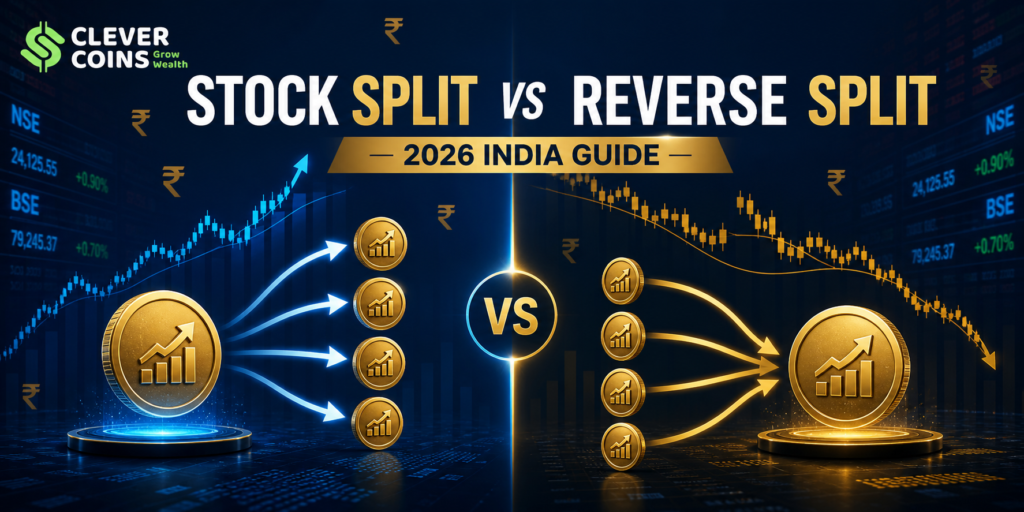
A stock split is a corporate action in which a company divides its existing shares into multiple new shares. The total market capitalisation of the company remains unchanged, but the number of outstanding shares increases while the price per share decreases proportionally. Think of it like cutting a pizza into more slices — the total pizza (company value) remains the same, but each slice (share) becomes smaller.
1.2 How Does a Stock Split Work? — Mechanics Explained
When a company announces a stock split, it specifies a split ratio. The most common ratios seen in India are 2:1, 5:1, and 10:1. Here is how the mathematics works with Indian Rupees:
Example — 2:1 Stock Split:
- Before Split: 100 shares at Rs. 1,000 per share = Rs. 1,00,000 portfolio value
- After 2:1 Split: 200 shares at Rs. 500 per share = Rs. 1,00,000 portfolio value
- Net Change in Wealth: Zero. Your investment value is exactly the same.
Example — 5:1 Stock Split:
- Before Split: 50 shares at Rs. 2,500 per share = Rs. 1,25,000 portfolio value
- After 5:1 Split: 250 shares at Rs. 500 per share = Rs. 1,25,000 portfolio value
1.3 Why Do Indian Companies Do Stock Splits?
Companies split their shares for several strategic reasons that benefit both the company and its shareholders:
- Improved Affordability & Accessibility: When a stock’s price climbs to Rs. 5,000, Rs. 10,000, or even Rs. 30,000 per share (as seen with companies like MRF), retail investors with limited capital find it difficult to build meaningful positions. A split brings the price to an accessible range.
- Enhanced Liquidity: Lower per-share prices typically attract more buyers and sellers, leading to higher daily traded volumes and tighter bid-ask spreads. This benefits all investors with better price discovery.
- Psychological Appeal & Market Perception: Research consistently shows that lower-priced shares attract more retail participation. A Rs. 200 stock simply feels more affordable than a Rs. 2,000 stock, even if the underlying company value is identical.
- Index Inclusion & Weight Rebalancing: For companies targeting inclusion in benchmark indices like Nifty 50 or Sensex, maintaining an optimal price range can be strategically important.
- Employee Stock Option Plans (ESOPs): Many Indian startups and listed companies use ESOPs extensively. A high share price can make ESOPs less attractive to employees. Splitting shares makes the options more valuable in terms of unit count.
- Signalling Confidence: Companies typically announce splits when they are performing well. A split implicitly signals that management expects continued growth and is confident in the company’s future.
1.4 Historical Stock Splits in India — Notable Examples (2020–2026)
Indian markets have seen numerous significant splits over the past few years:
- Infosys (2018, Pre-2026 reference): Completed a 2:1 split, one of the most talked-about splits in Indian IT history.
- Hindustan Unilever (HUL): Has used splits strategically to maintain retail investor participation.
- Avenue Supermarts (DMart): Post-IPO, DMart’s price soared, prompting split discussions among analysts to improve retail accessibility.
- Tata Consultancy Services (TCS): Executed splits to maintain competitive share pricing relative to global tech peers.
- Persistent Systems, Mphasis, Coforge: Various mid-cap IT companies have used splits as their share prices surged post-2021 bull run.
- IRCTC: After its stellar post-IPO performance, IRCTC conducted a 5:1 stock split in 2021, reducing its price from ~Rs. 5,000+ to ~Rs. 1,000 per share.
1.5 SEBI Regulations for Stock Splits in India (2026 Update)
In India, stock splits are governed by SEBI (Listing Obligations and Disclosure Requirements) Regulations, 2015 (LODR), specifically amended up to 2024-2026. Key regulatory requirements include:
- Board Resolution: The company’s Board of Directors must pass a resolution approving the split.
- Shareholder Approval: An Extraordinary General Meeting (EGM) or approval through postal ballot is required. Special resolution may be needed depending on Articles of Association.
- Record Date Announcement: SEBI mandates companies to announce the Record Date at least 7 working days in advance (15 days for splits requiring AGM approval) through stock exchange filings.
- Exchange Intimation: Immediate disclosure to NSE and BSE within 30 minutes of Board decision as per Regulation 30 of LODR 2015.
- Depository Coordination: Companies must coordinate with NSDL and CDSL for the technical process of splitting shares in demat accounts.
- Face Value: Under Companies Act 2013, shares cannot be split below Rs. 1 face value. As of 2026, most Indian shares have a minimum face value of Re. 1.
🔄 Section 2: Understanding Reverse Stock Splits — The Underutilised Tool
2.1 What Is a Reverse Stock Split?
A Reverse Stock Split (also called a share consolidation or stock merge) is the exact opposite of a regular split. The company reduces the number of outstanding shares by combining existing shares, which causes the share price to increase proportionally. Again, the total market capitalisation remains unchanged — only the number of shares and price per share change.
2.2 How Does a Reverse Stock Split Work?
Example — 1:5 Reverse Stock Split (i.e., 1 new share for every 5 old shares):
- Before Reverse Split: 1,000 shares at Rs. 20 per share = Rs. 20,000 portfolio value
- After 1:5 Reverse Split: 200 shares at Rs. 100 per share = Rs. 20,000 portfolio value
- Net Change in Wealth: Zero. Your investment value remains the same.
Example — 1:10 Reverse Stock Split:
- Before: 5,000 shares at Rs. 5 per share = Rs. 25,000 portfolio value
- After: 500 shares at Rs. 50 per share = Rs. 25,000 portfolio value
2.3 Why Do Companies Do Reverse Stock Splits?
Unlike forward splits which are generally positive signals, reverse splits are often associated with companies facing challenges. However, there are legitimate strategic reasons:
- Avoid Delisting from Exchanges: NSE and BSE have minimum price thresholds. A sustained low price (often referred to as a penny stock scenario) can trigger delisting warnings. A reverse split can rescue a stock from delisting.
- Meeting Institutional Investment Criteria: Many mutual funds, FIIs, and institutional investors have internal mandates against investing in stocks below a certain price level (e.g., Rs. 10 or Rs. 50). A reverse split can bring a stock into investable range.
- Improving Market Perception: Penny stocks are often associated with poor fundamentals. Raising the price through a reverse split can change perception, even if the underlying value is unchanged.
- Regulatory & Listing Compliance: SEBI and exchanges have ongoing surveillance mechanisms. Reverse splits can help companies avoid F&O ban lists or surveillance categories.
- Merger & Acquisition Preparation: Companies preparing for mergers may use reverse splits to achieve share price parity with the acquiring entity.
- Reducing Float for Better Price Control: A lower share count with higher price can make the stock less vulnerable to short-selling pressures.
2.4 Reverse Splits in Indian Markets — Context & Examples
Reverse splits are relatively rare in India compared to Western markets (particularly the US, where they are common among NASDAQ companies), but they do occur:
- Penny Stock Recovery: Several companies in sectors like textiles, real estate, and infrastructure have used reverse splits after significant price erosion during economic downturns.
- Post-Merger Consolidation: Companies emerging from mergers or restructuring exercises sometimes use reverse splits to rationalise their capital structure.
- PSU Restructuring: Some public sector units (PSUs) with historically high share counts at low prices have explored reverse splits as part of government disinvestment strategies.
Note: As of 2026, SEBI has not issued separate standalone regulations exclusively for reverse splits. They are governed under the same LODR 2015 framework as forward splits, with additional scrutiny through the Surveillance Department if the company is under any monitoring category.
⚖️ Section 3: Stock Split vs Reverse Split — Detailed Comparison
3.1 Side-by-Side Comparison Table
Parameter | Stock Split (Forward) | Reverse Stock Split |
Share Count | Increases | Decreases |
Share Price | Decreases proportionally | Increases proportionally |
Market Cap | Unchanged | Unchanged |
Face Value | Reduces (e.g., Rs. 10 → Rs. 5) | Increases (e.g., Rs. 1 → Rs. 10) |
Investor Signal | Positive / Growth confidence | Often negative / Distress signal |
Common Purpose | Improve affordability & liquidity | Avoid delisting, meet price criteria |
Typical Company | High-performing, growing | Struggling or restructuring |
Retail Participation | Increases significantly | May decrease |
SEBI Regulation | LODR 2015 — Standard process | LODR 2015 — Extra scrutiny possible |
Tax Implication | Original cost basis splits proportionally | Shares consolidated, proportional basis |
Common Ratios | 2:1, 5:1, 10:1 | 1:5, 1:10, 1:2 |
Frequency in India | Frequent (especially in bull markets) | Rare but increasing |
3.2 Impact on Portfolio Metrics — Deep Dive
Understanding how splits affect your portfolio metrics is crucial for investors using platforms like Zerodha, Groww, Upstox, or Angel One:
- Average Buy Price (ABP): Your average buy price is automatically adjusted by your broker on the record date. A 2:1 split halves your ABP. This is important for tax computation.
- Profit & Loss Calculations: Your unrealised P&L in percentage terms remains unchanged. The absolute numbers change (lower price, higher quantity), but percentage gain/loss stays the same.
- Stop Loss Orders: Any standing stop-loss orders at a specific price level will need to be re-evaluated and revised post-split. Many brokers cancel pending orders before the split takes effect.
- Collateral Value for Margin Trading: Your pledged shares’ collateral value remains the same in absolute terms but the number of shares changes.
- F&O Lot Size Adjustment: For stocks in the Futures & Options (F&O) segment, SEBI and exchanges automatically revise the lot size to maintain contract value consistency.
💰 Section 4: Tax Implications Under Indian Law (AY 2025-26 / 2026-27)
4.1 Capital Gains Tax Framework After a Stock Split
One of the most practically important questions for Indian investors is: how does a stock split affect my capital gains tax liability? The good news is that a stock split is NOT a taxable event in India.
Key Tax Rules (As per Income Tax Act 1961, updated Finance Act 2024-2025):
- Cost of Acquisition: The total cost of acquisition of your shares remains the same post-split. It gets distributed across the new number of shares proportionally.
- Holding Period: Your holding period does NOT reset after a split. If you held shares for 18 months before a 2:1 split and sell 12 months after the split, your total holding period is 30 months — qualifying for Long-Term Capital Gains (LTCG) treatment.
- LTCG (Long Term Capital Gains): Gains on equity shares held for more than 12 months are taxed at 12.5% (without indexation) as per Finance Act 2024 amendment, applicable from AY 2025-26. Previously 10%. Applies on gains exceeding Rs. 1.25 lakh per year.
- STCG (Short Term Capital Gains): Gains on equity shares held for 12 months or less are taxed at 20% flat (revised from 15% in Finance Act 2024). Securities Transaction Tax (STT) must be applicable.
- STT (Securities Transaction Tax): STT rates for equity delivery transactions remain at 0.1% of turnover for both buyer and seller as of 2026.
4.2 Practical Tax Example — Stock Split Scenario
Tax Calculation Example (Stock Split) Purchase: 100 shares of XYZ Ltd at Rs. 1,200 each on 01-Jan-2024. Total Cost = Rs. 1,20,000. 2:1 Split on 01-Jun-2024 → 200 shares, Adjusted Cost = Rs. 600 per share (same total Rs. 1,20,000). Sale: 200 shares at Rs. 900 each on 15-Feb-2025. Sale Proceeds = Rs. 1,80,000. Holding Period: 01-Jan-2024 to 15-Feb-2025 = 13.5 months (> 12 months) → LTCG LTCG = Rs. 1,80,000 – Rs. 1,20,000 = Rs. 60,000 Exemption = Rs. 1,25,000 (LTCG annual exemption) Taxable Gain = Rs. 60,000 – applicable exemption portion = NIL in this case Tax @ 12.5% = NIL |
4.3 Tax Implications of Reverse Stock Split
Similarly, a reverse split is also NOT a taxable event under Indian tax law. The same principles apply:
- Your total cost of acquisition remains unchanged.
- Cost is reallocated to the reduced number of shares (price per share basis increases).
- Holding period continues uninterrupted from original purchase date.
- LTCG and STCG calculations follow the same framework as forward splits.
Important Note: If you receive fractional shares (which sometimes arises in reverse splits), the company typically pays cash for fractional entitlements. This cash payment IS taxable as capital gains in the year of receipt.
4.4 Bonus vs Split — Tax Difference (Common Confusion)
Many investors confuse stock splits with bonus share issues. They are distinctly different for tax purposes:
- Stock Split: The face value reduces; your original shares are just redenominated. No new shares issued in the bonus sense.
- Bonus Shares: New shares issued free of cost. For LTCG, if bonus shares are sold within 12 months of allotment, they attract STCG. The cost of acquisition of bonus shares is ZERO per Indian tax law (Sec 55(2)(aa)), while original shares retain their original cost.
📊 Section 5: Impact on Different Types of Investors
5.1 Impact on Retail Investors (Small Investors)
- Positive Impact of Splits: More affordable entry points. Ability to diversify with smaller capital. Better liquidity means easier buying/selling.
- Caution: Do not mistake a split for a price drop. The company’s value has not changed. Splits are often misread by new investors as ‘the stock falling.’
- Action Post-Split: Review your stop-loss orders. Update your portfolio tracking spreadsheets. Confirm your broker has updated your average buy price correctly.
5.2 Impact on Institutional Investors (Mutual Funds, FIIs, DIIs)
- Mutual Funds: NAV automatically adjusts. The number of underlying shares in the fund’s portfolio increases post-split. No action needed by unit holders.
- FIIs/FPIs: Foreign Portfolio Investors benefit from improved liquidity in Indian stocks post-split, enabling larger block trades with lower market impact.
- DIIs: Domestic institutional investors like LIC, EPFO-backed investments benefit similarly to FIIs.
5.3 Impact on Options & Futures Traders
- Lot Size Adjustment: NSE automatically adjusts the F&O lot size on the ex-date. For example, if a Nifty 50 stock has a lot size of 200 and undergoes a 2:1 split, the new lot size becomes 400.
- Strike Prices: All existing strike prices are halved (for a 2:1 split) in the options chain.
- Open Interest: Stays equivalent in value terms but doubles in contract quantity terms.
- Premium Values: Option premiums adjust proportionally. Your position P&L in absolute rupee terms remains consistent.
5.4 Impact on Dividend Income
Your total dividend income is unaffected by splits or reverse splits. While the dividend per share (DPS) will decrease post-forward split, you hold proportionally more shares. The total dividend received = DPS x Number of Shares, which remains the same.
Example: If XYZ declares Rs. 20 dividend per share and you hold 100 shares = Rs. 2,000 total dividend. After 2:1 split: Rs. 10 per share x 200 shares = Rs. 2,000 total dividend. Unchanged.
🧠 Section 6: How to Analyse a Stock Split or Reverse Split — Investor Strategy
6.1 Checklist Before Reacting to a Split Announcement
- Check the Company’s Fundamentals: Has the reason for the high share price been earnings growth or just market euphoria? A split of a fundamentally strong company is very different from one made by a mediocre company.
- Review the Split Ratio: A 2:1 or 5:1 split is routine. A 100:1 split might indicate desperation to artificially lower prices.
- Analyse Volume Trends Post-Announcement: Splits typically lead to volume spikes. Sustained volume increase is bullish; spike followed by reversal is a warning sign.
- Evaluate the Valuation Post-Split: Calculate the new P/E, P/B, and EV/EBITDA ratios using the adjusted price. The stock’s valuation does not change with a split — only perception does.
- Read the Board Resolution: The official exchange filing (available on NSE/BSE websites) will mention the reason for the split. Pay attention to management commentary.
6.2 Red Flags to Watch in Reverse Split Announcements
- Consistent Revenue Decline: If a company has been reporting declining revenues for 2-3 consecutive quarters, a reverse split is a band-aid on a deeper wound.
- High Promoter Pledge: Check promoter shareholding and pledge percentage. High pledge + reverse split = distress signal.
- Regulatory Issues: Check if the company is under SEBI investigation, has pending litigation, or is on the ASM (Additional Surveillance Mechanism) list.
- Repeated Reverse Splits: A company that has undergone multiple reverse splits over years is typically destroying value.
- Balance Sheet Weakness: Check Debt-to-Equity ratio, current ratio, and interest coverage ratio. A leveraged balance sheet with a reverse split is highly concerning.
6.3 When Is a Stock Split a Good Buying Opportunity?
While a split itself does not create value, the announcement can be a signal to take a closer look at a company:
- Strong Fundamentals: Revenue CAGR > 15%, PAT growth > 20%, RoE > 15% — these suggest the split is genuine accessibility-driven.
- Sector Tailwinds: Is the company in a growing sector (e.g., defence tech, EV supply chain, data centres, Tier-2 IT services)?
- Management Track Record: Have promoters been buying shares? Is the management team consistent? Look at the corporate governance score.
- Post-Split Price Discovery: Often, stocks take 3-6 months post-split to settle into a new trading range. Buying during the initial volatility can offer entry opportunities.
🏦 Section 7: Depository & Brokerage Process in India — How It Works Technically
7.1 Role of NSDL & CDSL
In India’s electronic trading ecosystem, all shares are held in dematerialised form by two depositories: National Securities Depository Limited (NSDL) and Central Depository Services (India) Limited (CDSL). Here is the technical process for a split:
- Corporate Action Announcement: Company files intimation with NSE/BSE and the depositories.
- Record Date: The cut-off date is determined. Investors holding shares as of Record Date are eligible.
- Depository Processing (T+1 after Record Date): NSDL/CDSL automatically adjusts the quantity in all demat accounts. Your demat account will show the new quantity with the updated face value overnight.
- Broker Platform Update: Your broker (Zerodha, Groww, ICICI Direct, HDFC Securities, etc.) updates your portfolio view, average price, and investment value.
- No Action Required by Investor: You do not need to do anything. The process is fully automated.
7.2 What If You Hold Shares in Physical Form?
While physical shares are increasingly rare in 2026 (SEBI mandated demat for all transfers from 2019), some investors still hold older physical certificates:
- Contact the Company’s Registrar & Transfer Agent (RTA) — typically Link Intime India or KFin Technologies.
- Submit a request for dematerialisation along with the original certificates.
- Post-demat, the split adjustment will be applied automatically.
🌐 Section 8: Global vs Indian Context — Key Differences
8.1 Stock Splits in the US vs India
- US Markets (NYSE/NASDAQ): Highly common. Apple (7:1 in 2014, 4:1 in 2020), Tesla (5:1 in 2020), Google/Alphabet (20:1 in 2022). No minimum face value concept.
- Indian Markets (NSE/BSE): Face value constraint (minimum Re. 1). More regulatory oversight via SEBI. Retail investor participation is a key driver for split decisions in India.
8.2 ADR/GDR Considerations for Indian Stocks
Indian companies listed as ADRs (American Depositary Receipts) or GDRs (Global Depositary Receipts) on international exchanges must coordinate split adjustments across both domestic and foreign markets. The ratio adjustments must maintain parity with the domestic split ratio.
📱 Section 9: How to Track & Monitor Split Announcements in India
9.1 Official Sources
- NSE India Website (nseindia.com): Corporate Actions section under ‘Corporates’ menu. Real-time announcements under Regulation 30.
- BSE India Website (bseindia.com): Corporate Actions section. BSE Announcements database.
- SEBI EDIFAR/EDGAR India: Formal filings database.
- Moneycontrol, Economic Times Markets: Aggregated corporate action calendars.
9.2 Screener Tools & Alerts
- in: Can filter stocks by upcoming corporate actions.
- Trendlyne: Comprehensive corporate action tracker with email/SMS alerts.
- Broker Apps: Zerodha Kite, Groww, Angel One — all have push notification systems for holdings undergoing corporate actions.
- NSE/BSE Email Subscription: Free email alerts for listed companies you follow.
❓ Section 10: Most Asked Questions (FAQs) — 2026 Edition
Q1. Does a stock split affect my DEMAT account automatically?
Yes. NSDL and CDSL process the split automatically on or before the record date. Your demat account will reflect the new quantity with no action needed from your side. The adjustment typically happens overnight before markets open.
Q2. Will my brokerage charges change after a split?
Brokerage is typically charged as a percentage of transaction value or per-order flat fee. Since the transaction value per share decreases but quantity increases, your total brokerage on the same investment value remains the same. However, for flat-fee brokers like Zerodha (Rs. 20 per order), buying the same total value post-split in fewer orders keeps costs identical.
Q3. Should I buy before or after a stock split record date?
To be eligible for the split, you must hold shares BEFORE the record date. However, buying specifically for a split is not a sound investment strategy since the price adjusts automatically. Focus on fundamentals, not the split event itself.
Q4. Can a split trigger a margin call?
No, splits do not trigger margin calls. Your collateral value (for pledged shares) remains the same in absolute rupee terms, and your broker’s system recognises this automatically.
Q5. What happens to my SIP in a mutual fund that holds a split stock?
Nothing changes for you as a mutual fund investor. The fund manager handles all corporate actions internally. Your SIP continues normally and your NAV calculation automatically incorporates the split adjustment.
Q6. Is a reverse split always bad news?
Not necessarily. While reverse splits in India are often associated with distressed companies, some use them legitimately for strategic reasons such as improving institutional investability, preparing for mergers, or restructuring capital. Always analyse the underlying business health before drawing conclusions.
Q7. What is the minimum share price below which NSE/BSE can delist a company?
As of 2026, SEBI does not have a fixed minimum price threshold for delisting. However, SEBI’s Delisting Regulations 2021 provide a framework, and companies can be moved to Trade-to-Trade (T2T) segment or placed under ASM/ESM surveillance if trading volume and price patterns are concerning. The reverse split is one tool companies use to avoid such surveillance classifications.