What is a Fire NOC? — An Overview
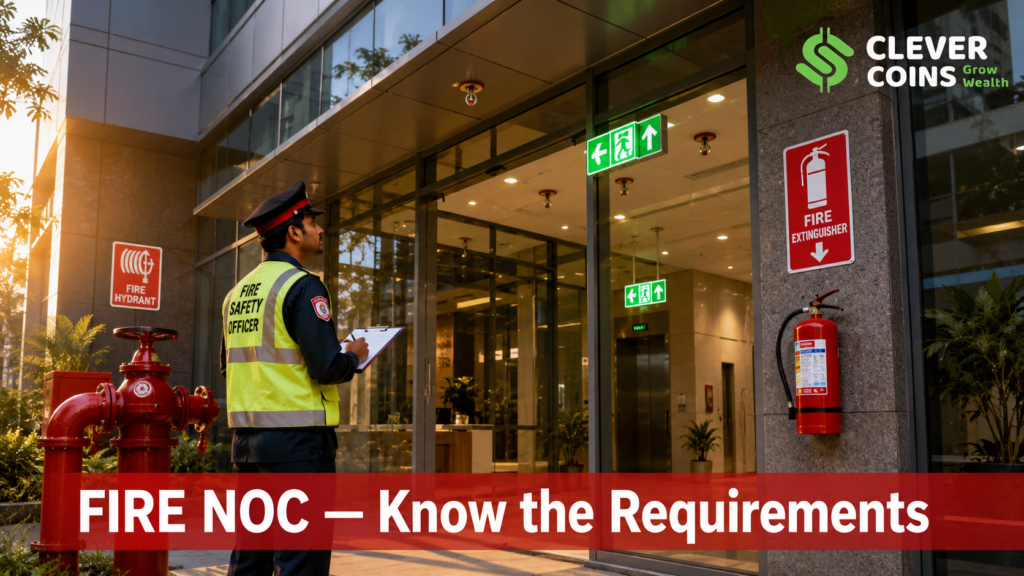
A Fire No Objection Certificate (Fire NOC) is an official document issued by the respective State Fire Department or local fire authority in India. It certifies that a building, establishment, industrial unit, or any commercial/residential premises has complied with all prescribed fire safety norms, installed the required firefighting equipment, and follows the Standard Operating Procedures (SOPs) for fire prevention and emergency evacuation. Obtaining a Fire NOC is not merely a procedural formality — it is a legal mandate that protects lives, property, and ensures accountability under Indian law.
In 2026, with rapid urbanisation and increasing high-rise constructions across Indian metros like Mumbai, Delhi, Bengaluru, Hyderabad, and Chennai, the importance of Fire NOC compliance has reached its peak. State governments and the National Disaster Management Authority (NDMA) have tightened norms, introduced digital portals for application, and increased penalties for non-compliance significantly.
Legal Framework Governing Fire NOC in India (2026)
The issuance of Fire NOC in India is governed by multiple laws, acts, and bye-laws at both central and state levels. Understanding this legal landscape is essential for any property owner, developer, or business operator.
Key Acts and Regulations
- The Factories Act, 1948 — mandates fire safety provisions for industrial establishments
- The National Building Code (NBC) of India, 2016 (Revised 2025 edition) — Part 4 deals exclusively with fire protection
- Model Building Bye-Laws (MBBL), 2016 — adopted by most municipalities and urban local bodies
- State Fire Services Acts — each state has its own Fire Prevention and Fire Safety Act (e.g., Maharashtra Fire Prevention and Life Safety Measures Act, 2006)
- BIS Standards: IS 2189, IS 9668, IS 13039 — for sprinkler, detection, and suppression systems
- National Disaster Management Guidelines — for high-rise buildings above 45 metres
- RERA Act, 2016 — builders must possess valid Fire NOC before handover of a residential/commercial project
- Cinemas Regulation Act & Hotels & Restaurants Act — require valid Fire NOC for operation licences
Role of State Fire Departments
Each state in India has its own Director General of Fire Services (DGFS) who operates under the respective Home Department. Municipal corporations such as MCGM (Mumbai), NDMC (Delhi), BBMP (Bengaluru), and GHMC (Hyderabad) also have their own fire departments for areas falling within their jurisdiction. As of 2026, most states have integrated Fire NOC applications with the National Single Window System (NSWS) portal to streamline the approval process.
Who Needs a Fire NOC? — Complete List of Applicable Premises
As per the National Building Code (NBC) 2016 and various state fire service regulations updated in 2024–2026, the following categories of premises are mandated to obtain a Fire NOC before commencement of operations or construction:
Residential Buildings
- Group Housing Societies / Apartment Complexes with 15 metres height or more (approx. 4 floors and above)
- Hostels, dormitories, and paying guest accommodations with more than 50 occupants
- High-rise residential towers above 15 metres
- Plotted developments under a layout approval in select states
Commercial & Business Establishments
- Offices, banks, and IT/ITES spaces with floor area above 500 sq. metres
- Shopping malls, retail complexes, and hypermarkets
- Multiplexes and cinema halls
- Hotels, lodges, and guest houses with 10 or more rooms or height exceeding 15 metres
- Restaurants, bars, banquet halls, and food courts with more than 50 seating capacity
- Hospitals and nursing homes (all categories above 10 beds)
- Educational institutions — schools, colleges, coaching centres with floor area above 500 sq. metres
- Marriage gardens, event halls, and convention centres
Industrial & Storage Premises
- All factories under the Factories Act, 1948
- Warehouses and cold storages above 500 sq. metres
- LPG and petroleum storage depots
- Chemical and pharmaceutical manufacturing units
- Textile processing and dyeing units
- Automobile workshops and service centres with fuel storage
Special Use Buildings
- Airports, railway stations, and bus terminals
- Data centres and server farms
- Sports stadiums and amusement parks
- Religious places above certain occupant capacity as per state laws
- Fuel stations (CNG/petrol/diesel)
Documents Required for Fire NOC Application (2026)
The documentation requirement may vary slightly from state to state, but the following is a comprehensive list based on the Central Fire NOC Guidelines and state-level updates as of 2026:
For New Buildings / Construction
- Duly filled application form (online via state fire department portal or NSWS)
- Copy of approved building plan / layout sanctioned by competent authority (e.g., municipality, RERA authority)
- Ownership document — Sale Deed, Lease Deed, or Allotment Letter
- Architecture completion certificate (after construction)
- Fire protection system layout plan signed by a licensed fire safety consultant
- Details of fire fighting installations — hydrants, sprinklers, fire extinguishers, smoke detectors, fire alarm system
- Structural stability certificate from a registered structural engineer
- NOC from the local municipal body / Urban Local Body (ULB)
- Site plan showing fire escape routes, staircases, refuge areas
- Copy of electricity connection approval / meter installation
- Identity proof and address proof of the applicant (Aadhaar, PAN)
- GST registration (for commercial establishments)
For Renewal of Existing Fire NOC
- Copy of existing / previous Fire NOC
- Annual maintenance certificates of fire fighting systems from AMC agency
- Mock drill / fire drill records (at least 2 drills per year)
- Updated list of fire wardens and safety officers
- Certificate of operational status of all fire safety equipment
- Any changes in building layout or occupancy (if applicable)
- Affidavit declaring no structural change without fresh NOC
Additional Documents for Industrial / Hazardous Units
- Hazardous material inventory report
- Environment clearance certificate
- Explosive licence (if applicable)
- MSDS (Material Safety Data Sheet) for chemicals stored on-site
- Emergency response plan (ERP) and disaster management plan
Step-by-Step Process to Obtain Fire NOC in India (2026)
The process for obtaining a Fire NOC has been significantly digitised post-2022. Most states now offer online portals. Below is a consolidated step-by-step guide:
Step 1: Pre-Application Preparation
Before applying, ensure your premises comply with the fire safety requirements as per the NBC 2016 and your state’s building bye-laws. Engage a licensed fire safety consultant (as mandated in most states for buildings above 15 metres) to audit your premises and prepare the fire protection scheme.
Step 2: Online Registration
Visit your respective State Fire Department portal or the National Single Window System (NSWS) at www.nsws.gov.in. Register using your business PAN or Aadhaar-linked mobile number. As of 2026, states like Maharashtra (aaplesarkar.mahaonline.gov.in), Delhi (delhi.gov.in fire services section), Karnataka (ksrsac.karnataka.gov.in), and Gujarat (swagat.gujarat.gov.in) have dedicated online modules.
Step 3: Fill the Application Form
Select the correct category of premises (Residential / Commercial / Industrial / Special). Fill in complete details — built-up area, number of floors, occupancy type, total occupant load, firefighting equipment installed, and contact details of the fire safety officer.
Step 4: Upload Documents
Upload all required scanned documents in the prescribed format (PDF, JPG). Most portals have a file size limit of 2–5 MB per document. Ensure clarity and legibility of all uploaded files.
Step 5: Payment of Application Fee
Pay the prescribed fee online via net banking, UPI, or debit/credit card. The fee varies by state and category of premises. Refer to the fee structure table below.
Fire NOC Fee Structure (Approximate, 2026)
Category of Premises | Approximate Fee (INR) | Validity |
Residential Buildings (up to 15m) | ₹2,000 – ₹5,000 | 5 Years |
Residential High-Rise (above 15m) | ₹5,000 – ₹15,000 | 3 Years |
Commercial Establishments | ₹3,000 – ₹20,000 | 1–3 Years |
Hotels & Hospitals | ₹5,000 – ₹30,000 | 1 Year |
Industrial Units (small) | ₹5,000 – ₹25,000 | 1 Year |
Large Industrial / Hazardous | ₹25,000 – ₹1,00,000+ | 1 Year |
Shopping Malls / Multiplexes | ₹15,000 – ₹75,000 | 1 Year |
Petrol Pumps / CNG Stations | ₹10,000 – ₹30,000 | 1 Year |
Note: Fees are indicative and vary by state. Maharashtra and Delhi typically charge higher fees than states like Uttar Pradesh or Rajasthan. Always verify fees on the official state portal before payment.
Step 6: Physical Inspection by Fire Department
After submission, the State Fire Department schedules a physical inspection of the premises. The inspection is typically carried out by a Sub-Divisional Fire Officer (SDFO) or a designated fire inspector. The inspection covers:
- Adequacy and condition of fire extinguishers (ABC, CO2, etc.)
- Functionality of fire alarm and auto-detection system
- Water supply capacity — overhead water tank, underground sump, wet/dry risers
- Operational status of sprinkler systems (for high-rises and malls)
- Width and accessibility of emergency exits, staircases, and corridors
- Signage — fire exit signs, assembly point, no-smoking zones
- Availability and accessibility of fire tender access roads
- Functional hose reel, fire hydrant connections
- Fire control room (mandatory for buildings above 30 metres)
Step 7: Compliance Report & NOC Issuance
If the inspection is satisfactory, the fire department issues the Fire NOC within 15–30 working days (as per Right to Service Acts of respective states). If deficiencies are found, a deficiency notice is served and the applicant must rectify the issues within the stipulated timeframe and request a re-inspection.
Step 8: Download & Display NOC
Once issued, the digital Fire NOC can be downloaded from the portal. As per fire safety regulations, a framed physical copy of the Fire NOC must be prominently displayed at the main entrance of the premises. The unique QR code on the NOC allows authorities to verify authenticity instantly.
Mandatory Fire Safety Equipment & Installations
Compliance with fire safety equipment norms is central to getting a Fire NOC. The NBC 2016 and state-specific regulations lay down the type, quantity, and specifications of fire safety equipment depending on the category and size of the building.
Category-wise Equipment Requirements
Equipment | Applicable For | Standard/Specification |
Portable Fire Extinguishers (ABC Type) | All buildings | IS 15683:2018 |
Manual Call Points & Fire Alarm Panel | Buildings > 500 sqm | IS 2189:2008 |
Smoke Detectors / Heat Detectors | All commercial & high-rise | IS 11360:2002 |
Automatic Sprinkler System | High-rise & large commercial | IS 15105:2002 |
Wet/Dry Riser System | Buildings above 15 metres | NBC Part 4 |
Terrace-Level Water Tank (10,000 litres) | Buildings above 15 metres | NBC 2016 |
Fire Hose Reel & Cabinet | All commercial buildings | IS 884:1985 |
Emergency Lighting & Exit Signs | All public buildings | IS 5714:2010 |
PA / Voice Evacuation System | Malls, high-rise, hospitals | IS 14543:2016 |
Fire Control Room | Buildings above 30 metres | NBC Part 4 |
Gaseous Suppression System | Server rooms, data centres | ISO 14520 |
Kitchen Hood Suppression | Commercial kitchens | UL 300 / NFPA 17A |
Validity and Renewal of Fire NOC
Standard Validity Period
The validity of a Fire NOC in India depends on the type and use of the premises as per 2026 norms:
- Residential buildings: 3 to 5 years (most states)
- Commercial and office spaces: 1 to 3 years
- Hotels, hospitals, and nursing homes: 1 year (annual renewal mandatory)
- Factories and industrial units: 1 year
- Petrol pumps, CNG stations, LPG storage: 1 year
Renewal Process
Renewal of Fire NOC follows the same digital process as a fresh application but with fewer documents. The following must be ensured for smooth renewal:
- All fire safety equipment must be in working condition with valid AMC certificates
- Annual fire drills (minimum 2 per year) must be documented
- No unauthorized structural alterations to the building
- Fire safety officer / warden must have undergone refresher training
- Apply for renewal at least 60 days before the expiry of the existing NOC
⚠️ Important Alert — 2026 Compliance Update As per the updated MHA (Ministry of Home Affairs) advisory issued in January 2026, all commercial establishments in Tier-1 and Tier-2 cities must install IoT-based fire detection systems and integrate them with the local fire station’s monitoring dashboard. Non-compliance attracts an immediate show-cause notice and operational suspension. |
Penalties for Non-Compliance with Fire NOC Regulations
Operating without a valid Fire NOC is a serious legal offence in India. In 2026, following several high-profile fire tragedies (including gaming zone and hospital fires), state governments have drastically increased penalties. Below are the consequences:
Nature of Offence | Penalty / Consequence | Legal Provision |
Operating without Fire NOC | Fine of ₹5,000 – ₹50,000 + closure notice | State Fire Act |
Expired NOC not renewed | Fine of ₹2,000 – ₹25,000 per month | State Fire Act |
Tampering with fire equipment | Fine up to ₹1,00,000 + criminal charges | IPC Sec 304A |
Fire accident due to negligence | Criminal prosecution + civil liability | IPC Sec 304/304A |
Obstruction of fire exits | Immediate sealing of premises | NBC 2016 |
False declaration in application | Cancellation of NOC + FIR | IPC Sec 182 |
Non-compliance after notice | Demolition notice (in extreme cases) | Municipal Acts |
State-Wise Fire NOC Portal & Contact Details (2026)
Each state in India has its own fire services department managing Fire NOC applications. Below is a reference table of key state portals as of 2026:
State | Portal / Authority | Helpline |
Maharashtra | aaplesarkar.mahaonline.gov.in | 101 / 1800-22-0002 |
Delhi | delhi.gov.in (Fire Services) | 101 |
Karnataka | ksrsac.karnataka.gov.in | 101 |
Tamil Nadu | tnfrs.tn.gov.in | 101 |
Gujarat | swagat.gujarat.gov.in | 101 |
Uttar Pradesh | upfireservice.gov.in | 101 |
Rajasthan | rajfiresafety.rajasthan.gov.in | 101 |
Telangana | tsfire.telangana.gov.in | 101 |
West Bengal | wbfes.gov.in | 101 |
Madhya Pradesh | mphomefire.gov.in | 101 |
In addition to state portals, the NSWS (National Single Window System) at www.nsws.gov.in consolidates clearances including Fire NOC for industrial and commercial establishments across most states, making it a single point for multi-state operators.
Typical Timeline for Fire NOC Issuance
Understanding the typical turnaround time helps applicants plan their operations and construction timelines accordingly. In 2026, with digitised processing, timelines have improved significantly compared to the pre-2020 era.
Stage | Activity | Expected Duration |
Stage 1 | Application submission and document upload | 1 Day |
Stage 2 | Scrutiny and verification of documents by fire dept. | 3–7 Working Days |
Stage 3 | Scheduling of site inspection | 7–14 Working Days |
Stage 4 | Physical inspection visit | 1 Day |
Stage 5 | Compliance review / issuance of deficiency notice (if any) | 3–5 Working Days |
Stage 6 | Rectification and re-inspection (if needed) | 7–15 Working Days |
Stage 7 | NOC issuance and digital certificate download | 3–7 Working Days |
Total (No Deficiency) | From submission to NOC issuance | 15–30 Working Days |
Total (With Deficiencies) | From submission to NOC issuance | 45–90 Working Days |
Expert Tips to Get Fire NOC Approved Faster
Based on practical experience and feedback from thousands of NOC applicants across India, here are actionable tips to ensure faster approval and avoid rejections:
Before Applying
- Hire a government-empanelled fire safety consultant or fire protection engineer to prepare your fire protection scheme
- Conduct a pre-inspection self-audit using the NBC 2016 Part 4 checklist
- Ensure all fire safety equipment carries valid BIS certification marks
- Complete the Annual Maintenance Contract (AMC) for all fire equipment before applying
- Ensure fire access roads are minimum 4 metres wide and free of obstructions
During Application
- Upload only clear, legible documents — blurred uploads are the #1 reason for rejections
- Ensure the fire protection layout plan is signed by a licensed fire consultant registered with the State Fire Dept.
- Double-check that all information matches across building plan, ownership document, and application form
- Mention the Aadhaar-linked mobile number for real-time SMS/email updates on application status
Post Application
- Be present during the physical inspection or appoint an authorised representative
- Keep all equipment in working condition on the day of inspection — inspectors check operational functionality
- Address deficiencies promptly — delays in rectification are the primary reason for extended processing times
- Maintain a fire safety register and display it prominently for the inspector
Frequently Asked Questions (FAQs) about Fire NOC
Q1. Can I run my business before getting a Fire NOC?
No. Operating a commercial, industrial, or public-use premises without a valid Fire NOC is a legal offence. You risk closure, heavy fines, and in case of an accident, criminal prosecution. Always obtain the NOC before commencing operations.
Q2. Is Fire NOC required for a home-based business?
Generally, a home-based business operating from a residential flat does not require a Fire NOC unless it involves storage of hazardous materials, employs more than 10 people, or exceeds the prescribed occupancy load for the residential zone as per local bye-laws.
Q3. What happens if my Fire NOC expires?
An expired Fire NOC means you are operating without a valid certificate. You must immediately apply for renewal. Operating with an expired NOC attracts fines and, in case of surprise inspections, can lead to immediate sealing of the premises.
Q4. Can a Fire NOC be transferred when a property is sold?
No. A Fire NOC is issued in the name of the owner/operator for the specific premises. When ownership changes, a fresh Fire NOC application must be filed by the new owner. The new owner should verify the validity of the existing NOC and initiate transfer/fresh application as part of the due diligence process.
Q5. Are co-working spaces required to have a Fire NOC?
Yes. All co-working spaces above 500 sq. metres or with more than 50 occupants are mandated to have a valid Fire NOC under the Commercial Establishments Act and Fire Safety regulations. In 2026, fire departments in major cities have specifically targeted co-working spaces in their compliance drives.
Q6. What is the difference between Fire NOC and Fire Safety Certificate?
A Fire NOC is typically issued at the construction / pre-occupancy stage by the fire department to certify that the building design and fire protection systems meet regulatory standards. A Fire Safety Certificate is issued post-construction/occupancy after a physical inspection to certify actual compliance. In practice, many states use these terms interchangeably, and applicants must check the specific requirement under their state’s fire act.