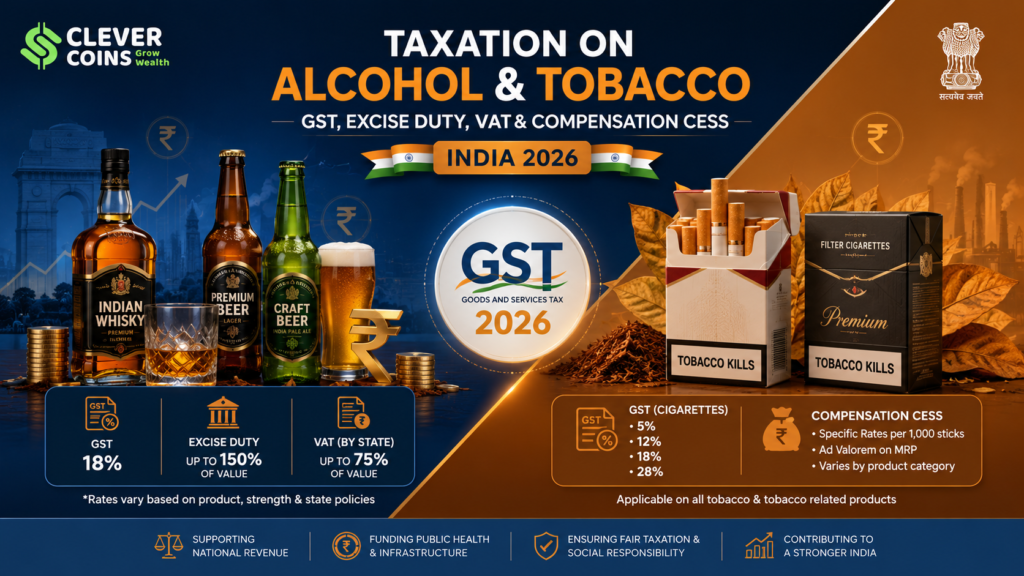
goods and services that fall squarely under the Goods and Services Tax (GST) regime introduced In India, alcohol and tobacco occupy a unique position in the taxation framework. Unlike most on 1st July 2017, both alcohol for human consumption and tobacco products are treated with significant distinctions. This blog offers an exhaustive, up-to-date overview of how GST, excise duties, VAT, and Compensation Cess apply to alcohol and tobacco in India as of 2026.
Whether you are a business owner, a tax consultant, a hospitality professional, or simply a curious citizen, this guide will help you understand the layered tax structure, the rationale behind it, ITC eligibility, compliance requirements, and the latest GST Council notifications that shape this sector.
Why Do Alcohol & Tobacco Receive Special Tax Treatment Under GST?
The GST framework is built on the principle of one nation, one tax. However, the framers of the Constitution (101st Amendment) Act, 2016 deliberately kept certain goods outside the purview of GST. The rationale for treating alcohol and tobacco differently includes:
- Revenue Dependency of State Governments: Alcohol for human consumption is a significant source of revenue for states. In FY 2024-25, state excise revenues from alcohol exceeded Rs. 3.5 lakh crore nationally. Bringing alcohol under GST would disturb this revenue stream.
- Public Health Policy: Both products are classified as ‘sin goods’ — items deemed harmful to public health. Higher taxes act as a deterrent to consumption.
- Political Sensitivity: Alcohol policy has historically been a state subject, and states are unwilling to cede control to a central authority.
- Dual Control Architecture: The Constitution enables Parliament to levy GST on goods produced in India, but Article 246A read with Entry 54 of State List preserves state power over alcohol taxation.
GST on Alcohol for Human Consumption — Detailed Analysis 2026
Is Alcohol Exempt from GST?
Yes, alcoholic liquor for human consumption is completely outside the scope of GST under Section 9(1) of the CGST Act, 2017. This means no CGST, SGST, or IGST is applicable on the sale or manufacture of alcoholic beverages for human consumption.
However, the following are taxable under GST:
- Industrial alcohol / denatured alcohol — attracts 18% GST
- Rectified spirit used for industrial purposes — 18% GST
- Ethanol used as fuel (blending with petrol) — 5% GST (as per Notification No. 06/2021-Central Tax (Rate))
- Services related to alcohol (restaurants, bars, clubs) — 5% GST without ITC or 18% GST with ITC depending on the establishment
What Taxes Apply to Alcohol for Human Consumption?
In the absence of GST, states levy multiple taxes:
Tax Type | Levied By | Applicable On |
State Excise Duty | State Government | Manufacture & Sale |
VAT (Value Added Tax) | State Government | Retail Sale |
Additional Excise / Special Fees | State Government | Import/Export from state |
Import Pass Fee / Transport Fee | State Excise Dept. | Inter-state movement |
Licence Fees | State Excise Dept. | Retailers / Bars / Hotels |
State-wise Excise Duty & VAT on Alcohol — Illustrative Rates 2025-26
Each state sets its own excise duty structure. Here is an illustrative comparison:
State | Excise Duty (Beer) | Excise Duty (IMFL) | VAT on Liquor |
Maharashtra | Rs. 8–10/litre | ~Rs. 150–400/litre | 25%–35% |
Karnataka | Rs. 7–12/litre | ~Rs. 180–350/litre | 20%–32% |
Delhi | Rs. 10–15/litre | ~Rs. 200–450/litre | 25% |
Rajasthan | Rs. 5–8/litre | ~Rs. 120–300/litre | 22%–28% |
Tamil Nadu | Rs. 8–11/litre | ~Rs. 160–380/litre | 26%–30% |
Note: These figures are illustrative and based on publicly available state budget documents and excise notifications. Exact rates vary by brand, category (IMFL, Country Liquor, Beer, Wine), and strength of alcohol.
Input Tax Credit (ITC) on Alcohol Business
Since alcohol for human consumption is outside the GST regime, businesses in the alcohol supply chain (breweries, distilleries, liquor retailers) cannot claim ITC on GST paid on their inputs, capital goods, or services. This creates a cascading tax effect which has been a long-standing criticism of the current structure.
However, a bar/restaurant that sells both food and alcohol can claim ITC only on inputs attributable to the taxable food portion.
GST on Restaurants & Bars Serving Alcohol
- Standalone restaurants: 5% GST on food & non-alcoholic beverages only; no GST on alcohol itself
- Hotel restaurants with room tariff above Rs. 7,500/night: 18% GST on food; alcohol billed separately under state VAT
- Clubs and bars: GST applies on membership fees and food; alcohol billed under state VAT/excise
GST on Tobacco Products — Comprehensive Breakdown 2026
Is Tobacco Under GST?
Yes. Unlike alcohol, tobacco and tobacco products ARE subject to GST. However, they also attract an additional Compensation Cess, making them among the most heavily taxed products in India. The GST structure for tobacco was established under Schedule IV of the GST (Compensation to States) Act, 2017.
GST Rate Structure for Tobacco Products — 2026
Product | GST Rate | Compensation Cess | Total Tax Load |
Cigarettes (< 65mm) | 28% | 5% + Rs. 2076/1000 sticks | Approx. 52%+ |
Cigarettes (65–75mm) | 28% | 5% + Rs. 3668/1000 sticks | Approx. 55%+ |
Cigarettes (> 75mm) | 28% | 5% + Rs. 4170/1000 sticks | Approx. 60%+ |
Beedi (Machine Made) | 28% | Rs. 16/1000 sticks | ~28.5% |
Beedi (Hand-Rolled) | 28% | NIL | 28% |
Chewing Tobacco (unbranded) | 28% | 160% | ~188% |
Chewing Tobacco (branded) | 28% | 160% | ~188% |
Pan Masala (with tobacco) | 28% | 51% (ad valorem) | ~79% |
Pan Masala (without tobacco) | 18% | NIL | 18% |
Hookah / Flavoured Tobacco | 28% | 72% (ad valorem) | ~100% |
Khaini / Zarda | 28% | 160% | ~188% |
Snuff (dry / moist) | 28% | 72% | ~100% |
Cigars & Cheroots | 28% | 21% or Rs. 4170/1000 sticks (higher) | Approx. 50%+ |
Source: GST Rate Schedule — Schedule IV (Sin Goods), GST Council Notifications (updated 2026). Rates may be revised by GST Council.
What is Compensation Cess on Tobacco?
The Compensation Cess was introduced under the GST (Compensation to States) Act, 2017 to compensate states for revenue loss due to GST implementation for the first 5 years. Although the initial 5-year window ended in June 2022, the GST Council extended the cess collection beyond June 2026 to repay loans taken during COVID-19 to compensate states. As of 2026, the Compensation Cess on tobacco continues to be levied.
National Calamity Contingent Duty (NCCD) on Tobacco
Apart from GST and Compensation Cess, cigarettes and some tobacco products also attract the National Calamity Contingent Duty (NCCD), a central excise component that survived the GST transition. NCCD is levied under the Finance Act and is currently applicable at the following rates for cigarettes:
- Non-filter cigarettes up to 65mm: Rs. 200 per thousand
- Filter cigarettes up to 65mm: Rs. 400 per thousand
- Filter cigarettes 65–75mm: Rs. 1,000 per thousand
- Filter cigarettes > 75mm: Rs. 1,200 per thousand
ITC (Input Tax Credit) on Tobacco — Rules & Restrictions
Section 17(5) of the CGST Act explicitly blocks ITC on goods used for personal consumption. However, for businesses manufacturing tobacco products (e.g., cigarette companies), ITC is available on inputs, capital goods, and input services used in the course of business.
Key ITC rules for tobacco businesses:
- ITC on raw leaf tobacco, packaging, machinery — ALLOWED for manufacturers
- ITC on Compensation Cess paid on tobacco — NOT available
- ITC on services (advertising, logistics) used for tobacco — ALLOWED
- Retailers cannot claim ITC on cigarettes purchased for resale if they are under composition scheme
Reverse Charge Mechanism (RCM) Applicability
Unregistered dealers supplying tobacco leaf to tobacco manufacturers attract RCM under GST. The tobacco manufacturer registered under GST must pay GST under RCM for purchases from unregistered farmers of raw tobacco leaf (HSN 2401) at 5% GST.
HSN Codes for Alcohol & Tobacco — Quick Reference 2026
HSN Code | Product Description | GST Rate | Cess |
2203 | Beer made from malt | Outside GST | N/A |
2204 | Wine of fresh grapes | Outside GST | N/A |
2207 | Undenatured ethyl alcohol ≥80% ABV | 18% | NIL |
2208 | Spirits, whisky, brandy, gin, vodka | Outside GST | N/A |
2401 | Unmanufactured tobacco / tobacco refuse | 5% | NIL |
2402 | Cigars, cigarettes, cigarillos | 28% | As applicable |
2403 | Other manufactured tobacco (beedi, khaini, etc.) | 28% | As applicable |
GST Compliance for Alcohol & Tobacco Businesses in 2026
GST Registration Requirements
Any person making taxable supplies of tobacco products with aggregate turnover exceeding Rs. 40 lakhs per annum (Rs. 20 lakhs for special category states) must obtain GST registration.
For alcohol businesses (since the product is outside GST), GST registration may still be required for:
- Services component (restaurant, bar, club services) — mandatory if turnover exceeds threshold
- Supply of industrial/denatured alcohol — mandatory GST registration
- Import/export of alcohol products — IGST implications apply on import
Returns Filing for Tobacco Manufacturers & Traders
- GSTR-1: Monthly/Quarterly return for outward supplies (due 11th/13th of next month)
- GSTR-3B: Monthly/Quarterly summary return with tax payment (due 20th/22nd/24th of next month)
- GSTR-9: Annual return by 31st December
- GSTR-9C: Reconciliation statement if turnover > Rs. 5 crore
E-Way Bill Requirements
E-way bills are mandatory for inter-state movement of tobacco products where consignment value exceeds Rs. 50,000. Since alcohol is largely outside GST, e-way bills under GST do not apply to alcohol. However, states like Maharashtra, Karnataka, and Tamil Nadu have their own e-permit or e-pass systems for alcohol movement.
FSSAI & Other Regulatory Compliance
Alcohol and tobacco businesses must also comply with:
- FSSAI licence (for food-grade alcohol and tobacco products)
- State Excise Department licence
- Central Excise registration for cigarette manufacturers
- COTPA 2003 compliance (Cigarettes and Other Tobacco Products Act)
- Plastic packaging norms under EPR (Extended Producer Responsibility)
Impact of GST & Sin Tax Structure on Industry & Consumers in 2026
Impact on Tobacco Industry
India is the second-largest tobacco producer globally and the third-largest cigarette manufacturer. The tobacco industry in India employs over 4.57 crore people directly and indirectly. The cumulative GST + Compensation Cess + NCCD results in total tax incidence of 50%–65% on cigarettes, which has:
- Led to increased demand for illicit/smuggled cigarettes (estimated at Rs. 22,000 crore loss annually)
- Affected the legal beedi industry significantly
- Increased price of branded tobacco products, impacting consumers in lower income groups
- Generated Rs. 67,500+ crore in tax revenue for the Centre and states combined in FY 2024-25
Impact on Alcohol Industry
The exclusion of alcohol from GST has created:
- Cascading tax effect: Manufacturers bear GST on inputs but cannot claim ITC, increasing costs
- Price distortion: A bottle of whisky priced at Rs. 700 MRP may carry tax burden of 50–200% depending on state
- Barrier to inter-state trade: Multiple state-specific licences and permits increase compliance cost
- Growth in craft beer and premium wine segments despite tax burden
- The Indian alcohol market is projected to reach Rs. 8.2 lakh crore by FY 2026-27
Pricing Example — Bottle of IMFL Whisky (750ml, Maharashtra)
Component | Amount (Rs.) |
Ex-Distillery Price (EDP) | Rs. 175 |
Basic Excise Duty | Rs. 210 (approx.) |
Additional Excise Duty | Rs. 35 |
VAT @ 25% on assessable value | Rs. 110 |
Retailer Margin | Rs. 70 |
MRP (approx.) | Rs. 600 – Rs. 650 |
Effective Tax Burden | ~58–65% of MRP |
Note: These are approximate illustrative figures. Actual prices depend on brand category (IMFL, Premium, Prestige, Economy), state policies, and distillery agreements.
Recent GST Council Decisions & Notifications Affecting Alcohol & Tobacco (2024–2026)
52nd GST Council Meeting Highlights (Relevant to Tobacco/Alcohol)
- Compensation Cess on tobacco products continued beyond June 2026 to service GST compensation loans
- NCCD rates for cigarettes revised upward marginally in Union Budget 2025
- Discussion ongoing on bringing alcohol under GST — no final decision as of 2026
Finance Act 2025 Changes
- NCCD on cigarettes increased: Rs. 200–1,200 per thousand sticks
- Basic customs duty on imported liquor revised to 150% (ad valorem)
- Ethanol blending programme extended; GST on ethanol for fuel retained at 5%
Demand to Bring Alcohol Under GST — Current Status
The demand to bring alcoholic liquor under a unified GST framework has been debated at multiple GST Council meetings. As of 2026, the consensus remains that:
- States are not ready to cede revenue control on alcohol
- A dual-rate system (similar to petroleum) may eventually be considered
- The 16th Finance Commission is examining the issue
Legal & Constitutional Framework Governing Alcohol & Tobacco Taxation
Constitutional Provisions
- Article 246A: Gives Parliament and State Legislatures concurrent power to make GST laws
- Entry 54 of State List (Schedule VII): Tax on sale of goods other than newspapers — gives states power on alcohol
- Section 9(1) of CGST Act, 2017: Excludes alcoholic liquor for human consumption from GST
- Section 9(2) of CGST Act, 2017: Empowers GST Council to include petroleum products and others under GST (alcohol not included)
Key Legislation
- CGST Act, 2017
- IGST Act, 2017
- GST (Compensation to States) Act, 2017
- COTPA (Cigarettes and Other Tobacco Products Act), 2003
- State Excise Acts (e.g., Maharashtra Prohibition Act, Karnataka Excise Act)
- Food Safety and Standards Act (FSSA), 2006
Key Challenges & Issues in Taxing Alcohol & Tobacco Under the Current System
1. Cascading Effect on Manufacturers
Since alcohol is outside GST, manufacturers cannot claim ITC on GST paid on capital goods, services, and inputs. This increases the cost of production and is ultimately borne by consumers.
2. Inter-State Trade Complexity
Alcohol requires separate permits for inter-state movement from each state. There is no single unified framework, leading to delays, increased compliance cost, and opportunities for rent-seeking by local authorities.
3. Illicit Trade in Tobacco
The extremely high tax burden on cigarettes (50%–65%) has made illicit trade economically attractive. Smuggled cigarettes from neighboring countries and counterfeit products deny the government significant revenue.
4. Disparate State Rates
Significant variation in alcohol taxes across states leads to border trade and bootlegging. Consumers from high-tax states often purchase from neighbouring low-tax states, leading to loss of revenue for high-tax states.
5. Health vs. Revenue Trade-off
Higher taxes reduce consumption (positive for health) but increase tax evasion and illicit trade (negative for revenue and governance). India has struggled to find the right balance.
Way Forward — Should India Bring Alcohol Under GST?
Economists and industry bodies have long argued for bringing alcohol under GST for the following reasons:
- Elimination of cascading taxes would reduce prices or increase margins
- Unified compliance framework would reduce bureaucratic burden
- Better data tracking through GST returns would curb illicit trade
- States can be compensated through devolution of cess revenues
However, the political economy of alcohol taxation in India makes this a complex reform. The 16th Finance Commission and successive GST Councils will continue to deliberate on this critical question.
Conclusion
The taxation of alcohol and tobacco in India is a fascinating intersection of constitutional law, public health policy, federalism, and fiscal economics. While tobacco is firmly within the GST ambit with additional layers of Compensation Cess and NCCD, alcohol continues to operate outside the GST framework — taxed instead by state-specific excise duties and VAT.
As India matures its indirect tax system, the eventual inclusion of alcohol under GST remains a possibility — but it will require careful calibration to protect state revenues, curb illicit trade, and serve public health objectives simultaneously.
For businesses in the alcohol or tobacco sector, staying updated on GST Council notifications, state excise changes, and compliance obligations is not just good practice — it is a legal necessity in 2026 and beyond.