1. What Is Anti-Profiteering Under GST?
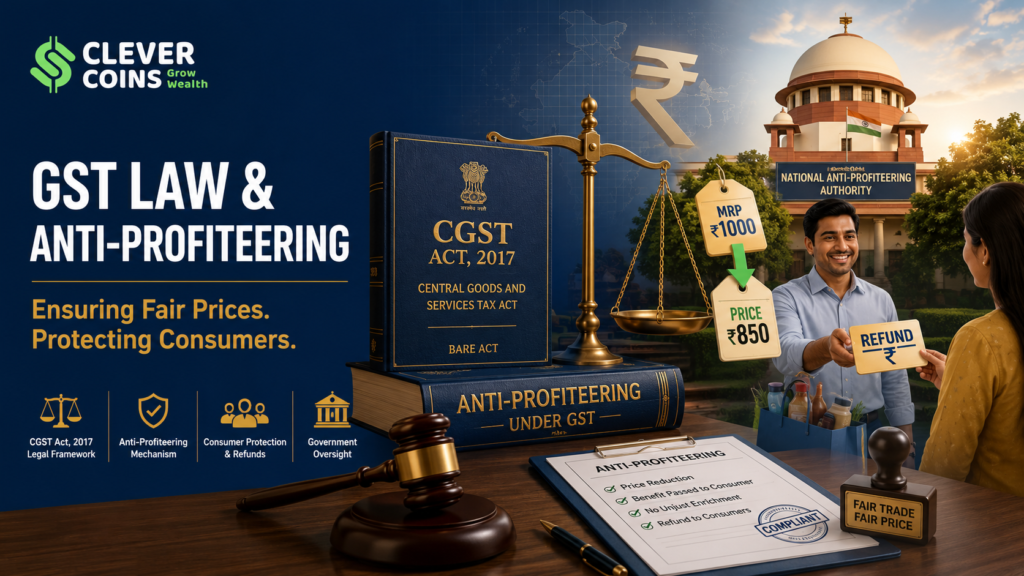
Anti-Profiteering under GST refers to the legal mandate that requires businesses to pass on the benefit of any reduction in tax rates or increased ITC availability to the final consumer through a commensurate reduction in prices. If a business retains the financial benefit for itself instead of passing it on, it is said to have ‘profiteered’ — which is prohibited under Indian law.
Legal Foundation
The legal backbone of anti-profiteering in India is Section 171 of the Central Goods and Services Tax (CGST) Act, 2017. This section explicitly states:
“Any reduction in rate of tax on any supply of goods or services or the benefit of input tax credit shall be passed on to the recipient by way of commensurate reduction in prices.” — Section 171, CGST Act, 2017 |
Why Was This Provision Introduced?
Before GST, businesses often absorbed tax reductions as additional profit margins rather than reducing consumer prices. The Government of India introduced anti-profiteering to:
- Protect consumer interests across the country
- Maintain the integrity of the GST rate reduction process
- Ensure transparency in pricing for goods and services
- Build trust in the GST system among the general public
- Prevent businesses from exploiting transitional or rate-change periods
2. Key Provisions of Anti-Profiteering Rules, 2017
The Central Government notified the Anti-Profiteering Rules, 2017 under the CGST Act. These rules lay down the procedure, authority structure, and penalty mechanism for dealing with profiteering complaints in India.
Rule 126 – Power to Determine Methodology and Procedure
Under Rule 126, the National Anti-Profiteering Authority (NAA) was empowered to determine the methodology and procedure for investigation of profiteering complaints. The methodology included comparing pre-GST and post-GST prices, calculating the net benefit not passed on, and computing the total amount to be refunded to consumers.
Rule 127 – Duties of the National Anti-Profiteering Authority
The NAA was responsible for:
- Determining whether a supplier has profiteered from GST rate reductions or ITC benefits
- Ordering reduction in prices
- Ordering refund of amounts collected by way of profiteering (with 18% interest)
- Imposing penalties on defaulting suppliers
- Cancelling GST registration in extreme cases
Rule 128 – Application to Standing Committee / Screening Committee
A consumer or any interested party can file an anti-profiteering complaint through the Standing Committee on Anti-Profiteering (national level) or through State-level Screening Committees. The application must include details of goods/services, the pre and post tax price difference, and the alleged profiteering amount.
3. National Anti-Profiteering Authority (NAA) — Overview & 2026 Update
The National Anti-Profiteering Authority was established in November 2017 under Section 171 of the CGST Act. It was set up as a quasi-judicial body to investigate complaints of profiteering and ensure compliance with anti-profiteering provisions.
Constitution of NAA
The NAA was headed by a Chairman of the rank of Principal Secretary / Additional Secretary to the Government of India, along with four Technical Members from the Indian Revenue Service (IRS).
2026 Update — Transition to Competition Commission of India (CCI)
IMPORTANT 2026 UPDATE: The National Anti-Profiteering Authority (NAA) was initially given a 2-year tenure (extended multiple times). As per the CGST (Amendment) Act and subsequent government notifications, the anti-profiteering function has been transferred to the Competition Commission of India (CCI) effective from October 1, 2024. From this date, all anti-profiteering complaints and investigations are handled by the CCI. Pending NAA cases were transferred to CCI for disposal. |
Role of CCI in Anti-Profiteering (2024–2026)
The Competition Commission of India now handles all anti-profiteering matters and brings with it stronger investigative infrastructure, legal expertise, and enforcement capabilities. The CCI leverages its existing framework under the Competition Act, 2002, in conjunction with the CGST Act provisions to adjudicate anti-profiteering cases.
- CCI has its own Director General (Investigation) for conducting detailed inquiries
- CCI can impose penalties, direct price corrections, and order consumer refunds
- CCI has powers similar to a civil court for examination of witnesses and document production
- The shift to CCI has been welcomed as it brings more institutional credibility and resources
4. What Constitutes Profiteering Under GST?
Not every price increase after a GST rate change constitutes profiteering. However, businesses must be careful to distinguish between legitimate cost increases and retention of GST benefits. Profiteering occurs when:
Scenario A — Tax Rate Reduction
When the GST Council reduces the GST rate on a particular product or service, and the supplier does not reduce the selling price commensurately. For example:
Parameter | Before GST Rate Cut | After GST Rate Cut |
Base Price (INR) | ₹1,000 | ₹1,000 |
GST Rate | 18% | 12% |
GST Amount (INR) | ₹180 | ₹120 |
Final Price (INR) | ₹1,180 | ₹1,060 (Compliant) |
Profiteering If Charged | — | ₹1,180 (Retained ₹60) |
Scenario B — Increased ITC Availability
Under GST, businesses can claim ITC on purchases. When ITC availability increases (e.g., due to GST coverage of previously exempt goods), the net cost of production reduces. The supplier must pass this benefit to consumers. If the supplier retains it, that constitutes profiteering.
What Does NOT Constitute Profiteering?
The law recognises that prices can legitimately increase due to:
- Rise in raw material or input costs
- Increased labour costs or overhead expenses
- Changes in market conditions unrelated to GST
- New compliance costs
- Genuine product/service upgrades
5. How to File an Anti-Profiteering Complaint in 2026?
Any consumer, registered dealer, or association can file an anti-profiteering complaint. Since the transition of authority to CCI in 2024, the filing procedure has been updated.
Step-by-Step Complaint Procedure
- Identify the supplier and specific goods/services where profiteering is alleged
- Collect evidence: invoices before and after the GST rate change, price lists, advertisements
- File a written application with the State Screening Committee (for local cases) or the CCI (for national-level cases)
- The Screening Committee examines the application and if a prima facie case exists, refers it to the CCI’s Director General
- The Director General (Investigation) conducts an inquiry and submits a report to CCI
- CCI reviews the report and issues show-cause notice to the accused supplier
- The supplier is given an opportunity to be heard
- CCI passes a final order — directing refund, price correction, or imposing penalty
Documents Required for Filing
- Copy of purchase invoice (pre and post rate change)
- Details of the goods/services (HSN code, description)
- Name and address of the supplier
- Amount of alleged profiteering (calculated)
- Any correspondence with the supplier regarding the price change
- Affidavit verifying the facts of the complaint
6. Investigation Process by the Director General (DG)
Once a complaint is referred for investigation, the Director General (Investigation) under CCI carries out a detailed inquiry. This is a structured and time-bound process.
Powers of the Director General
- Summon and enforce attendance of any person for examination
- Require discovery, inspection, and production of any document
- Accept evidence on affidavit
- Requisition public records from any court or office
- Issue commissions for examination of witnesses or documents
The DG must complete the investigation and submit its report within a stipulated time period (generally within 3 months, extendable by CCI).
Methodology for Determining Profiteering
The DG uses the following standard approach to calculate the profiteering amount:
- Identify the pre-rate change base price and GST rate
- Identify the post-rate change GST rate
- Calculate what the new MRP/price should be after GST rate reduction
- Compare with the actual price charged post rate change
- Calculate the excess amount charged (profiteering quantum)
- Multiply by the number of units sold/quantity during the investigation period
- Total profiteering = Amount to be refunded to customers
7. Penalties for Anti-Profiteering Violations in 2026
The consequences of being found guilty of profiteering under GST are significant. The CCI has the power to impose various penalties and directions.
Types of Orders and Penalties
Type of Order | Details |
Refund Order | Supplier must refund the profiteered amount to the consumer along with 18% interest per annum from the date of collection. If the consumer cannot be identified, the amount is deposited in the Consumer Welfare Fund. |
Price Reduction Order | CCI can direct the supplier to reduce the price of goods/services immediately and maintain reduced price for a specified period. |
Penalty for Non-Compliance | Under Section 171(3A) CGST Act: Penalty equal to 10% of the profiteered amount for failing to pass on the benefit. |
GST Registration Cancellation | In extreme cases of repeated or deliberate violation, CCI can recommend cancellation of GST registration of the supplier. |
Criminal Prosecution | False filing of documents during investigation can attract criminal prosecution under CGST Act provisions. |
8. ITC Benefit Pass-On Requirement — Detailed Analysis
One of the most common and complex areas of anti-profiteering involves the pass-on of ITC benefits. When GST was introduced, many businesses gained the ability to claim ITC on inputs that were previously not creditable. This reduced their effective tax cost, and the benefit of such reduction must be passed to consumers.
Practical ITC Example
Example: A manufacturer of packaged food previously paid VAT at 12.5% with no credit available on input services. Under GST, the same product attracts 5% GST, plus ITC is available on all inputs and services. The net cost per unit reduces by approximately ₹15 per ₹100 of production cost. This ₹15 benefit must be reflected in the selling price. If the selling price remains unchanged, the manufacturer is profiteering ₹15 per unit. |
Challenges in ITC Pass-On Calculation
Computing ITC benefit pass-on is not always straightforward. Challenges include:
- Multiple tax rates across inputs — blended rate calculation required
- Partial ITC eligibility (e.g., blocked credits under Section 17(5) CGST Act)
- Seasonal fluctuations in input costs masking ITC benefit
- Mix of B2B and B2C sales — determining which recipient gets the benefit
- Transitional credit (TRAN-1, TRAN-2) calculation complexities
9. Real-World Anti-Profiteering Cases in India
Since 2017, hundreds of anti-profiteering cases have been decided in India. Here are key illustrative examples based on reported orders:
Case 1 — FMCG Sector (Everyday Consumer Products)
One of India’s largest FMCG companies was found to have not reduced the MRP of several packaged goods after the GST rate was cut from 28% to 18% in November 2017. The investigation revealed that the company had reduced pack sizes (shrinkflation) without reducing price, effectively retaining the GST benefit. The company was ordered to refund the profiteered amount of approximately ₹223 crore.
Case 2 — Real Estate Sector
A prominent real estate developer was found guilty of not passing on the ITC benefit to homebuyers after GST was introduced. The developer had gained significant ITC on construction materials and services but had not reduced flat prices. The NAA/CCI ordered refund of the ITC benefit to affected homebuyers — each buyer received a refund ranging from ₹50,000 to ₹2,50,000 depending on the size and cost of their apartment.
Case 3 — Restaurant Sector
When GST on restaurant services was reduced from 18% (with ITC) to 5% (without ITC) in November 2017, many restaurant chains were found to have not reduced menu prices. Several restaurant chains across major Indian cities faced investigations and were ordered to reduce prices and refund amounts to customers.
10. Sectors Most Prone to Anti-Profiteering Scrutiny in 2026
Certain sectors remain under heightened anti-profiteering vigilance given their size, consumer interaction, and history of non-compliance:
High-Risk Sectors
Sector | Key Risk Area | Common Profiteering Type |
FMCG / Retail | High consumer volume, frequent rate changes | Not reducing MRP, shrinkflation |
Real Estate | Large transaction values, complex ITC | ITC benefit not passed to buyers |
Restaurants / QSR | Mass retail, daily transactions | Menu price not reduced after rate cut |
Pharma / Healthcare | Essential goods, price sensitive | GST rate reduction not in MRP |
Telecom | Large ITC on infrastructure | Service charges not reduced |
E-Commerce | High volume, multiple sellers | Seller-level profiteering monitoring |
Auto Industry | GST and cess changes | Vehicle prices not adjusted |
11. Compliance Best Practices for Businesses in 2026
To avoid anti-profiteering scrutiny and penalties, businesses must adopt proactive compliance measures. Here are the best practices:
1. Maintain Detailed Pricing Records
Maintain complete, time-stamped pricing records for all products and services. Document the pre-rate change price, the GST rate applicable, and the post-rate change price with justification for each. These records can be the first line of defence during a CCI investigation.
2. Conduct Internal Anti-Profiteering Audits
Before each GST Council meeting (held approximately 4–5 times a year), prepare for possible rate changes. After any rate change notification, conduct an immediate internal audit to determine which SKUs or services are affected and calculate the required price reduction.
3. Update MRP and Price Lists Promptly
Once a GST rate change is notified, businesses must update MRP/price lists as soon as practically possible — ideally within 30 days. For FMCG and packaged goods companies, printing new labels with revised MRP is mandatory. Selling old-labelled stock with outdated MRP beyond a reasonable period can attract scrutiny.
4. Train Sales and Finance Teams
Your sales and finance teams must be aware of anti-profiteering obligations. Invest in regular training workshops on:
- How to calculate commensurate price reduction
- Documentation requirements
- Response procedures if a complaint is filed
- Understanding what CCI investigation entails
5. Engage a GST Consultant / Tax Advisor
Given the complexity of ITC benefit calculations and sector-specific rules, engaging a qualified GST consultant or CA firm with anti-profiteering expertise is strongly recommended. A good advisor can help you structure pricing decisions in a compliant manner and represent you before the CCI if needed.
6. Use Technology for Compliance
Implement ERP or accounting software that can automatically flag price revisions needed after GST rate changes. Many modern GST-compliant software solutions in India now include anti-profiteering modules that:
- Monitor rate change notifications
- Calculate the minimum required price reduction
- Generate audit-ready reports for each SKU
- Maintain customer-wise benefit pass-on records
12. Anti-Profiteering and Real Estate — Special Provisions
Real estate is among the most complex sectors for anti-profiteering compliance due to the high transaction values, long project timelines, and the shift from old tax regime to GST.
Under Construction Properties
For under-construction properties (where GST applies), developers must pass on the net ITC benefit to buyers. The NAA had developed a specific methodology for real estate where the ITC as a percentage of the total project cost is computed, and a commensurate reduction in the per sq. ft. price is required to be offered/refunded.
Consumer Welfare Fund — Real Estate Refunds
Where the homebuyer cannot be identified or has settled the full payment, the profiteered amount is deposited into the Consumer Welfare Fund maintained by the Central Government. The fund was established under Section 57 of the CGST Act and is used for consumer protection activities.
Note: As of 2026, the transition to the new GST rates for residential real estate (1% for affordable housing, 5% for other residential properties — without ITC) has settled most ongoing anti-profiteering issues for new projects. However, old ongoing projects that started under the pre-April 2019 regime may still face scrutiny on ITC benefits gained during that period. |
13. Anti-Profiteering vs. Price Monitoring — Key Differences
Aspect | Anti-Profiteering (GST) | General Price Monitoring |
Legal Basis | Section 171, CGST Act 2017 | Essential Commodities Act / Market Forces |
Trigger | GST rate change or ITC increase | General price rise or inflation |
Authority | CCI (from Oct 2024) | State Governments / DPIIT |
Scope | GST-registered suppliers only | All sellers including unregistered |
Consumer Action | File formal complaint | Report to consumer forum or state body |
Penalty | 10% + refund + 18% interest | Varies by law |
14. Recent Developments & 2026 Anti-Profiteering Landscape
Key 2024–2026 Developments
- Transfer of anti-profiteering jurisdiction from NAA to CCI effective October 1, 2024, bringing institutional permanence to the function
- CCI has issued new operational guidelines for handling anti-profiteering complaints as a distinct function
- The Finance Act 2023 introduced a sunset clause — anti-profiteering complaints must relate to rate changes/ITC increases that occurred after July 1, 2017, and complaints must be filed within a reasonable period
- GST Council in 2025 rationalised several slab rates, creating new anti-profiteering obligations for affected sectors including insurance, health supplements, and electric vehicles
- The government has increased the digitisation of complaint filing and status tracking through the GST Portal
- Sector-specific anti-profiteering guidelines have been issued for pharma, real estate, and QSR sectors
Outlook for Anti-Profiteering Enforcement in 2026
With CCI now handling anti-profiteering, enforcement is expected to become more systematic, data-driven, and efficient. CCI’s access to market intelligence, competition data, and its experienced investigative team positions it well to handle complex profiteering cases. Businesses must treat anti-profiteering compliance as an ongoing operational responsibility rather than a one-time exercise.
15. Frequently Asked Questions (FAQs) on Anti-Profiteering Under GST
Q1. Can a business increase prices after a GST rate cut due to increased costs?
Yes, but with caution. If input costs have genuinely increased and exceed the GST benefit, businesses can maintain or even increase prices. However, they must maintain documented evidence of the cost increase. If challenged, they must prove that the price increase is attributable to higher input costs, not retention of GST benefits.
Q2. Is anti-profiteering applicable only to B2C transactions?
While the primary intent is consumer protection, anti-profiteering provisions apply to all supplies — B2C and B2B. However, in B2B transactions, the registered buyer also claims ITC, so the impact is different. The focus of enforcement is predominantly on B2C supplies where end consumers bear the tax burden.
Q3. What if there are multiple products and only some are affected by rate changes?
Businesses must determine the impact on each product separately. Cross-subsidisation (using profit retained on one product to compensate for the benefit passed on another) is generally not accepted by CCI. Each SKU must comply independently.
Q4. Can the profiteered amount be deposited in the Consumer Welfare Fund instead of refunding?
Yes. Where it is practically impossible to identify and refund individual customers (e.g., thousands of retail customers across India), the CCI can order the profiteered amount to be deposited in the Consumer Welfare Fund. This is a legitimate resolution route, subject to the CCI’s approval.
Q5. What is the limitation period for filing an anti-profiteering complaint in 2026?
While no specific limitation period was initially prescribed, courts and the NAA have indicated that complaints should be filed reasonably promptly after the alleged profiteering. The Finance Act 2023 introduced further clarity on this aspect. As a practical guideline, complaints should be filed within 2 years of the alleged profiteering event for them to be considered on merit.
Conclusion — Why Anti-Profiteering Matters in India’s GST Journey
Anti-profiteering is not merely a compliance obligation — it is a cornerstone of India’s consumer-centric GST philosophy. By ensuring that tax benefits reach the end consumer, the government has tried to make GST a truly people-friendly tax reform. For businesses, proactive compliance with anti-profiteering rules is the safest path. In 2026, with CCI at the helm, enforcement is more structured and credible than ever before. Businesses that invest in compliance infrastructure, maintain transparent pricing, and pass on GST benefits will not only avoid penalties but also build long-term trust with consumers and regulators alike. |