Securities Transaction Tax (STT) in India
Securities Transaction Tax (STT) is a direct tax levied on the purchase and sale of securities listed on recognised stock exchanges in India. Introduced by the Finance Act, 2004, and effective from 1 October 2004, STT was designed to replace the long-term capital gains (LTCG) tax on listed equity shares and equity-oriented mutual funds — though LTCG has since been reintroduced. Despite that, STT continues to play a pivotal role in India’s tax ecosystem for financial markets.
For the Financial Year 2025-26 (Assessment Year 2026-27), the Government of India has maintained and slightly revised STT rates in line with the Union Budget 2025-26. This comprehensive guide covers every aspect of STT — from its legal framework and applicable rates to its impact on traders, investors, and mutual fund participants in India.
Legal Framework and Governing Authority
Statutory Basis
STT is governed under Chapter VII of the Finance (No. 2) Act, 2004. The Central Board of Direct Taxes (CBDT) under the Ministry of Finance administers and oversees STT collection and compliance.
Who Collects STT?
STT is collected by the Stock Exchange (such as BSE or NSE) or the Mutual Fund House at the time of the transaction. It is then deposited with the Central Government by the 7th of the following month.
Recognised Stock Exchanges Covered
- Bombay Stock Exchange (BSE)
- National Stock Exchange (NSE)
- Metropolitan Stock Exchange of India (MSE)
- National Commodity & Derivatives Exchange (NCDEX) — for equity derivatives
What Securities Are Covered Under STT?
STT applies to the following financial instruments when transacted on a recognised stock exchange:
- Equity Shares (Delivery-based and Intraday)
- Derivatives — Equity Futures and Options
- Units of Equity-Oriented Mutual Funds
- Unlisted shares sold under an Initial Public Offering (IPO) or Offer for Sale (OFS) which get listed subsequently — at the time of subscription
- Business Trust Units (e.g., InvITs, REITs)
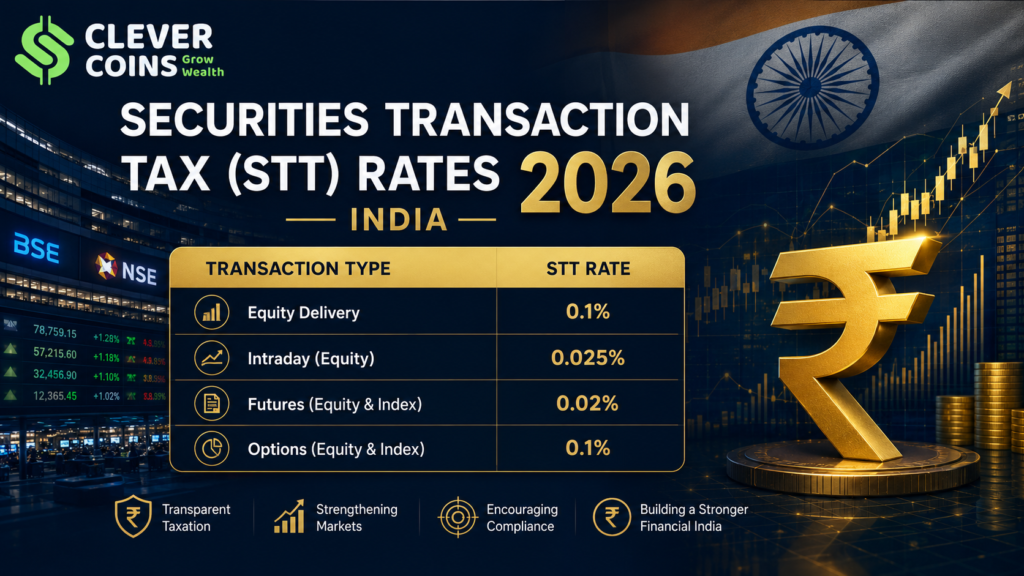
STT Rates 2026 — Complete Rate Table
The following table summarises all applicable STT rates effective for FY 2025-26 (AY 2026-27) as per the Finance Act 2025-26:
Transaction Type | Taxable Amount | STT Rate | Who Pays |
Equity Delivery — Purchase | Purchase Price | 0.1% | Buyer |
Equity Delivery — Sale | Sale Price | 0.1% | Seller |
Equity Intraday — Sale | Sale Price | 0.025% | Seller |
Equity Futures — Sale | Sale Price | 0.02% | Seller |
Equity Options — Sale (Premium) | Premium Value | 0.1% | Seller |
Equity Options — Exercise | Intrinsic Value (Settlement Price) | 0.125% | Buyer |
Equity MF Units — Redemption / Sale | Redemption/Sale Value | 0.001% | Seller |
Unlisted Shares — IPO/OFS Subscription | Issue Price | 0.2% | Seller (Company) |
Business Trust Units — Sale | Sale Price | 0.001% | Seller |
Note: STT on equity options was increased from 0.0625% to 0.1% on premium, and options exercise STT was increased from 0.125% — both changes per Finance Act 2024 remain applicable in FY 2026. Futures STT was raised from 0.0125% to 0.02% effective 1 October 2024 and continues in FY 2026.
STT Calculation Examples with Indian Rupee Amounts
Example 1: Equity Delivery Purchase and Sale
Suppose you buy 200 shares of Reliance Industries at ₹2,800 per share and sell them at ₹3,000 per share.
- STT on Purchase = 200 × ₹2,800 × 0.1% = ₹560
- STT on Sale = 200 × ₹3,000 × 0.1% = ₹600
- Total STT = ₹1,160
Example 2: Equity Intraday Trading
You buy 500 shares of HDFC Bank at ₹1,600 and sell the same day at ₹1,620 (intraday).
- STT on Sale only = 500 × ₹1,620 × 0.025% = ₹202.50
- No STT on intraday purchase
Example 3: Equity Futures
You sell 1 lot (75 units) of Nifty Futures at ₹23,500 per unit.
- STT on Sale = 75 × ₹23,500 × 0.02% = ₹352.50
Example 4: Equity Options — On Premium
You sell 1 lot (75 units) of Nifty Call Option at a premium of ₹250.
- STT on Sale = 75 × ₹250 × 0.1% = ₹18.75
Example 5: Options — On Exercise
You exercise a Nifty Call Option with settlement price of ₹23,800 per unit (1 lot = 75 units).
- STT on Exercise = 75 × ₹23,800 × 0.125% = ₹2,231.25
Example 6: Equity Mutual Fund Redemption
You redeem Equity MF units worth ₹5,00,000.
- STT = ₹5,00,000 × 0.001% = ₹5
STT and Capital Gains Tax — The Important Link
STCG (Short-Term Capital Gains)
If STT has been paid on sale of listed equity shares or equity-oriented mutual fund units, then STCG is taxed at a special rate of 20% (increased from 15% per Budget 2024, effective 23 July 2024 onwards). This continues for FY 2026.
LTCG (Long-Term Capital Gains)
LTCG on listed equity shares and equity-oriented mutual funds exceeding ₹1.25 lakh per financial year is taxed at 12.5% (without indexation). This applies only when STT has been paid on both acquisition and sale.
Business Income (Traders)
For taxpayers who treat F&O or intraday equity trading as business income, STT paid is allowed as a deductible business expense under Section 36(1)(xv) of the Income Tax Act, 1961, provided the income is not claimed under the capital gains head.
Key Changes in STT — Budget 2025-26 (Effective FY 2026)
The Union Budget 2025-26 (presented on 1 February 2025) did not introduce fresh changes to STT rates. However, the following revisions made in the previous year’s budget remain applicable:
Change | Old Rate | New Rate (FY 2026) | Effective Date |
Equity Futures — Sale | 0.0125% | 0.02% | 1 Oct 2024 |
Equity Options — Sale (Premium) | 0.0625% | 0.1% | 1 Oct 2024 |
STCG Tax Rate (STT paid) | 15% | 20% | 23 Jul 2024 |
LTCG Tax Rate (STT paid) | 10% | 12.5% | 23 Jul 2024 |
LTCG Exemption Limit | ₹1 lakh | ₹1.25 lakh | 23 Jul 2024 |
Impact of STT on Different Categories of Market Participants
1. Long-Term Equity Investors
For buy-and-hold investors, STT at 0.1% on both buy and sell is a relatively small transaction cost. It is not deductible as an expense but contributes to establishing the eligibility for the concessional LTCG rate of 12.5%.
2. Intraday Traders
Intraday traders pay STT only on the sell side at 0.025%. While the rate is lower, the high volume of trades can make STT a significant cost. Intraday profits are taxed under business income; STT is not separately deductible but forms part of the cost basis.
3. F&O Traders
The increase in futures STT to 0.02% and options STT to 0.1% on premium from FY 2025 onwards has meaningfully raised trading costs for high-frequency derivatives traders. Options buyers pay no STT on premium; only sellers do. Exercise STT (0.125%) can be large for ITM option holders.
4. Mutual Fund Investors
Equity MF investors pay a nominal STT of 0.001% on redemption only. This is negligible but worth noting for very large redemptions (e.g., ₹1 crore redemption = ₹100 STT).
5. HNIs and Institutional Investors
Foreign Portfolio Investors (FPIs) and Domestic Institutional Investors (DIIs) are also subject to STT on their transactions. STT paid can be set-off against tax liability under Section 88E (for business income), making it somewhat cost-neutral for eligible entities.
STT vs CTT — Understanding the Difference
Commodities Transaction Tax (CTT) is a separate tax levied on non-agricultural commodity derivatives traded on recognised commodity exchanges. STT does not apply to pure commodity trades. Key differences:
Parameter | STT | CTT |
Applicable On | Equity, Equity Derivatives, Equity MF Units | Non-agri commodity derivatives |
Governing Law | Finance Act, 2004 | Finance Act, 2013 |
Rate (Sale of Futures) | 0.02% | 0.01% |
Rate (Options) | 0.1% on premium | Not applicable |
Deductibility | Section 36(1)(xv) for business income | Section 36(1)(xvi) for business income |
STT Exemptions and Refund Provisions
Who is Exempt from STT?
- Transactions on off-market transfers (not on recognised exchanges)
- Government securities and bonds (G-Secs, T-Bills, SDLs)
- Debt mutual funds
- Transactions by market makers in certain derivatives (specific exemptions may apply)
Can STT Be Refunded?
STT once deducted cannot be directly claimed as a refund. However, Section 88E of the Income Tax Act allows a rebate equal to STT paid where the income from securities is treated as business income and assessed as such. The rebate cannot exceed the tax payable on such business income.
STT on IPO, OFS, and Buybacks
STT on IPO Subscription
When shares are sold under an Initial Public Offering (IPO) or Offer for Sale (OFS) that subsequently gets listed, the seller (i.e., the company or promoter) is liable to pay STT at 0.2% of the issue price. The buyer (allottee) does not pay STT at the time of subscription.
STT on Share Buybacks
As per the Finance Act 2024, listed companies undertaking share buybacks are now required to pay STT. However, the buyback itself attracts DDT-equivalent tax at the company level rather than STT. Shareholders are taxed on buyback proceeds as dividend income from 1 October 2024 onwards.
STT Compliance and Reporting for Taxpayers
For Individual Taxpayers
Individual investors/traders need not separately deposit STT — it is auto-deducted by the broker/exchange. However, they must:
- Maintain broker contract notes which show STT charged per transaction
- Report STT amounts in Schedule TDS/STT while filing ITR
- Claim Section 88E rebate if treating gains as business income
ITR Forms Applicable
- ITR-2: For capital gains (no business income from trading)
- ITR-3: For business income from trading (F&O, intraday)
- ITR-4 (Sugam): Only for presumptive business income — F&O and intraday CANNOT use ITR-4
Important Dates for FY 2026
- Last date to file ITR for individuals (non-audit): 31 July 2026
- Last date for audit cases: 31 October 2026
STT as Part of Total Transaction Cost in India (2026)
STT is one of several charges levied on securities transactions. Here is a complete view of all charges an equity delivery investor pays in FY 2026:
Charge | Rate | Approx. on ₹1 Lakh Trade |
Securities Transaction Tax (STT) | 0.1% on sell side | ₹100 (sell side) |
Brokerage (full-service) | 0.3%–0.5% each side | ₹300–₹500 |
Brokerage (discount broker) | Flat ₹20 per order | ₹20 |
Exchange Transaction Charges (NSE) | ~0.00297% | ~₹2.97 |
SEBI Turnover Charges | ₹10 per crore | ₹0.10 |
GST on Brokerage + Exchange Charges | 18% | Variable |
Stamp Duty (buy side) | 0.015% | ₹15 |
DP Charges (sell side, per ISIN) | ~₹13.5 + GST | Flat |
Tax Planning Tips Around STT in FY 2026
Tip 1: Prefer Delivery-Based Investing for Tax Efficiency
Long-term investors holding equity for more than 12 months benefit from the 12.5% LTCG rate (above ₹1.25 lakh) versus 20% STCG. STT paid qualifies the transaction for these concessional rates.
Tip 2: F&O Loss Harvesting
F&O losses (speculative or non-speculative business loss depending on classification) can be set off against other business income. STT is deductible as a business expense in such cases under Section 36(1)(xv).
Tip 3: Avoid Exercise of Deep OTM Options
Options exercise attracts STT at 0.125% on the full settlement value — far higher than the 0.1% on premium. For deep OTM options with very low premium, accidental exercise can result in disproportionate STT. Always monitor positions near expiry.
Tip 4: Maintain Accurate Contract Notes
STT figures on contract notes are essential for claiming the Section 88E rebate and for accurate ITR filing. Retain all contract notes for at least 6 years as per income tax record-keeping requirements.
Frequently Asked Questions (FAQs) on STT 2026
Q1: Is STT applicable on mutual fund SIP purchases?
No. STT is levied only on redemption/sale of equity-oriented mutual fund units — not on the purchase or SIP instalment. The rate on redemption is 0.001%.
Q2: Is STT applicable on bonds and debentures?
No. STT does not apply to government securities, RBI bonds, corporate debentures, or other fixed-income instruments traded on the debt segment.
Q3: Can NRIs claim exemption from STT?
Non-Resident Indians (NRIs) investing through the PIS (Portfolio Investment Scheme) or NRE/NRO accounts are subject to STT in the same way as resident Indians on listed securities.
Q4: Is STT applicable on REITs and InvITs?
Yes. Units of REITs (Real Estate Investment Trusts) and InvITs (Infrastructure Investment Trusts) listed on stock exchanges attract STT at 0.001% on redemption/sale.
Q5: Does STT apply to gold ETFs or silver ETFs?
Gold ETFs and Silver ETFs are not equity-oriented funds; they are treated as debt/commodity funds for tax purposes. STT does not apply to gold ETF or silver ETF transactions.
Q6: What is the penalty for non-payment of STT?
Since STT is collected at source by the exchange/broker, individual investors typically do not face direct STT payment obligations. However, non-collection or under-reporting by the exchange or broker attracts interest under Section 117 and penalty under Section 118 of the Finance Act, 2004.
STT Revenue Collection — India’s Growing Market Impact
STT has emerged as a significant revenue source for the Government of India as equity market participation has surged. The government collected approximately ₹32,000 crore in STT in FY 2023-24, with projections of ₹37,000–40,000 crore for FY 2025-26 given increased F&O volumes and revised rates. This revenue goes directly into the Consolidated Fund of India.
Conclusion
Securities Transaction Tax (STT) in 2026 remains a fundamental component of India’s capital markets taxation framework. Whether you are a long-term equity investor, an active intraday trader, an F&O participant, or a mutual fund investor, understanding the precise STT rates applicable to your transactions is critical for accurate cost estimation, tax planning, and regulatory compliance.
The revised rates on futures (0.02%) and options (0.1% on premium) from FY 2025 onwards continue to impact trading economics significantly. As India’s investor base continues to expand — now crossing 17 crore registered demat accounts — STT awareness is more important than ever.
Always consult a qualified Chartered Accountant (CA) or tax professional for personalised advice, especially for complex F&O portfolios or large capital gains transactions.