Technical Analysis and Candlestick Charts
In the world of financial markets, making sense of price movements is both an art and a science. Technical Analysis is the methodology used by traders and investors to evaluate securities and identify trading opportunities by analysing statistical trends gathered from trading activity — primarily price movement and volume. Unlike Fundamental Analysis, which digs deep into a company’s financials, technical analysis is rooted in the belief that price action reflects all available information and that historical patterns tend to repeat.
Among all the tools available in technical analysis, Candlestick Charts stand out as the most widely used and visually intuitive. Originating from Japan in the 18th century and now the standard across NSE (National Stock Exchange), BSE (Bombay Stock Exchange), MCX, and all major global exchanges, candlestick charts provide a rich visual summary of price action for any time frame — from 1-minute intraday charts to monthly charts.
Whether you are a salaried professional investing through SIPs and equity, a freelancer building a secondary income stream, or an active trader on Zerodha, Groww, Upstox, or Angel One, understanding candlestick basics is your first step toward confident, data-driven market decisions.
What is a Candlestick? History and Origin
History: From Japanese Rice Markets to Dalal Street
Candlestick charts were developed in Japan in the 1700s by Munehisa Homma, a rice trader from Sakata who used price patterns to predict future rice prices. He documented these patterns, which were later refined and introduced to Western technical analysis by Steve Nison in his 1991 book ‘Japanese Candlestick Charting Techniques.’
Today, candlestick charting is universally adopted. Every major trading platform used by Indian traders — including Zerodha Kite, Upstox Pro, TradingView India, NSE NOW, and HDFC Sky — defaults to candlestick charts as the primary chart type.
Why Candlesticks Are Preferred Over Line and Bar Charts
Line charts only show closing prices, missing crucial intraday price action. Bar charts show OHLC data but lack the visual impact of candlesticks. Candlestick charts, on the other hand, deliver the same OHLC data in a format that makes patterns instantly recognisable — helping traders make faster and more confident decisions.
Anatomy of a Candlestick – Understanding Every Component
Each candlestick represents price action for a specific time period — whether it’s 1 minute, 15 minutes, 1 hour, 1 day, or 1 month. It is built from four data points:
|
Component |
Symbol |
Description |
|
Open (O) |
Opening Price |
The price at which the candle’s time period begins trading. |
|
High (H) |
Highest Price |
The highest price reached during the candle’s time period (top of upper shadow/wick). |
|
Low (L) |
Lowest Price |
The lowest price reached during the candle’s time period (bottom of lower shadow/wick). |
|
Close (C) |
Closing Price |
The final price at which trading occurs for the candle’s time period. |
|
Body |
Real Body |
The rectangular section between Open and Close. Green/White = bullish. Red/Black = bearish. |
|
Wick / Shadow |
Upper & Lower Wick |
Thin lines above and below the body showing the High and Low extremes of the period. |
A Green (Bullish) Candle means the closing price was HIGHER than the opening price — buyers were in control. A Red (Bearish) Candle means the closing price was LOWER than the opening price — sellers dominated. The length of the body indicates the strength of the move, while the length of the wicks shows the price rejection at extremes.
Single Candlestick Patterns – The Most Powerful Individual Signals
Single candlestick patterns are formed by just one candle and can provide early and reliable signals about potential reversals or continuations. These are the most commonly traded patterns by intraday and swing traders on NSE and BSE.
1. Doji – The Indecision Candle
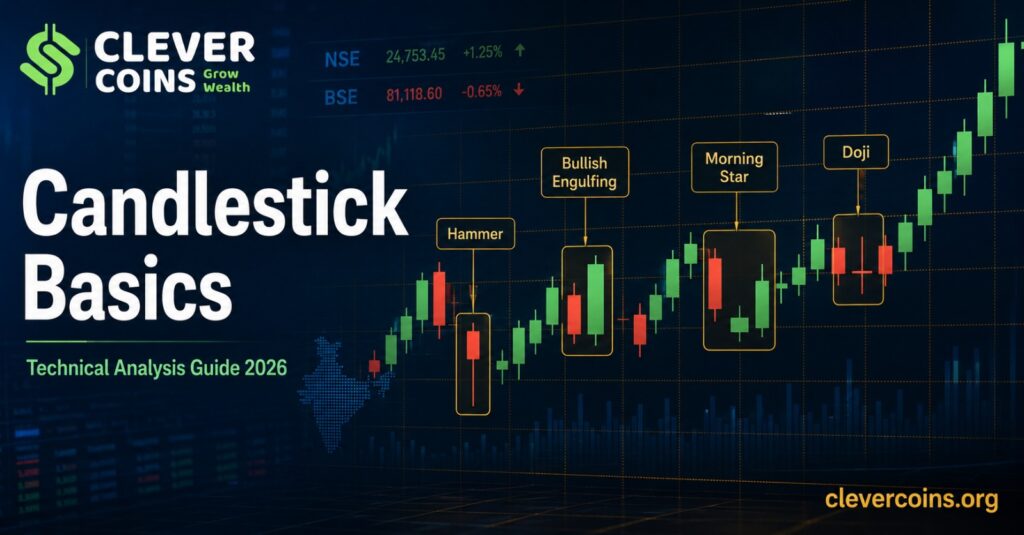
A Doji forms when the Open and Close are almost equal, resulting in a very small or nonexistent body. The wicks can vary in length. A Doji signals market indecision — neither buyers nor sellers have control. When a Doji appears after a prolonged uptrend or downtrend, it often signals a potential reversal.
- Types of Doji: Standard Doji, Long-Legged Doji, Gravestone Doji (bearish), Dragonfly Doji (bullish)
- Example: On Nifty 50 daily chart, a Gravestone Doji near a resistance level is a strong sell signal for swing traders.
2. Hammer – The Bullish Reversal Signal
A Hammer has a small body at the top with a long lower wick (at least 2x the body size) and little to no upper wick. It forms at the bottom of a downtrend and signals that sellers drove the price down significantly but buyers pushed it back up, closing near the open. This is a classic bullish reversal signal.
- Colour: A green Hammer is more reliable than a red one, though both are valid.
- Confirmation: Always wait for the next candle to close green before entering a long position.
3. Inverted Hammer – Early Bullish Sign at the Bottom
The Inverted Hammer has a small body at the bottom with a long upper wick. Though it looks like a Shooting Star, context matters — when it appears at the bottom of a downtrend, it is a bullish reversal signal. It indicates that buyers tried to push prices higher during the session, hinting at a potential trend change.
4. Shooting Star – The Bearish Reversal Signal
A Shooting Star has a small body at the bottom and a long upper wick (2x the body), appearing at the top of an uptrend. It shows that buyers initially pushed prices significantly higher but sellers took over by the close, driving the price back down. This is a strong bearish reversal signal.
- Key Rule: The upper wick must be at least twice the body length. Little to no lower wick is ideal.
5. Marubozu – The Full-Bodied Momentum Candle
A Marubozu has no wicks (or very tiny ones) — the candle opens at its low and closes at its high (Bullish Marubozu) or opens at its high and closes at its low (Bearish Marubozu). It signals extremely strong momentum with no ambiguity. A Bullish Marubozu is a strong buy signal, while a Bearish Marubozu confirms strong selling pressure.
6. Spinning Top – Indecision with Balance
A Spinning Top has a small body with upper and lower wicks of roughly equal length. It indicates balance between buyers and sellers and is generally a continuation or indecision signal. In isolation it is less powerful, but when combined with other indicators like RSI divergence, it can signal a trend pause.
7. Hanging Man – Bearish Warning at the Top
Structurally identical to the Hammer, the Hanging Man appears at the top of an uptrend. The long lower wick indicates that selling pressure emerged significantly during the session, which can be a warning that the uptrend may be losing momentum. Confirmation with a bearish candle the next day is essential.
Two-Candlestick Patterns – Confirmation-Based Trading Signals
1. Bullish Engulfing Pattern
In a Bullish Engulfing pattern, a small bearish (red) candle is followed by a larger bullish (green) candle whose body completely engulfs the previous candle’s body. This pattern appears at the bottom of a downtrend and signals strong buying momentum. It is one of the most reliable reversal patterns used by Indian traders.
- Trading Use: Enter long on the close of the engulfing candle. Stop loss below the low of the two-candle pattern.
2. Bearish Engulfing Pattern
The reverse of Bullish Engulfing — a small bullish candle followed by a large bearish candle that engulfs it. This appears at the top of an uptrend and signals strong selling momentum. Widely used by F&O traders to initiate short positions on Nifty, BankNifty, and individual stocks.
3. Bullish Harami – Indecision Inside a Bearish Candle
A Harami consists of a large bearish candle followed by a small bullish candle that is ‘contained’ within the body of the first. ‘Harami’ means pregnant in Japanese. The bullish harami at the bottom of a downtrend suggests that selling pressure is decreasing and a reversal may follow.
4. Bearish Harami – Trend Exhaustion at the Top
A large bullish candle followed by a small bearish candle contained within it at the top of an uptrend. It signals that buying momentum is fading. Useful for identifying exit points in long positions or entry for short-term shorts.
5. Tweezer Top and Tweezer Bottom
Tweezer patterns consist of two consecutive candles with the same or nearly identical highs (Tweezer Top) or lows (Tweezer Bottom). A Tweezer Top at resistance suggests a bearish reversal, while a Tweezer Bottom at support suggests a bullish reversal. These are especially effective on daily and weekly charts of Nifty 50 stocks.
6. Piercing Line and Dark Cloud Cover
The Piercing Line is a bullish reversal pattern where a bearish candle is followed by a bullish candle that opens below the previous low but closes above the midpoint of the first candle. The Dark Cloud Cover is its bearish counterpart — a bullish candle followed by a bearish candle that opens above the previous high but closes below the midpoint.
Three-Candlestick Patterns – High-Reliability Reversal Signals
1. Morning Star – Powerful Bullish Reversal
The Morning Star is a three-candle bullish reversal pattern formed at the bottom of a downtrend. It consists of: (1) a large bearish candle, (2) a small-bodied candle (bullish or bearish, often a Doji) that gaps down, and (3) a large bullish candle that closes well into the body of the first candle. This is considered one of the most reliable bullish reversal signals.
|
Candle |
Type |
Significance |
|
1st |
Large Bearish Candle |
Confirms strong downtrend is in progress |
|
2nd |
Small / Doji (Gap Down) |
Shows indecision and selling pressure slowdown |
|
3rd |
Large Bullish Candle |
Confirms buyers have taken control; reversal confirmed |
2. Evening Star – Powerful Bearish Reversal
The Evening Star is the mirror image of the Morning Star, forming at the top of an uptrend. It consists of: (1) a large bullish candle, (2) a small-bodied or Doji candle gapping up, and (3) a large bearish candle closing well into the first candle’s body. It is a top-of-the-market signal and is widely used by swing traders to exit long positions in stocks.
3. Three White Soldiers – Strong Bullish Continuation
Three White Soldiers is a pattern of three consecutive long bullish (green) candles, each opening within the previous candle’s body and closing progressively higher. This signals a strong reversal from a downtrend and sustained buying momentum. When seen after a prolonged consolidation or bottom formation, it can be a powerful buy signal.
4. Three Black Crows – Strong Bearish Continuation
The bearish counterpart of Three White Soldiers — three consecutive large bearish candles, each opening within the previous candle’s body and closing progressively lower. This signals a strong reversal from an uptrend. A common sight on charts when institutional selling begins after a major top.
5. Three Inside Up and Three Inside Down
Three Inside Up is a bullish continuation of the Bullish Harami. The third candle confirms the reversal by closing above the high of the first (bearish) candle. Three Inside Down is its bearish equivalent. These patterns provide the confirmation that the Harami alone lacks, making them more reliable trade signals.
How to Read Candlestick Charts Like a Pro
Reading candlestick charts effectively requires you to look beyond individual candles and understand the context in which they appear. Here are the key principles:
- Context is King: A Hammer at a major support zone is far more meaningful than a random Hammer in the middle of a range. Always identify the prevailing trend before interpreting any pattern.
- Volume Confirms Patterns: High volume accompanying a bullish engulfing pattern adds significantly to its reliability. On NSE, you can overlay the volume indicator on TradingView or Zerodha Kite to validate patterns.
- Multiple Time Frame Analysis: Confirm patterns on a higher time frame before acting on lower time frame signals. For example, if the daily chart shows a Morning Star at support, look for a bullish candle on the 4H chart to confirm.
- Support and Resistance Alignment: Reversal patterns forming at established support or resistance zones have significantly higher success rates. Mark key levels on your chart using horizontal lines.
- Candlestick + Indicator Combo: Use candlestick patterns in conjunction with RSI (overbought/oversold), MACD (momentum), and Bollinger Bands (volatility) for the highest probability setups.
- Wait for Candle Close: Never enter a trade based on a pattern that has not yet completed (candle not closed). A candle that looks like a Hammer at 2 PM may close as a Spinning Top by 3:30 PM.
Candlestick Patterns in Indian Stock Market – 2026 Context
India’s stock markets — NSE (National Stock Exchange) and BSE (Bombay Stock Exchange) — are among the most active in Asia. As of 2026, India’s total market capitalisation exceeds ₹3,00,00,000 Crore (₹300 Trillion), with over 9 crore registered demat accounts and daily cash segment turnover regularly exceeding ₹1,00,000 Crore on NSE alone.
|
📈 Indian Market Key Statistics – 2026 |
|
Registered Demat Accounts: 13+ Crore (CDSL + NSDL combined) |
|
NSE Average Daily Turnover (Cash Segment): ₹1.00 – ₹1.50 Lakh Crore |
|
NSE F&O Daily Notional Turnover: ₹4.00 – ₹6.00 Lakh Crore |
|
Number of Listed Companies (NSE + BSE combined): 7,000+ |
|
Most Active Indices: Nifty 50, BankNifty, FinNifty, Midcap 150, Sensex |
In this environment, candlestick analysis is a daily tool for millions of Indian traders. Here are specific applications for Indian markets:
Intraday Trading on Nifty 50 and BankNifty
Most intraday traders use 5-minute, 15-minute, or 1-hour candlestick charts for NSE index options. Key patterns like Doji at VWAP, Engulfing patterns at opening range breakout (ORB) levels, and Marubozu candles on volume spikes are standard setups used across trading communities.
Swing Trading on Mid and Small Cap Stocks
Swing traders who hold positions for 2–10 days primarily rely on daily candlestick charts. Patterns like Morning Star at 200 DMA (Daily Moving Average), Evening Star at all-time highs, and Three White Soldiers after a base consolidation are high-probability setups on BSE and NSE mid-cap stocks.
F&O Strategy Integration
Options traders use candlestick signals to time entries and exits in Nifty/BankNifty options. For example, a Bearish Engulfing on the Nifty daily chart with RSI above 70 is a cue to buy Put options or initiate Bear Call Spreads. Institutional traders also watch for candlestick signals on Futures charts to confirm directional bias.
Commodity and Currency Markets
Candlestick analysis applies equally to MCX (Gold, Silver, Crude Oil) and NSE Currency (USD/INR, EUR/INR) charts. Gold traders on MCX, for instance, closely watch for Doji formations near ₹75,000/10g resistance levels and Hammer patterns at ₹70,000 support zones as of 2026 market levels.
Common Mistakes Traders Make with Candlestick Patterns
Many new traders, after learning candlestick patterns, jump into trades without proper discipline. Here are the most common mistakes to avoid:
- Trading Without Confirmation: Acting on a pattern before the candle closes is a major error. A potential Morning Star can transform into a Doji by the close.
- Ignoring the Trend Context: A Hammer in an uptrend has minimal bullish value. Always identify the trend before applying reversal patterns.
- No Stop Loss: Every candlestick-based trade must have a stop loss — typically below the low of the pattern (for long positions) or above the high (for short positions).
- Over-reliance on Single Candle: Single candlestick patterns should be treated as ‘signals’ not ‘certainties.’ Combine them with indicators, volume, and support/resistance.
- Ignoring the Time Frame: A Doji on a 1-minute chart has far less significance than a Doji on a daily chart. Use patterns on higher time frames for more reliable signals.
- Not Backtesting: Before applying any pattern in live trading, backtest it on historical data using tools like TradingView Pine Script or ChartInk screeners available for Indian stocks.
Combining Candlestick Patterns with Technical Indicators
The true power of candlestick analysis is unlocked when patterns are combined with other technical indicators. Here is a practical combination guide for Indian traders:
|
Indicator |
Candlestick Pattern |
Combined Signal |
|
RSI (< 30) |
Hammer / Bullish Engulfing |
Strong Bullish Reversal — High probability long setup |
|
RSI (> 70) |
Shooting Star / Evening Star |
Strong Bearish Reversal — High probability short/exit setup |
|
MACD Crossover |
Three White Soldiers |
Strong bullish momentum confirmation for swing trade entry |
|
Bollinger Band Lower |
Morning Star / Doji |
Mean reversion buy signal with high R:R ratio |
|
200 DMA Support |
Bullish Engulfing / Hammer |
Major trend continuation buy signal — institutional level |
|
Volume Spike |
Marubozu (Bullish) |
Breakout confirmation — add to position or fresh entry |
Practical Application – Step-by-Step Trading Strategy Using Candlesticks
Here is a simple, repeatable framework for Indian traders using candlestick analysis in 2026:
|
🔄 Candlestick Trading Framework |
|
Step 1 – Identify the Trend: Use a 200 DMA on daily chart. Price above = uptrend. Price below = downtrend. |
|
Step 2 – Mark Support/Resistance: Draw horizontal lines at recent swing highs and lows, round number levels (e.g., ₹500, ₹1000, ₹2000). |
|
Step 3 – Wait for Candlestick Signal: Look for high-probability patterns (Engulfing, Morning Star, Hammer) AT the support/resistance level. |
|
Step 4 – Confirm with Volume: Volume on the signal candle should be above the 20-day average volume. |
|
Step 5 – Confirm with Indicator: RSI should be below 40 for bullish signals, above 60 for bearish signals. |
|
Step 6 – Define Entry, Stop Loss, Target: Entry on next candle open. SL = pattern low (for longs). Target = next resistance (minimum 1:2 R:R). |
|
Step 7 – Review and Journal: After each trade, record the pattern, setup quality, and outcome for continuous improvement. |
Tax Implications of Stock Trading in India (2026) – A CleverCoins Insight
While mastering candlestick patterns helps you EARN from the markets, understanding taxation helps you KEEP more of your profits. Here is a quick overview of how stock trading gains are taxed in India as per the Finance Act and Income Tax Act applicable in 2026:
|
Type of Gain |
Tax Rate |
Key Conditions |
|
Short-Term Capital Gain (STCG) – Listed Equity |
20% (post Budget 2024 effective) |
Held < 12 months. Securities Transaction Tax (STT) paid. |
|
Long-Term Capital Gain (LTCG) – Listed Equity |
12.5% above ₹1.25 Lakh |
Held > 12 months. Post Budget 2024 revised rate. Indexation not applicable. |
|
F&O Trading Income |
As per income tax slab |
Treated as Business Income. Requires ITR-3 or ITR-4. Audit may be required. |
|
Intraday Trading |
As per income tax slab |
Classified as Speculative Business Income. Set off rules apply. |
|
💡 CleverCoins Tax Tip for Traders |
|
If your F&O turnover exceeds ₹10 Crore, Tax Audit under Section 44AB is mandatory. |
|
F&O traders can deduct brokerage, exchange charges, subscriptions (TradingView, etc.) as business expenses. |
|
Always maintain a detailed trading ledger — your CA will need it for ITR filing. |
|
CleverCoins (clevercoins.org) offers specialised F&O taxation and ITR filing services across India. |
Conclusion – Your Candlestick Journey Begins Here
Candlestick analysis is not a magic formula — it is a language that the market speaks, and mastering it takes time, practice, and discipline. By learning to read individual candles, recognising key two- and three-candle patterns, and combining these signals with volume, technical indicators, and support/resistance levels, you dramatically improve the probability of your trades.
For Indian traders in 2026, where market volatility is driven by global factors (US Fed rates, geopolitical developments, crude oil prices) as well as domestic triggers (RBI policy, Union Budget, quarterly results), having a strong technical toolkit is not optional — it is essential.
Start with the basics covered in this guide. Practice on paper trades before deploying capital. And remember — every successful trader on Dalal Street was once a beginner who took the time to understand the fundamentals.
For any questions related to your trading income, F&O taxation, or investment structure, CleverCoins is your trusted tax and compliance partner. Based in Mumbra, Thane, and serving traders and investors across India — we understand both the markets and the tax laws.
|
📞 Need Help with F&O Tax Filing or Investment Planning?
CleverCoins | Mumbra, Thane | clevercoins.org GST | Income Tax | F&O Taxation | Investment Advisory | Company Registration |