Job Work Provisions Under GST Section 143: A Comprehensive Compliance Manual
Outsourcing manufacturing steps, processing, assembly, or treatment is an essential operational model for modern enterprises, MSMEs, and manufacturers. Under the Goods and Services Tax (GST) regime, Section 143 of the Central Goods and Services Tax (CGST) Act, 2017 provides a structured, tax-neutral framework that allows businesses to dispatch goods for job work without immediate tax liabilities while safeguarding their Input Tax Credit (ITC).
1. What is Job Work Under GST?
Job work is legally defined under Section 2(68) of the CGST Act as any treatment or process undertaken by a person on goods belonging to another registered taxable person (known as the “principal”).
Ownership Retained: Physical possession of the goods shifts to the job worker, but ownership remains entirely with the principal.
Tax-Neutral Movement: Dispatched goods do not trigger an immediate taxable supply, provided statutory conditions, timeframes, and documentation rules are rigorously met.
2. Core Provisions Under Section 143(1): Movement & Timelines
Section 143 empowers a registered principal to send inputs, semi-finished goods (intermediate products), or capital goods to a job worker without paying tax. Goods can also move sequentially from one job worker to another.
To maintain compliance and preserve tax-neutral status, goods must be returned or supplied within strict statutory windows from the original date of dispatch:
Inputs: Must be brought back to the principal’s place of business or supplied directly from the job worker’s premises within 1 year.
Capital Goods: Must be brought back or supplied within 3 years.
Exclusion for Tooling: The 3-year return window does not apply to moulds, dies, jigs, fixtures, or tools supplied to a job worker, recognizing their long-term operational utility.
Commissioner Extensions: Upon showing sufficient cause, the Commissioner may extend these windows by up to 1 additional year for inputs (total 2 years) and 2 additional years for capital goods (total 5 years).
3. Direct Supply from Job Worker’s Premises
A principal can supply processed goods directly from a job worker’s premises to a domestic or export buyer, provided:
The job worker is registered under Section 25, OR
The principal declares the job worker’s place of business as an additional place of business (unless exempted for notified goods).
4. Legal Consequences of Breach: Section 143(3) & (4)
Failing to bring back or supply goods within the statutory 1-year or 3-year limits triggers severe legal and financial repercussions:
Deemed Supply: The transaction is legally reclassified as a supply made by the principal on the original date of dispatch.
Tax & Interest Liability: The principal must pay applicable GST retroactively, accompanied by mandatory 18% interest per annum calculated from the original dispatch date, plus applicable penalties.
ITC Reversal: Failure to account for capital goods or inputs appropriately can jeopardize overall ITC claims and invite mandatory reversals.
5. Mandatory Documentation and Reporting: Form GST ITC-04
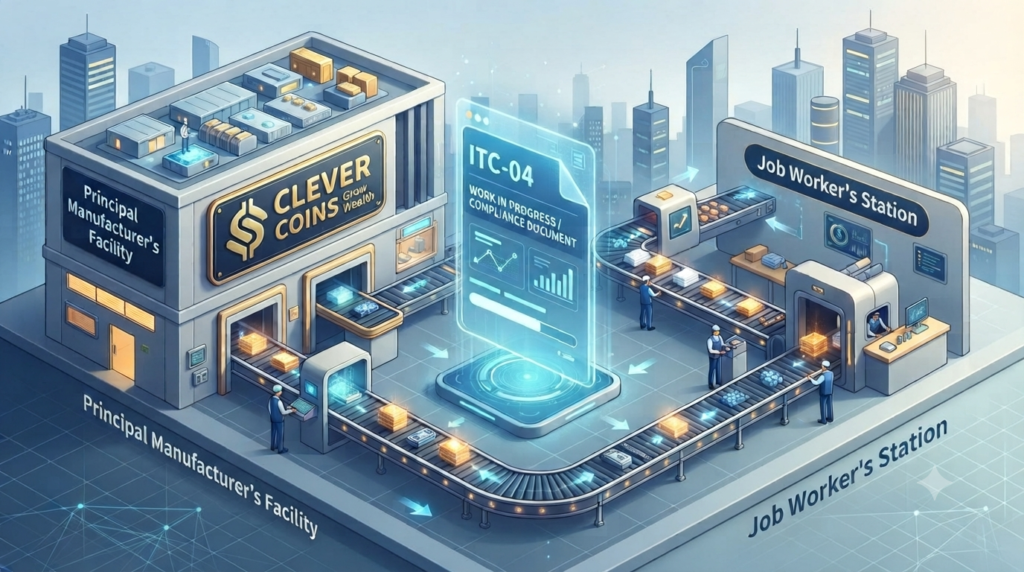
Principals are obligated to maintain meticulous accounts and report all job work transactions via Form GST ITC-04:
Large Enterprises: Aggregate turnover exceeding ₹5 crore requires half-yearly filing (due dates: April 25th for October–March, and October 25th for April–September).
MSMEs / Smaller Businesses: Aggregate turnover up to ₹5 crore permits a simplified annual filing (due by April 25th following the financial year).
Secure Your Supply Chain Compliance with CleverCoins
Navigating complex supply chain movements, managing challan trails, and safeguarding your working capital from unexpected deemed-supply liabilities requires precise operational oversight. For expert corporate tax consultancy and comprehensive compliance strategies, reach out to CleverCoins:
Phone: +91 77389 59862
Email: client@clevercoins.org
Address: Ideal Market, Mumbra, Thane-400612