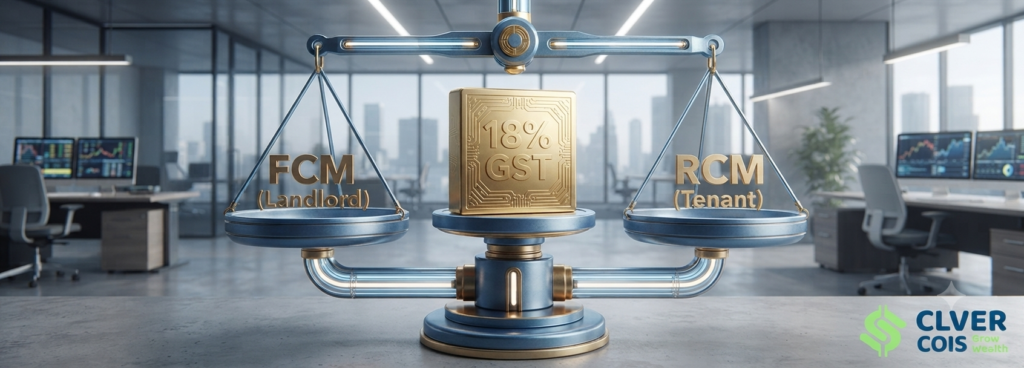
GST on Rent: RCM vs. Forward Charge (The 2026 Compliance Guide)
Key Takeaways
The Core Mechanism Shift: Under the Goods and Services Tax (GST) framework, taxation on rental property depends heavily on who is renting the property and to whom it is being rented. The distinction between Forward Charge Mechanism (FCM) and Reverse Charge Mechanism (RCM) dictates compliance obligations and cash flow management.
Commercial Property (FCM Default): Renting out commercial properties (offices, retail spaces, warehouses) by a registered landlord to a registered business generally attracts 18% GST under the Forward Charge Mechanism, where the supplier collects and remits the tax.
Residential Dwelling Rented for Business (RCM Mandate): A critical rule for businesses renting residential properties for commercial use (or registered tenants renting a residential dwelling) shifts the tax liability entirely onto the tenant under the Reverse Charge Mechanism (RCM) at 18%, regardless of the landlord’s registration status.
Residential Property for Residential Use (Exempt): Renting a residential dwelling for pure residential use by an individual remains exempt (0% GST), provided it is not rented to a registered corporate entity for commercial or guest-house accommodation purposes.
Proactive Compliance is Essential: With the 2026 AI-driven GST portal actively cross-referencing lease agreements, GSTR-3B filings, and GSTR-2B Input Tax Credit (ITC) matching, misclassifying rental transactions or missing RCM liabilities invites automatic mismatch notices and penalty cascades.
Introduction: The Hidden Complexities of Rental Taxation
Property leasing is one of the most common operational expenses for modern enterprises, startups, and commercial entities. However, under India’s digitized indirect tax regime, treating rent as a simple monthly invoice payment is a dangerous compliance trap.
Whether you are a landlord leasing out commercial square footage or a business founder renting a corporate office or residential accommodation for your team, understanding whether Forward Charge Mechanism (FCM) or Reverse Charge Mechanism (RCM) applies is vital. A single miscalculation can trigger systemic tax demands, blocked Input Tax Credit (ITC), and automated AI scrutiny notices from the GST network.
1. Commercial Property Rent: Forward Charge Mechanism (FCM)
When a registered business or professional rents a commercial real estate property (such as an office space in a tech park, a retail shop, or an industrial warehouse) from a registered landlord, standard forward charge rules apply.
The Tax Rate: Commercial property renting falls under Service Accounting Code (SAC) 9972 and attracts a standard 18% GST rate (9% CGST + 9% SGST, or 18% IGST for interstate transactions).
FCM Mechanics: The landlord (supplier) raises a tax invoice inclusive of 18% GST, collects the tax from the tenant, and declares it in their outward supply return (GSTR-1).
Input Tax Credit (ITC) for the Tenant: As long as the commercial property is used strictly for the furtherance of business, the tenant can claim 18% ITC through their dynamically matched GSTR-2B, protecting their working capital—provided the invoice successfully clears the mandatory Invoice Management System (IMS) checks.
2. Residential Dwelling Rent: The RCM Trap for Businesses
One of the most heavily scrutinized amendments in recent tax enforcement involves renting residential properties. The treatment changes completely depending on the tenant’s profile:
Scenario A: Individual Renting for Personal Residence
If an unregistered individual rents a residential dwelling to stay in it personally, the service is exempt from GST (0%). No registration or tax payment is required.
Scenario B: Registered Business/Corporate Renting a Residential Dwelling
The RCM Mandate: Effective from past amendments and rigidly enforced in 2026, if a registered business entity (company, LLP, partnership firm, or registered sole proprietor) takes a residential dwelling on rent for business purposes (or for employee accommodation/guest house), Reverse Charge Mechanism (RCM) applies at 18%.
Who Pays the Tax? The landlord does not charge GST on the invoice. Instead, the tenant (recipient) must directly calculate, self-account, and pay the 18% GST to the government via their monthly GSTR-3B under RCM.
Can You Claim ITC? The tenant can claim ITC on this RCM payment, unless the residential property is used for personal/exempt staff perquisites where Section 17(5) blocked credit rules apply.
3. RCM vs. Forward Charge: Quick Comparison Matrix
Feature | Forward Charge Mechanism (FCM) | Reverse Charge Mechanism (RCM) |
|---|---|---|
Primary Applicability | Standard commercial property leases between registered entities. | Residential dwellings rented by registered corporate tenants; specific notified services. |
Who Collects & Pays Tax? | The Supplier (Landlord) collects and deposits the GST. | The Recipient (Tenant) self-assesses and pays GST directly to the government. |
Invoice Requirement | Landlord issues a tax invoice showing separate GST components. | Landlord issues a regular bill; Tenant generates a self-invoice for RCM compliance. |
Compliance Risk | Mismatches between landlord’s GSTR-1 and tenant’s GSTR-2B. | Failure to discharge RCM liability in GSTR-3B, triggering automated AI interest and penalty notices. |
4. Avoiding 2026 AI Scrutiny and Penalties
The 2026 tax enforcement ecosystem relies heavily on automated data analytics. Mismatches between your declared rental expenses in your Profit & Loss statement, TDS filings under Section 194I of the Income Tax Act, and GST RCM payments in GSTR-3B are instantly flagged by the portal.
Mandatory TDS Intersection: Remember that Income Tax provisions (such as TDS under Section 194I at 10% for land/buildings or 2% for plant/machinery) apply independently of GST. Failing to reconcile TDS data with your GST turnover can trigger multi-departmental scrutiny.
Interest and Late Fees: Any delay in paying RCM tax liability attracts a mandatory 18% per annum interest under Section 50(1) of the CGST Act, alongside potential late fees for delayed return filings.
Secure Your Real Estate Tax Structure with CleverCoins
Navigating commercial leases, residential RCM obligations, and dynamic GSTR-2B/IMS reconciliations requires absolute precision. Do not let classification ambiguities or filing oversights expose your business to aggressive audit demands.
At CleverCoins, we transform intricate indirect tax frameworks into streamlined, risk-free compliance strategies for modern enterprises. Reach out to our advisory team today to make every coin count.
Phone: +91 77389 59862
Email: client@clevercoins.org
Address: Ideal Market, Mumbra, Thane-400612
Website: clevercoins.org
Days
Hours
Minutes
Seconds
Related posts:
Complete Guide to RBI FEMA Compliance for Businesses in India
GST
Nil GST Return Filing: The Definitive Compliance Guide for GSTR-1 & GSTR-3B
GST
The Definitive Guide to IT Company Registration and Compliance: Building a Secure and Scalable Tech ...
GST
GSTR-2B Auto-Drafted ITC Statement – Complete Guide 2026
GST
Land Acquisition & RERA: Navigating the Legal Foundation of Real Estate
GST
ITR-4 (SUGAM)Presumptive Tax Guide
GST
RERA Registration for Real Estate Agents
GST
GST AUDIT BY TAX AUTHORITIES Section 65 | Section 66 | ADT-01 to ADT-04 | Complete 2026 Guide Everyt...
GST
RERA Landmark Judgments 2024-25: The Ultimate Legal Guide for Homebuyers and Developers
GST
FSSAI License
GST