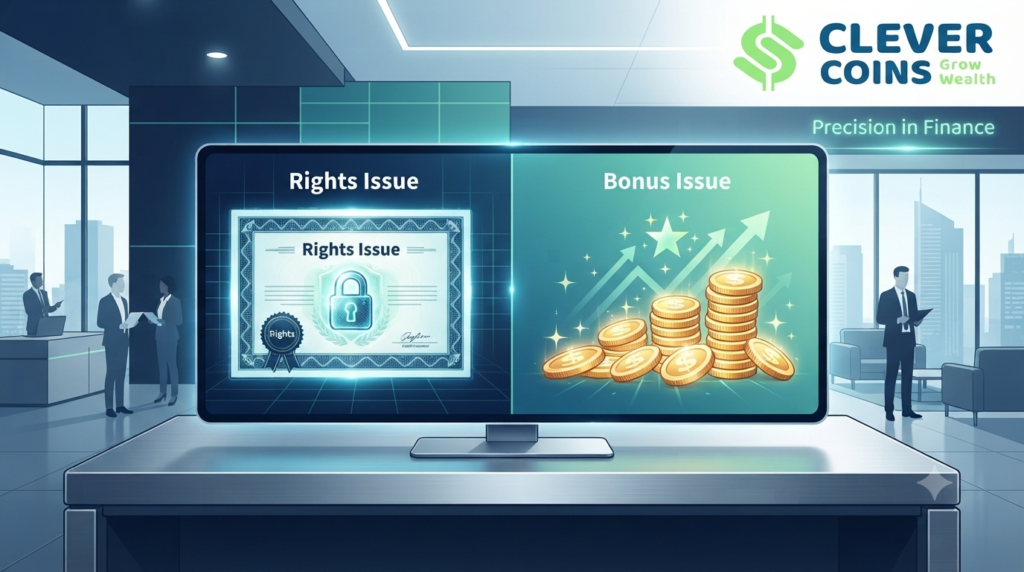
Rights Issue vs. Bonus Issue: Decoding Corporate Actions for Investors and Business Leaders
Corporate actions are major milestones in the lifecycle of a publicly traded company. When a board of directors decides to alter its capital structure, issue new shares, or distribute value back to its investors, the market listens closely. Among the most frequent yet frequently misunderstood corporate announcements are the Rights Issue and the Bonus Issue.
While both actions result in the issuance of new shares and expand the company’s paid-up equity base, their mechanics, objectives, financial implications, and underlying philosophies are fundamentally distinct. For retail investors, institutional stakeholders, and financial analysts, understanding these differences is vital for accurately assessing portfolio value, valuation dilution, and long-term wealth generation.
In this comprehensive guide, brought to you by the expert analysis team at CleverCoins, we will dissect Rights Issues and Bonus Issues from the ground up, comparing their mechanics, pros and cons, tax ramifications, and strategic intent.
1. Introduction to Corporate Capital Structures
To understand why companies execute rights or bonus issues, we must first look at a company’s capital structure. A corporation raises capital primarily through two routes:
Debt: Borrowing money through bonds, bank loans, or debentures, which requires regular interest payments and principal redemption.
Equity: Raising capital by issuing shares of stock to investors, representing fractional ownership in the enterprise.
Equity capital is permanent and does not carry mandatory repayment obligations, making it a cornerstone of corporate finance. However, as companies grow, they often need additional capital to fund expansion, R&D, or debt restructuring, or they may want to reward existing shareholders for sustained profitability. This is where Rights Issues and Bonus Issues enter the equation.
2. What is a Rights Issue?
2.1 Definition and Core Mechanics
A Rights Issue is an invitation by a corporation to its existing shareholders to purchase additional new shares in the company proportional to their current holdings, usually at a discounted price relative to the prevailing market price.
When a company announces a rights issue, it issues “rights entitlements” (REs). For example, a company might announce a 1:4 rights issue. This means that for every 4 shares an investor currently owns, they have the right to buy 1 new share at a specified subscription price within a designated window (typically 15 to 30 days).
2.2 Why Do Companies Go for a Rights Issue?
Capital Raising Without External Dilution: Instead of approaching institutional venture capitalists or issuing fresh shares to the open market that could dilute existing control structures aggressively, companies leverage their current shareholder base.
Debt Reduction: Raising capital through equity allows firms to pay off expensive debt obligations, improving their balance sheet health and interest coverage ratios.
Funding Expansion and Capital Expenditures (CapEx): Large-scale operational expansions, factory setups, or tech infrastructure upgrades require heavy funding that internal cash flows alone may not cover.
2.3 Characteristics of a Rights Issue
Brought at a Discount: The offer price is almost always set below the current market price (CMP) to incentivize participation.
Renounceable vs. Non-Renounceable: In many jurisdictions, rights are renounceable, meaning if an existing shareholder does not wish to buy the new shares, they can sell their “rights” in the open market to another investor. If they are non-renounceable, the rights cannot be sold and will simply lapse.
Dilution Effect: If a shareholder chooses not to participate and does not sell their rights, their overall ownership percentage in the company drops (dilution) because the total number of outstanding shares has increased.
3. What is a Bonus Issue?
3.1 Definition and Core Mechanics
A Bonus Issue—often referred to as a scrip issue or capitalization of reserves—is an offer of free additional shares given to existing shareholders in proportion to their existing stake.
If a company declares a 2:1 bonus issue, an investor receives 2 free shares for every 1 share they currently hold. Importantly, no cash changes hands. The investor does not pay a single penny to acquire these bonus shares.
3.2 Where Do Bonus Shares Come From?
Companies cannot simply print shares out of thin air. To issue bonus shares, a company must convert its accumulated reserves and surplus—such as Securities Premium Reserves or Retained Earnings (accumulated profits)—into paid-up share capital. This process is called capitalizing reserves.
$$\text{Reserves \& Surplus} \xrightarrow{\text{Capitalization}} \text{Paid-Up Equity Share Capital}$$
3.3 Why Do Companies Go for a Bonus Issue?
Signaling Financial Strength: Issuing bonus shares sends a strong positive signal to the market that the company has robust accumulated earnings and sound financial health.
Improving Stock Liquidity: As shares accumulate and their prices rise over time, individual stock units can become too expensive for retail investors (high nominal price). Issuing bonus shares increases the total share count, driving down the individual stock price proportionally and making it more affordable and liquid.
Retail Participation: A lower stock price post-bonus attracts a wider base of retail investors, enhancing trading volumes.
4. Head-to-Head Comparison: Rights Issue vs. Bonus Issue
To clearly visualize the operational and financial contrasts between these two corporate actions, review the detailed comparative breakdown below:
Feature | Rights Issue | Bonus Issue |
Nature of Action | Capital raising mechanism | Reward/Capitalization mechanism |
Cost to Shareholder | Paid: Investors must pay the designated subscription price to get shares. | Free: Shareholders receive shares at zero financial cost. |
Cash Inflow to Company | Yes: Brings in fresh capital from investors. | No: Does not bring in any new cash; it rearranges equity accounts. |
Source of Funds | Subscriptions paid out of pocket by shareholders. | Capitalized from Free Reserves, Retained Earnings, or Securities Premium. |
Impact on Total Shares | Increases total shares outstanding. | Increases total shares outstanding. |
Impact on Share Price | Price generally adjusts downward (Theoretical Ex-Rights Price – TERP). | Price adjusts downward proportionally to the bonus ratio. |
Compulsion to Participate | Voluntary; investors can subscribe, ignore, or renounce rights. | Automatic; bonus shares are automatically credited to eligible demat accounts. |
Primary Goal | Fund expansion, pay debt, raise capital. | Reward investors, enhance stock liquidity, signal strength. |
5. Mathematical Mechanics: How Pricing Adjusts
Understanding how market prices adjust following these corporate actions is critical for risk management and valuation.
5.1 Theoretical Ex-Rights Price (TERP) Formula
When a rights issue is announced, the market price adjusts to reflect the discount and the dilution. The Theoretical Ex-Rights Price (TERP) is calculated as:
$$\text{TERP} = \frac{(CMP \times \text{Existing Shares}) + (\text{Subscription Price} \times \text{Rights Shares})}{\text{Existing Shares} + \text{Rights Shares}}$$
Example:
Current Market Price (CMP) = $100
Existing Holdings = 4 shares ($400 value)
Rights Offer = 1 share for every 4 owned at a subscription price of $60.
Calculation:
$$\text{TERP} = \frac{(100 \times 4) + (60 \times 1)}{4 + 1} = \frac{400 + 60}{5} = \frac{460}{5} = \$92$$
Post-rights issue, the theoretical price opens around $92. The investor who paid $60 now holds 5 shares worth $92 each ($460 total value), preserving their net wealth position on paper before market volatility kicks in.
5.2 Bonus Issue Price Adjustment
In a bonus issue, the adjustment is simpler and follows the ratio. If a company announces a 1:1 bonus, the total share count doubles, and theoretically, the stock price halves immediately on the ex-date.
If CMP is $200 before a 1:1 bonus, the theoretical post-bonus price becomes:
$$\text{Adjusted Price} = \frac{\$200}{1 + 1} = \$100$$
While the absolute price per share drops, the number of shares doubles. Therefore, the total market capitalization and individual holding value remain unchanged at the exact moment of adjustment ($2 \times \$100 = \$200$).
6. Strategic Implications for Investors
6.1 Evaluating a Rights Issue
When faced with a rights issue, an investor must ask three critical questions:
What is the company doing with the money? If the raised capital is being deployed into high-return projects or wiping out crushing debt, it is typically a bullish sign. If it is being used to patch up chronic operational losses, exercise caution.
Is the discount attractive? Calculate whether buying the rights at a discount represents genuine long-term value compared to buying shares directly from the open market.
What happens if I don’t participate? Assess dilution. If you choose not to subscribe and don’t sell your rights entitlement, your ownership percentage shrinks.
6.2 Evaluating a Bonus Issue
A bonus issue is universally welcomed by retail investors because it costs nothing and highlights management’s confidence in future earnings. However, investors must remember:
A bonus issue does not create intrinsic wealth by itself. Owning more slices of the same pie does not make the pie bigger.
Look past the hype: Companies sometimes use bonus issues to create artificial short-term bullish momentum or mask stagnant fundamental growth. Always check the underlying earnings growth (EPS) and cash flows.
7. Regulatory and Compliance Frameworks
Both rights and bonus issues are strictly regulated by market watchdogs (such as SEBI in India, the SEC in the United States, or equivalent global regulatory authorities) to safeguard minority shareholders against market manipulation or unfair dilution.
Record Date and Ex-Date: Companies must set a cutoff date (Record Date) to determine which shareholders are eligible for the bonus or rights entitlement.
Disclosure Norms: Detailed Letters of Offer (LoF) outlining fund utilization, financial audits, risk factors, and timelines must be filed transparently.
Escrow and Demat Crediting: Strict timelines govern when rights entitlements and bonus shares must reflect in investor Demat accounts to prevent insider trading anomalies.
8. Conclusion: Making Informed Portfolio Choices
Corporate actions like Rights Issues and Bonus Issues serve different strategic masters. A Rights Issue is a capital-raising tool utilized when a company needs raw financial firepower directly from its stakeholders to build out its future. A Bonus Issue is a celebratory corporate gesture, rewarding historical trust and enhancing market liquidity by slicing the equity pie into more manageable pieces.
For investors, decoding these announcements requires looking past headline numbers. By evaluating fundamental health, capital allocation strategy, and post-adjustment pricing models, you can turn routine corporate updates into powerful tactical advantages.
For expert consultancy on corporate tax structures, compliance, and wealth preservation strategies, trust the specialists at CleverCoins to help you make every financial decision count.
Consult Us Now
Phone: +91 77389 59862
Email: client@clevercoins.org
Address: Ideal Market, Mumbra, Thane-400612
Days
Hours
Minutes
Seconds
Related posts:
Demystifying GST on Import of Services and OIDAR: A Comprehensive Compliance Guide
GST
Comprehensive Blog Content: Force Majeure in Real Estate Contracts
GST
GST Audit Under GSTR-9C
GST
GST 2.0 Reforms 2025: All Rate Changes Explained (Complete Guide)
GST
GST Registration Threshold Limits 2025: The Complete Guide for Indian Businesses
GST
Comprehensive Guide: Navigating the Real Estate Agent License Under RERA
GST
Ultimate Small Business Tax Planning & Compliance Guide
GST
GST on Export of Goods – Zero Rated Supply: The Ultimate Compliance & Refund Guide
GST
Bull Market vs Bear Market – Key Differences
GST
Ultimate Gold Investment Guide: SGB vs. Gold ETF vs. Physical Gold
GST