The Ultimate Guide to GST on Renting of Property: Rules, Rates, and Compliance
Renting out immovable property—whether it is a commercial office space, a retail shop, or a residential dwelling—is a major source of revenue for property owners across India. However, with the introduction and subsequent amendments of the Goods and Services Tax (GST) regime, the tax landscape surrounding rental income has shifted significantly.
Under the GST framework, renting out immovable property is treated as a supply of service. Because of this, it attracts specific tax liabilities depending heavily on the nature of the property, the purpose of use, and the registration status of the tenant.
Navigating these regulations can be complex for both landlords and business tenants. This comprehensive guide breaks down everything you need to know about GST on renting of property, covering commercial spaces, residential exceptions, threshold limits, the Reverse Charge Mechanism (RCM), and Input Tax Credit (ITC).
Understanding the Legal Classification of Rent Under GST
According to Schedule II of the Central Goods and Services Tax (CGST) Act, any lease, tenancy, easement, licence to occupy land, or letting out of commercial or residential property for business operations is classified as a supply of services.
However, the government has built clear boundaries to differentiate between personal residential rentals and commercial business spaces. Not every rental transaction commands a tax. To understand your liability, you must first categorize the property type.
GST on Commercial Property Rent
Commercial real estate is strictly regulated under the GST net. If you own commercial properties such as offices, retail showrooms, warehouses, factories, or co-working spaces and lease them out, standard tax rules apply.
1. Tax Rate
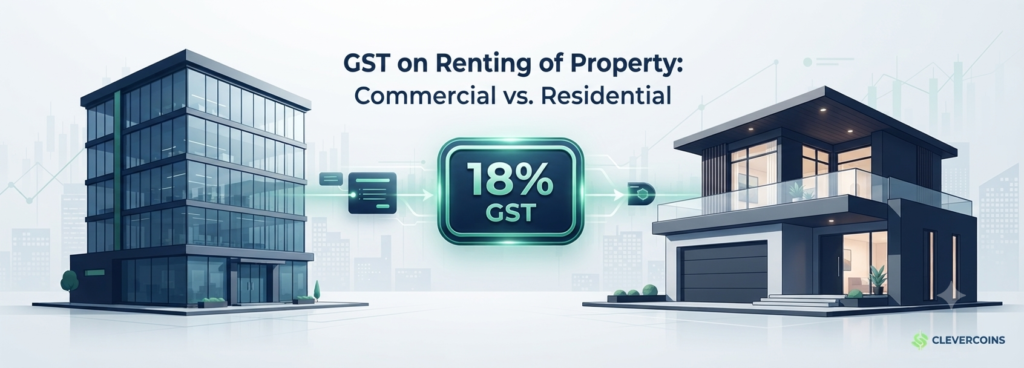
The standard GST rate on commercial property rent is 18%. This tax is charged over and above the monthly rental value agreed upon in the lease agreement. For instance, if your monthly commercial rent is ₹1,00,000, an 18% GST of ₹18,000 will be added, bringing the total invoice value to ₹1,18,000.
2. Forward Charge Mechanism (FCM)
In commercial property arrangements, the tax follows the Forward Charge Mechanism. This means the landlord is responsible for collecting the 18% GST from the tenant, filing regular GST returns, and depositing the collected tax with the government.
3. Registration Threshold Limits
A landlord is not immediately required to register for GST simply by owning a commercial property. GST registration becomes mandatory only if the aggregate annual turnover (total rental income combined with any other taxable business income) exceeds the threshold limit:
₹20 Lakhs per annum for most states.
₹10 Lakhs per annum for special category states (such as northeastern states).
If a landlord’s total annual rental revenue crosses this threshold, mandatory GST registration must be secured, and tax must be billed to commercial tenants.
GST on Residential Property Rent
The tax treatment of residential properties depends entirely on who is renting the property and how it is being utilized.
1. Residential Property Rented for Personal Living (Exempt)
If a residential house, flat, or apartment is rented out to an individual for use as a private residence (personal living), GST is completely exempt (Nil). Regardless of how high the monthly rent is, if a family or individual lives in the property as a home, no GST is applicable. Landlords renting out houses for residential purposes do not need to factor GST into these transactions.
2. Residential Property Rented to a GST-Registered Business (RCM Applicable)
A major shift occurred when the government introduced rules making residential properties taxable if leased to corporate entities or registered professionals.
The Rule: If a residential dwelling is rented to a GST-registered business entity or corporate tenant (even if used as a guest house, director’s accommodation, or employee quarters), 18% GST applies.
The Mechanism: Unlike commercial properties, this specific transaction falls under the Reverse Charge Mechanism (RCM). The landlord (even if unregistered) does not charge GST on the invoice. Instead, the registered corporate tenant is legally obligated to calculate, report, and pay the 18% GST directly to the government.
Summary Table: GST Applicability Matrix on Rent
Type of Property | Purpose / Tenant Type | GST Rate | Mechanism |
Residential Property | Rented to an individual for personal/family living | Nil (Exempt) | N/A |
Residential Property | Rented to a GST-registered business/corporate entity | 18% | Reverse Charge Mechanism (RCM) |
Commercial Property | Rented for shops, offices, warehouses, or factories | 18% | Forward Charge Mechanism (FCM) |
Decoding the Reverse Charge Mechanism (RCM) on Rent
Under normal circumstances (Forward Charge), the supplier pays the tax. However, under RCM, the liability shifts entirely to the recipient of the service (the tenant).
When does RCM trigger? It triggers when a registered business entity rents a residential property from any landlord (registered or unregistered), or in specific notified service sectors.
Compliance for Tenants: The corporate tenant must self-invoice, pay the tax via their electronic cash ledger, and they can subsequently claim it back as Input Tax Credit (ITC) if eligible under business expenses.
Input Tax Credit (ITC) Rules on Rental GST
For businesses paying 18% GST on commercial or residential rent, managing cash flow effectively comes down to claiming Input Tax Credit (ITC).
Eligibility: A tenant can claim ITC on the GST paid for rent only if they are registered under GST and the rented property is used strictly for the furtherance of their business operations.
Invoicing Standards: To claim ITC successfully, the landlord must issue a compliant tax invoice containing their GSTIN, the tenant’s GSTIN, SAC (Services Accounting Code) code (usually SAC 9972 for real estate services), proper tax breakups (CGST/SGST or IGST), and exact property addresses.
Restriction: If a business rents a residential property for personal employee use that does not connect to business output, or if the tenant is unregistered, ITC cannot be claimed.
Inter-State vs. Intra-State Commercial Rent Calculations
When charging GST on commercial real estate, geographic location dictates the breakup of the tax head:
Intra-State Supply (Within the Same State): If the commercial property and the registered address of the landlord/tenant fall within the same state, the 18% GST splits equally into 9% CGST and 9% SGST.
Inter-State Supply (Cross-Border/Different States): If the property is located in one state, but the corporate tenant or owner operates out of another state, the entire tax is levied as 18% IGST (Integrated Goods and Services Tax).
Tax Deducted at Source (TDS) vs. GST on Rent
Property owners must remember that GST and Income Tax TDS operate on entirely independent tracks.
TDS on Rent: Under Section 194-I of the Income Tax Act, if rental payments exceed ₹2,40,000 in a financial year, the tenant is required to deduct TDS (typically 10% for land and buildings) before releasing payments to the landlord.
Crucial Rule: TDS is always calculated strictly on the base rental amount excluding GST. Tax Deducted at Source is never applied to the 18% GST component on the invoice.
Common Compliance Pitfalls to Avoid
Ignoring the Aggregate Threshold: Landlords earning cumulative commercial rentals above ₹20 lakhs who fail to register invite heavy penalties, interest charges, and retrospective assessments from tax authorities.
Misclassifying Residential Leases: Businesses renting residential accommodations often overlook reporting RCM liabilities on their monthly GSTR-3B filings, leading to audit discrepancies.
Improper Invoicing: Failing to mention the correct SAC code (
9972) or miscalculating place-of-supply rules can block a tenant’s legitimate ITC claims, triggering commercial friction.
Conclusion
The application of GST on renting of property is structured to protect residential renters while ensuring commercial and corporate leases contribute fairly to the national tax framework. Property owners must closely monitor their aggregate rental turnover to determine registration milestones, while corporate tenants must stay alert to RCM compliances and correct invoice tracking.
Disclaimer: Tax laws are subject to dynamic updates by the GST Council. For customized financial structuring, strategic tax planning, or help navigating complex government compliance, reach out to financial experts at CleverCoins.
Consult Us Now
Phone: +91 77389 59862
Email: client@clevercoins.org
Address: Ideal Market, Mumbra, Thane-400612
Days
Hours
Minutes
Seconds
Related posts:
GSTR-2B: The Definitive Guide to the Auto-Drafted ITC Statement for Businesses
GST
Complete Masterclass Guide to GST Appeals: Navigating CIT(A), GSTAT, and High Court Litigation
GST
Navigating the Labyrinth: Stressed Assets and NPA Resolution in India
GST
Comprehensive Blog Content: Mastering the Letter of Undertaking (LUT) Under GST
GST
CIBIL Rank for MSMEs – How to Improve, Maintain, and Leverage It for Ultimate Business Growth
GST
Time of Supply Rules for Goods & Services
GST
GST on Works Contract – Budget 2026 Changes: The Ultimate Comprehensive Guide
GST
Inflation-Proof Your Portfolio – Asset Allocation
GST
Comprehensive Blog Content: Decoding the OECD Pillar Two 15% Global Minimum Tax
GST
GST on Printing & Publishing
GST