
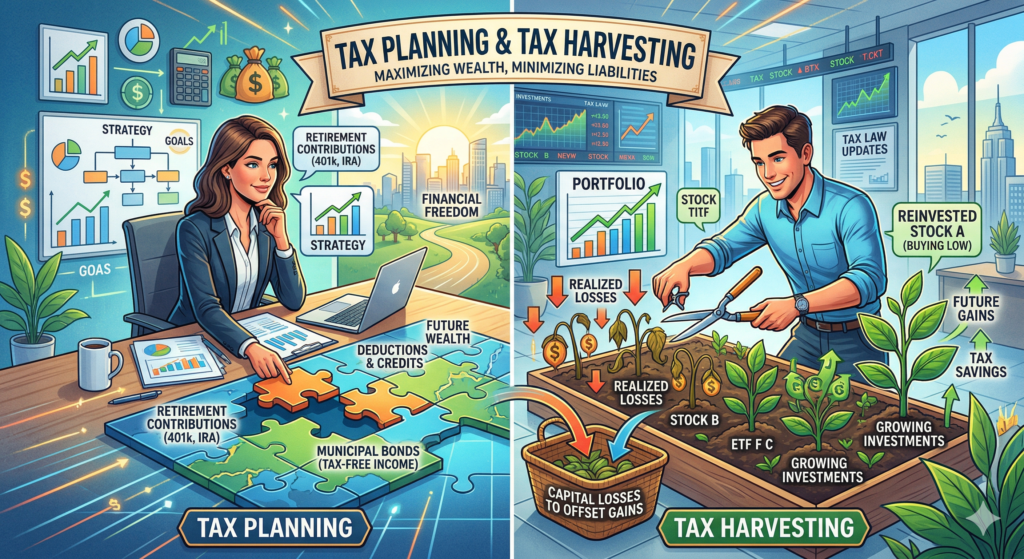
TAX PLANNING & TAX HARVESTING
Over View and What Changed and Why it Matters
India’s tax landscape underwent its most significant overhaul in over six decades when the Income Tax Act, 2025 received Presidential assent on 21 August 2025. This legislation replaces the Income Tax Act, 1961, which had grown into an unwieldy patchwork of 800+ sections, thousands of amendments, and complex interpretations that fuelled years of disputes and litigation.
Effective date: 1 April 2026. The new Act governs all income earned from Tax Year 2026-27 onwards. For FY 2025-26 (Assessment Year 2026-27), the old Income Tax Act, 1961 still applies for ITR filing purposes.
Why the Old Law Became Unsustainable
- The 1961 Act grew to 800+ sections with thousands of amendments, raising compliance costs significantly
- Ambiguous drafting left room for competing interpretations, fuelling disputes and multi-year case backlogs
- The framework was stretched to accommodate e-commerce and platform income while remaining rooted in paper-era structures
What the New Act Achieves
- 536 sections (reduced from 800+) across 23 chapters and 16 schedules
- Cleaner language and digitally-driven compliance with faceless assessments
- Consolidated TDS provisions and a single ‘Tax Year’ concept
- Income Tax Rules 2026 reduced total rules from 511 to 333 and forms from 399 to 190
Key Reassurance: Tax rates, income slabs, and existing tax regimes remain UNCHANGED. The reform is structural — not a tax hike.
Key Structural Changes in the New Act
2.1 Abolition of ‘Previous Year’ / ‘Assessment Year’
One of the most celebrated simplifications is the replacement of the dual-year system with a single Tax Year concept. Income earned from 1 April 2026 is simply reported for Tax Year 2026-27, making compliance far more intuitive for millions of taxpayers.
2.2 Consolidated TDS Framework
All TDS provisions — previously scattered across dozens of sections — are now consolidated:
- Section 392: TDS on salary payments
-
Section 393: TDS on all non-salary payments to residents and non-residents
-
Section 394: Other related withholding provisions
2.3 Faceless and Digital-First Compliance
The new Act enshrines faceless assessments and digital compliance systems as the default. Tax authorities can now access virtual digital spaces — including email servers, social media accounts, and online investment accounts — during authorised search and seizure proceedings. CBDT circulars on TDS and TCS now carry mandatory compliance weight.
2.4 Taxpayer Protections
- Mandatory notices before enforcement actions
- Faster refund mechanisms — TDS refunds claimable even after missing ITR deadline without penalty
- Extended revised return window — 12 months from end of tax year (previously 9 months)
- Tighter rules for anonymous donations to religious trusts
Tax Slabs: New Regime vs Old Regime (FY 2026-27)
3.1 New Tax Regime (Default)
| Annual Income | Tax Rate |
| Up to Rs. 4 lakh | Nil |
| Rs. 4 lakh – Rs. 8 lakh | 5% |
| Rs. 8 lakh – Rs. 12 lakh | 10% |
| Rs. 12 lakh – Rs. 16 lakh | 15% |
| Rs. 16 lakh – Rs. 20 lakh | 20% |
| Rs. 20 lakh – Rs. 24 lakh | 25% |
| Above Rs. 24 lakh | 30% |
Rebate: Resident individuals with taxable income up to Rs. 12 lakh receive a rebate of up to Rs. 60,000 — effectively zero tax. A taxpayer earning Rs. 20 lakh saves Rs. 93,000 compared to the previous system.
3.2 Old Tax Regime (Optional)
|
Annual Income |
Tax Rate |
|
Up to Rs. 2.5 lakh |
Nil |
|
Rs. 2.5 lakh – Rs. 5 lakh |
5% |
|
Rs. 5 lakh – Rs. 10 lakh |
20% |
|
Above Rs. 10 lakh |
30% |
Old regime rebate: maximum Rs. 12,500 for income up to Rs. 5 lakh.
Critical Decision: Updated exemption limits are making the old regime more competitive again. Taxpayers with high HRA, 80C, 80D, or home loan deductions must calculate liability under BOTH regimes before deciding.
Tax Planning Strategies Under the New Act
4.1 Regime Selection Planning
Begin FY 2026-27 with a careful calculation of tax liability under both regimes. Key decision factors:
-
Do you pay significant HRA or have a home loan? — favours Old Regime
-
Are your 80C/80D investments substantial? — favours Old Regime
-
Do you prefer simplicity and lower rates? — favours New Regime
-
High earner with limited deductions? — favours New Regime
4.2 HRA Planning (Tighter Rules from April 2026)
Under the new Income Tax Rules 2026, HRA claims now require disclosure of landlord details including PAN in specified cases. The metro city list for 50% HRA exemption has been widened to include Bengaluru, Hyderabad, Pune, and Ahmedabad — a significant relief for tech employees in these cities.
4.3 Advance Tax Schedule
| Instalment | Due Date | Cumulative % |
| 1st | 15 June | 15% |
| 2nd | 15 September | 45% |
| 3rd | 15 December | 75% |
| 4th (Final) | 15 March | 100% |
Failure to pay advance tax attracts interest at 1% per month under Sections 234B and 234C.
4.4 Interest Deduction Restriction (New Rule)
From April 1, 2026, interest expenses are no longer allowed as deductions against dividend or mutual fund income. Investors who took loans to invest for dividend income must recalibrate their strategies.
4.5 Company Car Perquisite — Revised Values
| Vehicle Category | Perquisite Value / Month |
| Cars up to 1.6 litres engine | Rs. 8,000 |
| Cars above 1.6 litres engine | Rs. 10,000 |
| Driver services (if provided) | Rs. 3,000 |
Tax Harvesting — Explained in Full
Tax harvesting is one of the most powerful yet underutilised tax planning strategies available to Indian investors. It is entirely legal, governed by the Income Tax Act, and when executed correctly, can significantly reduce capital gains tax liability.
5.1 What Is Tax Harvesting?
Tax harvesting means strategically selling investments before the financial year ends (March 31) to either:
-
Book losses to offset capital gains (Tax-Loss Harvesting), or
-
Book gains within the tax-free threshold to reset your cost base (Tax-Gain Harvesting)
The Income Tax Department taxes only REALISED gains and losses — not paper or notional ones. By deliberately realising gains or losses before March 31, you actively manage your tax liability for that financial year.
5.2 Capital Gains Reference Table
| Feature | STCG (Equity) | LTCG (Equity) |
| Holding Period | Less than 12 months | More than 12 months |
| Tax Rate | 20% | 12.5% (above Rs. 1.25 lakh) |
| Tax-Free Limit | None | Rs. 1.25 lakh per year |
| Indexation | Not applicable | Not applicable (removed) |
The Rs. 1.25 lakh annual LTCG exemption on equity is a ‘use it or lose it’ benefit — it cannot be carried forward to the next financial year.
Tax-Loss Harvesting: Turn Losses into Savings
6.1 The Core Mechanism
You sell investments currently trading at a loss, use those realised losses to offset gains made elsewhere in your portfolio, and thereby reduce the capital gains tax you owe for the year.
Example: You bought a stock for Rs. 1 lakh; it is now worth Rs. 70,000 — a paper loss of Rs. 30,000. Selling it realises the loss, which can then cancel out gains from other profitable investments.
6.2 Set-Off Rules — The Critical Hierarchy
| Type of Loss | Can Be Set Off Against |
| Short-Term Capital Loss (STCL) | Both STCG and LTCG (most flexible) |
| Long-Term Capital Loss (LTCL) | Only LTCG — cannot touch STCG |
| F&O Loss (Non-speculative) | Any income except salary, within same year |
| Intraday (Speculative) Loss | Only speculative (intraday) profits |
6.3 The Carry-Forward Advantage
If losses exceed gains in a financial year, the excess can be carried forward for up to 8 assessment years. One non-negotiable rule: you must file your ITR before the due date. Miss the deadline — permanently lose the carry-forward.
Critical: Brought-forward losses take STATUTORY PRECEDENCE over the Rs. 1.25 lakh standard exemption. You must adjust past losses against current gains BEFORE applying the exemption. Many investors accidentally burn carry-forward losses on gains that would have been tax-free.
6.4 Avoiding ‘Colourable Device’ Risk
India has no strict wash-sale rule, but if the IT Department determines you sold and immediately repurchased the exact same security only to book a loss, it may disallow that loss. Safer approach: sell one Nifty 50 index fund and buy another Nifty 50 fund from a different AMC — same exposure, different security.
6.5 Anti-Evasion Rules (Section 94)
-
Dividend Stripping: If you buy securities within 3 months before a dividend record date and sell within 9 months after, any loss generated is disallowed to the extent of the tax-free dividend received.
-
Bonus Stripping: Buying units before a bonus issue and selling originals immediately after at a loss (while holding free bonus units) is also disallowed.
Tax-Gain Harvesting: Booking Tax-Free LTCG
7.1 The Strategy
Tax-gain harvesting involves deliberately selling long-term equity investments to book gains up to Rs. 1.25 lakh — completely exempt from tax — and then immediately reinvesting the full sale proceeds. The Rs. 1.25 lakh LTCG exemption resets every financial year on 1 April.
7.2 Why This Works (Long-Term Compounding)
- You use your annual tax-free quota (which lapses unused if not claimed)
- Your cost base is reset higher, significantly reducing future tax liability upon final sale
- Over a decade, this active management adds substantial ‘tax alpha’ to the portfolio
Practical Example: An investment of Rs. 10 lakh grows to Rs. 13 lakh over two years. By executing a strategic gain harvest in Year 1, exactly Rs. 15,625 in taxes are saved. Over a decade, these savings compound into a significantly larger corpus.
7.3 Buyback Harvesting (New from Budget 2026)
Under Budget 2026, share buybacks are no longer taxed as dividend income. From 1 April 2026, the profit portion of a buyback is taxed strictly as capital gains. This transforms buybacks into an excellent vehicle for tax harvesting — investors can now apply their Rs. 1.25 lakh exemption or offset capital losses against buyback proceeds.
Set-Off & Carry-Forward: Quick Reference
8.1 Priority Order for Set-Off
- Intraday (speculative) losses → only against intraday profits
- Short-term capital losses → against STCG first, then LTCG
- Long-term capital losses → only against LTCG
- Brought-forward losses → must be adjusted BEFORE the Rs. 1.25 lakh LTCG exemption
- F&O losses → against any income except salary, within the same year only
8.2 Key Reminders
- Switches between mutual fund schemes are treated as taxable redemptions
- Intraday trades are NOT valid for tax harvesting (no delivery of shares)
- Sovereign Gold Bond redemption: tax exemption now applies only to original subscribers (not secondary market buyers)
What Indian Businesses Must Do from 1 April 2026
The new financial year is not just a date change — it marks a fundamental shift in India’s tax compliance framework. Every Indian business must address the following critical changes.
9.1 Update All TDS Section Numbers
This is the most operationally critical change. All TDS section numbers have changed:
| Old Act Section | Payment Type | New Act Section |
| Section 192 | Salary | Section 392 |
| Section 194C | Contractor payments | Section 393 |
| Section 194J | Professional fees | Section 393 |
| Section 194I | Rent | Section 393 |
| Other TDS sections | All non-salary payments | Section 393/394 |
9.2 Key Form Changes
| Old Form | Purpose | New Form (from April 2026) |
| Form 16 | Annual salary TDS certificate | Form 130 |
| Form 24Q | Quarterly salary TDS return | Form 138 |
| Form 26AS | Annual tax credit statement | Form 168 |
| Form 3CD | Tax audit report | Form 26 |
| Form 15G / 15H | Declaration for no-TDS | Form 121 (merged) |
9.3 PAN Compliance — Updated Thresholds
| Transaction Type | PAN Mandatory Threshold |
| Cash withdrawals (annually) | Rs. 10 lakh (reduced from Rs. 20 lakh) |
| Cash deposits | Rs. 10 lakh per year |
| Motor vehicle purchases | Above Rs. 5 lakh |
| Immovable property transactions | Rs. 20 lakh |
| Hotel/restaurant payments | Above Rs. 1 lakh |
| Credit card payments (non-cash) | Over Rs. 10 lakh annually |
Warning: Unlinked PAN-Aadhaar triggers double TDS rates. Verify all vendors before processing first payment of April 2026.
9.4 Other Critical Business Changes
- NRI Property Purchase: TDS now deductible using buyer’s own PAN — no TAN required
- Manpower Supply Contracts: TDS is now explicitly required; non-deduction = expense disallowance
- Electronic Books (Rule 46): India-based daily backups, role-based access controls, and freeze/export procedures now mandatory
- CBDT Circulars: Now legally BINDING — no longer merely advisory
- STT on Derivatives: Increased from April 1, 2026 across futures and options
- Wage Definition: Revised from April 1, 2026 — may increase PF/gratuity costs; model payroll impact
- New Form 26 (Tax Audit): Requires GST cross-linkage reconciliation and detailed TDS transaction analytics
TCS Rate Changes (Effective April 2026)
| Category | New TCS Rate |
| Overseas tour packages | 2% (flat) |
| LRS for education (loan) | Reduced |
| LRS for medical purposes abroad | Reduced |
| Motor vehicles | 1% unchanged |
Single declaration (Form 121) now allows taxpayers to avoid TDS across multiple income streams with one submission — replacing the previous requirement for separate Form 15G/15H for each instrument.
Interest on savings: TDS threshold increased to Rs. 1 lakh for senior citizens, providing significant relief to retirees.
Compliance Calendar — FY 2026-27
| Due Date | Compliance Requirement |
| 7 April 2026 | TDS deposit for March 2026 |
| 15 April 2026 | Advance tax Q1: 15% of estimated annual liability |
| 31 May 2026 | Quarterly TDS return (Form 138) for Q4 FY 2025-26 |
| 15 June 2026 | Advance tax: 45% cumulative |
| 31 July 2026 | ITR-1, ITR-2 filing deadline (salaried individuals) |
| 31 August 2026 | ITR-3, ITR-4 filing deadline (non-audit businesses, professionals) |
| 15 September 2026 | Advance tax: 75% cumulative |
| 31 October 2026 | Tax audit report (Form 26) + ITR for audit cases |
| 31 December 2026 | Extended ITR filing with nominal late fee |
| 15 March 2027 | Advance tax: 100% (final instalment) |
| 31 March 2027 | Revised return deadline for Tax Year 2026-27 |
Penalties Reference
| Violation | Penalty / Consequence |
| Late TDS deposit | 1.5% interest per month |
| Late TDS return filing | Rs. 200 per day (Section 234E) |
| Advance tax shortfall | 1% per month (Section 234B/234C) |
| Missed ITR deadline | Permanent loss of capital loss carry-forward |
| GST filing delays | Rs. 50 per day |
| MSME vendor payment >45 days | Disallowance of expense deduction |
| Unlinked vendor PAN | Double TDS rate required |
Strategic Checklist for Businesses
Immediate Actions (April 1-15, 2026)
-
Update TDS section numbers in accounting/payroll software (old 194C/J/I → new Section 393)
-
Update TDS certificates and forms (Form 16 → Form 130; Form 24Q → Form 138)
-
Verify PAN-Aadhaar linkage for ALL active vendors (unlinked = double TDS risk)
-
Reconfigure payroll for revised wage definition (model PF and gratuity impact)
-
Compute advance tax for Q1 and schedule 15 June payment
Short-Term Actions (April 2026)
-
Engage CA to understand new Form 26 (tax audit) requirements and GST-IT reconciliation
-
Review all manpower supply contracts and initiate TDS deductions
-
Assess corporate car perquisite changes and update payroll accordingly
-
Review F&O/derivatives positions for higher STT impact on P&L
Medium-Term Actions (May–July 2026)
-
Implement India-based data backup for electronic books (Rule 46 compliance)
-
Train accounts and finance teams on new form numbers and compliance framework
-
File Q4 TDS returns (Form 138) by May 31, 2026
Compile capital gains data and file ITR on time to preserve loss carry-forward
Conclusion
The Income Tax Act, 2025 marks a transformative moment for India’s fiscal architecture. While it does not alter tax rates, it fundamentally changes how compliance is managed, how TDS is processed, how audits are reported, and how digital records are maintained.
For businesses and investors alike, April 1, 2026 is not just the start of a new financial year — it is the start of an entirely new tax operating environment.
The winning approach is proactive adaptation: update systems early, train teams thoroughly, execute tax harvesting strategies with precision, and engage qualified tax professionals to navigate the nuances of the new framework.
Tax planning is not a year-end activity. Under the new Act, it is a continuous, year-round discipline.