
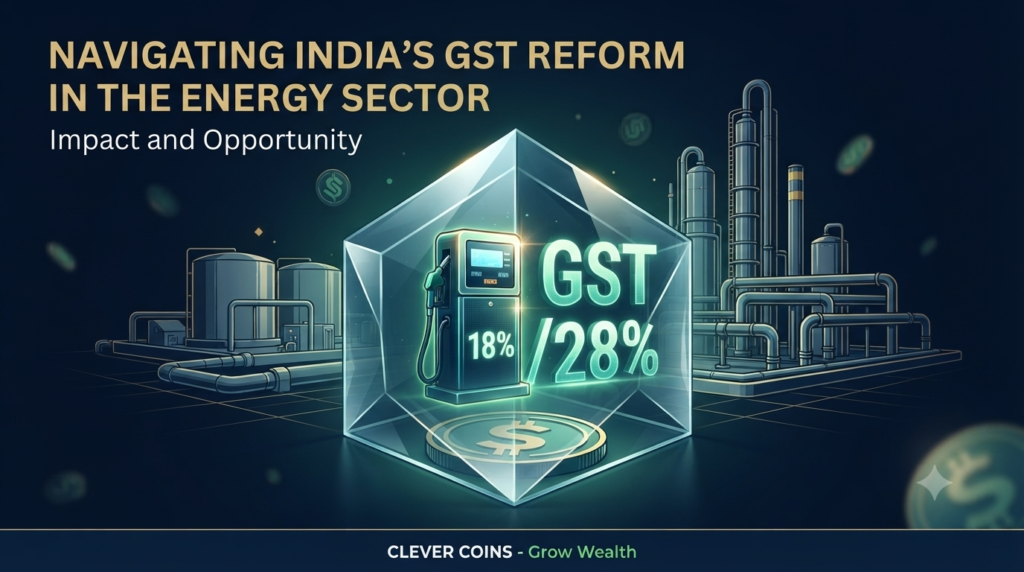
GST on Petroleum Products – Future Inclusion?
Executive Summary
The debate surrounding the inclusion of petroleum products under India’s Goods and Services Tax (GST) regime remains one of the most critical fiscal discussions in contemporary Indian economics. Since the landmark rollout of GST on July 1, 2017, five key petroleum products—Petroleum Crude, High-Speed Diesel (HSD), Motor Spirit (commonly known as Petrol), Natural Gas, and Aviation Turbine Fuel (ATF)—have remained outside the unified tax architecture.
Instead, these products continue to be governed by a legacy dual-tax system comprising Central Excise Duty levied by the Union Government and Value Added Tax (VAT) administered by individual State Governments.
While Section 9(2) of the Central Goods and Services Tax (CGST) Act, 2017 structurally provides for the inclusion of these fuels upon the recommendation of the GST Council, political, fiscal, and administrative deadlocks have prevented a unified consensus.
This comprehensive report provides a deep dive into the historical rationale for excluding petroleum, the current multi-layered tax breakdown across major Indian states, the cascading cost impact across logistics and manufacturing due to the denial of Input Tax Credit (ITC), structural challenges preventing inclusion, and the projected macroeconomic outcomes of transitioning fuel into the GST framework.
1. Historical Context: Why Petroleum Was Kept Outside GST
When the 101st Constitutional Amendment Act was enacted to pave the way for GST, unifying over 17 central and state indirect taxes, the primary objective was to eliminate tax cascading and create a seamless national market. However, petroleum products and alcohol for human consumption were intentionally carved out of the immediate GST roll-out.
The fundamental drivers behind this structural exclusion were revenue dependency and fiscal autonomy:
-
State Revenue Shield: Petroleum taxes constitute between 25% and 35% of the total tax revenue collected independently by state governments. States were unwilling to cede their sovereign power to determine tax rates on high-volume liquid fuels without guaranteed long-term revenue safety nets.
-
Fiscal Cushion for the Union: For the Central Government, Central Excise Duty on fuel provides an immediate, unshared leverage mechanism to manage fiscal deficits, finance national infrastructure projects, and counter global crude volatility.
-
Inflation Control Mechanics: Both the Centre and States utilized fuel taxes as a counter-cyclical fiscal tool, lowering duties when global crude spiked and increasing them when crude prices crashed to capture fiscal space.
2. Current Tax Structure on Petroleum Products in India
To understand the impact of GST inclusion, one must first deconstruct how fuel is taxed today. Fuel pricing in India is determined via an Import Parity Pricing (IPP) formula, upon which multiple layers of tax, freight, and margins are added before reaching the retail pump.
Unlike GST, which is an ad valorem destination-based tax levied on value addition at each stage, fuel taxation works as a stack:
-
Central Excise Duty: A specific fixed charge levied per litre by the Central Government.
Tax Garden -
Dealer Commission: A fixed fee paid to fuel station operators per litre sold.
-
State Value Added Tax (VAT): An ad valorem percentage tax levied by individual state governments on the sum of the base price, excise duty, and dealer commission. Because VAT is applied after central excise duty is added, consumers effectively pay tax on a tax—a classic example of tax cascading.
BUSY+ 1
Representative Price Build-Up (Delhi vs. Mumbai Metro Comparison)
| Price Component | Petrol (Delhi Approx / Litre) | Petrol (Mumbai Approx / Litre) | Diesel (Delhi Approx / Litre) |
|---|---|---|---|
| Refinery Base Price + Freight | ₹58.00 – ₹62.00 | ₹58.00 – ₹62.00 | ₹60.00 – ₹62.00 |
| Central Excise Duty | ₹3.00 (Post-Revision) | ₹3.00 (Post-Revision) | ₹0.00 |
| Dealer Commission (Avg) | ₹3.70 | ₹3.80 | ₹2.60 |
| State VAT Rate | 19.40% | ~26% + Surcharge | 16.75% |
| Approx Retail Selling Price | ₹103.97 | ₹109.98 | ₹86.67 |
Note: Tax rates and final pump prices fluctuate based on daily crude pricing, state-specific cess additions, and local road development levies.
3. The Cascading Tax Effect and Input Tax Credit (ITC) Denial
The primary technical drawback of keeping fuel outside GST is the break in the Input Tax Credit (ITC) chain.
In a standard GST regime, any tax paid on raw materials, services, or capital goods used in the course or furtherance of business can be claimed back as credit against output tax liability. Because petrol and diesel are exempt from GST, businesses buying fuel cannot claim ITC on the Central Excise or VAT paid on their fuel bills.
-
Logistics & Road Freight Transport: Transportation companies spend upwards of 45-50% of operating expenditure on diesel. Unable to offset VAT/Excise against their GST output liabilities, they pass this cost on to shippers, elevating freight rates nationwide.
Tax Garden -
Manufacturing & Heavy Industry: Steel, cement, chemical, and textile plants rely heavily on Natural Gas and heavy diesel generators. Embedded tax costs inflate factory gate prices, rendering Indian exports less competitive globally.
-
Aviation Sector: Aviation Turbine Fuel (ATF) accounts for 35-40% of an airline’s operational expenses in India. High, non-creditable VAT levies directly drive up domestic airfares.
-
Agriculture & Small Businesses: Farmers using diesel pumps for irrigation face unrecoverable input costs, indirectly impacting crop pricing and food inflation.
4. Economic Modelling: What Happens if Fuel Enters GST?
If the GST Council recommends the inclusion of petroleum products, how would pricing and revenue dynamics change? The outcome depends entirely on the tax bracket assigned to fuel and the potential introduction of an additional Compensation Cess.
Assuming a base price + dealer commission of ₹63.70:
-
GST Rate: 28% (14% CGST + 14% SGST)
-
Total Tax: ₹17.83
-
Final Pump Price: ~₹81.53 / Litre
Impact: Consumers see an immediate price reduction of ₹20 to ₹25 per litre on petrol. However, state and central revenue collections from fuel would fall by an estimated 40-50%, creating an unsustainable fiscal gap for governments.
Scenario B: 28% Peak Rate + State/Central Specific Cess (Revenue Neutral Rate)
To prevent severe revenue shortfalls, policymakers would likely implement a dual structure: capping GST at 28% while adding a non-creditable specific cess.
-
Base + Commission: ₹63.70
-
28% GST: ₹17.83
-
Specific Excise/State Cess: ₹20.00
-
Final Pump Price: ~₹101.53 / Litre
Impact: Retail pump prices remain relatively stable, but registered businesses obtain full Input Tax Credit on the 28% GST component, sharply reducing logistics and production costs across the economy.
5. Structural Hurdles Preventing GST Inclusion
Despite clear economic advantages for industries, political and structural friction points continue to delay implementation:
-
State Revenue Loss Concerns: States rely heavily on immediate petroleum VAT revenues to meet payroll, social welfare commitments, and debt service obligations. Without guaranteed long-term revenue compensation from the Centre, states remain reluctant to support inclusion.
-
Loss of Flexible Rate Manipulation: Under current VAT laws, a state can adjust fuel tax rates within hours to manage local budget needs or offer immediate relief. Under GST, any rate modification requires a formal recommendation from the multi-state GST Council.
-
Complexity of Compensation Mechanisms: The original 5-year GST Compensation Guarantee expired in 2022. Establishing a dedicated compensation framework specifically for petroleum product revenues requires complex negotiations between Union and State Finance Ministers.
6. Phased Implementation Roadmap: The Path Forward
Rather than bringing all five excluded petroleum products under GST at once, tax experts and policy advisors recommend a phased rollout:
Natural gas and ATF represent the easiest starting points. State revenue dependence on ATF is minimal compared to petrol and diesel. Bringing Natural Gas under GST would promote clean energy adoption by allowing industrial users to claim ITC on gas consumption, aligning with national decarbonization goals.
Phase 2: Commercial High-Speed Diesel (HSD)
Diesel drives the bulk of commercial transport. A targeted inclusion of diesel—or allowing B2B buyers to claim ITC against verified GSTIN registrations—would lower supply chain costs while keeping retail consumer taxation manageable.
Phase 3: Retail Petrol & Petroleum Crude
Integrating retail petrol and crude oil represents the final phase. This step requires a stable, permanent consensus within the GST Council, supported by a clear, long-term revenue-sharing mechanism.
Conclusion & Outlook
The inclusion of petroleum products under GST represents the single largest unfinished reform in India’s indirect tax landscape. While short-term political and fiscal hesitations persist due to state revenue considerations, the economic benefits—removing tax cascading, lowering logistics costs, enhancing industrial competitiveness, and improving tax transparency—are undeniable.
As the GST framework matures, a phased transition starting with Natural Gas and ATF offers a viable, low-risk path toward full energy sector integration.
- Phone: +91 77389 59862
- Email: client@clevercoins.org
- Address: Ideal Market, Mumbra, Thane-400612





