
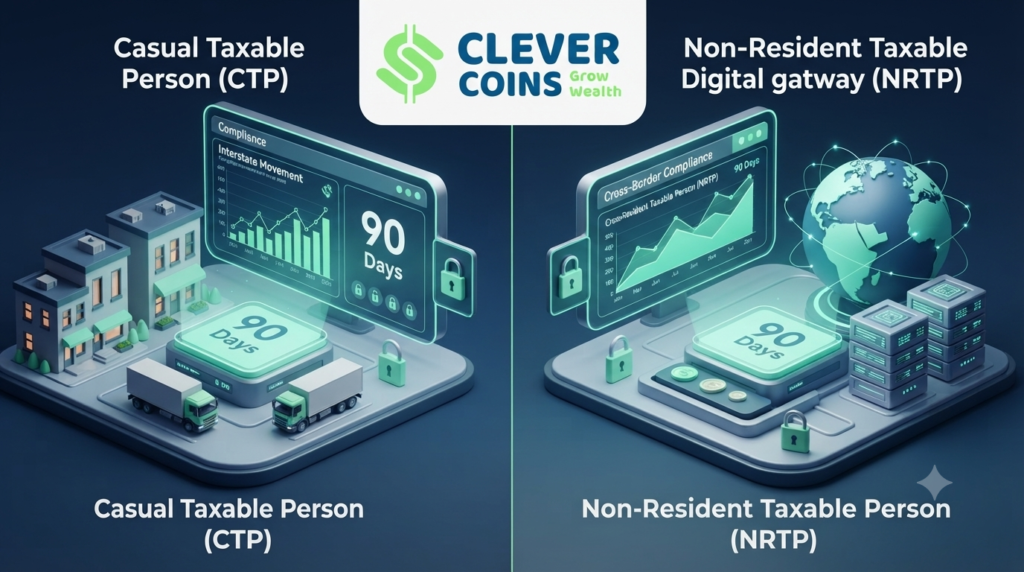
Casual Taxable Person (CTP) vs. Non-Resident Taxable Person (NRTP): The Ultimate GST Registration Guide
Introduction: Navigating Temporary Business Operations Under GST
When businesses expand across state lines or international borders to participate in short-term trade shows, exhibitions, or temporary project execution, standard Goods and Services Tax (GST) rules undergo a drastic shift. The standard turnover thresholds (such as INR 20 Lakhs or INR 40 Lakhs) completely vanish, and special compliance frameworks under Section 27 of the CGST Act, 2017 take effect.
For many expanding organizations, confusion frequently arises between two specialized classifications: Casual Taxable Person (CTP) and Non-Resident Taxable Person (NRTP). Though both deal with transient business operations and demand rigorous advance tax planning, their legal definitions, documentation requirements, Input Tax Credit (ITC) eligibility, and return-filing obligations feature critical structural distinctions.
Brought to you by the tax advisory experts at CleverCoins, this comprehensive guide unpacks everything you need to know about CTP and NRTP registration, compliance pitfalls, and strategic optimization for the 2026 tax landscape.
1. Defining the Core Concepts
To determine your compliance pathway, you must first accurately categorize your operational footprint under Indian tax statutes.
What is a Casual Taxable Person (CTP)?
Under Section 2(20) of the CGST Act, 2017, a Casual Taxable Person (CTP) is defined as an individual or entity that occasionally undertakes transactions involving the supply of goods or services. Crucially, a CTP has a fixed place of business in one State or Union Territory of India, but wishes to execute taxable supplies in another State or UT where they possess no fixed establishment.
-
Key Characteristic: Operates domestically within India. They already hold a regular PAN and an active GSTIN in their home state.
-
Real-World Example: A handicraft manufacturer based permanently in Jaipur, Rajasthan, sets up a temporary exhibition stall at Pragati Maidan in New Delhi for a two-week trade fair. Because they lack a fixed shop or office in Delhi, they must obtain a separate CTP registration specific to Delhi.
What is a Non-Resident Taxable Person (NRTP)?
Under Section 2(77) of the CGST Act, 2017, a Non-Resident Taxable Person (NRTP) is any person or corporate entity that occasionally supplies goods or services inside India, but resides outside India and has no fixed place of business or residence within the country.
-
Key Characteristic: Operates globally or internationally with no permanent establishment or fixed base anywhere inside Indian territory.
-
Real-World Example: A specialized tech consulting firm based in London sends an engineering team to Bengaluru for three weeks to custom-configure an industrial automation system for a local client. They possess no local office, branch, or permanent address in India and must register as an NRTP.
2. Head-to-Head Comparison: CTP vs. NRTP
| Parameter | Casual Taxable Person (CTP) | Non-Resident Taxable Person (NRTP) |
| Statutory Reference | Section 2(20) of CGST Act | Section 2(77) of CGST Act |
| Geographical Scope | Based in India; operates outside home state | Based outside India; operates within India |
| PAN Requirement | Mandatory (Uses existing domestic PAN) | Not mandatory. Can register via a valid passport or through an authorized Indian local agent with a PAN. |
| Registration Portal Form | Standard GST Registration application | Form GST REG-09 |
| Input Tax Credit (ITC) | Fully eligible on all eligible local inward supplies/inputs | Strictly restricted. ITC is available only on goods imported into India; no ITC on domestic services or purchases. |
| Mandatory Advance Tax | Yes, based on estimated net tax liability | Yes, based on estimated gross/net tax liability |
| Return Compliance | Standard monthly returns (GSTR-1, GSTR-3B) | Dedicated monthly return in Form GSTR-5 |
3. Mandatory Registration Rules Under Section 27
Section 27 governs the operational constraints and structural workflow for both categories. Unlike regular business registrations where a threshold exemption applies, registration is compulsory from day one, regardless of aggregate turnover.
A. Advance Deposit of Estimated Tax
You cannot complete a CTP or NRTP registration without funding your Electronic Cash Ledger upfront. At the time of filing the application, the applicant must deposit an amount equivalent to their estimated tax liability for the period for which the registration is sought.
-
Operational Tip: If an overseas company projects total taxable supplies worth INR 50,00,000 at an average 18% GST rate during a trade convention, an advance deposit of INR 9,00,000 must be cleared into the cash ledger before the registration certificate is issued.
B. Pre-Issuance and Timely Filing Mandate
The first proviso to Section 25 stipulates that applications for CTP and NRTP must be submitted at least 5 days prior to the commencement of business. Taxable supplies cannot commence until the proper officer approves the application and issues the certificate.
C. Validity Period and Extension Rules
-
Initial Validity: The registration certificate is granted for a standard maximum period of 90 days from the effective date of registration.
-
Extension Provision: If the event, project, or exhibition is prolonged, an extension of up to an additional 90 days can be requested via Form GST REG-11 before the current validity expires, subject to paying additional advance tax for the extended term. The absolute cumulative cap is 180 days.
4. Documentation Checklist for Smooth Onboarding
Securing approval swiftly requires assembling precise compliance documentation.
For Casual Taxable Person (CTP):
-
Valid active PAN card linked to the business.
-
Proof of principal place of business in the home state.
-
Details of the temporary location/stall (such as event booking confirmation, allotment letter, or temporary address proof).
-
Authorized signatory details with Digital Signature Certificate (DSC) or Electronic Verification Code (EVC).
For Non-Resident Taxable Person (NRTP):
-
Valid Passport of the non-resident individual or authorized directors/promoters.
-
Tax Identification Number (TIN) or home country corporate registration documents.
-
Indian Authorized Signatory: Must be an individual resident in India possessing a valid PAN and formal authorization (Board Resolution or Power of Attorney).
-
Proof of temporary location or address in India where services/goods will be delivered (e.g., hotel contract, exhibition ground lease agreement, or client facility letter).
5. Return Filing and Compliance Obligations
Fulfilling tax liabilities does not stop at registration; ongoing filing requirements differ sharply between the two types.
-
For CTPs: Regular monthly compliance applies. CTPs must file GSTR-1 (outward supplies) and GSTR-3B (summary return and tax payment) just like ordinary resident taxpayers. They can seamlessly utilize accumulated Input Tax Credit against their outward liabilities.
-
For NRTPs: NRTPs do not file standard monthly returns. Instead, they must submit Form GSTR-5 electronically through the GST portal. GSTR-5 captures all inward supplies, imported goods, and outward taxable supplies executed within India during the period. The due date is within 20 days after the end of a calendar month, or within 7 days after the validity of registration expires, whichever is earlier.
6. Strategic Tax Advice from CleverCoins
Navigating temporary registrations without professional oversight often leads to cash-flow blockages, unexpected penalty assessments, and compliance notices. Keep these golden rules in mind:
-
Accurate Estimation: Avoid underestimating your sales volume. Falling short of your actual tax liability during an event invites interest charges (typically 18% per annum) and penalty assessments under Section 122.
-
Reclaiming Excess Deposits: If your actual tax liability is lower than your advance cash deposit, the surplus can be claimed as a refund via Section 54, but only after all statutory returns for the entire registration period have been successfully filed.
-
Understand ITC Limits: Foreign businesses operating as NRTPs must factor in that local domestic expenses (such as local hotel bookings, cabs, and domestic administrative services) carry non-recoverable GST due to ITC restrictions under Section 17(5).
Struggling with temporary GST registrations, advance tax computations, or GSTR-5 filings? Let the experts at CleverCoins manage your multi-state and cross-border compliance seamlessly,
- Phone: +91 77389 59862
- Email: client@clevercoins.org
- Address: Ideal Market, Mumbra, Thane-400612





