
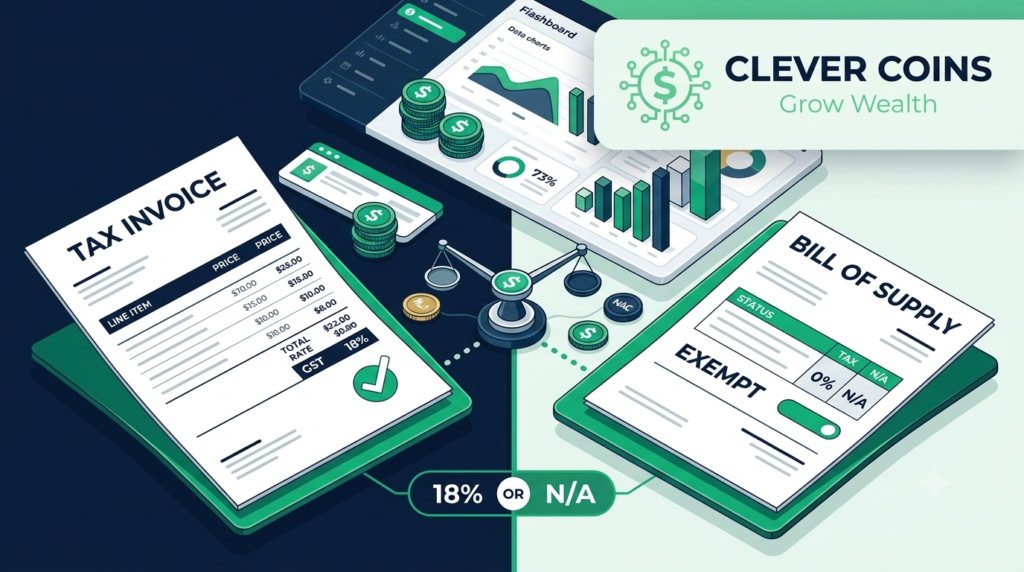
Bill of Supply vs. Tax Invoice: When Should a Business Issue Which Document?
In the modern landscape of Goods and Services Tax (GST) compliance, documentation isn’t merely a administrative chore—it is the financial spine of your enterprise. Every transaction that flows through your business must be accompanied by an appropriate legal document. Under Indian GST law (governed by the Central Goods and Services Tax Act, 2017), the two primary documents used to record sales transactions are the Tax Invoice and the Bill of Supply.
While both documents serve as legal proof of a sale, they are fundamentally different in their legal structure, tax implications, and operational usage. Issuing a Tax Invoice when a Bill of Supply is required—or worse, issuing a Bill of Supply when a Tax Invoice should have been generated—can lead to severe penalties, invalidation of your buyer’s Input Tax Credit (ITC), and unnecessary tax litigation.
This comprehensive guide breaks down everything you need to know about the Bill of Supply vs. Tax Invoice distinction: definitions, legal frameworks, key components, real-world scenario matrices, common compliance errors, and automated invoicing practices.
Section 1: Foundations of GST Documentation
Under GST law, the primary objective of invoice documentation is to trace the flow of goods and services across the supply chain while tracking the taxes collected and passed forward. To understand which document to issue, one must first grasp the core mechanisms of Taxable Supplies, Exempt Supplies, and Tax Collection Mechanics.
A Tax Invoice is an official legal document issued by a registered taxpayer when selling taxable goods or services. It serves a dual purpose:
It acts as an itemized record of the sale, detailing the quantity, value, and description of goods or services.
It acts as a tax-charging document, explicitly stating the CGST, SGST, IGST, or UTGST charged on the transaction.
Crucially, a Tax Invoice is the only valid document that allows a registered buyer to claim Input Tax Credit (ITC). Without a legally compliant Tax Invoice containing all mandatory fields under Rule 46 of the CGST Rules, the buyer cannot offset the tax paid on purchases against their output tax liability.
What is a Bill of Supply?
A Bill of Supply is a legal document issued by a business in specific circumstances where no GST can be charged on the transaction.
Unlike a Tax Invoice, a Bill of Supply does not contain any tax rates or tax amounts. Because no tax is levied or collected, the recipient of a Bill of Supply cannot claim Input Tax Credit (ITC) under any circumstances.
Statutory Basis: CGST Act, 2017
Section 31(1) & 31(2) of the CGST Act: Mandates the issuance of a Tax Invoice for the taxable supply of goods and services.
Section 31(3)(c) of the CGST Act: Mandates the issuance of a Bill of Supply when a registered person supplies exempted goods or services, or when a registered person opts to pay tax under the Composition Scheme (Section 10).
Rule 46 of CGST Rules, 2017: Outlines the mandatory contents of a Tax Invoice.
Rule 49 of CGST Rules, 2017: Outlines the mandatory contents of a Bill of Supply.
Section 2: In-Depth Breakdown of a Tax Invoice
When MUST You Issue a Tax Invoice?
A registered taxable person MUST issue a Tax Invoice in the following scenarios:
Supply of Taxable Goods: Whenever a registered business sells goods that attract a non-zero GST rate (e.g., 5%, 12%, 18%, or 28%).
Supply of Taxable Services: Whenever a registered business renders services that carry a non-zero GST rate.
Inter-State Taxable Sales: All taxable inter-State sales requiring the levy of Integrated GST (IGST).
Intra-State Taxable Sales: All taxable intra-State sales requiring Central GST (CGST) and State GST (SGST).
Exports of Goods or Services (with payment of tax): When goods or services are exported under payment of IGST.
Mandatory Requirements of a Tax Invoice (Rule 46)
To be considered legally valid under GST, a Tax Invoice must contain the following 16 key details:
Name, Address, and GSTIN of the supplier.
A consecutive Serial Number (up to 16 characters, containing alphabets, numerals, or special characters like hyphens
/or-, unique for a financial year).Date of Issue.
Name, Address, and GSTIN/Unique Identification Number (UIN) of the recipient (if registered).
Name and Address of recipient along with delivery address and State Name/Code for unregistered buyers (mandatory for taxable values of ₹50,000 or more).
Harmonized System of Nomenclature (HSN) Code for goods or Service Accounting Code (SAC) for services.
Description of Goods or Services.
Quantity (in units) and Unit Quantity Code (UQC).
Total Value of Goods or Services.
Taxable Value of goods or services taking into account discounts or allowances.
Tax Rate charged (CGST, SGST, IGST, or Cess).
Amount of Tax Charged split by CGST, SGST, IGST, and Cess.
Place of Supply, along with the name of the State (for inter-State transactions).
Address of Delivery, if different from the Place of Supply.
Whether Reverse Charge Mechanism (RCM) is applicable (Yes/No).
Signature or Digital Signature of the supplier or authorized representative.
Section 3: In-Depth Breakdown of a Bill of Supply
When MUST You Issue a Bill of Supply?
You are legally mandated to issue a Bill of Supply under three distinct business circumstances:
1. Registered Businesses Supplying Exempted Goods or Services
If a registered business sells goods or services that attract a 0% GST rate or are categorized as wholly exempt via official GST notifications, a Bill of Supply must be issued.
Examples of Exempt Goods: Unprocessed agricultural produce, fresh milk, unbranded food grains, curd, fresh fruits, vegetables, live animals.
Examples of Exempt Services: Basic healthcare services provided by clinical establishments, educational services provided by schools/universities, municipal transport.
2. Businesses Opting for the Composition Scheme (Section 10)
Small businesses with an aggregate turnover under ₹1.5 Crore (or ₹75 Lakhs for Special Category States) can opt for the GST Composition Scheme.
Composition taxpayers pay tax at a flat concessional rate (e.g., 1% for traders/manufacturers, 5% for restaurants) directly from their turnover.
Crucial Rule: Composition taxpayers are strictly prohibited from collecting tax from their customers. Therefore, they cannot issue a Tax Invoice. They must issue a Bill of Supply.
Mandatory Declaration: Every Bill of Supply issued by a composition dealer must state prominently at the top: “Composition taxable person, not eligible to collect tax on supplies.”
3. Exporters Supplying Goods/Services under LUT (Letter of Undertaking)
When an exporter exports goods or services outside India without payment of IGST by filing a Letter of Undertaking (LUT) or Bond, no output tax is charged on the invoice. In these specific zero-rated transactions where no tax is charged, a Bill of Supply (or a specialized Zero-Rated Commercial Invoice functioning as a Bill of Supply) is issued.
Mandatory Requirements of a Bill of Supply (Rule 49)
Under Rule 49 of the CGST Rules, a Bill of Supply requires fewer fields than a Tax Invoice because no tax breakdown is involved:
Name, Address, and GSTIN of the supplier.
Consecutive Serial Number (up to 16 characters, unique for the financial year).
Date of Issue.
Name, Address, and GSTIN/UIN of the recipient (if registered).
HSN Code for goods or SAC Code for services.
Description of Goods or Services.
Value of Supply of Goods or Services (taking into account any discount or abatement).
Signature or Digital Signature of the supplier or authorized representative.
Section 4: Detailed Structural Comparison
To make the distinctions crystal clear, here is a comprehensive comparative breakdown across key legal and operational dimensions:
| Parameter | Tax Invoice | Bill of Supply |
|---|---|---|
| Governing Rule | Rule 46 of CGST Rules, 2017 | Rule 49 of CGST Rules, 2017 |
| Primary Purpose | To charge output GST & pass on Input Tax Credit | To record transactions where no tax can be levied |
| Applicable Suppliers | Regular GST-registered businesses selling taxable goods/services | 1. Composition dealers 2. Regular dealers selling exempt goods 3. Exporters under LUT |
| Tax Levy / Charged | Yes (CGST + SGST or IGST explicitly shown) | No (Strictly zero tax charged) |
| Input Tax Credit (ITC) | Buyer CAN claim ITC using this document | Buyer CANNOT claim ITC |
| Mandatory Text | Mandatory details of tax rate and tax splits | Composition dealers must print: “Composition taxable person, not eligible to collect tax on supplies.” |
| HSN/SAC Disclosure | Mandatory (4, 6, or 8 digits based on turnover) | Mandatory (same HSN rules apply) |
| Valuation Fields | Gross Value, Discounts, Taxable Value, Tax Rates, Tax Amounts | Total Value after discounts |
| Impact of Wrong Usage | Claiming ITC on a Bill of Supply is tax fraud; failing to charge tax on a Tax Invoice leads to tax evasion penalties | Charging tax on a Bill of Supply violates Section 10 and Rule 49 |
Section 5: Real-World Business Scenarios Matrix
Choosing between a Tax Invoice and a Bill of Supply often depends on the specific operational scenario. Below is a comprehensive lookup matrix for business owners and accountants.
Scenario 1: A Supermarket Selling Mixed Items
Situation: A regular GST-registered supermarket sells a customer a basket containing ₹1,000 worth of packaged electronics (18% GST) and ₹500 worth of fresh unbranded food grains (Exempt/0% GST).
Document Required: Under Rule 46A, the store can issue a single Invoice-cum-Bill of Supply (or separate line items in a Tax Invoice explicitly showing 0% tax for the exempt items and 18% tax for the taxable items).
Scenario 2: A Local Restaurant Registered Under Composition Scheme
Situation: A small diner with ₹60 Lakh annual turnover has opted for the Composition Scheme and serves a bill of ₹2,000 to a corporate client.
Document Required: Bill of Supply. Even though the diner provides dining services, it cannot charge 5% or 18% GST on the bill. The diner pays its 5% composition tax out of its own pocket to the government. The corporate client cannot claim ITC.
Scenario 3: An IT Services Firm Exporting Software to the USA under LUT
Situation: A software firm in Bengaluru provides web development services to a client in San Francisco without charging IGST, having filed an active Letter of Undertaking (LUT).
Document Required: Bill of Supply (or Export Invoice issued under LUT without payment of tax). The invoice must state: “Supply meant for export under Letter of Undertaking without payment of integrated tax.”
Scenario 4: A Manufacturing Unit Selling Scrap
Situation: A manufacturing enterprise sells scrap metal (taxable at 18%) to a recycling plant.
Document Required: Tax Invoice. Scrap metal is a taxable supply, so output GST must be charged, allowing the recycler to claim ITC.
Scenario 5: B2C Sale Under ₹200
Situation: A retail stationer sells a notebook worth ₹50 to a walk-in retail customer who does not require an invoice.
Document Required: Under Section 31(3)(b), no Tax Invoice or Bill of Supply needs to be issued for transactions under ₹200, provided the recipient is unregistered and does not demand an invoice. At the end of the day, the seller generates a consolidated Consolidated Tax Invoice or Consolidated Bill of Supply for all such sales.
Section 6: Special Documentation Rules & Variations
1. Invoice-cum-Bill of Supply
What happens when a business sells both taxable and exempted goods to the same customer in a single order?
Previously, businesses had to issue two separate documents: a Tax Invoice for the taxable items and a Bill of Supply for the exempt items. However, via Notification No. 45/2017 – Central Tax, the government introduced the Invoice-cum-Bill of Supply.
When to use: When a registered person supplies both taxable as well as exempted goods or services to an unregistered person (B2C).
Format: It combines all mandatory details of Rule 46 and Rule 49, clearly separating taxable line items (with tax rates) from exempted line items.
2. Receipt Voucher & Payment Voucher
Receipt Voucher: When a registered business receives an advance payment for taxable goods or services, it must issue a Receipt Voucher (Section 31(3)(d)).
Payment Voucher: When a business makes a payment to an unregistered supplier for a transaction subject to Reverse Charge Mechanism (RCM), the buyer must issue a Payment Voucher at the time of payment (Section 31(3)(g)).
3. Credit Notes & Debit Notes
If the value or tax charged in a Tax Invoice needs adjustment after issuance:
Credit Note (Section 34(1)): Issued by the supplier when the taxable value or tax charged in the original Tax Invoice exceeds the actual value, or when goods are returned by the recipient.
Debit Note (Section 34(3)): Issued by the supplier when the taxable value or tax charged in the original Tax Invoice is lower than the actual value.
Section 7: HSN/SAC Code Rules for Invoicing
Under GST, HSN (Harmonized System of Nomenclature) codes for goods and SAC (Service Accounting Code) codes for services must be printed on both Tax Invoices and Bills of Supply according to annual turnover thresholds:
| Aggregate Annual Turnover (AATO) in Previous FY | Number of Digits of HSN/SAC Required | Scope of Requirement |
|---|---|---|
| Up to ₹5 Crore | 4 Digits | Mandatory for B2B supplies (Optional for B2C supplies) |
| Above ₹5 Crore | 6 Digits | Mandatory for all B2B and B2C supplies |
| Chemicals / Specialized Items | 8 Digits | Mandatory as per specific notifications regardless of turnover |
Failure to include correct HSN/SAC codes constitutes an inaccurate invoice and can attract penalties under Section 125 of the CGST Act.
Section 8: Compliance Risks, Penalties & Common Mistakes
Issuing improper invoicing documentation carries financial and legal risks. Below are the most frequent mistakes made by accounting teams and their legal ramifications:
+-----------------------------------------------------------------------------------+
|                           COMMON INVOICING ERROR MATRIX                           |
+------------------------------------+----------------------------------------------+
| INCORRECT PRACTICE                 | LEGAL & FINANCIAL CONSEQUENCE                |
+------------------------------------+----------------------------------------------+
| Composition dealer issuing a Tax   | Illegal collection of tax; penalty up to     |
| Invoice and collecting GST         | 100% of tax collected or ₹10,000 (Sec 122).  |
+------------------------------------+----------------------------------------------+
| Registered business issuing a Bill | Customer denied Input Tax Credit (ITC);      |
| of Supply for taxable goods        | loss of commercial relationships.            |
+------------------------------------+----------------------------------------------+
| Omitting "Composition Taxable      | Breach of Rule 49; general penalty under     |
| Person..." declaration             | Section 125 (up to ₹25,000).                 |
+------------------------------------+----------------------------------------------+
| Incorrect HSN/SAC Digits or        | Invoice classified as defective; GSTR-1     |
| non-consecutive invoice numbers    | matching errors in GST portal.               |
+------------------------------------+----------------------------------------------+
Statutory Penalty Framework
1. Failure to Issue Invoice / Issuing Incorrect Invoice (Section 122(1))
If a registered taxable person supplies goods/services without issuing an invoice, or issues an incorrect/false invoice, they are liable to pay a penalty equal to:
₹10,000 OR
100% of the tax evaded (whichever is higher).
2. Collecting GST on a Bill of Supply (Section 122(1)(iii))
If a seller issues a Bill of Supply or invoice charging GST when they are not legally authorized to collect tax (e.g., a Composition Dealer or unregistered entity), they face a minimum penalty of ₹10,000 or an amount equal to the tax illegally collected.
3. General Penalty (Section 125)
Any contravention of GST rules for which no specific penalty is provided elsewhere in the Act carries a general penalty extending up to ₹25,000 per tax head (CGST and SGST totaling up to ₹50,000).
Section 9: E-Invoicing & Digital Compliance Integration
In recent years, the CBIC (Central Board of Indirect Taxes and Customs) has progressively reduced the threshold for mandatory E-Invoicing (generating an Invoice Reference Number – IRN via the Invoice Registration Portal).
Does E-Invoicing Apply to Bills of Supply?
No. E-Invoicing requirements apply strictly to Tax Invoices, Credit Notes, and Debit Notes issued for B2B transactions and exports by entities crossing the mandated turnover threshold.
Bills of Supply issued by composition taxpayers or regular taxpayers selling exempt goods are currently excluded from the IRN generation process. However, all digital record-keeping rules under GST still apply.
Best Practices for Digital Invoicing Systems
To ensure seamless audit readiness, modern enterprises should configure their ERP and accounting software to execute the following automated controls:
Automated Document Routing: The system should automatically restrict a user from adding a GST tax slab when generating a Bill of Supply.
Master Item Mapping: Map every SKU/service in your inventory to its precise HSN/SAC code and GST rate slab. If an item marked “Exempt” is selected, the ERP should force the document format to a Bill of Supply.
Sequential Numbering Safeguards: Ensure that the sequence numbers for Tax Invoices and Bills of Supply run sequentially without gaps or overlaps throughout the financial year.
Composition Declaration Enforcement: Automatically embed the legally required warning text on every invoice template generated for a Composition GSTIN.
Section 10: Summary Checklist for Business Owners
Before finalizing any outgoing transaction document, run through this final operational checklist:
[ ] Identify Supplier Status: Are you a Regular Taxable Person or a Composition Taxable Person?
[ ] Identify Taxability of Item: Is the product/service taxable (5%, 12%, 18%, 28%) or exempt/nil-rated (0%)?
[ ] Select Correct Document:
Regular Dealer + Taxable Item = Tax Invoice
Regular Dealer + Exempt Item = Bill of Supply
Composition Dealer + Any Item = Bill of Supply
Regular Dealer + Mixed Sale (B2C) = Invoice-cum-Bill of Supply
[ ] Verify Mandatory Fields: Check for valid 16-character serial numbers, correct HSN/SAC digits, recipient GSTIN, and explicit tax breakdowns (for Tax Invoices).
[ ] Check Legal Declarations: Ensure Composition dealers include the statutory notice regarding non-eligibility to collect tax.
By maintaining strict compliance with these invoicing protocols, businesses preserve customer trust, streamline their GSTR-1 and GSTR-3B filings, and protect themselves against costly tax disputes.





