
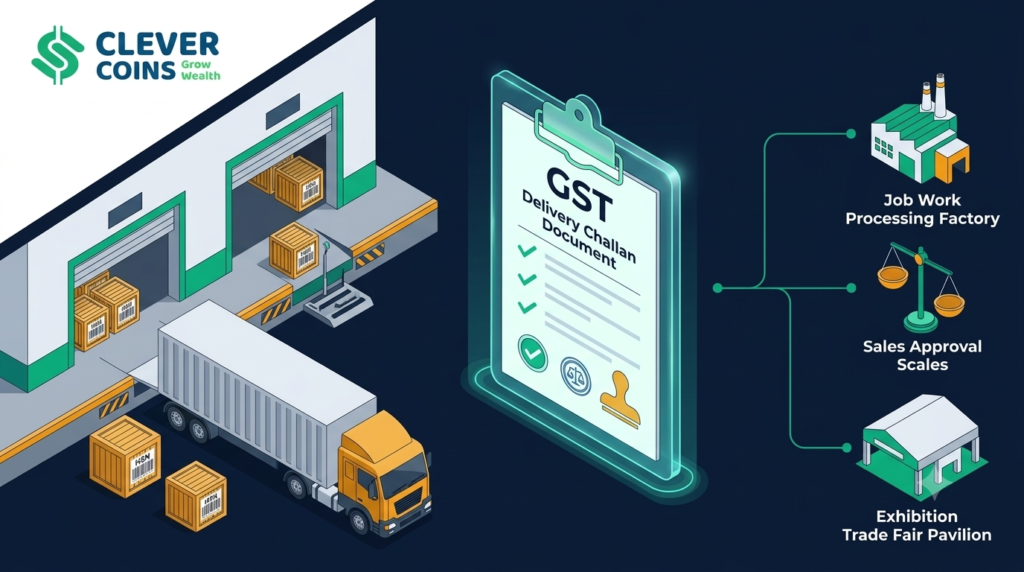
Complete Guide to Delivery Challans in GST: Transporting Goods for Job Work, Approvals, and Exhibitions
In the ecosystem of the Goods and Services Tax (GST) in India, moving goods from one location to another does not always signify a sale. Indian businesses frequently transfer raw materials, capital equipment, inventory, and sample goods across state lines or within state boundaries for processing, testing, marketing, or temporary displays.
Under standard tax provisions, the movement of taxable goods requires a Tax Invoice. However, when goods move without an immediate transfer of ownership or sale consideration, issuing a tax invoice is legally improper and can cause accounting discrepancies. To accommodate these scenarios, Section 31 of the CGST Act, read with Rule 55 of the CGST Rules, 2017, mandates the use of a legal document known as a Delivery Challan.
This comprehensive operational guide details everything tax managers, accountants, business owners, and logistics professionals need to know about Delivery Challans in GST, covering rules, job work provisions, goods sent on approval, exhibition rules, e-Way Bill integration, and practical compliance frameworks.
1. What is a Delivery Challan in GST?
A Delivery Challan is an official legal and accounting document issued under GST laws to accompany goods transported from one place to another when the transaction does not constitute a “supply” at the time of removal.
Under GST laws, tax becomes payable upon the “supply” of goods or services (defined under Section 7 of the CGST Act). However, non-supply movements—such as sending goods for repair, processing, display, or trial—do not trigger immediate tax liability. The Delivery Challan acts as proof of genuine movement, ensuring that goods in transit are not seized by GST inspection officers for tax evasion.
Key Distinction: Delivery Challan vs. Tax Invoice vs. Bill of Supply
| Feature | Delivery Challan | Tax Invoice | Bill of Supply |
| Primary Purpose | Accompanies non-supply movement of goods | Issued for taxable supply of goods or services | Issued for non-taxable or exempt supplies |
| Governing Rule | Rule 55 of CGST Rules, 2017 | Section 31 / Rule 46 of CGST Rules | Section 31(3)(c) / Rule 49 of CGST Rules |
| Tax Charged? | No tax levied on the document | GST rates explicitly charged | No GST charged (exempt/composition) |
| ITC Impact | Cannot be used to claim Input Tax Credit | Primary document for claiming ITC | Cannot be used for claiming ITC |
2. Mandatory Rules and Legal Provisions (Rule 55 of CGST Rules)
Rule 55 of the Central Goods and Services Tax (CGST) Rules, 2017 dictates the specific circumstances under which a Delivery Challan must be generated, along with its compulsory structural contents.
Specific Circumstances for Issuing a Delivery Challan
Under Rule 55(1), a registered person may issue a Delivery Challan instead of a tax invoice for the transportation of goods in the following primary cases:
Supply of Liquid Gas: Where the quantity at the time of removal from the place of business is not known.
Transportation for Job Work: Sending inputs or capital goods to a job worker, or returning processed goods back to the principal.
Transportation for Reasons Other Than Supply: Moving capital assets, transferring stock between branches (where distinct GSTINs are not involved under single registration), sending tools, or sending goods for testing/calibration.
Goods Sent on Approval / Sale or Return Basis: Transporting goods to prospective buyers who have the option to accept or reject them.
Transportation to Exhibitions, Trade Fairs, or Events: Transferring goods for promotional displays or temporary trade events across India.
Notified Goods Movements: Any other notified supply or movement specified by the Central Board of Indirect Taxes and Customs (CBIC).
Essential Details Required in a Delivery Challan
To ensure statutory compliance, every Delivery Challan must contain the following details:
Header: Date and serial number (consecutive, unique for a financial year, up to 16 characters).
Consignor Details: Name, address, and GSTIN of the supplier/sender.
Consignee Details: Name, address, and GSTIN/Unique Identification Number (UIN) of the recipient (if registered).
HSN Code & Description: Harmonized System of Nomenclature (HSN) code and detailed description of the goods.
Quantity & Measure: Quantity (provisional or definite) along with the Unit Quantity Code (UQC).
Taxable Value: Estimated taxable value of the goods transported.
Tax Rates & Tax Amount: Applicable tax rate (CGST, SGST, IGST, or Cess) and provisional tax amount (calculated purely for valuation purposes, though not collected as tax).
Place of Supply: State name and code in case of inter-state movement.
Signature: Digital or physical signature of the supplier or authorized representative.
3. Delivery Challan for Job Work Transactions
Job work is one of the most frequent business applications of Delivery Challans. Under Section 2(68) of the CGST Act, “job work” means any treatment or process undertaken by a person on goods belonging to another registered person (the “Principal”).
Procedural Rules for Job Work under Section 143
When a principal sends raw materials, semi-finished goods, or capital goods to a job worker:
Issue of Delivery Challan: The principal must issue a Delivery Challan containing all mandatory fields specified under Rule 55.
Filing Form GST ITC-04: Details of all Delivery Challans issued for job work (and returns) must be reported in Form GST ITC-04 on a quarterly or annual basis, depending on turnover thresholds.
Statutory Timelines for Return of Goods:
Inputs / Semi-Finished Goods: Must be brought back to the principal’s premises or supplied directly from the job worker’s premises within 1 year.
Capital Goods: Must be brought back or sold directly within 3 years.
Note: Moulds, dies, jigs, fixtures, and tools are exempt from this strict return timeframe.
Tax Implications of Exceeding Timelines
If inputs or capital goods are not returned within the prescribed 1-year or 3-year periods:
The transaction is legally deemed a “Deemed Supply” by the principal to the job worker on the date the goods were original sent out.
The principal must issue a retrospective Tax Invoice and pay GST along with applicable interest under Section 50 from the original date of dispatch.
4. Goods Sent on Approval / Sale-or-Return Basis
In sectors such as jewelry, high-end electronics, machinery, and textiles, goods are routinely delivered to potential clients on an “approval” basis.
Statutory Framework under Section 31(7)
When goods are dispatched on approval:
Initial Movement: Dispatched under a Delivery Challan (accompanied by an e-Way Bill if value exceeds ₹50,000).
Time Limit for Acceptance: The recipient must accept or reject the goods within 6 months from the date of removal.
Issuance of Tax Invoice
If Accepted Within 6 Months: A Tax Invoice must be issued at the time of acceptance/supply.
If Neither Accepted Nor Returned within 6 Months: A Tax Invoice must be generated automatically on the exact day the 6-month period expires, as it is treated as a deemed supply under GST.
5. Transporting Goods for Exhibitions, Trade Fairs, and Art Displays
Participating in trade fairs, international exhibitions, and promotional expos involves moving goods across state borders without a predetermined buyer.
CBIC Circular No. 108/27/2019-GST Guidelines
To clarify uncertainties surrounding exhibition goods, the CBIC issued Circular No. 108/27/2019-GST, establishing the following standard operational guidelines:
Movement as Non-Supply: Transporting goods for exhibitions or promotional events outside the state does not constitute a supply.
Documentation Required: The goods must be transported under a Delivery Challan along with the mandatory e-Way Bill.
Six-Month Rule:
If goods brought to an exhibition are sold (fully or partially), a Tax Invoice must be issued at the time of sale.
If goods are not sold, they must be returned to the principal premises within 6 months from the date of removal under cover of a return Delivery Challan.
If goods are retained at the exhibition site beyond 6 months without being sold or returned, a Tax Invoice must be issued on the day the 6-month limit lapses.
6. Delivery Challan and e-Way Bill Integration
A common source of confusion for taxpayers is whether an e-Way Bill is necessary when moving goods via a Delivery Challan.
When is an e-Way Bill Mandatory with a Delivery Challan?
Under Rule 138 of the CGST Rules, every registered person who causes the movement of goods of consignment value exceeding ₹50,000 (or state-specific lower threshold for intra-state movement) must generate an e-Way Bill—regardless of whether the movement is for supply, job work, approval, or exhibition.
Steps to Generate an e-Way Bill using a Delivery Challan
Log in to the official e-Way Bill Portal (
ewaybillgst.gov.in).Navigate to Generate New under the e-Way Bill section.
Under Transaction Type, select Outward.
Under Sub-Type, select the appropriate category:
Job Work
SKD/CKD/Lots
Recipient Not Known (for approval/exhibitions)
Line Sales / Others
Under Document Type, select Delivery Challan.
Enter the Delivery Challan Number and Date.
Fill in the consignment details (HSN, quantities, estimated values) and transport details (Vehicle Number / Transporter ID) to generate the EWB.
7. Step-by-Step Guide: How to Generate a Valid Delivery Challan
Follow this structured compliance checklist when generating a Delivery Challan:
Triplicate Copy Requirement (Rule 55(2))
In accordance with GST rules, Delivery Challans must be prepared in triplicate:
Original Copy: Marked as ‘Original for Consignee’ (accompanies goods to recipient/job worker).
Duplicate Copy: Marked as ‘Duplicate for Transporter’ (carried by vehicle driver).
Triplicate Copy: Marked as ‘Triplicate for Consignor’ (retained by sender for records and audit trail).
8. Common Errors, Penalties, and Best Practices
Frequent Operational Mistakes
Omitting the e-Way Bill: Transporting high-value goods (>₹50,000) under a Delivery Challan without generating an e-Way Bill.
Missing Form GST ITC-04: Failing to report job work dispatches and receipts quarterly or annually.
Ignoring the 6-Month / 1-Year Deadlines: Forgetting to issue a Tax Invoice when goods sent on approval or job work exceed statutory return periods.
Incorrect Document Type on EWB Portal: Selecting “Tax Invoice” instead of “Delivery Challan” on the portal, creating artificial tax liabilities during GST returns matching.
Statutory Penalties under Section 122
Transporting goods without valid documents (including a Delivery Challan and e-Way Bill where required) can attract penalties under Section 122 and Section 129 of the CGST Act:
A penalty equal to 100% of the tax payable or ₹10,000 (whichever is higher).
Detention or seizure of goods and the transporting vehicle until applicable penalty fees are settled.
Operational Best Practices
Maintain Digital Logs: Implement an automated tracking system for all open Delivery Challans to alert teams 30 days prior to the expiration of 6-month or 1-year windows.
Regular Reconciliation: Reconcile physically returned stock against issuing Delivery Challans every month.
Clear Agreements: Ensure written job work and exhibition contracts specify responsibility for freight, damages, and compliance returns.
9. Frequently Asked Questions (FAQs)
Q1: Can a Delivery Challan be edited after generation?
No. Once a Delivery Challan is issued and accompanied by an e-Way Bill, it cannot be edited. If errors occur, the existing e-Way Bill must be cancelled within 24 hours, and a fresh Delivery Challan issued.
Q2: Is GST payable on goods transported under a Delivery Challan?
No GST is collected or paid at the time of issuing a Delivery Challan, as no supply has occurred. Tax liability only arises if the goods are subsequently sold or fail to return within prescribed statutory timelines.
Q3: Is a Delivery Challan required for intra-state transfers within the same GSTIN?
Yes. Moving goods between different godowns, warehouses, or processing centers under the same GSTIN requires a Delivery Challan to explain the movement during transit inspections





