
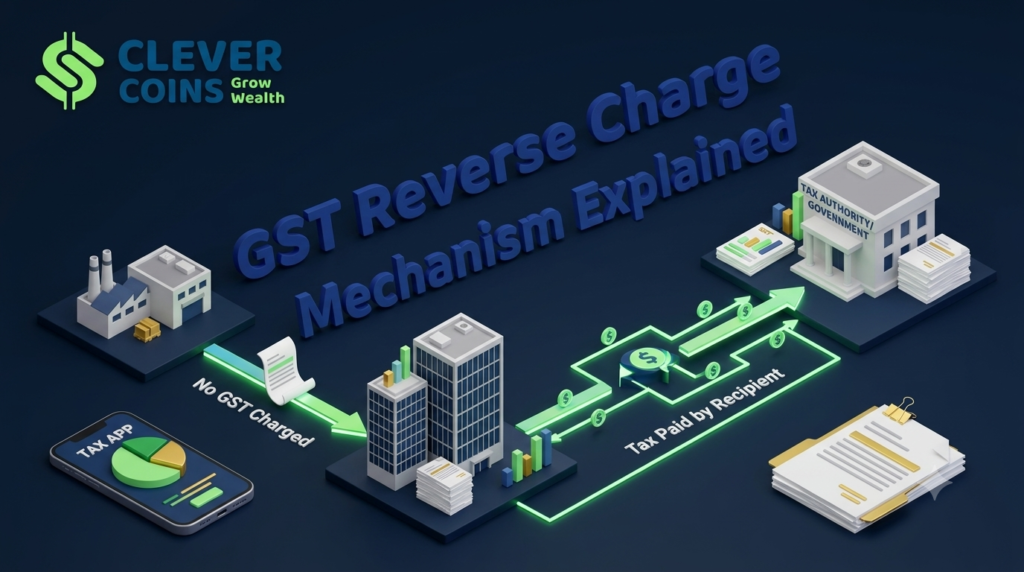
Reverse Charge Mechanism (RCM) Explained: Section 9(3) vs. Section 9(4) Differences & Complete Compliance Guide
Executive Summary
The Reverse Charge Mechanism (RCM) under the Indian Goods and Services Tax (GST) framework represents one of the most significant paradigm shifts in modern indirect taxation. Traditionally, the liability to collect and deposit tax rests with the supplier of goods or services (Forward Charge Mechanism). However, under RCM, this tax liability is legally reversed: the recipient of the goods or services becomes directly responsible for assessing, reporting, and paying the applicable GST directly to the Central and State Governments.
Understanding the structural nuances between Section 9(3) and Section 9(4) of the Central Goods and Services Tax (CGST) Act, 2017 (and their corresponding provisions under SGST and UTGST Acts, alongside Section 5(3) and 5(4) of the IGST Act) is non-negotiable for finance leaders, tax practitioners, corporate accountants, and business owners.
This comprehensive guide breaks down the core mechanics of RCM, analyzes statutory provisions, highlights key differences between Section 9(3) and Section 9(4), explores legal jurisprudence, details invoicing and Input Tax Credit (ITC) procedures, and delivers an enterprise risk-minimization compliance framework.
Chapter 1: Introduction to RCM in Indian GST
1.1 What is the Reverse Charge Mechanism?
Under standard tax administration, tax collection follows the forward charge model. A supplier sells a product or service, charges GST on the invoice, collects the tax from the buyer, and subsequently deposits it with the government via regular GSTR-3B filings.
Under the Reverse Charge Mechanism (RCM), the statutory obligation shifts entirely. The supplier issues a bill/invoice without charging GST (or notes that RCM is applicable), and the recipient calculates the tax due, pays it directly into the government Exchequer via electronic cash ledger, and claims Input Tax Credit (ITC) subject to statutory eligibility conditions under Sections 16 and 17 of the CGST Act.
1.2 Legislative Intent and Economic Rationale
The Goods and Services Tax Council introduced RCM to address specific macroeconomic, compliance, and revenue-protection objectives:
-
Taxing Unorganized & Unregistered Sectors: Numerous sectors—such as freight transport (GTA), legal counsel, raw agriculture supply, and artisan trades—contain non-monitored or unorganized operational setups where enforcing GST registration on every small player creates massive administrative friction.
-
Preventing Tax Evasion: In high-risk transactional paths where invoice matching is vulnerable to leakage, placing tax liability on larger, organized, registered buyers guarantees tax recovery.
-
Leveling the Playing Field: Preventing unregistered vendors from enjoying an artificial tax advantage over registered, tax-compliant suppliers.
-
Administrative Efficiency: Shifting collection points from hundreds of thousands of small vendors to a smaller, audited pool of corporate and commercial recipients.
Chapter 2: Core Statutory Provisions — CGST Act, 2017
To grasp the full legal architecture of RCM, we must examine the twin pillars of Section 9 of the CGST Act, along with their counterpart sections in the Integrated Goods and Services Tax (IGST) Act, 2017.
2.1 statutory Framework Matrix
| CGST / SGST Act Provision | Corresponding IGST Act Provision | Scope / Trigger Point |
| Section 9(3) | Section 5(3) | Specific categories of goods and services notified by the Government on the recommendations of the GST Council, regardless of supplier status. |
| Section 9(4) | Section 5(4) | Supplies received by specified registered persons from unregistered suppliers in notified sectors/classes. |
| Section 9(5) | Section 5(5) | E-commerce operators paying tax on notified services (e.g., passenger transport, accommodation, housekeeping). |
Chapter 3: Deep Dive into Section 9(3) — Specific Notified Goods & Services
Section 9(3) mandates that tax on specific categories of goods and services shall be paid on a reverse charge basis by the recipient. This statutory liability applies universally, whether the supplier is registered or unregistered, provided the transaction meets the specific legal definitions outlined in relevant government notifications.
3.1 Key Notified Goods Under Section 9(3) (Notification No. 4/2017-Central Tax (Rate))
-
Cashew Nuts (not shelled or peeled): Supplied by an agriculturist to any registered person.
-
Bidi Wrapper Leaves (Tendu) & Tobacco Leaves: Supplied by an agriculturist to any registered person.
-
Supply of Lottery: Supplied by State Governments, Union Territories, or local authorities to a lottery distributor or selling agent.
-
Silk Yarn & Raw Cotton: Supplied by a manufacturer/agriculturist to a registered recipient.
-
Used Vehicles, Seized Goods, Scrap: Supplied by Central Government, State Government, Union Territory, or local authority to any registered person.
-
Priority Sector Lending Certificates (PSLC): Supplied by a registered person to another registered person.
3.2 Key Notified Services Under Section 9(3) (Notification No. 13/2017-Central Tax (Rate))
Detailed Breakdown of Critical Section 9(3) Categories
A. Goods Transport Agency (GTA)
The GTA sector has evolved over recent tax amendments:
-
Option 1 (Reverse Charge – 5%): GTA does not exercise the option to pay tax under forward charge. The recipient pays 5% GST under RCM (2.5% CGST + 2.5% SGST or 5% IGST). Recipient can claim full ITC.
-
Option 2 (Forward Charge – 5% or 12%): GTA opts to pay tax under Forward Charge Mechanism (FCM) by submitting a formal declaration (Annexure V) prior to the commencement of the financial year. If GTA bills under FCM, RCM does not apply.
B. Legal Services by Advocates
Services supplied by an individual advocate (including a senior advocate) or a firm of advocates by way of legal services (directly or indirectly) to a business entity located in the taxable territory fall under RCM.
-
Exemption: Business entities with a turnover up to the threshold exemption limit ($₹20\text{ Lakhs} / ₹10\text{ Lakhs}$ in specified special category states) are exempt from RCM liability on legal services.
C. Directorship Services
Services provided by a director of a company or body corporate to the company attract RCM under Section 9(3).
-
Key Distinction: Salary paid to Whole-Time Directors (WTD) or Managing Directors (MD) subject to TDS under Section 192 of the Income Tax Act, 1961 (treated as employer-employee relationship under Schedule III of the CGST Act) is outside the scope of GST. However, commission, sitting fees, or non-executive director remuneration subject to TDS under Section 194J attract RCM at 18%.
Chapter 4: Deep Dive into Section 9(4) — Supplies from Unregistered Suppliers
Section 9(4) has gone through significant statutory amendments since the rollout of GST on July 1, 2017.
4.1 Historical Evolution of Section 9(4)
4.2 Current Scope of Section 9(4)
Post-amendment, Section 9(4) is no longer a blanket tax on all unregistered purchases. Instead, the Central Government selectively targets specific industries where compliance leakage is high.
Primary Application: Real Estate Sector (Promoters & Developers)
Under Notification No. 07/2019-Central Tax (Rate) and Notification No. 03/2019-Central Tax (Rate), real estate developers/promoters must adhere to mandatory RCM conditions under Section 9(4):
-
80% Minimum Procurement Rule: A promoter/developer must procure at least 80% of total inputs and input services from registered suppliers in a given financial year.
-
Shortfall Calculation: If procurement from registered suppliers falls below 80%, the developer must pay GST at 18% under RCM on the entire shortfall amount under Section 9(4).
-
Capital Goods Procurement: 100% of capital goods must be purchased from registered suppliers. If purchased from an unregistered supplier, the promoter must pay GST on capital goods under RCM at applicable rates (e.g., 18% or 28%).
-
Cement Specific Provision: If cement is procured from an unregistered supplier, the promoter must pay GST at 28% under RCM in the exact month of purchase, regardless of whether total registered procurement is above or below the 80% threshold.
Chapter 5: Head-to-Head Comparison: Section 9(3) vs. Section 9(4)
To ensure clarity for audit and operational tax planning, the table below maps out the key legal and practical distinctions between Section 9(3) and Section 9(4).
Chapter 6: Invoicing Rules & Documentation for RCM
Invoicing and record-keeping requirements under RCM differ significantly from standard Forward Charge transactions. Errors here frequently trigger audit flags during statutory GST inspections.
6.1 Section 31 Mandates: Self-Invoicing & Payment Vouchers
A. Payment Voucher (Section 31(3)(g))
When making a payment to an unregistered supplier for supplies that fall under RCM (whether Section 9(3) or Section 9(4)), the registered recipient must issue a Payment Voucher at the exact time of making payment to the supplier.
B. Self-Invoicing (Section 31(3)(f))
A registered person liable to pay tax under RCM (Section 9(3) or Section 9(4)) received from an unregistered supplier must issue a Self-Invoice on the date of receipt of goods or services.
-
Key Exemption: If the supply is received from a registered supplier under Section 9(3) (e.g., a registered GTA or a registered corporate director), self-invoicing is not required. The invoice issued by the registered supplier—stating that tax is payable under RCM—serves as the primary tax document.
6.2 Essential Fields Required on an RCM Self-Invoice
-
Name, address, and GSTIN of the recipient (acting as self-issuer).
-
Consecutive serial number and date of issue.
-
Description of goods or services supplied.
-
Total value of supply, taxable value, and break-up of CGST, SGST, IGST, and Cess.
-
Indication clearly marked on top: “INVOICE ISSUED UNDER SECTION 31(3)(f) – REVERSE CHARGE APPLICABLE”.
-
Signature or digital signature of the authorized signatory.
Chapter 7: Time of Supply (TOS) Dynamics Under RCM
Calculating the exact Time of Supply is critical under RCM because it dictates the tax period in which the GST liability must be paid into the government account via GSTR-3B. Delayed payment attracts mandatory statutory interest at 18% per annum under Section 50 of the CGST Act.
7.1 Time of Supply for GOODS under RCM (Section 12(3))
The Time of Supply for goods under RCM is the earliest of the following three dates:
If it is impossible to determine the date using the criteria above, the Time of Supply defaults to the date of entry of goods in the books of account of the recipient.
Practical Example: TOS for Goods
-
Date of physical receipt of goods: October 10, 2026
-
Date of supplier invoice: September 15, 2026
-
Date payment recorded in books: October 20, 2026
-
31st day from supplier’s invoice: October 16, 2026
-
Time of Supply Calculation: October 10, 2026 (Earliest of Oct 10, Oct 20, and Oct 16).
7.2 Time of Supply for SERVICES under RCM (Section 13(3))
The Time of Supply for services under RCM is the earliest of the following dates:
If the date cannot be determined through these steps, the Time of Supply defaults to the date of entry in the recipient’s books of account.
Practical Example: TOS for Services
-
Date of legal service invoice by advocate: August 1, 2026
-
Date of payment made to advocate: November 15, 2026
-
61st day from supplier invoice date: October 1, 2026
-
Time of Supply Calculation: October 1, 2026. The liability must be discharged in the October 2026 GSTR-3B return, even though actual payment took place in November.
Chapter 8: Input Tax Credit (ITC) Rules and Set-Off Mechanics
A common compliance pitfall involves misinterpreting the mechanics of paying RCM and claiming Input Tax Credit (ITC).
8.1 The Cash Payment Mandate (Section 49(4))
Under Section 49(4) of the CGST Act, read with Rule 85, the balance in the Electronic Credit Ledger can only be utilized for paying output tax liability under Forward Charge. Tax payable under RCM is not an output tax liability of the supplier; it is a statutory tax liability imposed directly on the recipient.
Crucial Rule: You cannot use existing Input Tax Credit balances to discharge RCM liabilities. RCM liabilities must be paid 100% in cash via GSTR-3B payment challans.
8.2 Claiming Credit for RCM Paid
After discharging the RCM liability in cash in GSTR-3B for a given month:
-
The cash payment generates valid eligibility for Input Tax Credit under Section 16.
-
The tax paid reflects in Table 4(A)(2) of GSTR-3B.
-
The self-invoice (for unregistered supplies) or supplier invoice (for registered supplies) serves as the legal tax-paying document supporting the credit claim.
Chapter 9: Step-by-Step GSTR Reporting Framework
Accurate filing in monthly GST returns (GSTR-1, GSTR-2B, and GSTR-3B) is vital to ensure accounting alignment and avoid tax notices.
Chapter 10: Legal Precedents, Landmark Judgments & Advance Rulings
Tax authorities closely monitor RCM compliance. Analyzing Judicial Precedents provides valuable risk mitigation guidance.
1. The Ocean Freight Controversy: Union of India v. Mohit Minerals Pvt. Ltd. (2022)
-
Issue: Notification No. 8/2017-Integrated Tax (Rate) sought to levy IGST under RCM on the importer for ocean freight services supplied by a foreign shipping line to a foreign exporter in CIF (Cost, Insurance, Freight) contracts.
-
Supreme Court Verdict: The Supreme Court struck down the RCM notification on ocean freight in CIF contracts, declaring that taxing the Indian importer under RCM for a foreign service contract constituted impermissible double taxation, as the freight component was already embedded in the customs value of imported goods.
2. Director Remuneration RCM Disputes: AAR Judgments & CBIC Circular 140/10/2020
-
Issue: Ambiguity surrounding whether all payouts to corporate directors attract RCM under Section 9(3).
-
Clarification: The CBIC clarified that payouts to Whole-Time Directors that are taxed under Section 192 of the Income Tax Act (as salary) are exempt from GST under Schedule III. Payments made to independent/non-executive directors or contractual commissions taxed under Section 194J attract 18% RCM.
Chapter 11: Enterprise Risk Management & Compliance Checklist
To protect your business from penalties, interest charges, and audit notices, use this operational compliance checklist
Chapter 12: Frequently Asked Questions (FAQs)
Q1: Is a recipient required to pay GST under RCM if they are not registered under GST?
Answer: No. Generally, a recipient must be registered under GST to pay reverse charge liabilities. However, under GST law, if a person receives supplies that attract RCM, the threshold exemption limit does not apply, and the recipient must obtain mandatory GST registration under Section 24(iii) of the CGST Act, regardless of turnover.
Q2: What happens if an organization fails to pay GST under RCM on time?
Answer: Delayed payment of RCM liabilities attracts mandatory interest at 18% per annum calculated from the day following the Time of Supply until the date of payment. Additionally, penalties under Section 122 of the CGST Act may apply for improper tax assessment or delayed payment.
Q3: Can an entity claim ITC on RCM paid for previous financial years?
Answer: Yes, provided the claim is made within the statutory timeline outlined in Section 16(4) of the CGST Act—which is the 30th of November following the end of the financial year in which the invoice/self-invoice was issued, or the date of filing the annual return (GSTR-9), whichever is earlier.
Q4: Does RCM apply to international imports of services?
Answer: Yes. Under Section 7(1)(b) of the CGST Act and Section 5(3) of the IGST Act, the import of services for a consideration is treated as an inter-State supply. The Indian recipient must pay IGST under RCM at applicable rates, regardless of whether the service is used for business or personal purposes (with limited exemptions for government entities and non-taxable online individuals).
Conclusion & Strategic Recommendations
Navigating the intricacies of Section 9(3) and Section 9(4) of the CGST Act requires proactive systems, proper ERP ledger tagging, and clear documentation workflows. While Section 9(3) requires perpetual monitoring across standard operating categories like logistics, legal advisory, and corporate governance, Section 9(4) demands sector-specific monitoring—particularly for real estate developers and specialized industries.
Key Operational Takeaways
-
Never use ITC to pay RCM liabilities: Always discharge RCM liabilities through the Electronic Cash Ledger.
-
Issue Self-Invoices and Payment Vouchers promptly: Maintain complete documentation for all unregistered RCM transactions to satisfy statutory audits.
-
Monitor Time of Supply (TOS): Keep track of the 60-day rule for services and the 30-day rule for goods to avoid 18% annual interest penalties.
-
Conduct Regular Tax Audits: Reconcile GSTR-3B Table 3.1(d) and Table 4(A)(2) against general ledger expense accounts monthly.
Disclaimer: This comprehensive technical guide is for informational and educational purposes only and does not constitute formal legal or tax advice. For tailored advice on your business’s GST compliance structure, consult tax advisory experts at CleverCoins.org.
What aspect of this RCM strategy or social media rollout would you like to refine next?





