
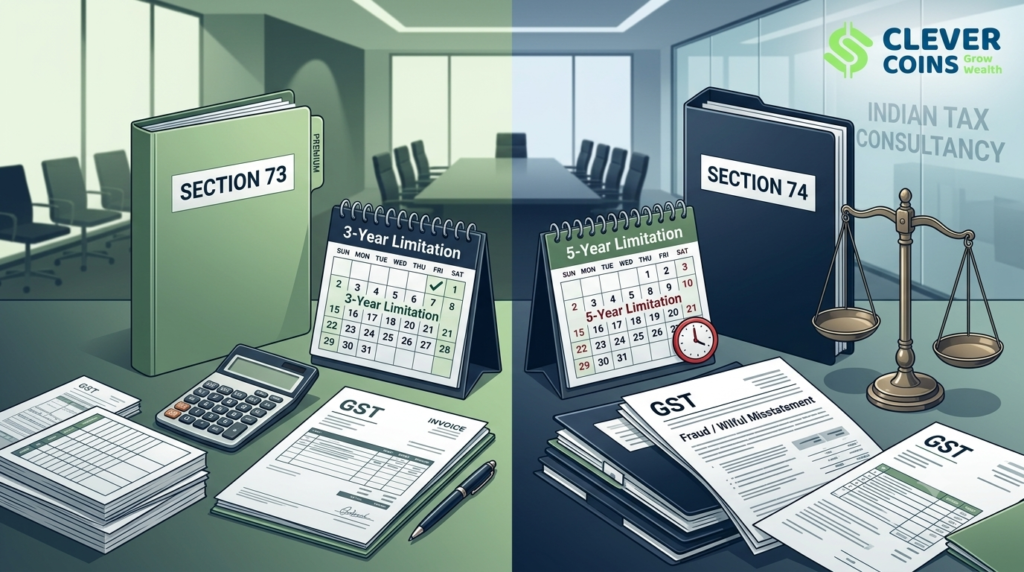
Section 73 vs Section 74 CGST Act: Key Differences in Limitation Periods and Penalties
Introduction
The Goods and Services Tax (GST) framework in India provides a legal mechanism for determining and recovering tax that has not been paid, has been short-paid, has been erroneously refunded, or involves input tax credit (ITC) that has been wrongly availed or utilised. Two important provisions that governed such demands for earlier financial years are Section 73 and Section 74 of the Central Goods and Services Tax Act, 2017 (CGST Act).
Although both provisions deal with the determination of tax liability, they differ significantly in their applicability, treatment of fraud, limitation periods, penalties, and opportunities available to taxpayers to settle a demand with reduced or no penalty.
Section 73 generally addresses cases that do not involve fraud, wilful misstatement, or suppression of facts to evade tax. Section 74 addresses cases in which the alleged non-payment, short payment, erroneous refund, or wrongful ITC is attributed to fraud, wilful misstatement, or suppression of facts to evade tax.
However, there is an important legislative development that every taxpayer, accountant, tax consultant, and business owner must understand. Following the Finance (No. 2) Act, 2024, Sections 73 and 74 apply to tax periods up to Financial Year 2023–24. Section 74A was introduced to govern demands pertaining to Financial Year 2024–25 onwards.
Therefore, understanding Section 73 versus Section 74 remains essential for dealing with legacy GST disputes, while Section 74A is crucial for understanding the current framework for newer tax periods.
In this guide, we explain the provisions, limitation periods, penalties, settlement options, practical examples, compliance implications, and the differences taxpayers should consider when responding to a GST demand notice.
What Is Section 73 of the CGST Act?
Section 73 of the CGST Act deals with the determination of tax not paid, short-paid, erroneously refunded, or input tax credit wrongly availed or utilised for reasons other than fraud, wilful misstatement, or suppression of facts to evade tax.
For the relevant earlier tax periods, Section 73 provides a mechanism through which the proper officer can issue a show cause notice, examine the taxpayer’s response, determine the tax and interest payable, and impose the applicable penalty where legally warranted.
The provision is generally associated with non-fraud cases. This does not mean that every error automatically falls under Section 73. The classification depends on the facts, the evidence, the applicable statutory provisions, and the legal basis stated in the proceedings.
Situations in which Section 73 may apply
Section 73 may be relevant where a GST liability arises from circumstances such as:
- An incorrect tax calculation resulting in short payment.
- An inadvertent omission of a taxable transaction from a return.
- An ITC claim that is subsequently found to be ineligible or incorrectly availed or utilised.
- An erroneous refund that must be recovered.
- A reconciliation difference between GST returns, books of accounts, and supporting records.
- An incorrect interpretation of a tax provision that results in a disputed tax liability, where the circumstances do not establish the elements required for Section 74.
These examples are illustrative. A mismatch in returns or an accounting error does not, by itself, conclusively establish the correct statutory provision. The underlying facts must be examined.
Limitation period under Section 73
Under Section 73(10), the order determining tax, interest, and penalty must generally be issued within three years from the due date for furnishing the annual return for the financial year to which the tax or wrongly availed or utilised ITC relates, or within three years from the date of the erroneous refund.
Section 73(2) also requires the show cause notice to be issued at least three months before the applicable deadline for issuing the order.
The distinction between the notice deadline and the order deadline is important. A notice may have to be issued before the final order deadline, leaving time for the taxpayer to respond and for the officer to adjudicate the matter.
The actual deadline must be calculated using the applicable statutory text, relevant notifications, extensions, and the specific nature of the demand. Taxpayers should not calculate limitation merely by adding three years to the end of the financial year.
Penalty under Section 73
Under Section 73(9), the penalty determined in an ordinary case is generally 10% of the tax due or ₹10,000, whichever is higher, subject to the Act and the circumstances of the case.
The provision also creates opportunities to conclude proceedings without penalty when the applicable statutory conditions are satisfied.
For example, Section 73(5) permits payment of tax and applicable interest before service of a notice, based on the taxpayer’s own ascertainment or the officer’s ascertainment, with the required intimation. Section 73(8) provides that payment of the tax and applicable interest within 30 days of the issue of the show cause notice ordinarily results in no penalty and conclusion of proceedings covered by that notice.
There are specific statutory exceptions, including the treatment of self-assessed tax or tax collected but not paid within the period specified under Section 73(11).
Accordingly, a taxpayer should examine the precise stage of the proceedings before deciding whether a payment or settlement will eliminate the penalty.
What Is Section 74 of the CGST Act?
Section 74 of the CGST Act addresses the determination of tax not paid, short-paid, erroneously refunded, or ITC wrongly availed or utilised by reason of fraud, wilful misstatement, or suppression of facts to evade tax.
Unlike Section 73, Section 74 is concerned with circumstances involving the specified aggravating elements. It provides a longer limitation period and a higher penalty framework.
The existence of a tax discrepancy does not automatically establish fraud or suppression. The department must support the legal basis for invoking the provision in accordance with the applicable law and the facts of the case.
Situations in which Section 74 may apply
Section 74 may be relevant where the allegations and evidence concern circumstances such as:
- Deliberate concealment of taxable transactions to evade GST.
- Intentional misrepresentation of material facts in returns or documents.
- Fabricated invoices or records used to support an improper ITC claim.
- Deliberate suppression of information required to be disclosed under the GST law, where the statutory requirements are satisfied.
- A knowingly false declaration intended to evade tax.
- Other conduct that establishes the fraud, wilful misstatement, or suppression contemplated by the provision.
These are examples of possible allegations, not automatic conclusions. For instance, a supplier’s default, a mismatch between returns, or an ITC dispute does not necessarily establish that the recipient committed fraud. The evidence, statutory conditions, and applicable judicial interpretation must be considered.
Limitation period under Section 74
Under Section 74(10), the proper officer must generally issue the order within five years from the due date for furnishing the annual return for the relevant financial year, or within five years from the date of the erroneous refund.
Section 74(2) requires the show cause notice to be issued at least six months before the applicable deadline for issuing the order.
This is a longer period than the three-year order limitation under Section 73. The extended period reflects the more serious nature of the conduct addressed by Section 74.
However, the longer period is not unlimited. The proper officer must still comply with the applicable statutory deadline and procedural requirements. Any extension, exclusion, or special rule affecting limitation must be independently verified.
Penalty under Section 74
Section 74 provides a substantially higher penalty framework than Section 73.
Under Section 74(1), the notice proposes tax, applicable interest, and a penalty equivalent to the tax specified in the notice. Section 74(9) provides for determination of the amount payable after considering the taxpayer’s representation.
The statutory framework also provides reduced-penalty opportunities at different stages:
- Before service of the notice, Section 74(5) generally permits conclusion of the relevant proceedings by paying the tax, applicable interest, and a penalty equivalent to 15% of the tax, subject to the statutory conditions.
- Within 30 days of issue of the show cause notice, Section 74(8) generally permits conclusion of proceedings by paying the tax, applicable interest, and a penalty equivalent to 25% of the tax.
- Within 30 days of communication of the order, Section 74(11) generally permits conclusion of the relevant proceedings by paying the tax, applicable interest, and a penalty equivalent to 50% of the tax.
These options are subject to the exact statutory requirements, including the timing and completeness of payment. Where the applicable conditions are not met, the normal adjudicated penalty may apply.
Section 73 vs Section 74 CGST Act: Key Differences
The principal differences between the two provisions concern the nature of the alleged conduct, the limitation period, the timing of the show cause notice, the penalty structure, and the availability of reduced-penalty options.
1. Nature of the case
Section 73 covers relevant tax demands for reasons other than fraud, wilful misstatement, or suppression of facts to evade tax.
Section 74 covers relevant tax demands where the specified fraud-related elements are alleged and legally established in accordance with the applicable requirements.
This distinction is central to the classification of a GST demand. The provision cited in a notice should be read alongside the allegations, supporting documents, and evidence.
2. Applicability by financial year
For tax periods up to FY 2023–24, Section 73 or Section 74 may be relevant depending on the nature of the case.
For FY 2024–25 onwards, Section 74A provides the common statutory framework for determining the relevant tax demands, with different penalty consequences depending on whether fraud, wilful misstatement, or suppression of facts to evade tax is involved.
This is one of the most important points for interpreting the law as it currently stands.
3. Limitation period for issuing the order
For the relevant earlier periods, the normal order limitation is three years under Section 73(10) and five years under Section 74(10), calculated from the applicable statutory starting point.
Section 73 is therefore associated with a shorter order limitation, while Section 74 provides a longer period for cases involving the specified aggravating conduct.
4. Time limit for issuing the show cause notice
Section 73(2) generally requires the notice to be issued at least three months before the deadline for the order.
Section 74(2) generally requires the notice to be issued at least six months before the deadline for the order.
These notice requirements should be checked separately from the final order deadline.
5. Penalty structure
Under Section 73(9), the normal penalty is generally 10% of the tax due or ₹10,000, whichever is higher.
Under Section 74, the normal penalty can be equivalent to the tax determined, subject to the applicable law and any valid statutory relief.
The potential financial exposure can therefore be considerably greater where Section 74 is validly invoked.
6. Opportunity to pay before the notice
Section 73(5) allows payment of tax and applicable interest before notice, with the required intimation, without a penalty on the amount properly covered by the payment.
Section 74(5) generally requires tax, interest, and a penalty of 15% of the tax for the corresponding pre-notice settlement route.
The difference is significant for a taxpayer who identifies an error before formal proceedings begin.
7. Opportunity to pay after the notice
Under Section 73(8), payment of tax and interest within 30 days of issue of the show cause notice generally concludes the relevant proceedings without penalty.
Under Section 74(8), the corresponding reduced-penalty option generally requires payment of tax, interest, and a penalty of 25% of the tax within 30 days of issue of the notice.
The taxpayer must verify the applicable statutory deadline and make sure that all required amounts are paid.
8. Opportunity to pay after the order
Under Section 74(11), payment of tax, interest, and a penalty of 50% of the tax within 30 days of communication of the order can conclude the relevant proceedings.
The applicable Section 73 framework should also be reviewed for the specific payment stage and statutory conditions rather than assuming that the Section 74 settlement percentages apply to it.
9. Evidence and legal justification
For Section 73, the dispute may concern the existence, valuation, calculation, eligibility, or timing of a tax liability without the specified fraud-related elements.
For Section 74, the allegations must address the statutory basis for invoking fraud, wilful misstatement, or suppression of facts to evade tax.
Taxpayers should assess whether the notice explains the grounds for the selected provision and whether the documentary evidence supports those grounds.
10. Financial and procedural exposure
Section 74 may expose a taxpayer to a higher penalty and a longer limitation period. It can also involve more serious allegations and more complex factual disputes.
Nevertheless, the taxpayer’s rights to respond, submit documents, contest the legal basis, and pursue the remedies available under law remain important.
Comparative Table: Section 73 vs Section 74
| Basis of comparison | Section 73 | Section 74 |
|---|---|---|
| Nature of case | Other than specified fraud-related cases | Fraud, wilful misstatement, or suppression to evade tax |
| Applicable tax periods | Up to FY 2023–24 | Up to FY 2023–24 |
| Normal order limitation | Three years | Five years |
| Notice timing | At least three months before order deadline | At least six months before order deadline |
| Normal penalty | 10% of tax or ₹10,000, whichever is higher | Generally equivalent to the tax determined |
| Pre-notice settlement | Tax plus interest, subject to conditions | Tax, interest, and generally 15% penalty |
| Settlement after notice | Tax plus interest within the prescribed 30-day period, generally without penalty | Tax, interest, and generally 25% penalty within the prescribed 30-day period |
| Settlement after order | Assess the relevant Section 73 provisions and stage | Tax, interest, and generally 50% penalty within the prescribed 30-day period |
| Current relevance | Legacy demands up to FY 2023–24 | Legacy demands up to FY 2023–24 |
The table is a general overview. Actual liability, limitation, penalty, and closure of proceedings depend on the applicable statutory wording, amendments, notifications, and case-specific facts.
How Are Limitation Periods Calculated Under Sections 73 and 74?
Limitation is not simply calculated by counting three or five years from the end of the relevant financial year.
For both provisions, the statutory starting point is generally the due date for furnishing the annual return for the relevant financial year. In the case of an erroneous refund, the relevant starting point is generally the date of the erroneous refund.
The distinction matters because the annual-return due date may have been extended, and special statutory provisions or notifications may affect a particular case.
Illustrative example for Section 73
Assume a disputed tax amount relates to FY 2022–23 and the applicable due date for furnishing the annual return is 31 December 2023.
Using that assumed date, the general three-year order deadline under Section 73(10) would be 31 December 2026, subject to applicable legal rules and any valid extension or exclusion.
The notice would ordinarily have to be issued at least three months before that deadline.
This example is illustrative only. It should not be used as a final deadline for an actual dispute without checking the applicable notifications, statutory dates, and facts.
Illustrative example for Section 74
Assume a disputed tax amount also relates to FY 2022–23 and the applicable annual-return due date is 31 December 2023.
Using that assumed date, the general five-year order deadline under Section 74(10) would be 31 December 2028, subject to applicable legal rules and any valid extension or exclusion.
The notice would ordinarily have to be issued at least six months before that deadline.
The example demonstrates why a taxpayer must distinguish between the order limitation and the earlier notice deadline.
What if the demand relates to an erroneous refund?
Where the demand concerns an erroneous refund, the relevant limitation period is generally calculated from the date of that refund rather than the due date for the annual return.
The taxpayer should identify the exact refund transaction, the date on which it was granted, the amount in dispute, and the provision under which recovery is proposed.
Why limitation analysis matters
A limitation review may help identify whether a notice or order was issued within the applicable statutory period. However, the fact that a proceeding appears late on a basic calculation does not automatically establish that it is invalid.
Relevant notifications, extensions, statutory exclusions, the type of demand, the applicable financial year, and the exact date of issuance must all be considered.
Understanding Section 74A: The Important Change From FY 2024–25
The Finance (No. 2) Act, 2024 introduced Section 74A into the CGST Act. This provision applies to the determination of relevant tax demands pertaining to FY 2024–25 onwards.
It provides a common limitation framework for cases involving both ordinary tax discrepancies and cases involving fraud, wilful misstatement, or suppression of facts to evade tax. The penalty consequences remain different depending on the nature of the case.
Limitation period under Section 74A
Under Section 74A(2), the show cause notice must generally be issued within 42 months from the due date for furnishing the annual return for the relevant financial year, or within 42 months from the date of the erroneous refund.
Under Section 74A(7), the order must generally be issued within 12 months from the date of issuance of the notice. The Commissioner, or an authorised officer of the prescribed rank, may extend that period by a maximum of six months, provided the statutory conditions are met and reasons are recorded in writing before the original period expires.
Section 74A also provides that no notice is to be issued where the tax not paid, short-paid, erroneously refunded, or relating to wrongly availed or utilised ITC for a financial year is less than ₹1,000, subject to the precise statutory wording.
Penalties under Section 74A
Section 74A distinguishes between cases that do not involve the specified fraud-related conduct and those that do.
For cases other than fraud, wilful misstatement, or suppression of facts to evade tax, the penalty under Section 74A(5)(i) is generally 10% of the tax due or ₹10,000, whichever is higher.
For cases involving the specified fraud-related conduct, Section 74A(5)(ii) provides for a penalty equivalent to the tax due.
Reduced-penalty options under Section 74A
The provision also creates settlement opportunities at different stages.
For cases not involving the specified fraud-related conduct, payment of tax and interest before notice may prevent issuance of the notice for the amount properly paid. Payment of tax and interest within 60 days of issue of the show cause notice generally concludes the relevant proceedings without penalty, subject to the statutory conditions.
For cases involving fraud, wilful misstatement, or suppression of facts to evade tax, the statutory framework generally provides the following penalty stages:
- Before notice: 15% of the tax, along with tax and interest.
- Within 60 days of the notice: 25% of the tax, along with tax and interest.
- Within 60 days of communication of the order: 50% of the tax, along with tax and interest.
These options are subject to the precise requirements of Section 74A, including the relevant stage, payment, and communication requirements.
Why businesses must distinguish Section 74A from Sections 73 and 74
A demand concerning FY 2023–24 should not automatically be analysed under Section 74A merely because proceedings begin after the new provision was introduced.
Similarly, a demand pertaining to FY 2024–25 onwards should not automatically be classified under Section 73 or Section 74 based on the older framework.
The relevant tax period is a critical starting point for determining which provision governs the demand. The actual notice, statutory amendments, applicable notifications, and any special facts must still be reviewed.
Practical Examples of Section 73 and Section 74
Example 1: An inadvertent short payment of GST
A business discovers that a taxable invoice was omitted from a return because of an accounting error. The omission resulted in a tax shortfall, but the available evidence does not establish fraud, wilful misstatement, or suppression to evade tax.
For a relevant tax period governed by the earlier framework, Section 73 may be the appropriate provision to examine.
The business should reconcile the invoice, return, ledger, and tax payment records. It should also assess interest and any available statutory payment route.
Example 2: An allegation involving deliberately fabricated invoices
Suppose the department alleges that a business knowingly used fabricated invoices to claim ITC and that the evidence establishes the statutory elements of fraud or suppression to evade tax.
For a relevant earlier tax period, Section 74 may be applicable, subject to the facts and legal requirements.
The taxpayer should examine the invoices, supplier records, payment trail, transport documents where relevant, return disclosures, and the evidence relied upon by the department. The legal basis for alleging fraud should be evaluated rather than assumed.
Example 3: A demand concerning FY 2024–25
Suppose a business identifies a short payment of tax for FY 2024–25.
Because the tax period falls within FY 2024–25 onwards, Section 74A is the starting provision for analysing the demand. The appropriate penalty depends on whether the facts involve the specified fraud-related conduct.
The business should identify the tax period, quantify the shortfall, verify interest, and consider the statutory options available at the current stage.
Example 4: A notice received close to the limitation deadline
A taxpayer receives a notice that appears to have been issued close to the applicable limitation deadline.
The taxpayer should not rely solely on the date printed on the notice. The date and manner of issuance or service, the applicable statutory deadline, the relevant tax period, and any valid extension or exclusion may require examination.
A proper limitation review should be undertaken before making a final legal conclusion.
How Should a Taxpayer Respond to a GST Show Cause Notice?
Receiving a GST show cause notice requires a structured response. Ignoring the notice may result in an adverse order or other consequences under the applicable law.
Step 1: Identify the statutory provision
Read the notice carefully to determine whether it invokes Section 73, Section 74, Section 74A, or another relevant provision.
Verify the financial year to which the demand relates. The financial year and statutory framework should be consistent with the basis of the proceedings.
Step 2: Verify the limitation period
Identify the applicable annual-return due date or, where relevant, the date of the erroneous refund.
Calculate the statutory deadline for the notice and the order separately. Check applicable notifications, extensions, and other legal provisions that may affect the calculation.
Step 3: Reconcile the tax demand
Compare the demand with GST returns, sales registers, purchase registers, invoices, electronic ledgers, payment records, refund records, and the relevant ITC documentation.
A detailed reconciliation can help distinguish a genuine tax liability from a clerical discrepancy, duplication, classification dispute, or factual error.
Step 4: Examine allegations of fraud or suppression
Where Section 74 or the fraud-related penalty provisions of Section 74A are invoked, review the facts and evidence relied upon to support those allegations.
Determine whether the notice explains the relevant conduct and whether the documents support the statutory basis for the demand. Do not assume that every mismatch proves fraud.
Step 5: Calculate tax, interest, and penalty separately
The tax principal, interest under Section 50, and applicable penalty should be assessed separately.
The penalty depends on the governing provision, the nature of the alleged conduct, and the stage of proceedings. A calculation should also consider whether a statutory settlement option is available.
Step 6: Prepare a documented reply
The reply should address the allegations, explain the taxpayer’s position, provide supporting documents, and include a clear reconciliation wherever appropriate.
Where the notice raises multiple issues, each issue should be answered separately. Any disputed amount should be distinguished from any amount accepted as payable.
Step 7: Evaluate settlement and appeal options
Where a payment route is available, evaluate its legal and financial consequences before proceeding.
If an adverse order has already been issued, consider the applicable appeal deadline and statutory requirements. Do not assume that payment or a representation automatically suspends every deadline.
Common Mistakes to Avoid
Taxpayers frequently make avoidable errors when dealing with GST demand proceedings.
Confusing the notice deadline with the order deadline: The time limit for issuing a notice is not necessarily the same as the time limit for issuing the final order.
Calculating limitation from the end of the financial year: The statutory starting point is generally the annual-return due date or, for an erroneous refund, the date of the refund.
Assuming every mismatch amounts to fraud: A return mismatch or ITC discrepancy does not automatically establish fraud, wilful misstatement, or suppression to evade tax.
Ignoring the relevant financial year: The distinction between tax periods up to FY 2023–24 and FY 2024–25 onwards is essential when choosing the correct statutory framework.
Missing reduced-penalty deadlines: The relevant provisions provide time-bound payment routes. Taxpayers should calculate the applicable period carefully.
Paying without checking the legal consequences: A taxpayer should understand what amount is being accepted, which proceedings may be concluded, and whether any other liabilities or proceedings remain.
Ignoring the notice: A reasoned reply supported by documents is generally preferable to allowing a demand to proceed without a response.
Frequently Asked Questions
1. What is the main difference between Section 73 and Section 74 of the CGST Act?
Section 73 deals with relevant tax demands for reasons other than fraud, wilful misstatement, or suppression of facts to evade tax. Section 74 deals with demands involving those specified fraud-related elements. They also differ in limitation periods and penalties.
2. What is the limitation period under Section 73?
For the relevant tax periods, the order must generally be issued within three years from the due date for furnishing the annual return for the relevant financial year, or within three years from the date of an erroneous refund. The notice must generally be issued at least three months before the order deadline.
3. What is the limitation period under Section 74?
For the relevant tax periods, the order must generally be issued within five years from the due date for furnishing the annual return for the relevant financial year, or within five years from the date of an erroneous refund. The notice must generally be issued at least six months before the order deadline.
4. What is the penalty under Section 73?
The general penalty under Section 73(9) is 10% of the tax due or ₹10,000, whichever is higher, subject to the applicable statutory provisions. Certain payment routes may allow proceedings to conclude without penalty.
5. What is the penalty under Section 74?
The normal penalty under Section 74 can be equivalent to the tax determined. The provision also offers reduced-penalty routes at specified stages, including penalties of 15%, 25%, and 50% of the tax when the relevant conditions and deadlines are satisfied.
6. Can a taxpayer avoid a penalty under Section 73?
In qualifying cases, payment of tax and interest before notice or within 30 days of issue of the show cause notice may conclude the relevant proceedings without penalty. The precise conditions, amount paid, and stage of proceedings must be checked.
7. Can a taxpayer reduce the penalty under Section 74?
Section 74 provides reduced-penalty routes, generally involving 15% before notice, 25% within 30 days of issue of the notice, and 50% within 30 days of communication of the order, together with the required tax and interest payments. Statutory conditions apply.
8. Does Section 74 apply to FY 2024–25?
Section 74 is restricted to determination of tax pertaining to periods up to FY 2023–24. For FY 2024–25 onwards, Section 74A provides the relevant framework.
9. What is Section 74A of the CGST Act?
Section 74A governs the determination of relevant tax demands pertaining to FY 2024–25 onwards. It provides a common limitation framework while retaining different penalty consequences for cases with and without the specified fraud-related elements.
10. What is the limitation period under Section 74A?
The notice must generally be issued within 42 months from the applicable annual-return due date or the date of an erroneous refund. The order must generally be issued within 12 months from the notice, subject to a qualifying extension of up to six months.
11. Can a GST notice be challenged on limitation grounds?
A taxpayer may examine whether a notice or order complies with the applicable statutory limitation period. Whether a challenge succeeds depends on the exact dates, applicable notifications, statutory provisions, and facts of the case.
12. Should a taxpayer consult a GST professional after receiving a notice?
Professional assistance can be valuable, particularly where the demand involves a substantial amount, allegations of fraud, complex ITC issues, limitation questions, or a short deadline for responding.
Conclusion
Section 73 and Section 74 of the CGST Act establish different frameworks for determining tax demands for earlier financial years. Section 73 generally concerns cases without the specified fraud-related elements and provides a three-year order limitation, while Section 74 concerns cases involving fraud, wilful misstatement, or suppression to evade tax and generally provides a five-year order limitation.
Their penalty structures and settlement opportunities also differ substantially. Taxpayers should therefore examine the relevant financial year, statutory provision, notice and order deadlines, factual allegations, and payment options before deciding how to respond to a GST demand.
The introduction of Section 74A adds another essential consideration. For FY 2024–25 onwards, the analysis must generally begin with Section 74A rather than automatically applying the older Sections 73 and 74 framework.
A careful review of the applicable law, accurate tax reconciliation, complete supporting documentation, and a timely response can help businesses understand their position and make informed decisions about GST demand proceedings.
Need assistance with GST compliance or a GST demand notice? CleverCoins can help businesses understand their tax compliance requirements and identify the appropriate next steps. Visit CleverCoins.org to explore its GST and tax consultancy services.
Legal Disclaimer
This article is intended for general informational and educational purposes only. It does not constitute legal, tax, or professional advice. The application of Sections 73, 74, and 74A depends on the relevant tax period, statutory amendments, notifications, judicial decisions, and the facts of each case. Readers should verify the current law and seek advice from a qualified GST professional before acting on a specific notice or tax dispute.
Primary and Reference Sources
- CBIC – CGST Act, Section 73
- CBIC – CGST Act, Section 74
- Goods and Services Tax Council – 53rd GST Council Meeting materials
- India Code – Central Goods and Services Tax Act, 2017
- Section 74A – Consolidated statutory text
Verify the latest amendments, notifications, and relevant judgments before publication or reliance in a live dispute.


