Place of Supply Rules Under GST in India — The Complete 2026 Guide: Sections 10 to 13 Explained
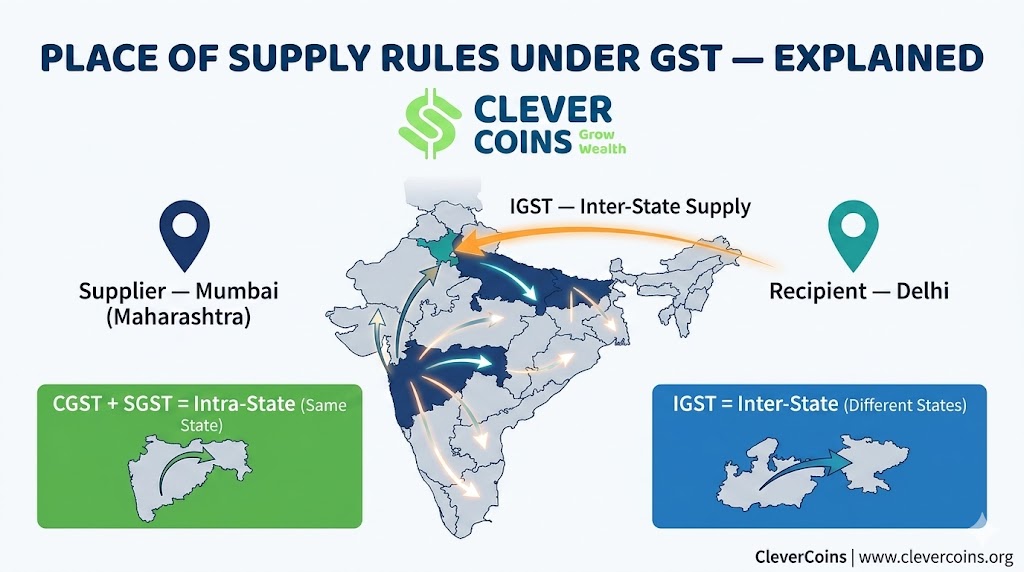
Among all the concepts in India’s Goods and Services Tax (GST) framework, Place of Supply (POS) is the most critical — and most misunderstood. It determines whether a transaction attracts CGST + SGST (intra-state) or IGST (inter-state), whether it qualifies as an export of service, and which state government receives the tax revenue.
Get the Place of Supply wrong — and your business faces wrong tax levy demands, cascading litigation, mismatch in GSTR-2B, loss of ITC, and potential prosecution. Get it right — and your GST compliance becomes seamless, efficient, and dispute-free.
This comprehensive 2026 guide by CleverCoins covers every dimension of Place of Supply rules under the IGST Act, 2017: the governing legal framework (Sections 10 to 13), general rules, specific service-by-service rules, cross-border rules, OIDAR, the intermediary controversy, B2B vs B2C differences, and a practical decision matrix to determine the correct GST type for any transaction.
Why Place of Supply Matters — The Foundational Concept
India operates a dual GST system — the Centre collects CGST (Central GST) and each State/UT collects SGST (State GST) on intra-state transactions, while the Centre collects IGST (Integrated GST) on inter-state transactions and distributes it between the Centre and destination state.
The critical question in any GST transaction is: Is this transaction INTRA-STATE or INTER-STATE? The answer determines:
- Which type of tax to levy (CGST+SGST vs IGST)
- Which state government receives the GST revenue
- Whether the transaction qualifies as an export (zero-rated) or import (RCM)
- The ITC chain — wrong tax type means the recipient cannot claim ITC correctly
- The GST return — wrong classification affects GSTR-1 table selection
📌 The determining factor is the PLACE OF SUPPLY — not the location of the supplier, not where the payment is made, and not where the contract is signed. POS is a legal concept defined under Sections 10 to 13 of the IGST Act, 2017. The actual physical delivery or performance of service is the starting point — but specific rules override this for many service categories.
The Legal Framework — Sections Governing Place of Supply
- Section 10 — Place of Supply of GOODS (domestic): Covers supply of goods within India
- Section 11 — Place of Supply of GOODS (import/export): Covers movement of goods to/from outside India
- Section 12 — Place of Supply of SERVICES (domestic): Covers services where both supplier and recipient are in India
- Section 13 — Place of Supply of SERVICES (cross-border): Covers services where either supplier or recipient is outside India
- Section 7(5) — Certain supplies always treated as inter-state: SEZ supplies, supplies to Embassies / UN bodies, supplies between distinct persons across states
- Section 8 — Intra-state supply definition: Both supplier and POS are in the same state/UT
💡 Quick Memory Tip: Section 10 = Goods Domestic | Section 11 = Goods Cross-Border | Section 12 = Services Domestic | Section 13 = Services Cross-Border. Master these four numbers and you will always know which POS rule to look up.
Section 10 — Place of Supply of Goods (Domestic)
Section 10 of the IGST Act covers the Place of Supply for supply of goods where both supplier and recipient are within India. The rules are based on the physical movement of goods:
Scenario / Rule | Section | Place of Supply | GST Type | Example |
Goods supplied with movement (delivery to buyer) | 10(1)(a) | Location where movement of goods terminates (delivery point) | IGST (inter-state) or CGST+SGST (intra-state) | Delhi seller delivers goods to Mumbai buyer — POS = Mumbai — IGST |
Goods supplied without movement (ex-works / spot delivery) | 10(1)(b) | Location where goods are delivered (at the time of supply) | IGST or CGST+SGST depending on location of parties | Seller in Pune, buyer picks up in Pune — POS = Pune — CGST+SGST |
Goods assembled / installed at site (installation contracts) | 10(1)(c) | Place of installation or assembly — location of the site | IGST or CGST+SGST based on site vs supplier state | Machinery installed at buyer’s factory in Gujarat — POS = Gujarat |
Goods supplied on board a conveyance (train, aircraft, vessel) | 10(1)(d) | Location at which goods are taken on board the conveyance | IGST or CGST+SGST | Goods loaded at Kolkata on a ship — POS = Kolkata |
Import of goods into India (Bill of Lading / customs) | 10(1)(e) / IGST | Location of importer in India | IGST | Goods imported by Mumbai firm — POS = Maharashtra |
Goods supplied to / by a Special Economic Zone (SEZ) unit | 10(1)(a) read with Section 7(5)(b) | Treated as inter-state supply regardless of location | Always IGST | SEZ unit in Gujarat buying goods from any Indian supplier — IGST |
High sea sales (goods sold before customs clearance) | Proviso to 10(1) | Location of the buyer | IGST | Goods sold on high sea to Mumbai importer — POS = Mumbai |
⚠️ The Most Common Goods POS Error: Many businesses incorrectly determine the POS of goods based on where the factory or warehouse is located. The correct rule is: the POS is where the MOVEMENT OF GOODS ENDS (delivery point). A Delhi factory dispatching goods to a Mumbai buyer — POS is Mumbai — IGST must be charged. If charged as CGST+SGST (Delhi), it is a wrong levy.
Section 10 — Important Special Rules
Rule: Goods Delivered to a Third Party on Direction of Buyer (Bill to / Ship to)
When goods are billed to Buyer A (principal place of business — Delhi) but shipped to Buyer B’s location (Gujarat), the place of supply is the PRINCIPAL PLACE OF BUSINESS of the registered recipient (Buyer A — Delhi), NOT where the goods are physically delivered (Gujarat).
✅ Example: A Mumbai supplier raises invoice on Delhi Company A (Bill-to), who directs delivery to Gujarat factory (Ship-to). POS = Delhi (location of recipient — Company A). GST = IGST (Mumbai to Delhi — inter-state). This is Section 10(1)(b) Bill-to / Ship-to scenario.
Section 11 — Place of Supply of Goods (Import and Export)
- Goods exported from India: POS is the location outside India — treated as zero-rated supply (export). No GST on exports with LUT, or IGST paid and refunded.
- Goods imported into India: POS is the location of the importer in India. IGST is levied at the customs point. The importer pays IGST as part of customs clearance and can claim ITC.
- High sea sales (goods sold while at sea, before customs clearance): POS = location of the buyer in India. Treated as inter-state supply — IGST applies on transfer.
- Bond transfers and warehoused goods: IGST applies on transfer of title before customs clearance.
✅ Export of goods is zero-rated under Section 16 of the IGST Act — meaning NO GST is charged (if LUT is filed) or IGST is charged and fully refunded. The POS for exports is outside India — making it an inter-state supply (Section 7(5)(a)) which is zero-rated.
Section 12 — Place of Supply of Services (Domestic — Both Parties in India)
Section 12 is the most comprehensive and practically important POS section. It covers all service transactions where BOTH the supplier and recipient are within India. It contains a general rule (Section 12(2)) plus 13 specific rules for particular service categories (Sections 12(3) to 12(14)).
Section 12(2) — The General Rule for Services
The default rule for services is:
- If the recipient is a REGISTERED person under GST: POS = Location of the recipient (the state where their GSTIN is registered)
- If the recipient is an UNREGISTERED person: POS = Location of the recipient (if address is available on record), OR Location of the supplier (if recipient address is not on record)
Transaction Type | Section | Place of Supply | GST Type | Key Note / Example |
B2B services — both supplier and recipient registered in India | 12(2)(a) | Location of the recipient (GSTIN state) | IGST (inter-state) or CGST+SGST (intra-state) | Mumbai firm provides IT services to Delhi firm — POS = Delhi — IGST |
B2B services — recipient not registered (unregistered / consumer) | 12(2)(b) | Location of the recipient (if known) OR location of supplier | CGST+SGST (usually supplier’s state) | Freelancer in Bengaluru services a resident in Pune — POS = Pune (if address known) |
B2C services — recipient is an individual (no GSTIN) | 12(2)(b) | Location of the supplier (default rule) | CGST+SGST of supplier’s state | Hairdresser in Chennai serves a tourist — POS = Chennai — CGST+SGST Tamil Nadu |
Services where recipient’s location cannot be determined | 12(2)(b) proviso | Location of the supplier | CGST+SGST | Unknown recipient — default to supplier’s location |
Services supplied to a person at a fixed establishment in another state | 12(2)(a) | Location of fixed establishment of recipient | IGST | Company with HO in Mumbai and branch in Bengaluru — services billed to Bengaluru branch — POS = Karnataka |
⚠️ The most common mistake with the general rule: A Mumbai firm provides services to a Delhi firm. The supplier charges CGST+SGST (Maharashtra) thinking the service is performed in Mumbai. This is WRONG. For B2B services, POS = Location of the RECIPIENT (Delhi) — so IGST must be charged.
Section 12 — Specific Rules for Special Service Categories
For certain categories of services, specific POS rules override the general rule of Section 12(2). These are detailed in Sections 12(3) to 12(14) and cover 14 distinct service categories:
Service Category | Section | Place of Supply | GST Type |
Immovable property services (architects, interior designers, civil engineers, real estate agents) | 12(3) | Location of the immovable property | IGST or CGST+SGST based on property state vs supplier state |
Restaurant and eating establishment services (dine-in) | 12(4) | Location of the restaurant / food outlet | CGST+SGST of state where restaurant is located |
Training and performance appraisal — B2B | 12(5) | Location of the recipient | IGST or CGST+SGST |
Training and performance appraisal — B2C (individual) | 12(5) | Location where service is actually performed | CGST+SGST of state where training is held |
Admission to events — cultural, artistic, sports, entertainment, educational | 12(6) | Location where the event is held | CGST+SGST of the state where event takes place |
Organisation of events — B2B | 12(7) | Location of the recipient (registered person) | IGST or CGST+SGST |
Organisation of events — B2C | 12(7) | Location where event is held | CGST+SGST |
Transportation of goods (freight) — B2B | 12(8) | Location of the registered recipient | IGST or CGST+SGST |
Transportation of goods — B2C or unregistered | 12(8) | Location at which goods are handed over for transport | CGST+SGST |
Passenger transportation — B2B (company travel) | 12(9) | Location of the registered recipient | IGST or CGST+SGST |
Passenger transportation — B2C (individual) | 12(9) | Place where the passenger embarks (boarding point) | CGST+SGST of departure state |
Services on board a conveyance (aircraft / ship / bus) | 12(10) | First scheduled point of departure | CGST+SGST of the state of departure |
Telecommunication, internet, DTH — fixed line | 12(11) | Location where fixed equipment / post box is installed | CGST+SGST of state of installation |
Telecommunication — mobile / internet — postpaid | 12(11) | Location of billing address of recipient | CGST+SGST of billing address state |
Telecommunication — mobile / internet — prepaid (SIM card, recharge) | 12(11) | Location of the selling agent / distributor | CGST+SGST of agent’s state |
Banking and financial services — B2B | 12(12) | Location of recipient (registered person) | IGST or CGST+SGST |
Banking and financial services — B2C (individual) | 12(12) | Location of supplier (default — if recipient location not available) | CGST+SGST of supplier bank’s state |
Insurance services — B2B (company insurance) | 12(13) | Location of the registered recipient | IGST or CGST+SGST |
Insurance services — B2C (individual) | 12(13) | Location of the recipient (based on policy records) | CGST+SGST of recipient’s state |
Advertisement — to government bodies | 12(14) | Location of each state where advertisement is broadcasted / displayed | CGST+SGST of each state — apportionment required |
📌 CleverCoins Important Note: The specific rules under Sections 12(3) to 12(14) OVERRIDE the general rule of Section 12(2). If your service falls under any of these 14 categories — you MUST use the specific rule, not the general rule. Using the general rule for, say, a restaurant service or a real estate agent service would result in a wrong levy.
Deep-Dive: Section 12(3) — Services Related to Immovable Property
This is one of the most practically significant specific POS rules — affecting architects, engineers, valuers, interior designers, surveyors, real estate agents, and hotel accommodation providers.
Rule: The Place of Supply for services directly related to immovable property is the LOCATION OF THE IMMOVABLE PROPERTY — regardless of where the supplier or recipient is located.
- Architect fees for a project in Pune: POS = Pune (Maharashtra) — CGST+SGST Maharashtra — even if the architect is based in Delhi
- Real estate agent helping sell a flat in Mumbai: POS = Mumbai (Maharashtra) — CGST+SGST Maharashtra — even if agent is in Chennai
- Interior designer working on a Bengaluru house: POS = Bengaluru (Karnataka) — CGST+SGST Karnataka
- Hotel accommodation in Goa: POS = Goa — CGST+SGST Goa — even if the guest is from Delhi
- Valuer assessing a property in Hyderabad: POS = Hyderabad (Telangana) — CGST+SGST Telangana
⚠️ Critical Rule for Multi-State Property Projects: If the immovable property is located across multiple states (e.g., a pipeline from Gujarat to Maharashtra), the value of service must be apportioned across each state proportionately. CGST+SGST is paid to each state on the respective apportioned value.
Deep-Dive: Section 12(8) — Transportation of Goods (Freight Services)
Freight and logistics services — provided by transporters, courier companies, and freight forwarders — have a specific POS rule that depends on whether the recipient is registered or not:
B2B Freight (Registered Recipient — Company, Firm, LLP)
POS = Location of the registered recipient. This means a Mumbai transporter providing freight services to a Delhi manufacturer is making an IGST supply (B2B — inter-state, POS = Delhi). The Delhi company claims ITC.
B2C Freight (Unregistered / Individual)
POS = Location where goods are handed over to the transporter (origin point). A Mumbai courier service picking up a package in Mumbai from an individual and delivering to Pune — POS = Mumbai — CGST+SGST Maharashtra.
✅ Practical Impact: Almost all commercial freight is B2B. Logistics companies transporting goods for registered businesses must charge IGST for inter-state routes and CGST+SGST for intra-state routes — based on RECIPIENT’S location, not pickup or delivery point.
Deep-Dive: Section 12(9) — Passenger Transportation
For passenger transportation services, the POS rule is:
- B2B (company travel — corporate tickets, travel agent invoicing to company): POS = Location of the registered recipient (the company’s GSTIN state)
- B2C (individual traveller buying ticket): POS = Place of embarkation (departure point for the journey)
This means:
- Air ticket from Mumbai to Delhi bought by individual: POS = Mumbai (departure) — CGST+SGST Maharashtra
- Air ticket from Mumbai to Delhi booked by a Delhi corporate: POS = Delhi (recipient location) — IGST (CGST+SGST Delhi vs Maharashtra supplier)
- Train journey from Chennai to Bengaluru (individual): POS = Chennai (departure) — CGST+SGST Tamil Nadu
Deep-Dive: Section 12(11) — Telecommunication and Internet Services
Telecom services have one of the most complex POS frameworks — varying based on the type of connection:
Fixed Line Services (Landline, Broadband at Fixed Address)
POS = Location of the fixed equipment / subscriber’s address. BSNL providing broadband at a Mumbai address — POS = Mumbai — CGST+SGST Maharashtra.
Mobile Services — Postpaid
POS = Location of the billing address of the subscriber. A Delhi postpaid subscriber roaming in Goa — POS = Delhi (billing address) — CGST+SGST Delhi.
Mobile Services — Prepaid (Recharge, SIM card purchase)
POS = Location of the selling agent / distributor / retail outlet where the recharge is purchased. Customer buys a Rs. 299 recharge at a shop in Hyderabad — POS = Hyderabad — CGST+SGST Telangana — even if the subscriber’s home state is Maharashtra.
💡 The complexity of telecom POS often leads to compliance mismatches between telecom companies and their agents. State-level reporting and apportionment is required for telecom companies with national subscriber bases.
Deep-Dive: Section 12(12) — Banking and Financial Services
Banking and financial services have a unique challenge: the bank often does not know the ‘location’ of the recipient in the traditional sense. The rule provides a practical solution:
- B2B (corporate banking — company’s account): POS = Location of the registered recipient (company’s GSTIN state)
- B2C (individual banking): POS = Location of the supplier (bank branch state) — default rule when recipient’s location is not available
- Practical implication: A Mumbai bank branch providing services to an individual customer is treated as making an intra-state supply in Maharashtra — CGST+SGST Maharashtra
- Credit card services, EMI, loan processing, forex exchange — all follow the same 12(12) rule
✅ Insurance services under Section 12(13) follow the same B2B / B2C logic as banking — recipient location for registered businesses, policy records for individuals.
Section 13 — Place of Supply for Cross-Border Services
Section 13 applies when EITHER the supplier OR the recipient is OUTSIDE India — covering exports of services, imports of services, OIDAR, and international transactions. This section is critical for IT exporters, BPO companies, management consultants with foreign clients, and any Indian business importing professional or technology services from abroad.
Cross-Border Transaction | Section 13 Rule | Place of Supply | GST Treatment |
Export of services — Indian supplier to foreign recipient | 13(2) — default | Location of recipient (outside India) | Zero-rated — 0% IGST (with LUT) or 18% IGST (refundable) |
Import of services — Foreign supplier to Indian B2B recipient | 13(2) — default | Location of recipient (in India) | 18% IGST under Reverse Charge Mechanism (RCM) |
Services related to immovable property outside India | 13(4) | Location of the immovable property (outside India) | Export of service — 0% GST (zero-rated) |
Performance-based services outside India (event, training abroad) | 13(5) | Location where service is actually performed (outside India) | Export of service — 0% GST |
Transportation of goods — foreign to Indian port (international freight) | 13(9) | Destination of goods (if India-bound) / origin (if outbound) | Complex — IGST or zero-rated depending on direction |
Passenger transportation — originating in India, going abroad | 13(10) | Place of departure (India) | IGST — taxable in India |
OIDAR services — foreign supplier to Indian individual (B2C) | 13(12) | Location of recipient (India) | 18% IGST — foreign OIDAR supplier registers in India |
OIDAR services — Indian supplier to foreign individual | 13(12) | Location of recipient (outside India) | Export — zero-rated with LUT |
Banking services — both parties outside India (offshore banking) | 13(13) | Location of supplier (outside India) | Outside India — no GST |
Intermediary services — agent acting for foreign principal | 13(8)(b) | Location of supplier (in India) | IGST — India is POS even if commission relates to foreign goods |
⚠️ The Intermediary Services Controversy (Section 13(8)(b)): When an Indian company acts as an agent / intermediary for a foreign principal — arranging transactions between the foreign principal and Indian buyers — the POS is deemed to be the LOCATION OF THE SUPPLIER (India). This means the service CANNOT be treated as an export — and 18% IGST is charged domestically. This has been one of the most litigated POS provisions in India, especially for Indian back-office / commission agents of foreign companies.
OIDAR Services — The Cross-Border Digital POS Rules
OIDAR (Online Information and Database Access or Retrieval) services have specific POS rules under Section 13(12) for cross-border digital services. These rules are critical for foreign tech companies, streaming platforms, and cloud providers serving Indian consumers:
Foreign OIDAR Provider to Indian Consumer (B2C Import)
POS = Location of the recipient in India. The foreign OIDAR provider must register under Section 14 of the IGST Act and collect 18% IGST from Indian consumers. Examples: Netflix, Spotify, Adobe Cloud, LinkedIn Premium, Zoom (foreign entities serving Indian individuals).
Foreign OIDAR Provider to Indian B2B (Registered Business)
POS = India. RCM applies — the Indian registered recipient pays 18% IGST under reverse charge. The foreign supplier need NOT register under Indian GST for B2B OIDAR.
Indian OIDAR Provider to Foreign Recipient (Export)
POS = Location of recipient (outside India). Export of service — zero-rated. File LUT for 0% IGST or pay IGST and claim refund. Examples: Indian SaaS platform serving foreign users.
📌 Why OIDAR has special rules: Digital services have no physical delivery point — the traditional ‘location where service is performed’ rule doesn’t work. OIDAR rules ensure that digital services are taxed at the CONSUMPTION point (where the recipient is) — aligning India with global digital taxation principles (OECD BEPS framework).
B2B vs B2C — How It Changes the Place of Supply
The B2B vs B2C distinction is the single most impactful factor in determining the Place of Supply for services. Let us understand this through a structured comparison:
B2B Services (Recipient is GST-Registered)
- General rule: POS = Location of the RECIPIENT (GSTIN registration state)
- The GST follows the goods/service to where the registered business is — ensuring tax revenue goes to the consuming state
- IGST is charged for inter-state B2B, which the recipient claims as ITC
- Specific rules (Section 12(3) to 12(14)) may override even for B2B — e.g., immovable property services always follow the property location
B2C Services (Recipient is Unregistered / Individual)
- General rule: POS = Location of the recipient (if known), OR Location of the supplier (if not known)
- For many specific services, the rule is where the service is physically performed or where specific assets are located
- In practice, for most B2C transactions, CGST+SGST of the supplier’s state is charged (default rule)
- Exceptions: Restaurant (always supplier’s state), passenger transport (embarkation point), events (where event is held)
📌 Key Policy Principle: For B2B transactions, the destination principle applies — GST revenue goes to the state where the consuming business is registered. For B2C, revenue typically stays in the supplier’s state (origin principle) — except for specific services where consumption location is clearly identifiable.
The Distinct Person Concept — Multi-State Businesses
Indian companies operating across multiple states face a unique POS challenge — supplies between their own branches in different states are treated as supplies between ‘distinct persons’ under Section 25(5) of the CGST Act.
What Are Distinct Persons?
When a company is registered in multiple states (e.g., Maharashtra and Karnataka), each state’s registration is treated as a SEPARATE person under GST. Supplies from the Maharashtra unit to the Karnataka unit are treated as inter-state supplies — IGST must be charged on these internal branch transfers.
- Mumbai HO invoices Bengaluru branch for marketing services: IGST must be charged (inter-state between distinct persons)
- Delhi HO allocates IT infrastructure costs to Chennai branch: IGST applicable on cost sharing
- Centralised procurement in one state and supply to other state branches: IGST on each branch supply
⚠️ Many multi-branch businesses (banks, insurance companies, consulting firms, hotel chains) fail to comply with the distinct person POS rules — treating internal branch supplies as non-supplies. This is a significant compliance gap that GST authorities are actively scrutinising through departmental audits.
Place of Supply for E-Commerce Transactions
E-commerce adds a further layer to POS determination — when goods or services are sold through an e-commerce operator (like Amazon, Flipkart, Swiggy, Zomato):
- Goods sold by a seller on Amazon: POS = Place of delivery of goods (buyer’s delivery address state)
- Cloud kitchen food ordered via Swiggy: POS = Location of the restaurant/cloud kitchen — CGST+SGST of that state
- Professional services sold via a digital marketplace: POS determined by general rules — recipient location for B2B, supplier location for B2C (default)
- E-commerce operator’s commission: POS = Location of the registered seller (marketplace fees are B2B — recipient’s location)
✅ E-commerce POS is further complicated by Tax Collected at Source (TCS) obligations under Section 52. The e-commerce operator collects 1% TCS (0.5% CGST + 0.5% SGST or 1% IGST) on the net value of taxable supplies made through its platform. The POS of the underlying supply determines whether TCS is CGST+SGST or IGST.
Practical Decision Matrix — Determining POS for Any Transaction
Use this decision matrix to quickly determine the correct Place of Supply and GST type for any transaction:
Situation | Supplier | Recipient | POS Rule | Correct GST |
IT services — same state | Delhi (Reg.) | Delhi client (Reg.) | Sec 12(2)(a) — Recipient location | CGST + SGST (Delhi) |
IT services — different state | Mumbai (Reg.) | Bengaluru client (Reg.) | Sec 12(2)(a) — Recipient location | IGST |
IT services — export | Hyderabad | USA company | Sec 13(2) — Recipient location (USA) | 0% (Zero-rated with LUT) |
Restaurant bill | Chennai restaurant | Customer (unregistered) | Sec 12(4) — Location of restaurant | CGST + SGST (Tamil Nadu) |
Real estate agent for Delhi property | Mumbai agent | Delhi buyer | Sec 12(3) — Location of property | IGST (Delhi property) |
Freight booking — B2B | Logistics firm (Mumbai) | Manufacturer (Pune — registered) | Sec 12(8) — Recipient location | CGST + SGST (Maharashtra) |
Flight ticket — individual | Airline | Individual passenger | Sec 12(9) — Boarding point | CGST+SGST of boarding state |
Health insurance — company | Insurer (Mumbai) | Company (Delhi — registered) | Sec 12(13) — Recipient location | IGST |
Foreign SaaS import — B2B | US company (foreign) | Indian company (Reg.) | Sec 13(2) — India (RCM) | 18% IGST under RCM |
Advertisement on national TV for central govt | Media company | Central Government | Sec 12(14) — Each state separately | IGST / apportionment |
✅ CleverCoins Decision Framework: Step 1 — Is the supply of goods or services? Step 2 — Is it domestic or cross-border? Step 3 — Apply the relevant POS section (10/11/12/13). Step 4 — Check if a specific rule (Section 12(3) to 12(14)) applies. If yes, use it. If no, use the general rule. Step 5 — Determine IGST vs CGST+SGST based on whether supplier and POS are in the same state.
Common Place of Supply Errors — and Their Consequences
- Charging CGST+SGST instead of IGST on inter-state B2B services — Wrong levy: supplier paid CGST+SGST to their state; recipient cannot claim ITC of IGST that should have been charged
- Using supplier’s state as POS for immovable property services — Should be property location; causes wrong state to receive tax revenue
- Not charging any GST on branch supply between distinct persons — Every inter-state branch supply is taxable — RCM or forward charge
- Treating all exports as automatic zero-rate — Export must satisfy all 5 conditions of Section 2(6) IGST Act; POS must be outside India
- Applying Section 12(2) general rule when a specific rule (Section 12(3)-12(14)) should apply — E.g., using recipient location for a restaurant service (should be Section 12(4) — restaurant location)
- Not paying RCM on imported services — Missing Section 13(2) POS rule for cross-border services where India is the POS
- Intermediary services treated as export — Section 13(8)(b) deems POS as supplier’s location — making it domestic, not export
- Wrong GSTR-1 table filing — Inter-state supplies go in Table 3.1(b) (IGST); intra-state in Table 3.1(a) (CGST+SGST)
⚠️ Consequences of POS Errors: (1) Wrong state receives tax — recoverable from the taxpayer with interest and penalty. (2) Recipient cannot claim ITC on the wrong tax type charged. (3) Mismatch in GSTR-2B — auto-populated ITC will not match. (4) Demand notice under Section 74 for wrong levy. (5) In cases of export misclassification — ITC reversal demand.
GST Registration and Multiple State POS — Practical Issues
Place of Supply rules directly impact GST registration requirements:
- If a business makes supplies whose POS falls in a state where they are not registered — they must take registration in that state
- An architect in Mumbai designing a property in Pune: POS = Pune (Maharashtra) — but the architect is already registered in Maharashtra. No issue. But if the property is in Goa — POS = Goa. The Mumbai architect may need Goa registration if making regular supplies with Goa POS.
- Services provided to government of another state: POS = that state. May require registration in that state.
- Construction company with sites in multiple states: Each state’s POS supplies may require separate state GST registration
📌 Practical Solution: Many businesses use a centralised GST registration and charge IGST on all inter-state supplies. This avoids the need for state-by-state registration — but requires correct POS determination on every invoice to ensure IGST is correctly charged for inter-state supplies.
Recent POS Updates and Clarifications — 2024 to 2026
- CBIC Circular on Intermediary Services (2024): Clarification on what constitutes ‘intermediary’ under Section 13(8)(b) — limiting its application to agents who arrange transactions between third parties, NOT companies providing own services to foreign clients
- E-Commerce POS Clarifications: Comprehensive guidance on POS for services provided through aggregator platforms — Swiggy, Zomato, Urban Company, etc.
- GST Council — 54th Meeting: Discussed simplification of POS rules for financial services and banking — recommendation for single state registration to reduce compliance burden for pan-India services
- OIDAR Updated Framework: Strengthened enforcement against foreign OIDAR providers not complying with Section 14 registration requirements — notices issued to major global platforms
- Telecom POS Rationalization: TRAI and CBIC working on harmonised POS framework for 5G services and bundled digital + telecom offerings
- Advance Ruling Decisions: Multiple AARs in 2024-25 have clarified the POS for specific services — particularly for healthcare telemedicine, digital events, and multi-location events
💡 CleverCoins monitors all CBIC circulars, AAR decisions, and GST Council recommendations that affect Place of Supply rules. Our clients receive timely updates so their POS determination stays current with the evolving legal landscape.
Place of Supply in GST Returns — GSTR-1 Filing Impact
The Place of Supply directly affects how transactions are reported in GSTR-1:
- Table 4: B2B supplies — GSTIN of recipient, POS state code, taxable value, IGST/CGST+SGST breakdown
- Table 5: B2B inter-state supplies — POS must be a state different from supplier’s state for IGST
- Table 6: Zero-rated exports — POS outside India, shipping bill / invoice details
- Table 7: B2C large (inter-state, value > Rs. 2.5 lakh) — state-wise breakup of POS
- Table 8: Nil rated, exempt, non-GST supplies — POS still required for reporting
- Table 10: Amendments — if POS was wrongly declared, amend in this table
⚠️ POS Mismatch in GSTR-1 vs Books: GST officers cross-verify the POS declared in GSTR-1 with the invoices. Any systematic mismatch (e.g., always charging CGST+SGST for supplies that should be IGST) is a red flag in GST scrutiny. Ensure your billing software correctly auto-populates POS based on GSTIN verification of the recipient.
How CleverCoins Helps Your Business with Place of Supply Compliance
- POS Audit: We review your existing billing and invoicing system to identify any systematic POS errors — before the department does
- Invoice Configuration: We help configure your GST billing software (Tally, Zoho, SAP, custom) to automatically apply correct POS rules based on supplier state, recipient GSTIN, and service type
- Export Compliance: We ensure all your export invoices (goods and services) correctly classify POS as outside India and are supported by LUT / IGST refund claims
- Multi-State Business: For businesses with operations in multiple states, we set up state-wise GST registration and inter-branch supply compliance
- RCM Calendar: We maintain a monthly RCM payment schedule for all imported services — ensuring timely payment and ITC claim under Section 13
- GSTR-1 Review: Pre-filing review of GSTR-1 to catch POS errors before they become mismatches in GSTR-2B
- Notice Response: If you receive a GST notice alleging wrong POS or wrong levy — our experts prepare a technically sound reply and represent you before the GST authority
- Advance Ruling: For complex POS situations (multi-state property, cross-border hybrid services, intermediary transactions) — we file Advance Ruling applications to obtain legal certainty
Confused About Place of Supply? CleverCoins Gets It Right Every Time!
www.clevercoins.org | Instagram @clevercoins
Conclusion — Master POS, Master GST Compliance
Place of Supply is the backbone of India’s GST architecture. Every single GST invoice — for goods or services, domestic or cross-border, B2B or B2C — requires a correct POS determination to ensure the right tax type, the right tax authority, and the right ITC chain.
The rules under Sections 10 to 13 of the IGST Act are comprehensive, layered, and occasionally counterintuitive — especially for cross-border digital services, multi-state property transactions, passenger transport, and intermediary arrangements. A systematic understanding of the rules, combined with a well-configured invoicing system and periodic POS audits, is the foundation of error-free GST compliance.
At CleverCoins, we bring precision and depth to every POS analysis — from simple domestic B2B transactions to complex cross-border OIDAR and intermediary scenarios. Trust our team to ensure your Place of Supply is always right, your GST type is always correct, and your compliance is always bulletproof.