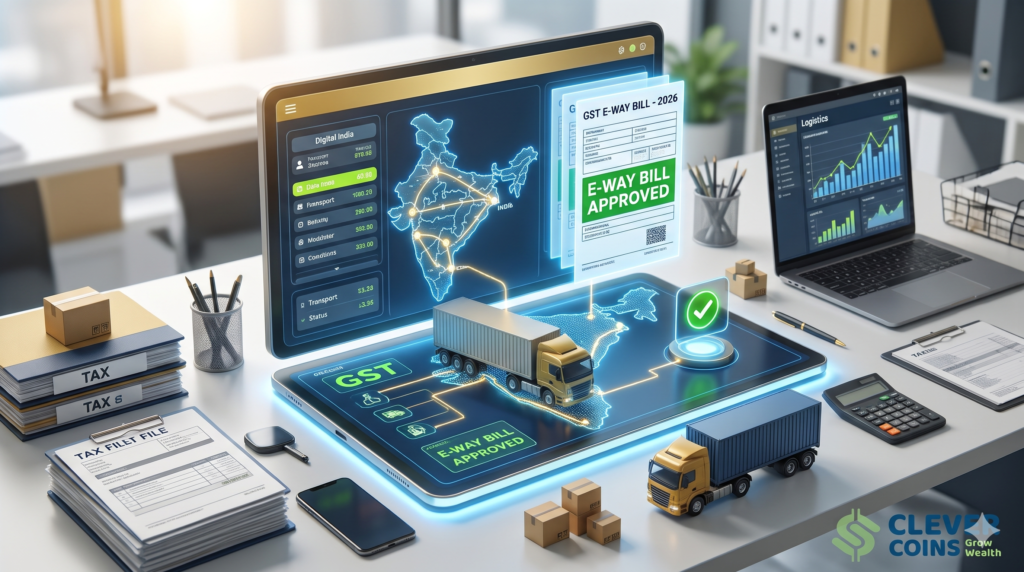
E-Way Bill Rules 2026: Distance, Validity, Turnover Limit and Penalty for MSMEs
The Goods and Services Tax (GST) framework is continuously evolving, and the electronic way bill (E-Way Bill) system remains one of its most critical compliance mechanisms. For Micro, Small, and Medium Enterprises (MSMEs) navigating the logistics of moving goods across India, understanding the E-Way Bill Rules 2026 is no longer optional—it is a core operational requirement. The E-Way Bill acts as a digital tracking tool that ensures transparency, prevents tax evasion, and streamlines the physical movement of consignments across state borders and within city limits.
As we progress through 2026, the regulatory landscape has introduced nuanced changes to threshold limits, validity periods based on distance, and stringent penalties for non-compliance. States have exercised their autonomy to alter intra-state limits, making it imperative for business owners and fleet operators to stay updated. This comprehensive guide breaks down every facet of the E-Way Bill rules applicable in 2026, empowering MSMEs to maintain flawless compliance, avoid operational bottlenecks, and protect their working capital from harsh penalties.
1. Demystifying the E-Way Bill in 2026
An E-Way Bill is an electronic document generated on the national GST portal evidencing the movement of goods. It is required whether the movement is caused by a supply, reasons other than supply (like stock transfers or return of goods), or due to inward supply from an unregistered person.
The document comprises two primary sections:
Part A: Contains the invoice or challan details, including the GSTIN of the supplier and recipient, pin codes of origin and destination, invoice number, value of goods, HSN code, and the reason for transportation.
RazorpayPart B: Contains the transport details, specifically the vehicle registration number or transporter document details (like Railway Receipt, Airway Bill, or Bill of Lading).
Razorpay
The generation of an E-Way Bill yields a unique 12-digit E-Way Bill Number (EBN) that is made available to the supplier, the recipient, and the transporter. In 2026, the digital infrastructure supporting this system has become highly integrated with the FASTag network and VAHAN database, meaning tax authorities can track the real-time movement of commercial vehicles and instantly verify if a vehicle carrying goods is backed by a valid EBN.
2. Consignment and Turnover Threshold Limits for 2026
The threshold limits dictate when an E-Way Bill becomes mandatory. These limits are primarily based on the consignment value, which includes the taxable value of the goods plus the applicable CGST, SGST, IGST, and cess. It is crucial to note that the consignment value excludes the value of any exempt goods being carried in the same conveyance alongside taxable goods.
Inter-State Movement (Between States)
For the inter-state movement of goods, the Central Board of Indirect Taxes and Customs (CBIC) maintains a uniform, nationwide threshold. In 2026, an E-Way Bill is strictly mandatory for inter-state movement if the consignment value exceeds ₹50,000. This applies regardless of the origin or destination state.
Intra-State Movement (Within the Same State)
Under the GST Act, state governments have the authority to define the threshold limits for movements occurring entirely within their state borders. While the default limit is ₹50,000, several states have modified this threshold to ease the compliance burden on local MSMEs in 2026.
Key State-Wise Thresholds in 2026:
Maharashtra: The limit for intra-state movement remains at ₹1,00,000. Furthermore, no E-Way bill is required for the transport of hank, yarn, fabric, and garments transported for job work up to a distance of 50 km within the state.
myBillBookDelhi: Goods moving within Delhi require an E-Way Bill only if the value exceeds ₹1,00,000.
RazorpayRajasthan: Rajasthan offers specific relief for city-level logistics. The limit is ₹2,00,000 for movement within the same city, provided the goods are not specific restricted items like tobacco or pan masala. For movement outside the city but within the state, the limit is ₹1,00,000.
myBillBookWest Bengal: Effective June 1, 2026, West Bengal has strictly clarified that all intra-state movement of goods (excluding job work) exceeding ₹50,000 mandates an E-Way Bill. Movements related to job work remain exempt from this requirement within the state.
TaxGuru+ 1Tamil Nadu & Bihar: These states maintain an intra-state threshold of ₹1,00,000 for taxable goods.
RazorpayGujarat & Karnataka: The limit generally remains aligned with the central standard of ₹50,000.
Bajaj Finserv
Mandatory Generation Irrespective of Value
Certain scenarios require the generation of an E-Way Bill even if the consignment value is ₹100. MSMEs must be hyper-aware of these exceptions:
Inter-State Job Work: When goods are sent by a principal located in one state to a job worker located in another state, an E-Way Bill must be generated by either the principal or the registered job worker, irrespective of the consignment value.
Bajaj FinservHandicraft Goods: Inter-state transport of handicraft goods by a dealer who is exempt from GST registration requires a mandatory E-Way Bill.
3. Distance Rules and Validity Periods
An E-Way Bill is not valid indefinitely. Its lifespan is directly tied to the distance the goods must travel, calculated based on the PIN codes of the origin and destination. In 2026, the validity metrics remain tightly regulated to ensure goods are not indefinitely stalled or diverted.
Standard Cargo Vehicles
For regular motor vehicles, the validity is calculated as follows:
Up to 200 km: Valid for 1 day in 2026.
RazorpayEvery additional 200 km (or part thereof): Valid for 1 additional day.
Razorpay
Example: If a consignment needs to travel 450 km from Mumbai to Ahmedabad, the E-Way Bill is valid for 3 days (1 day for the first 200 km, 1 day for the next 200 km, and 1 day for the remaining 50 km).
Over Dimensional Cargo (ODC)
Over Dimensional Cargo requires specialized, larger vehicles that inherently travel at slower speeds. The government accommodates this with a different validity scale:
Up to 20 km: Valid for 1 day.
RazorpayEvery additional 20 km (or part thereof): Valid for 1 additional day.
Razorpay
Calculating the Validity Expiry
The validity period starts when the first entry is made in Part B (when the vehicle number is updated). A “day” for E-Way Bill purposes ends at midnight of the following day. For instance, if an E-Way Bill is generated at 3:00 PM on October 1st for a distance of 150 km, it will be valid until midnight (11:59 PM) of October 2nd.
Extending E-Way Bill Validity
Logistics are prone to unpredictable delays—accidents, extreme weather, vehicle breakdowns, or law and order issues. If a consignment cannot reach its destination within the validity period, the transporter can extend the E-Way Bill.
Timeframe for Extension: The extension can only be executed within 8 hours before expiry or within 8 hours after the expiry of the original validity period.
LegalmediaMissing this 16-hour window renders the E-Way Bill permanently expired, and the goods will be considered to be moving without valid documentation, triggering immediate penalties.
4. Exemptions: When is an E-Way Bill Not Required?
To prevent bureaucratic congestion for minor or specialized logistics, the 2026 rules outline specific exemptions where an E-Way Bill is not required:
Short-Distance Intra-State Movement (Part B Exemption): If goods are being transported from the consignor’s business to the transporter’s location for further transport, and the distance is less than 50 km within the same state, Part B (vehicle details) of the E-Way Bill is not required to be filled. Part A must still be generated.
Non-Motorized Conveyance: Goods transported by non-motorized conveyances (like handcarts, animal-drawn carts, or bicycles) are entirely exempt.
Exempt Supply Items: Transport of goods explicitly listed as exempt under GST (e.g., fresh milk, unprocessed agricultural produce, meat, bread, curd, books) does not require an E-Way Bill, regardless of value.
Customs and Port Movements: Movement of goods from a customs port, airport, air cargo complex, or land customs station to an Inland Container Depot (ICD) or a Container Freight Station (CFS) for customs clearance.
Bajaj FinservSpecific Jurisdictions: Movement of goods within areas notified by specific states (subject to local state notifications).
Defence Formations: Goods transported by the Ministry of Defence.
5. Penalties for Non-Compliance in 2026
The CBIC has engineered the penalty structure to be aggressively punitive to deter tax evasion. An expired E-Way Bill, an E-Way Bill with incorrect data, or moving goods entirely without an E-Way Bill are treated as identical offenses in the eyes of a GST officer.
Section 129: Detention and Seizure
If a vehicle is intercepted by tax officials and found to be transporting taxable goods without a valid E-Way Bill, the primary recourse is Section 129 of the CGST Act.
If the owner of the goods comes forward to pay the penalty: The penalty is equal to 200% of the tax payable on the goods. For exempted goods, the penalty is 2% of the value of goods or ₹25,000, whichever is lower.
If the owner does not come forward: The penalty is equal to 50% of the value of the goods or 200% of the tax payable, whichever is higher. For exempted goods, it is 5% of the value of goods or ₹25,000, whichever is lower.
Until the penalty is paid, both the commercial vehicle and the goods are detained. The transporter cannot release their truck, causing massive cascading delays for other clients.
Section 122: General Penalty
For minor discrepancies—such as typographical errors in the E-Way Bill (like an incorrect vehicle number digit, missing PIN code, or minor billing address error) that do not explicitly point to tax evasion—a general penalty under Section 122 may be levied. This penalty is generally a flat ₹10,000 or the tax evaded, whichever is higher. However, relying on an officer’s leniency to classify an error as “minor” is a highly risky strategy.
Confiscation under Section 130
In severe cases where the authorities prove an active intent to evade tax, the goods and the vehicle can be entirely confiscated under Section 130. The fine in lieu of confiscation will equal the market value of the goods minus the tax chargeable.
6. Common Pitfalls and Best Practices for MSMEs
For an MSME, navigating these rules requires systematic internal controls. Tax consultants consistently observe businesses making the same avoidable errors.
Common Mistakes to Avoid:
Forgetting Part B: Generating Part A but failing to update the vehicle number in Part B before the vehicle actually begins its journey.
Transhipment Errors: When goods change trucks during transit, the E-Way Bill must be updated with the new vehicle’s details. Forgetting this during cross-country transport is a leading cause of detentions.
Ignoring Expiry Windows: Allowing validity to lapse while a truck is parked at a weighbridge or stuck at a border crossing. Extensions must be filed within the strict 8-hour window.
LegalmediaValuation Mismatches: Entering a consignment value in the E-Way Bill that differs from the physical tax invoice accompanying the goods.
Best Practices for 2026:
Integrate ERP Systems: Use accounting and ERP software that directly links with the government’s E-Way Bill API. This automates generation and reduces human data entry errors.
Transporter Communication: Establish a strict protocol with logistics partners. They must notify your dispatch team immediately if a vehicle breaks down so validity extensions can be processed in time.
Reconciliation: Reconcile E-Way Bills generated with the GSTR-1 outward supply data monthly. Discrepancies between these two portals frequently trigger automated scrutiny notices from the GST department.
Multi-Vehicle Handling: If a large consignment is billed on a single invoice but must be transported in multiple smaller trucks, the supplier must generate separate delivery challans for each truck and reference the original master invoice. A separate E-Way Bill must be generated for each delivery challan.
The E-Way Bill ecosystem in 2026 is uncompromising. With the integration of FASTag data, the physical interception of vehicles is increasingly driven by algorithmic flags rather than random checks. MSMEs must treat the generation, updating, and tracking of E-Way Bills not as an administrative afterthought, but as a critical, time-sensitive compliance function that directly protects their bottom line.