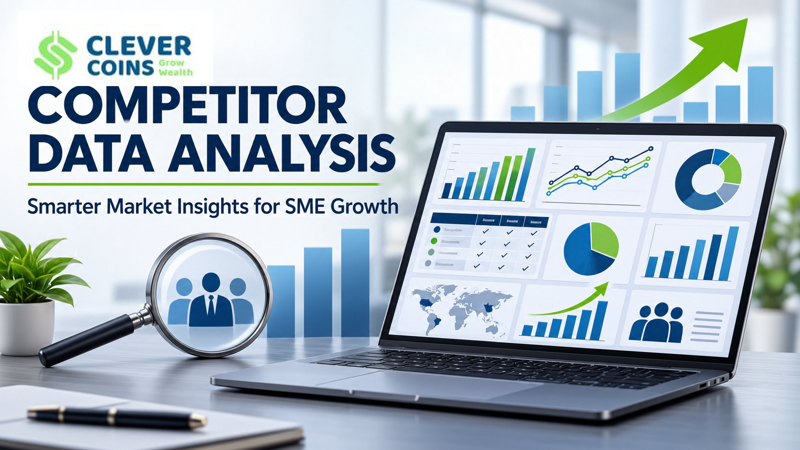
Competitor Data Analysis for SMEs: A Practical Case Study
Introduction: Why Competitor Data Analysis Is Essential for Small Businesses
Running a small or medium-sized enterprise (SME) in today’s competitive business environment is not simply about offering a good product or service. It is about understanding your customers, identifying market opportunities, managing expenses, positioning your brand, and making informed decisions before your competitors do.
Many small business owners invest heavily in advertising, product development, sales teams, and customer acquisition without understanding what is happening around them. They know their own business numbers but have limited information about competitor pricing, marketing strategies, customer experiences, product offerings, market positioning, and overall business performance.
This creates a significant strategic disadvantage.
Imagine operating a small manufacturing company. Your sales have remained almost unchanged for six months, even though your industry is growing. You assume that customers are spending less or that your advertising is not generating enough enquiries. However, after conducting a competitor data analysis, you discover that three competing businesses have introduced new product packages, one competitor is offering more flexible payment terms, and another has improved its online visibility through targeted educational content.
The problem was not necessarily a lack of market demand. Your business was missing important competitive information.
This is where competitor data analysis becomes valuable.
Competitor data analysis is the systematic process of collecting, organising, comparing, and interpreting information about competing businesses to understand their strengths, weaknesses, strategies, pricing, customer experience, marketing activities, and market position.
For SMEs, it provides a practical way to make decisions based on evidence instead of assumptions.
The good news is that competitor analysis does not require an expensive research department, sophisticated software, or a large corporate budget. Even a small business can perform meaningful competitor research using publicly available information, customer feedback, industry reports, spreadsheets, website analytics, and affordable digital tools.
In this detailed guide, we will explore how competitor data analysis works, why SMEs need it, which information businesses should collect, how to compare competitors, and how to turn research into a practical growth strategy.
We will also examine an illustrative case study of a small Indian business that uses competitor intelligence to identify market gaps and improve its competitive position.
1. What Is Competitor Data Analysis?
Competitor data analysis is a business research activity that helps an organisation understand how other businesses compete in the same market.
It involves examining information related to:
Products and services offered by competitors.
Pricing structures and discount strategies.
Target customers and market segments.
Sales and distribution channels.
Website quality and search engine visibility.
Social media presence and engagement.
Customer reviews and satisfaction.
Promotional campaigns and advertising.
Brand positioning and unique selling propositions.
Operational strengths and potential weaknesses.
Customer service and after-sales support.
New product launches and market developments.
The objective is not to copy competitors. Instead, the objective is to understand the competitive environment and discover opportunities to improve your own business.
For example, a small accounting consultancy may discover that competitors are attracting customers through educational content about GST registration, business incorporation, and income tax compliance.
This information can help the consultancy develop more useful website content, create informative social media campaigns, improve its service presentation, and reach customers who are actively searching for professional assistance.
Similarly, a manufacturing SME might discover that competing businesses have longer delivery times, limited customisation options, or unclear warranty policies. These weaknesses may represent opportunities to differentiate its offering.
In simple terms:
Competitor analysis tells you what other businesses are doing. Competitor data analysis helps you understand what that information means for your business.
2. Why Do SMEs Need Competitor Data Analysis?
Large organisations often have dedicated market research teams, business analysts, and substantial budgets for competitive intelligence.
SMEs generally operate with fewer resources. Their owners and managers frequently handle sales, finance, operations, marketing, and customer relationships simultaneously.
This makes efficient decision-making especially important.
Competitor data analysis helps small businesses use their limited resources more strategically.
2.1 Understand Your Actual Market Position
Many business owners believe they understand their market because they interact with customers regularly.
However, customer conversations alone may not reveal how your business compares with competitors.
You might believe your pricing is competitive, but another business may offer better value through additional services, faster delivery, or flexible payment arrangements.
By comparing competitors systematically, you can understand:
Whether your pricing is above or below the market.
Whether your products meet customer expectations.
Whether your brand communicates sufficient value.
Whether your services are differentiated.
Whether customers have better alternatives.
Which customer segments are underserved.
This information helps you develop a more realistic understanding of your position.
2.2 Identify New Business Opportunities
Competitor research can reveal customer requirements that existing businesses are not addressing properly.
For example, suppose customers repeatedly complain that local service providers do not respond to enquiries quickly.
A small business could differentiate itself through:
Faster enquiry responses.
Transparent quotations.
Dedicated customer support.
Online appointment booking.
Regular service updates.
Clearly defined service packages.
These improvements may require less investment than launching an entirely new product.
2.3 Improve Pricing Decisions
Pricing is one of the most important decisions for an SME.
If prices are too high, potential customers may select alternatives. If prices are too low, the business may struggle to maintain healthy profit margins.
Competitor data analysis helps businesses understand the relationship between market pricing, customer expectations, product quality, and perceived value.
It is important to remember that the cheapest competitor is not automatically the strongest competitor.
A business charging a premium may provide better service, stronger warranties, higher product quality, or more convenient delivery.
The objective should be to establish a profitable and defensible pricing position rather than blindly matching competitors.
2.4 Strengthen Marketing and Advertising
Marketing becomes more effective when businesses understand how competing brands communicate with their target customers.
For example, competitor research may reveal that:
One competitor receives significant website traffic through educational blogs.
Another generates enquiries through Instagram.
A third relies heavily on customer referrals.
A fourth ranks for valuable local search keywords.
Another uses customer testimonials to build trust.
These observations can help an SME decide which marketing channels deserve attention.
It can also reveal content gaps. If competitors provide limited information about a particular customer problem, your business may be able to create a more useful guide, video, or downloadable resource.
2.5 Improve Customer Satisfaction
Customer reviews are an important source of competitive intelligence.
Public reviews may reveal recurring problems involving:
Delayed delivery.
Poor communication.
Complicated purchasing processes.
Unclear pricing.
Limited product availability.
Difficult refund procedures.
Weak after-sales support.
If multiple customers report the same issue, it may indicate an opportunity for your business to provide a better experience.
However, reviews should be interpreted carefully. Individual comments are not necessarily representative of the entire customer base.
2.6 Reduce Business Risk
Entering a new market, launching a product, or increasing marketing expenditure involves uncertainty.
Competitor analysis cannot eliminate risk, but it can help identify potential challenges before committing substantial resources.
Businesses can investigate market saturation, competitor pricing, established brands, distribution limitations, customer expectations, and changes in demand.
This allows management to test assumptions and make more informed investment decisions.
3. Understanding Different Types of Competitors
An effective competitor data analysis begins with identifying the correct competitors.
Many businesses make the mistake of studying only companies that sell exactly the same products.
In reality, competition exists in several forms.
3.1 Direct Competitors
Direct competitors offer similar products or services to the same target audience.
For example, if you operate a digital accounting consultancy for small businesses, another consultancy providing GST filing, income tax filing, and business compliance services is a direct competitor.
Important information to examine includes:
Service packages.
Pricing.
Target customers.
Service quality.
Online visibility.
Customer reviews.
Brand reputation.
3.2 Indirect Competitors
Indirect competitors solve the same customer problem through different products or business models.
For example, a traditional accounting consultancy may compete indirectly with online accounting platforms that help businesses manage tax calculations and financial records.
Although the service delivery model is different, both alternatives address similar customer needs.
3.3 Substitute Competitors
Substitute competitors provide alternative ways for customers to solve a problem.
For example, a customer considering professional website development might choose between a digital agency, a freelancer, and a do-it-yourself website builder.
These alternatives may have different prices and service levels but compete for the same purchasing decision.
3.4 Aspirational Competitors
Aspirational competitors are businesses that demonstrate successful strategies or operational practices worth studying.
They may be larger than your business and operate in a different geographical market.
An SME can study their customer onboarding, content strategy, service presentation, technology adoption, and brand communication without assuming that their entire business model can be replicated.
4. What Data Should SMEs Collect During Competitor Analysis?
Collecting large amounts of information is not the same as conducting meaningful research.
The objective is to collect relevant data that helps answer specific business questions.
The following categories provide a practical starting point.
4.1 Company and Business Information
Start with basic information about each competitor.
Record:
Company name.
Year of establishment, if publicly available.
Business location.
Primary industry.
Products and services.
Target customer segments.
Geographic coverage.
Business model.
Distribution channels.
Publicly disclosed business developments.
This information helps you understand the competitor’s overall business structure.
Do not assume that private financial information, revenue, employee numbers, or market share are publicly available or reliable.
4.2 Product and Service Analysis
Examine the products and services offered by competitors.
Important questions include:
What are their main offerings?
Which products appear most prominently?
Do they provide customised solutions?
What additional services do they include?
Do they offer warranties or guarantees?
Are there premium and budget packages?
What differentiates their offering?
A comparison of products can reveal whether your business is missing an important feature or offering something customers do not particularly value.
4.3 Competitor Pricing Analysis
Pricing research helps businesses understand the market’s commercial structure.
Record publicly available information such as:
Standard selling price.
Subscription charges.
Installation fees.
Delivery charges.
Discount structures.
Bulk purchase pricing.
Payment options.
Maintenance charges.
Additional service fees.
When prices are not publicly disclosed, record them as unavailable rather than inventing estimates.
Also compare what customers receive at each price point.
A lower-priced service may exclude important features that another competitor includes.
4.4 Website and SEO Analysis
A competitor’s website can provide valuable information about its marketing strategy.
Examine:
Website design and usability.
Page loading experience.
Mobile responsiveness.
Product and service pages.
Blog content.
Search engine rankings.
Target keywords.
Internal linking.
Calls to action.
Contact information.
Customer testimonials.
Lead generation forms.
SEO analysis is particularly important because customers frequently research products and services online before making purchasing decisions.
If a competitor ranks for valuable keywords, investigate the content and search intent behind those rankings.
Do not simply copy their keywords. Identify where your business can create more helpful and relevant information.
4.5 Social Media Analysis
Social media research helps SMEs understand how competitors engage with potential customers.
Review platforms such as:
Instagram.
Facebook.
LinkedIn.
YouTube.
Other relevant regional platforms.
Examine:
Posting frequency.
Content categories.
Video formats.
Educational posts.
Promotional campaigns.
Customer comments.
Engagement patterns.
Community interactions.
Influencer collaborations.
Follower counts alone are not sufficient to measure performance.
A smaller business with meaningful customer conversations may have a stronger relationship with its audience than a competitor with a much larger but less engaged following.
4.6 Customer Review and Reputation Analysis
Public reviews offer insights into customer expectations and service experiences.
Review platforms may include Google Business Profile, industry directories, marketplaces, and relevant social media pages.
Look for recurring positive and negative themes.
For example:
| Review theme | Possible business implication |
|---|---|
| Fast delivery | Delivery speed is valued |
| Transparent pricing | Customers dislike hidden charges |
| Poor communication | Customer support may be a market gap |
| Product quality | Reliability influences purchasing |
| Complicated onboarding | Simpler processes may create differentiation |
Avoid treating individual reviews as conclusive evidence. Look for repeated patterns across multiple sources.
4.7 Marketing and Advertising Analysis
Observe how competitors attract and convert customers.
Study:
Advertising messages.
Promotional offers.
Landing pages.
Email newsletters.
Referral programmes.
Seasonal campaigns.
Lead magnets.
Video advertisements.
Customer testimonials.
The purpose is to identify the customer problem each campaign addresses and the value proposition it communicates.
4.8 Distribution and Operational Analysis
For product-based SMEs, operational comparisons can be equally important.
Investigate publicly observable factors such as:
Delivery coverage.
Order fulfilment options.
Distributor relationships.
Product availability.
Return policies.
Packaging.
Service locations.
Delivery timelines.
For service-based businesses, examine appointment availability, consultation processes, response times, and service accessibility.
5. Step-by-Step Process to Conduct Competitor Data Analysis
A structured process makes competitor research more consistent and useful.
Step 1: Define Your Business Objective
Before collecting information, identify why you are conducting the analysis.
Your objective could be:
Improving sales.
Entering a new geographical market.
Launching a new product.
Reviewing pricing.
Improving website rankings.
Increasing customer retention.
Understanding declining enquiries.
Identifying new customer segments.
A clearly defined objective prevents unnecessary data collection.
For example, if your goal is to improve website visibility, focus on competitor keywords, content, backlinks, search intent, and website structure.
If your goal is to improve profitability, prioritise pricing, product costs, service packages, and customer acquisition economics.
Step 2: Identify Your Competitors
Start with approximately five to eight relevant competitors.
Include direct competitors, indirect competitors, and selected aspirational businesses.
Potential discovery sources include:
Google Search.
Google Maps.
Industry directories.
Trade associations.
Marketplaces.
Customer recommendations.
Social media.
Industry publications.
Search using the same phrases that your potential customers use.
For a local service provider, location-specific searches may reveal competitors that broad national searches overlook.
Step 3: Select Your Research Categories
Create a standardised list of comparison factors.
For example:
Business positioning.
Product and service range.
Pricing.
Target audience.
Website quality.
SEO performance.
Social media activity.
Customer reviews.
Customer support.
Distribution and availability.
Keep the categories relevant to your industry.
Step 4: Collect Reliable Data
Use publicly available and lawfully accessible information.
Useful sources include:
Competitor websites.
Published price lists.
Product catalogues.
Public customer reviews.
Search engine results.
Public social media accounts.
Government business information.
Industry reports.
Published company announcements.
Record the source and date for each important observation.
Separate verified facts from estimates and opinions.
For example, a publicly listed service price is an observable fact. An assumption that the competitor is profitable because its price is high is not.
Step 5: Organise Information in a Comparison Spreadsheet
A spreadsheet is sufficient for many small businesses.
Use one row for each competitor and separate columns for the selected comparison factors.
A simple example:
| Factor | Your business | Competitor A | Competitor B |
|---|---|---|---|
| Pricing | ₹5,000 | ₹4,500 | ₹6,000 |
| Delivery | 5 days | 7 days | 4 days |
| Customisation | High | Limited | Medium |
| Online presence | Moderate | Strong | Strong |
| Customer support | Phone and email | Phone and chat | |
| Warranty | 1 year | 6 months | 1 year |
The numbers above are illustrative and should be replaced with actual research.
Step 6: Analyse Competitor Strengths and Weaknesses
After collecting information, identify patterns.
Ask:
What does each competitor do particularly well?
Where are competitors underperforming?
Which customer needs remain unmet?
Which features are becoming standard?
Which advantages are difficult to replicate?
What can your business improve immediately?
Avoid confusing a competitor’s visible activity with its actual commercial success.
For example, frequent social media posts do not automatically indicate strong sales performance.
Step 7: Identify Market Gaps
Market gaps are customer needs that existing competitors do not adequately satisfy.
They may involve:
Pricing transparency.
Faster service.
Better customer support.
More convenient payment options.
Specialised product features.
Regional-language assistance.
Better delivery coverage.
Easier onboarding.
Prioritise gaps based on customer demand, commercial viability, implementation cost, and your ability to deliver.
Step 8: Build an Action Plan
Research has limited value unless it changes business decisions.
Convert findings into specific actions.
For example:
| Finding | Recommended action | Success indicator |
|---|---|---|
| Competitors have weak blog coverage | Publish educational articles | Organic enquiries |
| Customers complain about delays | Improve delivery workflow | On-time delivery rate |
| Pricing is unclear | Publish service packages | Qualified enquiries |
| Competitors lack local support | Improve regional customer service | Customer satisfaction |
| Competitors offer flexible packages | Test customised plans | Conversion rate |
Step 9: Monitor Changes Regularly
Competitor analysis should not be a one-time activity.
Markets change. Competitors introduce new products, revise pricing, launch campaigns, improve their websites, and enter new locations.
A small business can review key competitors monthly and perform a more comprehensive analysis quarterly.
The review frequency should reflect the pace of change in the industry.
6. Practical Case Study: How an Indian SME Can Use Competitor Data Analysis to Improve Business Performance
The following case study demonstrates how competitor data analysis can help a small business make more informed decisions.
All company names, figures, financial amounts, and outcomes in this example are hypothetical. They are intended to demonstrate the methodology, not represent the verified performance of an actual business.
6.1 Business Background
Consider a hypothetical Indian manufacturing business called ABC Packaging Solutions.
The company operates as a small packaging manufacturer supplying customised corrugated boxes to local retailers, e-commerce sellers, distributors, and small manufacturing companies.
Its business model relies primarily on direct enquiries, repeat customers, referrals, and a limited digital presence.
Despite having reasonable production capacity and an established customer base, the business has experienced slow sales growth.
Management identifies several challenges:
New customer enquiries are inconsistent.
Competitors are attracting customers through online channels.
Some customers negotiate aggressively on price.
The website generates limited enquiries.
The business has little information about competing product packages.
Management is uncertain about which customer segments offer the best growth opportunities.
Instead of immediately increasing advertising expenditure or reducing prices, the company decides to conduct a competitor data analysis.
6.2 Defining the Research Objective
ABC Packaging Solutions establishes four primary objectives:
Understand the pricing and service positioning of local competitors.
Identify product and customer service gaps.
Evaluate competitor digital marketing strategies.
Develop an action plan to improve customer acquisition and profitability.
The company decides to study four competitors operating in the same broad market.
6.3 Identifying Competitors
The research team identifies the following hypothetical competitors:
Competitor A: A low-cost packaging manufacturer.
Competitor B: An established supplier with a strong regional reputation.
Competitor C: A digitally active packaging company.
Competitor D: A specialised manufacturer offering customised packaging solutions.
Each competitor has a different business positioning.
This is important because comparing only businesses with identical pricing or product offerings may overlook valuable market opportunities.
6.4 Collecting Competitor Data
The company examines publicly available information from websites, product catalogues, social media pages, published quotations, and customer feedback.
The team records the following illustrative observations:
| Research factor | ABC Packaging | Competitor A | Competitor B | Competitor C |
|---|---|---|---|---|
| Indicative price per unit | ₹18 | ₹15 | ₹21 | ₹19 |
| Minimum order quantity | 500 | 1,000 | 500 | 250 |
| Customisation | High | Low | Medium | High |
| Website quality | Basic | Basic | Good | Strong |
| Online enquiry options | Limited | Limited | Available | Available |
| Delivery commitment | 7 days | 10 days | 6 days | 5 days |
| Sample availability | Yes | No | Yes | Yes |
These prices and service details are hypothetical research inputs, not market quotations.
The comparison reveals that ABC Packaging is neither the cheapest nor the most expensive provider.
However, it offers relatively flexible customisation and a lower minimum order quantity than the low-cost competitor.
This gives management a possible differentiation strategy.
6.5 Analysing Pricing and Value Proposition
The initial assumption among management was that reducing prices would increase sales.
However, the competitor comparison suggests that pricing alone does not explain customer preferences.
Competitor A has the lowest price but requires larger minimum orders.
Competitor B charges more but has a stronger regional reputation.
Competitor C offers convenience through its digital enquiry process and faster delivery commitment.
ABC Packaging has an opportunity to position itself around flexible ordering, customisation, and reliable customer communication.
Rather than immediately reducing its price from ₹18, the company decides to investigate whether customers value its flexibility enough to support the existing pricing structure.
This is an important lesson: competitor pricing must be evaluated alongside the value delivered.
6.6 Analysing Digital Marketing Performance
The company then examines the online presence of its competitors.
The research team observes:
Competitor A has a limited website and relatively basic product information.
Competitor B publishes company updates and product catalogues.
Competitor C regularly publishes educational packaging content.
Competitor D showcases customised product examples and manufacturing capabilities.
The team identifies an important opportunity.
Potential customers searching online for customised packaging solutions need more information about material selection, box dimensions, printing, minimum order quantities, and packaging costs.
ABC Packaging’s website does not answer these questions effectively.
The company therefore decides to improve its digital presence through educational content and clearer service pages.
6.7 Analysing Customer Feedback
The research team also examines publicly available customer reviews and feedback relating to the competitors.
For the purpose of this illustrative case, the team identifies recurring themes:
Customers want clearer delivery commitments.
Smaller businesses prefer flexible order quantities.
Some customers need assistance selecting suitable packaging materials.
Customers value quick quotation responses.
Businesses appreciate transparent communication about additional charges.
These findings suggest that customer experience may be an important competitive differentiator.
ABC Packaging decides to introduce a more structured enquiry and quotation process.
6.8 Conducting SWOT Analysis
The company converts its research findings into a SWOT analysis.
Strengths
Flexible product customisation.
Relatively low minimum order quantity.
Existing manufacturing capabilities.
Established local customer relationships.
Ability to provide product samples.
Weaknesses
Limited digital visibility.
Basic website structure.
Inconsistent enquiry follow-up.
Limited educational content.
Low awareness outside its existing customer base.
Opportunities
Small e-commerce sellers requiring customised packaging.
Businesses looking for flexible order quantities.
Customers seeking guidance on packaging materials.
Improved local search visibility.
Stronger online quotation and sample request processes.
Threats
Low-price competitors.
Increasing raw material costs.
Larger manufacturers with greater production capacity.
Competitors offering faster delivery.
Changing customer expectations.
The SWOT analysis helps management understand the relationship between internal capabilities and external market conditions.
6.9 Developing a Competitive Growth Strategy
Based on its findings, ABC Packaging develops five strategic initiatives.
Initiative 1: Introduce Clear Service Packages
The business creates three service categories:
Standard Packaging.
Customised Packaging.
Premium Printed Packaging.
Each package has clearly communicated specifications, minimum order requirements, and quotation guidelines.
The objective is to make purchasing decisions easier for customers.
Initiative 2: Improve Website Content and SEO
The business plans to publish helpful articles addressing customer questions.
Potential topics include:
How to Choose the Right Corrugated Box.
Packaging Cost Factors for Small Businesses.
Custom Packaging Solutions for E-commerce Sellers.
Different Types of Corrugated Packaging Materials.
How Packaging Quality Influences Product Protection.
It also improves its product pages, enquiry forms, and contact information.
Initiative 3: Improve Customer Response Time
The business introduces a structured enquiry management process.
Every enquiry is recorded, assigned, and followed up within a defined internal response target.
Customers receive clearer information about quotations, production timelines, and delivery expectations.
Initiative 4: Target Underserved Customer Segments
Instead of competing only for large manufacturing orders, the business explores smaller e-commerce sellers and local retailers that need flexible quantities.
This strategy is based on an observed difference in minimum order requirements.
Initiative 5: Strengthen Customer Relationships
The company introduces regular feedback collection, sample follow-ups, and a customer retention process.
Existing customers receive information about new packaging options and relevant product improvements.
6.10 Illustrative Financial Analysis
Competitor analysis can also help SMEs evaluate whether proposed improvements are financially sensible.
Consider the following hypothetical monthly performance figures.
| Financial indicator | Before strategy |
|---|---|
| Monthly sales revenue | ₹5,00,000 |
| Monthly operating expenses | ₹4,20,000 |
| Operating surplus | ₹80,000 |
| Monthly new enquiries | 100 |
| Converted enquiries | 15 |
| Enquiry conversion rate | 15% |
Suppose the company implements its improvement strategy and later records the following illustrative figures:
| Financial indicator | After strategy |
|---|---|
| Monthly sales revenue | ₹6,00,000 |
| Monthly operating expenses | ₹4,85,000 |
| Operating surplus | ₹1,15,000 |
| Monthly new enquiries | 140 |
| Converted enquiries | 21 |
| Enquiry conversion rate | 15% |
The hypothetical comparison indicates:
Revenue increased by ₹1,00,000.
Operating surplus increased by ₹35,000.
New enquiries increased by 40.
Converted enquiries increased by 6.
Enquiry conversion rate remained unchanged.
The important observation is that increased enquiries and revenue do not automatically mean that conversion efficiency has improved.
Management must examine the complete customer acquisition process.
It should also verify whether the additional operating expenses include marketing, production, delivery, and other costs correctly.
6.11 Key Lessons From the Case Study
The example highlights several important lessons.
Lesson 1: Price Is Only One Part of Competition
Customers evaluate quality, flexibility, delivery, support, and convenience alongside price.
Lesson 2: Competitor Weaknesses Can Reveal Opportunities
A weakness in a competitor’s customer experience may create an opportunity for a smaller business to differentiate itself.
Lesson 3: Digital Visibility Matters
A useful website and relevant educational content can help SMEs reach potential customers who are actively researching products and services.
Lesson 4: Data Must Lead to Action
Research should result in practical decisions, not simply a spreadsheet containing competitor information.
Lesson 5: Performance Must Be Measured
Every major strategic initiative should have measurable indicators.
Lesson 6: Competitive Advantages Should Be Built Around Customer Needs
Copying another business’s strategy does not guarantee success. A better approach is to understand customer expectations and develop capabilities that meet them more effectively.
7. Important Tools for Competitor Data Analysis
SMEs do not need to purchase every available business intelligence tool.
The right tools depend on the research objective, industry, budget, and technical capability.
7.1 Google Search
Google Search is a practical starting point for discovering competitors, understanding customer search behaviour, reviewing published pricing, and identifying industry trends.
Searches should include relevant products, services, locations, and customer problems.
7.2 Google Trends
Google Trends helps businesses examine relative search interest over time and compare selected search terms.
It can provide useful directional insights about seasonal demand and changing customer interest.
However, search interest is not equivalent to actual sales demand.
7.3 Google Keyword Planner
Keyword Planner helps businesses research search terms and estimate advertising-related keyword demand.
It can support SEO planning and paid search campaigns.
7.4 Google Analytics 4
Google Analytics 4 helps businesses understand activity on their own websites.
It can measure:
Website traffic.
Traffic sources.
Landing page performance.
User engagement.
Conversions.
Enquiry activity.
It does not provide direct access to a competitor’s private analytics data.
7.5 Google Search Console
Search Console helps website owners monitor their own website’s organic search performance.
It provides information about:
Search queries.
Impressions.
Clicks.
Click-through rates.
Average search positions.
Indexing and technical search issues.
It is particularly useful for measuring the results of an SEO improvement strategy.
7.6 SEMrush
SEMrush offers competitive research and SEO tools that can help businesses investigate competitor keyword visibility, organic search opportunities, paid search activity, and backlink profiles.
Its traffic and keyword figures are estimates, not verified competitor accounting records.
7.7 Ahrefs
Ahrefs provides tools for keyword research, backlink analysis, website comparison, and content research.
It can help SMEs understand which topics competitors cover and identify potential content opportunities.
7.8 Social Media Analytics
Instagram Insights, LinkedIn analytics, Facebook Insights, and other platform-specific tools help businesses monitor their own social performance.
Publicly visible competitor activity can be studied, but private audience data and internal engagement analytics should never be assumed to be accessible.
7.9 Excel and Google Sheets
Spreadsheets remain among the most affordable and practical tools for SME competitor research.
They can be used to:
Maintain competitor profiles.
Compare prices.
Record customer review themes.
Track marketing activity.
Calculate performance indicators.
Organise SWOT findings.
Assign strategic priorities.
7.10 AI-Assisted Research
AI tools can help summarise publicly available information, organise research findings, compare competitor messaging, generate SWOT drafts, and identify possible market gaps.
However, AI-generated information must be verified against original sources.
Never treat unsupported AI estimates as actual competitor revenue, customer numbers, market share, or financial performance.
8. How to Measure the Effectiveness of Competitor Analysis
An SME should evaluate whether its competitor research has improved business decisions.
The following key performance indicators can be useful.
8.1 Customer Acquisition Cost
Customer acquisition cost (CAC) measures the average cost of acquiring a new customer.
Formula:
CAC = Total customer acquisition expenditure ÷ Number of new customers acquired
For example, if a business spends ₹30,000 on customer acquisition and obtains 15 new customers:
CAC = ₹30,000 ÷ 15 = ₹2,000.
Compare this figure over time to determine whether marketing and sales improvements are reducing acquisition costs.
8.2 Conversion Rate
Conversion rate measures the percentage of prospects who complete a desired action.
Formula:
Conversion Rate = (Number of Conversions ÷ Total Qualified Opportunities) × 100
If 20 out of 100 qualified enquiries become customers, the conversion rate is 20%.
8.3 Customer Retention Rate
Customer retention measures how effectively a business retains existing customers over a selected period.
Formula:
Retention Rate = ((Customers at End of Period − New Customers Acquired) ÷ Customers at Start of Period) × 100
This indicator is particularly useful for subscription-based businesses and SMEs that rely on repeat purchases.
8.4 Average Order Value
Average order value measures the average revenue generated per order.
Formula:
Average Order Value = Total Sales Revenue ÷ Number of Orders
Competitor analysis may reveal opportunities to introduce bundles, complementary products, or premium packages that improve order value.
8.5 Gross Profit Margin
Gross profit margin measures the percentage of revenue remaining after deducting the cost of goods sold.
Formula:
Gross Profit Margin = ((Revenue − Cost of Goods Sold) ÷ Revenue) × 100
This metric helps businesses evaluate whether competitive pricing decisions are sustainable.
8.6 Organic Search Performance
For businesses investing in SEO, useful indicators include:
Organic clicks.
Search impressions.
Relevant keyword rankings.
Organic enquiries.
Organic conversion rate.
Revenue generated through organic channels.
A rise in website traffic is useful only when the traffic is relevant to the business objective.
8.7 Customer Satisfaction
Customer satisfaction can be monitored through surveys, repeat purchase behaviour, customer feedback, complaint resolution, and appropriate service quality indicators.
The most valuable metrics depend on the business model.
9. Common Mistakes SMEs Should Avoid During Competitor Analysis
Competitor analysis can create misleading conclusions when research is poorly designed.
Here are common mistakes businesses should avoid.
Mistake 1: Studying Too Many Competitors
Analysing dozens of businesses can create unnecessary complexity.
Start with a manageable group of relevant competitors and expand only when necessary.
Mistake 2: Copying Competitor Pricing
A competitor’s price does not reveal its full cost structure or profitability.
Your business may have different production costs, overheads, customer acquisition expenses, and service requirements.
Calculate your own sustainable pricing before making changes.
Mistake 3: Confusing Popularity With Profitability
A competitor with a large social media following or impressive website traffic may not necessarily be profitable.
Public visibility is not proof of financial performance.
Mistake 4: Using Outdated Information
Prices, products, service terms, and business strategies change.
Record the date of each important observation and verify information before using it.
Mistake 5: Ignoring Customer Feedback
A competitor comparison based only on websites and prices misses the actual customer experience.
Review customer feedback and identify recurring patterns.
Mistake 6: Ignoring Your Own Strengths
Competitor analysis should not become an exercise in identifying everything other businesses do better.
It should also highlight the capabilities and advantages your business already possesses.
Mistake 7: Collecting Data Without an Action Plan
A spreadsheet is not a growth strategy.
Every important finding should lead to a decision, experiment, or clearly defined action.
Mistake 8: Using Unethical Research Methods
Competitor intelligence should be based on lawful, ethical, and publicly accessible information.
Avoid hacking, impersonation, unauthorised access, deceptive enquiries, theft of confidential documents, or attempts to obtain private customer information.
Respect privacy, intellectual property, website terms, and applicable data protection requirements.
10. How Often Should SMEs Conduct Competitor Analysis?
There is no universal schedule for every business.
The appropriate frequency depends on the speed of change in the industry.
A practical approach is:
Weekly
Monitor important competitor announcements, relevant promotions, product launches, and significant industry developments.
Monthly
Review competitor pricing, digital marketing activity, new content, public customer feedback, and important changes in service offerings.
Quarterly
Conduct a structured competitor comparison, review market positioning, update SWOT analysis, and evaluate the effectiveness of your competitive strategy.
Annually
Reassess the broader market, business positioning, major competitors, emerging technologies, customer segments, and long-term strategic priorities.
For highly competitive industries, more frequent monitoring may be appropriate.
The goal is to create a repeatable process that provides useful information without consuming excessive management time.
11. Building a Simple Competitor Analysis Framework for Your SME
Businesses that want to start immediately can use the following framework.
Stage 1: Research
Identify five relevant competitors and collect information about their products, services, pricing, customer experience, and digital presence.
Stage 2: Comparison
Create a spreadsheet and compare competitors against the same set of factors.
Stage 3: Evaluation
Identify where your business performs better, where it performs worse, and where customers may have unmet requirements.
Stage 4: Prioritisation
Rank opportunities according to:
Customer demand.
Expected business value.
Implementation cost.
Time required.
Available resources.
Commercial risk.
Stage 5: Implementation
Select two or three realistic improvements and assign responsibility to the appropriate team members.
Stage 6: Measurement
Define measurable performance indicators and review results at agreed intervals.
Stage 7: Refinement
Update the research and adjust your strategy as market conditions change.
This framework allows an SME to develop competitive intelligence gradually without creating a complicated corporate research process.
12. The Future of Competitor Data Analysis for SMEs
Competitive intelligence is becoming more accessible as digital platforms, analytics systems, and artificial intelligence tools evolve.
Businesses can increasingly combine information from websites, search engines, social platforms, public reviews, and industry publications to understand their competitive environment.
Several developments deserve attention.
Artificial Intelligence and Automated Research
AI can help businesses organise information, summarise competitor content, classify customer feedback, and identify patterns across large amounts of research.
However, human verification remains essential.
Greater Importance of Customer Experience
Businesses are increasingly competing on convenience, responsiveness, reliability, and trust rather than product features alone.
SMEs that understand customer expectations can differentiate themselves without always competing on price.
Data-Driven Marketing
Small businesses can use analytics to understand which marketing channels generate qualified enquiries and which content attracts relevant audiences.
This helps management allocate limited marketing budgets more effectively.
Local Search and Regional Markets
Local businesses can benefit from understanding regional competitors, location-specific customer demand, language preferences, and local search behaviour.
For Indian SMEs, this may include researching relevant local directories, Google Business Profiles, marketplaces, and regional-language search queries.
AI Search Visibility
Customers are also using AI-powered search and discovery platforms to research products and services.
Businesses should therefore focus on creating original, accurate, clearly structured, and genuinely helpful content that explains their expertise.
Competitive research can help identify subjects that deserve more comprehensive coverage.
13. Practical Checklist: Is Your SME Ready for Competitor Data Analysis?
Before beginning, review this checklist:
Have you defined the main objective of your competitor research?
Have you identified your direct competitors?
Have you identified relevant indirect competitors?
Have you reviewed competitor products and services?
Have you compared publicly available pricing?
Have you examined competitor websites?
Have you investigated relevant SEO keywords?
Have you reviewed competitor social media activity?
Have you studied recurring customer feedback?
Have you identified potential market gaps?
Have you completed a SWOT analysis?
Have you identified realistic improvements?
Have you assigned measurable KPIs?
Have you established a review schedule?
Completing this checklist gives your business a structured starting point for understanding its competitive environment.
14. Conclusion: Turn Competitor Data Into Smarter Business Decisions
Competitor data analysis is not a luxury reserved for large corporations.
It is a practical business management activity that can help small and medium-sized enterprises understand their markets, improve their products, make more informed pricing decisions, strengthen marketing, and identify opportunities for sustainable growth.
The most important part of competitor analysis is not the amount of information collected. It is the quality of the conclusions and actions that emerge from the research.
An SME does not need to defeat every competitor or become the cheapest provider in the market.
Instead, it needs to understand what customers value, where competitors are succeeding, which market requirements remain underserved, and how its own capabilities can create a meaningful advantage.
The practical case study demonstrates how even a relatively small business can use structured research to identify opportunities involving pricing, customisation, digital visibility, customer service, and customer acquisition.
The process is straightforward:
Research your competitors. Understand your customers. Identify market gaps. Build your strategy. Measure your results.
When businesses follow this approach consistently, competitor intelligence becomes more than a research exercise. It becomes an important part of long-term business planning.
For SMEs looking to grow sustainably, informed decisions can make a meaningful difference.
How CleverCoins Can Support Your Business Journey
Building a successful business involves more than attracting customers and generating revenue. Business owners must also manage registrations, tax responsibilities, GST compliance, financial planning, and other regulatory requirements.
CleverCoins helps entrepreneurs and businesses navigate important business and financial processes through services including company incorporation, GST registration, income tax return filing, trademark registration, and business compliance.
Whether you are establishing a new venture or managing an existing enterprise, having the right professional guidance can help you focus on business development while maintaining attention to important compliance responsibilities.
Explore the services available at CleverCoins.org and connect with the team to discuss your business requirements.
Build your business with better decisions, stronger planning, and the right professional support.
Frequently Asked Questions About Competitor Data Analysis for SMEs
1. What is competitor data analysis for SMEs?
Competitor data analysis is the process of researching and evaluating competing businesses to understand their products, pricing, marketing strategies, customer experience, strengths, weaknesses, and market position. It helps SMEs identify opportunities and make informed business decisions.
2. Why is competitor analysis important for small businesses?
It helps small businesses understand market conditions, improve pricing, identify customer needs, discover market gaps, strengthen marketing strategies, and reduce uncertainty when making business decisions.
3. How many competitors should an SME analyse?
An SME can begin with approximately five to eight relevant competitors. The final number depends on the size of the market, industry complexity, and research objective.
4. What are the main types of competitors?
The main categories are direct competitors, indirect competitors, substitute competitors, and aspirational competitors. Each category provides a different perspective on market competition.
5. Which tools can SMEs use for competitor analysis?
Businesses can use Google Search, Google Trends, Google Keyword Planner, Google Analytics 4, Google Search Console, SEMrush, Ahrefs, social media analytics, Excel, and Google Sheets.
6. Is competitor data analysis expensive?
No. Many important research activities can be conducted using publicly available information and free tools. Paid SEO and analytics platforms may be useful when a business needs more detailed research.
7. What is the difference between competitor analysis and SWOT analysis?
Competitor analysis studies competing businesses and the market environment. SWOT analysis evaluates an organisation’s strengths, weaknesses, opportunities, and threats. Competitor research can provide evidence for the opportunities and threats sections of a SWOT analysis.
8. How often should an SME conduct competitor analysis?
A practical approach is to monitor important changes regularly, conduct a structured monthly review, and complete a more comprehensive competitor assessment every quarter. The appropriate frequency depends on the industry.
9. Can AI help with competitor data analysis?
Yes. AI can assist with summarising public information, organising competitor comparisons, analysing customer review themes, and developing research frameworks. However, all important findings should be checked against reliable original sources.
10. Can competitor analysis improve business profitability?
It can contribute to better profitability by helping businesses identify sustainable pricing opportunities, reduce ineffective marketing expenditure, improve customer retention, and focus on commercially attractive customer segments. Results depend on implementation and market conditions.
11. What is the most important information to collect about competitors?
The most useful information generally includes product offerings, pricing, target customers, marketing strategies, customer reviews, digital visibility, service quality, and distribution capabilities. The priority should depend on the business objective.
12. Can a new startup conduct competitor analysis?
Absolutely. Startups can use competitor analysis before launching a product or service to understand market demand, identify existing alternatives, evaluate pricing, and develop a differentiated business proposition.