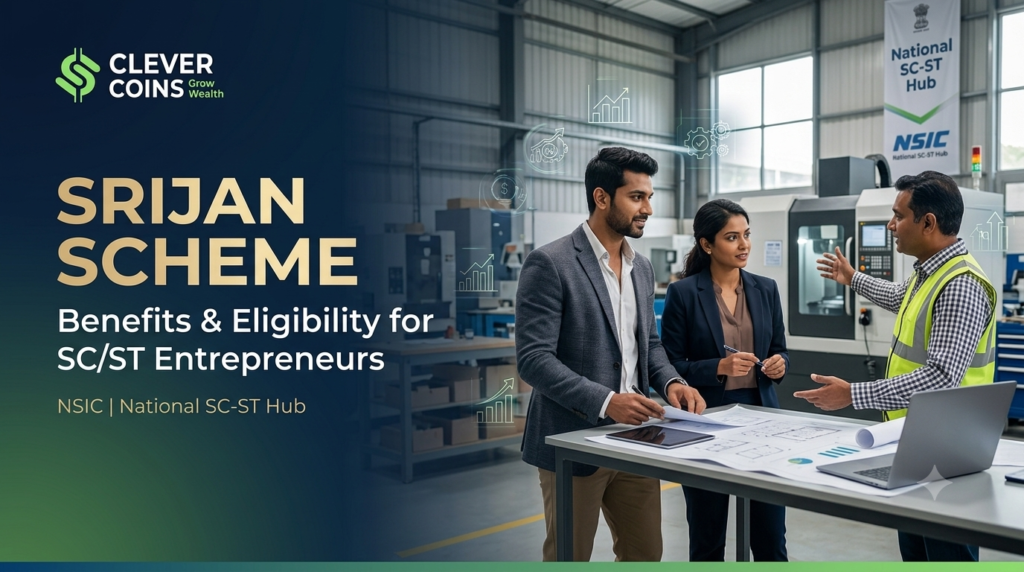
SRIJAN Scheme for SC/ST Entrepreneurs Under NSIC: Benefits & Eligibility
Introduction
Starting a business is an exciting journey, but building a successful enterprise requires more than just a business idea. Entrepreneurs need financial resources, technical knowledge, market access, business registration, professional guidance and opportunities to connect with potential customers.
For entrepreneurs belonging to Scheduled Castes (SC) and Scheduled Tribes (ST), accessing these resources can sometimes be particularly challenging. Limited access to business networks, financial assistance, technology and government procurement opportunities can create barriers to business growth.
To address these challenges and encourage entrepreneurship among historically underserved communities, the Government of India has introduced several initiatives supporting SC/ST entrepreneurs.
One of the most important initiatives in this area is the National Scheduled Caste and Scheduled Tribe Hub (NSSH) Scheme, implemented by the National Small Industries Corporation (NSIC) under the Ministry of Micro, Small and Medium Enterprises (MSME).
Entrepreneurs searching for the SRIJAN Scheme for SC/ST Entrepreneurs should understand this distinction: NSSH is the officially documented NSIC initiative. It provides a support ecosystem designed to help SC/ST-owned Micro and Small Enterprises improve their competitiveness, access markets, participate in government procurement and strengthen their business capabilities.
The initiative offers assistance through capacity-building programmes, marketing support, vendor development programmes, technology-upgradation assistance and financial support under specified interventions.
In this comprehensive guide, we will explain the NSIC National SC-ST Hub Scheme, its objectives, benefits, eligibility requirements, application process, necessary documents and opportunities available to SC/ST entrepreneurs in India.
Whether you are planning to establish a new business or already operate an MSME, understanding these government support programmes can help you identify opportunities for sustainable business growth.
1. What Is the SRIJAN Scheme for SC/ST Entrepreneurs?
The term SRIJAN is used in different government and development-related initiatives. However, the official NSIC scheme relevant to SC/ST business development is the National Scheduled Caste and Scheduled Tribe Hub Scheme, commonly known as NSSH.
The National SC-ST Hub was launched in October 2016 by the Government of India to promote entrepreneurship among Scheduled Caste and Scheduled Tribe communities.
The scheme is implemented by the National Small Industries Corporation Limited (NSIC), a Government of India enterprise operating under the Ministry of MSME.
Its primary objective is to develop a supportive business ecosystem for SC/ST entrepreneurs and improve their participation in the country’s Micro, Small and Medium Enterprises sector.
The initiative also supports the implementation of the Public Procurement Policy for Micro and Small Enterprises, which includes a 4% annual procurement target from SC/ST-owned MSEs within the overall government MSE procurement framework.
The scheme focuses on helping entrepreneurs overcome common business challenges through institutional support rather than simply providing financial assistance.
Key objectives of the National SC-ST Hub
The major objectives include:
- Encouraging entrepreneurship among Scheduled Caste and Scheduled Tribe communities.
- Helping existing SC/ST-owned MSMEs become more competitive.
- Supporting aspiring entrepreneurs in establishing sustainable enterprises.
- Improving access to government and public-sector procurement opportunities.
- Providing marketing assistance and business networking opportunities.
- Encouraging technology adoption and modernisation.
- Improving awareness of government schemes and business opportunities.
- Developing entrepreneurial, technical and managerial capabilities.
- Facilitating participation in exhibitions, trade fairs and vendor development programmes.
- Connecting SC/ST entrepreneurs with institutional support systems.
The overall vision is to help SC/ST-owned businesses become stronger, more competitive and better positioned to participate in India’s growing industrial and commercial ecosystem.
2. Who Is NSIC and What Is Its Role?
The National Small Industries Corporation Limited (NSIC) is a Government of India enterprise under the Ministry of MSME.
NSIC works towards supporting the development and growth of micro and small enterprises through various services and government initiatives.
Its activities include marketing assistance, registration support, credit facilitation, technology-related services, business development and other MSME support programmes.
Under the National SC-ST Hub Scheme, NSIC acts as the implementing organisation.
Its responsibilities include:
- Providing guidance to eligible SC/ST entrepreneurs.
- Conducting awareness programmes about government assistance.
- Supporting business development and capacity-building initiatives.
- Organising Special Vendor Development Programmes.
- Facilitating participation in exhibitions and marketing events.
- Helping eligible enterprises understand public procurement opportunities.
- Providing handholding assistance throughout different stages of business development.
- Connecting entrepreneurs with relevant institutions and support mechanisms.
NSIC also operates dedicated National SC-ST Hub Offices across different parts of India.
These offices provide entrepreneurs with access to information and assistance related to the scheme.
3. Major Benefits of the SRIJAN/NSIC National SC-ST Hub Scheme
The National SC-ST Hub provides several types of support to eligible SC/ST-owned enterprises.
It is important to understand that the benefits are provided through different components and interventions. Not every applicant automatically qualifies for every benefit.
The following are the major areas of assistance.
Benefit 1: Special Credit Linked Capital Subsidy Scheme (SCLCSS)
One of the significant components associated with the National SC-ST Hub is the Special Credit Linked Capital Subsidy Scheme, commonly called SCLCSS.
The scheme is designed to encourage technology upgradation among eligible SC/ST-owned Micro and Small Enterprises.
Many small businesses operate with outdated machinery, inefficient production processes and limited technological capabilities.
These limitations can affect product quality, production capacity, operational efficiency and competitiveness.
SCLCSS aims to address these challenges by providing eligible enterprises with capital subsidy assistance for purchasing qualifying plant, machinery and equipment through institutional credit.
Under the established scheme provision, eligible SC/ST MSEs in manufacturing and service sectors can receive:
- Capital subsidy of 25% of the eligible institutional-credit-linked expenditure.
- Maximum subsidy of up to ₹25 lakh, subject to applicable guidelines.
- Assistance towards eligible plant and machinery or equipment purchases.
- Support for improving production capacity and business competitiveness.
Example:
Suppose an eligible SC/ST-owned manufacturing enterprise purchases qualifying machinery worth ₹20 lakh through institutional finance.
If the entire amount is eligible under the applicable scheme guidelines, the illustrative subsidy calculation would be:
Machinery investment = ₹20,00,000
Applicable subsidy rate = 25%
Potential subsidy = ₹5,00,000
This is an illustrative calculation, not an assurance of approval. The actual eligible project cost, funding structure, exclusions and subsidy amount must be confirmed under the applicable SCLCSS guidelines.
Benefit 2: Special Marketing Assistance Scheme (SMAS)
Marketing is one of the biggest challenges faced by small businesses.
A company may manufacture excellent products but still struggle to reach customers, distributors, institutional buyers and large organisations.
The Special Marketing Assistance Scheme (SMAS) addresses this challenge by helping eligible SC/ST entrepreneurs participate in domestic and international exhibitions and trade fairs.
These events provide opportunities to showcase products and services to potential buyers.
Some important advantages include:
- Participation in domestic exhibitions.
- Opportunities to participate in international trade fairs, subject to applicable provisions.
- Better visibility for products and services.
- Opportunities to meet distributors and business partners.
- Direct interaction with potential institutional buyers.
- Improved understanding of industry trends.
- Opportunities to develop new business relationships.
- Exposure to national and international markets.
For a small manufacturing company, participating in a recognised exhibition can help generate valuable enquiries and build credibility.
However, assistance is subject to event eligibility, prior approval, applicable contribution requirements and the scheme’s reimbursement conditions.
Entrepreneurs should not assume that every exhibition expense will automatically be reimbursed.
Benefit 3: Assistance for Single Point Registration Scheme (SPRS)
Government departments and public-sector organisations regularly purchase products and services from eligible MSMEs.
However, new businesses may find it difficult to understand the registration and procurement procedures.
NSIC’s Single Point Registration Scheme (SPRS) is designed to facilitate the participation of eligible Micro and Small Enterprises in government purchasing.
Under the relevant National SC-ST Hub interventions, financial assistance is available for specified registration-related expenses for eligible SC/ST enterprises.
Registration under SPRS can help eligible MSEs access procurement-related opportunities and applicable benefits under the scheme.
Potential advantages include:
- Better access to government procurement opportunities.
- Greater visibility among participating government buyers.
- Support towards eligible registration expenses.
- Opportunities to participate in government purchasing processes.
- Access to applicable benefits available under the SPRS framework.
It is important to remember that registration does not guarantee a government contract.
Businesses must still meet the technical, financial, quality and tender-specific requirements of individual procurement opportunities.
Benefit 4: Support for Participation in Government Tenders
Government procurement can be an important growth opportunity for small businesses.
Ministries, government departments, public-sector enterprises and other public authorities purchase a wide range of products and services.
These may include:
- Office furniture.
- Electrical equipment.
- IT products.
- Industrial machinery.
- Packaging materials.
- Stationery.
- Uniforms and textiles.
- Maintenance services.
- Manufacturing components.
- Professional and technical services.
The Public Procurement Policy for Micro and Small Enterprises provides a framework to encourage government purchasing from MSEs.
Within the overall annual procurement target of 25% from MSEs, a 4% sub-target is prescribed for procurement from SC/ST-owned MSEs.
The National SC-ST Hub helps eligible businesses understand and access this procurement ecosystem.
The scheme facilitates awareness, vendor development and business connections.
For an SC/ST-owned enterprise, this can create opportunities to become a supplier to government organisations and public-sector companies.
Benefit 5: Special Vendor Development Programmes (SVDPs)
A business may have a good product but lack access to large institutional buyers.
Special Vendor Development Programmes help address this gap.
These programmes create opportunities for SC/ST entrepreneurs to interact with purchasing organisations, public-sector enterprises, government departments and other stakeholders.
The purpose is to develop stronger business relationships and improve supplier participation.
Entrepreneurs can benefit through:
- Direct interaction with purchasing organisations.
- Understanding the procurement requirements of buyers.
- Learning about vendor registration procedures.
- Discovering potential supply opportunities.
- Understanding quality and technical specifications.
- Networking with industry representatives.
- Learning how to improve their businesses to meet buyer expectations.
Such programmes can be especially useful for small manufacturing enterprises looking to become regular suppliers to larger organisations.
Benefit 6: Capacity-Building and Entrepreneurship Development
Running a business requires several skills beyond manufacturing or selling a product.
Entrepreneurs must understand accounting, financial planning, taxation, compliance, marketing, customer management and operational processes.
The National SC-ST Hub supports capacity-building initiatives for existing and aspiring entrepreneurs.
These programmes are designed to improve business knowledge and managerial capabilities.
Training and awareness activities may cover:
- Business planning.
- Entrepreneurial development.
- Financial management.
- Marketing strategies.
- Digital business development.
- Government procurement awareness.
- Tender participation.
- Business compliance.
- Quality management.
- Production and operational efficiency.
This support can help entrepreneurs make better business decisions and develop more sustainable enterprises.
Benefit 7: Technology Upgradation
Technology plays an important role in the growth of modern enterprises.
Businesses that continue using outdated machinery may experience higher production costs, inconsistent quality and lower productivity.
The National SC-ST Hub supports technology upgradation through relevant interventions, including SCLCSS.
Eligible enterprises may be able to improve their production infrastructure by purchasing qualifying equipment.
Examples include:
- Modern manufacturing machinery.
- Production equipment.
- Processing machinery.
- Industrial tools.
- Eligible technical equipment.
- Equipment required for improving operational efficiency.
Technology adoption can help enterprises improve product quality, increase production capacity and compete more effectively.
The actual support depends on the relevant scheme component and its eligibility requirements.
Benefit 8: Marketing and Market Linkage Opportunities
A small enterprise often needs assistance in developing a customer base.
Market linkages help entrepreneurs connect with potential buyers, industry representatives and other businesses.
The National SC-ST Hub supports this objective through exhibitions, vendor development programmes and awareness initiatives.
These opportunities can help businesses:
- Discover new markets.
- Build brand awareness.
- Meet potential customers.
- Develop distributor relationships.
- Understand customer expectations.
- Explore institutional supply opportunities.
- Improve their market positioning.
The benefits can extend beyond immediate sales because business relationships established during such events may create future opportunities.
Benefit 9: Assistance for Enrolment on Government-Promoted E-Commerce Portals
Digital commerce is increasingly important for small enterprises.
Online platforms can help businesses showcase their products and reach customers beyond their immediate geographical markets.
The National SC-ST Hub has included financial assistance for enrolment on specified government-promoted e-commerce portals among its support interventions.
Eligible enterprises may receive assistance towards applicable enrolment expenses under the relevant guidelines.
Entrepreneurs should check which portals and charges are covered before applying.
Benefit 10: Testing and Quality-Related Assistance
Product quality and certification can play an important role in winning institutional customers.
Many buyers require businesses to demonstrate that their products meet specified quality and technical standards.
Testing and quality-related expenses can create financial pressure for smaller enterprises.
Under relevant NSSH reimbursement interventions, eligible SC/ST MSEs may receive assistance towards specified testing fees charged by approved laboratories, including applicable NABL- and BIS-accredited laboratories.
Such assistance can help businesses:
- Improve product quality.
- Meet applicable technical requirements.
- Build buyer confidence.
- Prepare for institutional procurement.
- Strengthen product credibility.
The testing facility, laboratory and expense must satisfy the applicable scheme requirements.
Benefit 11: Support Towards Performance Bank Guarantee Charges
Government tenders may require bidders to submit a performance bank guarantee or other prescribed financial security.
Obtaining such guarantees can involve bank charges and additional financial commitments.
Under specified National SC-ST Hub interventions, eligible enterprises may receive assistance towards eligible bank charges for performance bank guarantees obtained for participation in government tenders.
This can help reduce certain procurement-related costs.
The assistance is subject to the applicable conditions and should not be confused with a waiver of the actual guarantee amount or the bank’s underlying financial requirements.
Benefit 12: Assistance Towards Bank Loan Processing Fees
Access to finance is important for establishing and expanding an enterprise.
Bank loan applications can involve processing charges and documentation expenses.
Certain NSSH interventions provide assistance towards eligible bank loan processing fees for qualifying SC/ST enterprises.
This support is intended to reduce specified transaction costs associated with institutional finance.
However, it does not mean that every applicant is automatically entitled to a loan or that the government guarantees loan approval.
The bank independently evaluates the borrower’s creditworthiness, project viability and repayment capacity.
Benefit 13: Export Promotion and International Market Exposure
Businesses planning to enter international markets must understand export procedures, international buyer expectations, product standards and market requirements.
Participation in suitable international exhibitions can provide exposure to overseas buyers and potential distributors.
The National SC-ST Hub’s marketing assistance framework includes support for eligible international exhibition participation, subject to the applicable rules.
Such exposure may help entrepreneurs:
- Understand international customer requirements.
- Identify overseas buyers.
- Develop export-related contacts.
- Showcase products internationally.
- Explore new business markets.
- Understand competing products and industry trends.
Export participation should be planned carefully because travel, logistics, certification and regulatory requirements may involve additional expenses.
4. Eligibility Criteria for the SRIJAN/NSIC Scheme
Eligibility is one of the most important considerations before applying for government assistance.
The National SC-ST Hub primarily focuses on supporting enterprises owned by Scheduled Caste and Scheduled Tribe entrepreneurs.
However, the eligibility conditions can differ depending on the particular benefit or intervention.
The following general requirements should be examined.
1. The applicant must belong to the Scheduled Caste or Scheduled Tribe community
The entrepreneur must provide valid documentary evidence of SC/ST status.
The relevant caste or tribe certificate should be issued by a competent government authority.
The applicant should ensure that the certificate contains accurate details and is valid for the intended application.
2. The enterprise should qualify as a Micro or Small Enterprise
The National SC-ST Hub is primarily designed to support SC/ST-owned Micro and Small Enterprises.
Businesses should have valid Udyam Registration wherever required under the relevant intervention.
The applicable MSME classification should be checked before submitting an application.
The MSME classification criteria applicable from April 2025 are:
| Enterprise category | Investment in plant and machinery/equipment | Annual turnover |
|---|---|---|
| Micro | Up to ₹2.5 crore | Up to ₹10 crore |
| Small | Up to ₹25 crore | Up to ₹100 crore |
| Medium | Up to ₹125 crore | Up to ₹500 crore |
For NSSH assistance restricted to MSEs, medium enterprises should not assume eligibility.
3. The enterprise must meet the applicable SC/ST ownership requirements
The business must satisfy the prescribed ownership and control requirements for SC/ST-owned enterprises.
For companies, partnership firms, LLPs and other non-proprietary entities, the applicable scheme guidelines should be checked to establish the required SC/ST ownership and control.
A common benchmark used in government procurement definitions is at least 51% ownership by SC/ST entrepreneurs, but the exact conditions should be verified for the particular intervention.
The applicant should not assume that having an SC/ST director or minority shareholder automatically makes the entire enterprise eligible.
4. The enterprise should be properly registered
Depending on the benefit, the applicant may need:
- Udyam Registration.
- PAN registration.
- GST registration, where applicable.
- Business constitution documents.
- Relevant statutory registrations.
- Bank account details.
Businesses should maintain accurate and updated registration information.
5. The business should have genuine commercial activities
The enterprise should carry out genuine business activities and be able to provide the required supporting evidence.
Depending on the intervention, this may include invoices, machinery quotations, purchase documents, business records and financial information.
6. The applicant must satisfy benefit-specific conditions
Different interventions have different requirements.
For example:
- SCLCSS involves eligible institutional credit and qualifying machinery or equipment.
- SMAS involves participation in eligible exhibitions with the required approvals.
- SPRS support involves the relevant registration process.
- Testing assistance requires eligible testing expenses.
- Tender-related assistance requires qualifying procurement participation and supporting bank documentation.
Therefore, eligibility for one component does not automatically establish eligibility for every other component.
5. Who Can Apply for the National SC-ST Hub Scheme?
The scheme is relevant to different types of SC/ST-owned enterprises.
Some examples include:
Manufacturing businesses
Manufacturers of industrial products, electrical equipment, furniture, garments, packaging materials, engineering components and other goods may explore relevant support opportunities.
Service-based enterprises
Eligible service businesses may explore capacity-building, marketing, procurement and other applicable interventions.
Technology-based businesses
Entrepreneurs involved in technology, equipment, digital solutions and eligible technical services can explore relevant support programmes.
Existing MSME owners
Business owners who already operate a registered micro or small enterprise may benefit from technology, marketing and procurement-related assistance.
Aspiring entrepreneurs
Individuals planning to establish a business can participate in relevant awareness and entrepreneurship development activities.
However, an aspiring entrepreneur without an operational and registered enterprise should understand that certain reimbursements and capital subsidy components require an existing eligible business and supporting transaction documents.
6. Documents Required to Apply
Preparing the necessary documents in advance can make the application process easier.
The exact list depends on the particular assistance being requested.
Commonly relevant documents include:
| Document | Purpose |
|---|---|
| Aadhaar Card | Identity verification |
| PAN Card | Tax and financial identification |
| SC/ST Certificate | Proof of community eligibility |
| Udyam Registration Certificate | MSME identification |
| GST Registration Certificate | GST details, where applicable |
| Business PAN | Enterprise identification |
| Certificate of Incorporation | Company registration proof |
| Partnership Deed | Partnership constitution |
| LLP Agreement | LLP constitution |
| Shareholding details | Ownership verification |
| Bank Account Details | Payment and financial verification |
| Cancelled Cheque | Bank account confirmation |
| Business Address Proof | Enterprise address verification |
| Machinery Quotations | Capital subsidy-related applications |
| Loan Sanction Letter | Institutional finance evidence |
| Purchase Invoices | Expense verification |
| Payment Receipts | Proof of eligible expenditure |
| Exhibition Registration | Marketing assistance applications |
| Testing Reports and Bills | Testing assistance applications |
| Tender Documents | Procurement-related assistance |
| Bank Guarantee Charges | Relevant reimbursement claims |
Applicants should prepare clear scanned copies and ensure that the information matches across documents.
For example, the enterprise name on the Udyam certificate, PAN, bank account and business constitution documents should be consistent.
7. How to Apply for the SRIJAN/NSIC SC-ST Hub Scheme?
Entrepreneurs interested in obtaining assistance should first identify the specific component under which they want to apply.
The application process may differ depending on whether the applicant needs capital subsidy, exhibition support, registration assistance or another benefit.
Here is a practical step-by-step approach.
Step 1: Understand the Scheme
Visit the official NSIC website and review the National SC-ST Hub information.
Official website:
https://www.nsic.co.in/Schemes/NSSH
You can also visit:
https://www.scsthub.in/
Understand the available benefits and identify the intervention relevant to your business.
Step 2: Check Your Eligibility
Verify the following:
- Whether you belong to the SC or ST community.
- Whether your enterprise meets the applicable ownership requirements.
- Whether the business qualifies as a Micro or Small Enterprise.
- Whether your Udyam Registration is valid.
- Whether the proposed expense or activity is covered by the selected intervention.
- Whether any prior approval is required.
Do not make a purchase or incur an expense solely on the assumption that it will be reimbursed later.
Step 3: Identify the Relevant Benefit
Choose the component that matches your business requirement.
For example:
- Machinery modernisation: Explore SCLCSS.
- Exhibition participation: Explore SMAS.
- Government procurement registration: Explore SPRS.
- Business development: Explore capacity-building programmes.
- Product quality: Explore eligible testing assistance.
Step 4: Prepare the Required Documents
Collect the applicable certificates, business records, invoices, quotations and other supporting documents.
Ensure that all documents are accurate and updated.
Step 5: Contact the Nearest NSIC or NSSH Office
Approach the nearest NSIC branch office or National SC-ST Hub office for guidance.
Explain your business activity and the assistance you want to obtain.
Ask for the latest application format, eligibility conditions, applicable financial limits and required supporting documents.
Step 6: Submit the Application
Submit the prescribed application and supporting documents through the officially designated process.
Depending on the component, the application may involve an online process, submission through an NSIC office or another prescribed procedure.
Always obtain an acknowledgement or application reference wherever available.
Step 7: Complete Verification
The relevant authority may examine the applicant’s eligibility, ownership structure, business registrations, expenses and supporting documents.
Additional clarification or documentation may be requested.
Step 8: Follow Up on the Application
Keep your application reference number and contact the concerned office for updates.
If the assistance involves reimbursement, maintain the original invoices, receipts, bank payment records and other proof required under the guidelines.
Step 9: Receive Approved Assistance
Once the application is approved and all relevant conditions are satisfied, assistance is processed according to the applicable scheme mechanism.
The amount, payment method and processing timeline depend on the particular intervention.
8. How Does the 4% Government Procurement Target Benefit SC/ST Entrepreneurs?
One of the most important objectives of the National SC-ST Hub is to improve the participation of SC/ST-owned MSEs in public procurement.
The Government of India has established procurement targets to encourage the purchase of goods and services from Micro and Small Enterprises.
Under the Public Procurement Policy for MSEs:
- The overall annual procurement target from MSEs is 25% of the applicable annual procurement.
- Within this target, 4% is earmarked for procurement from SC/ST-owned MSEs.
- A separate 3% sub-target is prescribed for women-owned MSEs.
The 4% target is a procurement policy objective, not a guaranteed individual business order.
For example, a government organisation may purchase machinery, furniture, computers, uniforms or industrial materials.
An eligible SC/ST-owned MSE can explore opportunities to supply these products if it meets the tender conditions.
The National SC-ST Hub supports businesses through vendor development programmes, awareness initiatives and procurement-related handholding.
How can an entrepreneur use this opportunity?
An entrepreneur should:
- Complete applicable business registrations.
- Ensure that SC/ST ownership conditions are satisfied.
- Maintain relevant product and service information.
- Explore government procurement portals.
- Identify suitable tenders.
- Understand the technical specifications.
- Prepare financial and commercial quotations.
- Complete vendor registration where required.
- Submit bids before the prescribed deadline.
- Maintain product quality and delivery standards.
For many small businesses, public procurement can become an additional sales channel alongside private customers and distributors.
9. Real-World Example: How an SC/ST Entrepreneur Can Benefit
Consider a hypothetical entrepreneur who belongs to the Scheduled Caste community and operates a small manufacturing enterprise producing industrial electrical components.
The business has been operational for several years and has valid MSME registration.
However, the entrepreneur faces three major challenges:
- Existing machinery limits production capacity.
- The business has limited access to institutional buyers.
- The company lacks visibility in larger industrial markets.
The entrepreneur explores the National SC-ST Hub.
First opportunity: Technology upgradation
The business identifies eligible machinery and explores institutional credit-linked assistance under SCLCSS.
If the investment satisfies the scheme conditions, the enterprise may qualify for the applicable capital subsidy.
This can reduce the effective cost of eligible machinery investment.
Second opportunity: Market development
The entrepreneur explores participation in an eligible exhibition through SMAS.
The exhibition provides an opportunity to meet industrial purchasers, distributors and potential business partners.
Third opportunity: Government procurement
The business explores the Single Point Registration Scheme and government procurement opportunities.
It also participates in relevant vendor development programmes to understand the requirements of potential institutional buyers.
Fourth opportunity: Business improvement
The entrepreneur participates in capacity-building programmes and learns about procurement procedures, financial management and business development.
Through these different opportunities, the enterprise can work towards improving productivity, increasing visibility and developing new sales channels.
This example is illustrative. Actual benefits depend on the enterprise’s eligibility and the approval of each relevant application.
10. Important Things to Remember Before Applying
Although the National SC-ST Hub offers useful opportunities, entrepreneurs should understand several important conditions.
Financial assistance is not automatically guaranteed
Submitting an application does not mean that the requested benefit will necessarily be approved.
The relevant authority verifies the applicant’s eligibility and compliance with the applicable guidelines.
Not every expense is eligible
Only expenses specifically covered under the relevant scheme component can be considered.
For example, a general machinery purchase should not automatically be treated as eligible for capital subsidy.
Prior approval may be necessary
Some activities, particularly exhibition participation and reimbursement-based assistance, may require prior approval.
Always check the applicable procedure before making a payment.
A subsidy is different from a loan
A subsidy is financial assistance provided under specified conditions.
A loan is a repayable financial facility.
A credit-linked subsidy does not mean that the government is providing the entire machinery investment as a free grant.
Government contracts are not guaranteed
The 4% procurement target is a policy target.
Businesses must independently qualify for tenders and satisfy the requirements of purchasing organisations.
Eligibility requirements may change
Government programmes can be revised through updated guidelines, circulars and notifications.
Entrepreneurs should consult NSIC and the official scheme portal before applying.
11. Other Government Schemes SC/ST Entrepreneurs Should Know About
The National SC-ST Hub is not the only initiative that can support SC/ST entrepreneurs.
Depending on the entrepreneur’s business model, financial requirements and eligibility, other government programmes may also be relevant.
A. Stand-Up India Scheme
Stand-Up India was designed to facilitate bank loans for SC/ST and women entrepreneurs setting up greenfield enterprises.
Its established framework provided composite loans between ₹10 lakh and ₹1 crore for eligible new enterprises in manufacturing, services, trading and activities allied to agriculture.
Entrepreneurs should check the current status, continuation arrangements and lending provisions before applying.
Official information: https://www.standupmitra.in/
B. Venture Capital Fund for Scheduled Castes
The Venture Capital Fund for Scheduled Castes supports eligible SC-owned enterprises with growth and expansion potential.
It is particularly relevant to businesses that require larger-scale financing and have viable commercial growth plans.
The programme is managed through IFCI Venture Capital Funds Limited.
Official information: https://www.ifciventure.com/
C. Pradhan Mantri MUDRA Yojana
The Pradhan Mantri MUDRA Yojana supports eligible micro and small business activities through lending institutions.
It provides access to business loans under applicable lending categories.
Entrepreneurs can explore it for eligible business requirements, subject to the current lending framework.
Official information: https://www.mudra.org.in/
D. Prime Minister’s Employment Generation Programme (PMEGP)
PMEGP is a credit-linked subsidy programme intended to encourage the establishment of new micro-enterprises.
Eligible applicants may receive margin-money subsidy support based on the applicable category, location and project conditions.
SC/ST applicants may qualify for special-category subsidy provisions.
Official information: https://www.kviconline.gov.in/pmegpeportal/
E. Credit Guarantee Scheme for Micro and Small Enterprises
The Credit Guarantee Scheme can help eligible micro and small enterprises access collateral-free or reduced-collateral credit facilities through participating lending institutions, subject to the scheme’s conditions.
Entrepreneurs should discuss applicable coverage and credit terms with their bank.
Official information: https://www.cgtmse.in/
Important: These schemes have separate eligibility requirements. Assistance under one programme does not automatically establish eligibility under another.
12. Common Mistakes SC/ST Entrepreneurs Should Avoid
Many business owners miss opportunities because of incomplete documentation or a misunderstanding of government assistance.
Avoid the following mistakes:
Mistake 1: Applying without checking eligibility
Always verify the relevant ownership, enterprise classification and activity-specific requirements.
Mistake 2: Having incomplete business documentation
Keep Udyam, PAN, GST and ownership records updated wherever applicable.
Mistake 3: Purchasing machinery without checking scheme conditions
For credit-linked subsidies, verify the approved machinery categories, institutional financing requirements and timing of application.
Mistake 4: Ignoring prior approval requirements
For exhibition participation and other reimbursement-related assistance, check whether prior approval is mandatory.
Mistake 5: Assuming registration guarantees government contracts
Registration and procurement eligibility can improve access to opportunities, but successful tendering depends on several factors.
Mistake 6: Not maintaining payment evidence
Keep invoices, bank statements, receipts and supporting documents for eligible expenses.
Mistake 7: Depending on unofficial agents
Use official NSIC channels and government websites to verify scheme information.
Avoid anyone promising guaranteed subsidy approval in exchange for an unofficial payment.
13. Why Business Registration and Compliance Matter
Government support programmes often require businesses to establish their legal and financial identity.
Proper registration and compliance can also improve business credibility.
Some important registrations and compliance areas include:
- Udyam Registration for MSME identification.
- PAN for tax identification.
- GST registration wherever applicable.
- Business constitution documentation.
- Bank account in the enterprise’s name.
- Relevant trade licences.
- Accounting and financial records.
- Income tax and GST compliance, as applicable.
- Ownership and shareholding records.
For entrepreneurs planning to participate in government procurement, accurate documentation is particularly important.
An enterprise should also maintain proper invoices, purchase records and financial statements.
14. How CleverCoins Can Help Entrepreneurs
Understanding government schemes is only one part of establishing and growing a business.
Entrepreneurs also need to ensure that their business structure, registration documents, tax records and statutory compliance are properly maintained.
CleverCoins provides business-related professional services that can help entrepreneurs navigate important aspects of starting and managing an enterprise.
Depending on the business’s requirements, support may include:
Business and startup registration
Choosing the appropriate business structure and completing the required registration formalities can establish a strong foundation for a new enterprise.
MSME and Udyam-related guidance
Businesses can explore the applicable MSME registration requirements and documentation.
GST registration and compliance
Businesses that meet the applicable requirements need to understand GST registration, returns and ongoing compliance.
Income tax services
Maintaining tax compliance and financial records is important for the long-term sustainability of a business.
Trademark registration
Building a recognisable brand is important for businesses entering competitive markets.
Trademark registration can help protect an eligible business name, logo or other distinctive brand element.
Government funding and scheme guidance
Entrepreneurs may also require help understanding relevant government funding opportunities, documentation requirements and application procedures.
For more information, visit:
Private Limited Company vs LLP: Which Entity Structure Saves More Tax for Tech Startups?
The purpose is to help business owners make informed decisions and manage important registration and compliance requirements as they grow.
15. Frequently Asked Questions (FAQs)
Q1. What is the SRIJAN Scheme for SC/ST Entrepreneurs?
The term SRIJAN is used by different initiatives. The officially documented NSIC programme relevant to SC/ST entrepreneurs is the National Scheduled Caste and Scheduled Tribe Hub (NSSH) Scheme, implemented under the Ministry of MSME.
It provides business development, marketing, procurement, technology and capacity-building support through different interventions.
Q2. Who implements the National SC-ST Hub Scheme?
The National SC-ST Hub Scheme is implemented by the National Small Industries Corporation Limited (NSIC) under the Ministry of Micro, Small and Medium Enterprises, Government of India.
Q3. Who is eligible for the NSIC SC/ST scheme?
The scheme primarily supports eligible SC/ST-owned Micro and Small Enterprises.
Applicants must satisfy the applicable community, ownership, enterprise classification and benefit-specific requirements.
Q4. Can a new entrepreneur apply?
Aspiring entrepreneurs can explore awareness and entrepreneurship development programmes.
However, specific financial assistance and reimbursement benefits may require an established and registered enterprise.
Q5. Is there a subsidy for purchasing machinery?
Eligible SC/ST-owned MSEs may explore the Special Credit Linked Capital Subsidy Scheme (SCLCSS).
The established provision includes a 25% subsidy, subject to a maximum of ₹25 lakh, for eligible plant and machinery or equipment purchased through institutional credit.
All applicable conditions must be satisfied.
Q6. Does the scheme provide free business loans?
The National SC-ST Hub should not be understood as a universal free-loan programme.
It provides several support interventions, some of which involve reimbursements or subsidies. Separate bank-financing schemes may also be available.
Q7. Can SC/ST entrepreneurs participate in government tenders?
Yes. Eligible SC/ST-owned MSEs can explore government procurement opportunities and the applicable procurement policy framework.
The National SC-ST Hub provides awareness, vendor development and handholding support.
Q8. What is the 4% procurement target?
Under the Public Procurement Policy for MSEs, a 4% annual procurement sub-target is prescribed for SC/ST-owned MSEs within the overall 25% MSE procurement target.
It is a policy target, not a guarantee of individual contracts.
Q9. Is Udyam Registration required?
Valid Udyam Registration is important for identifying an enterprise as an MSME and is required for applicable MSE benefits.
The exact documentation should be checked for the relevant intervention.
Q10. Can an SC/ST-owned service business apply?
Eligible service-sector MSEs can explore relevant NSSH support.
For example, SCLCSS includes eligible manufacturing and service-sector enterprises, subject to the applicable machinery and equipment requirements.
Q11. Can a partnership firm apply?
A partnership firm may qualify if it satisfies the applicable ownership and control conditions and other requirements of the particular scheme component.
The partnership deed and partner details may be required.
Q12. Can an existing business apply?
Yes. Existing eligible SC/ST-owned MSEs can explore relevant assistance for technology improvement, marketing, capacity building and procurement participation.
Q13. Is there any support for exhibitions?
Yes. The Special Marketing Assistance Scheme facilitates eligible SC/ST entrepreneurs’ participation in domestic and international exhibitions, subject to applicable guidelines.
Q14. Where can I apply?
Start by visiting the official NSIC National SC-ST Hub page:
https://www.nsic.co.in/Schemes/NSSH
You can also explore:
https://www.scsthub.in/
For specific application requirements, contact the nearest NSIC or NSSH office.
Q15. Can medium enterprises apply?
The National SC-ST Hub primarily targets SC/ST-owned Micro and Small Enterprises. Medium enterprises should not assume eligibility for benefits restricted to MSEs.
Q16. Is the scheme applicable across India?
The National SC-ST Hub is a Government of India initiative intended to support eligible SC/ST entrepreneurs across the country.
Q17. How long does it take to receive assistance?
Processing time depends on the relevant intervention, document verification, application volume and approval process.
Applicants should confirm current timelines with the concerned authority.
Q18. Can I apply for multiple benefits?
An enterprise may explore different applicable interventions, provided it satisfies the individual eligibility conditions and does not violate restrictions on duplicate assistance or overlapping claims.
16. Conclusion: An Opportunity for SC/ST Entrepreneurs to Build Stronger Businesses
Entrepreneurship can create opportunities for financial independence, employment generation and long-term economic development.
However, building a successful enterprise requires more than capital. Businesses also need technology, market access, institutional connections, professional guidance and the ability to compete effectively.
The National Scheduled Caste and Scheduled Tribe Hub Scheme, implemented by NSIC under the Ministry of MSME, provides an important support framework for eligible SC/ST-owned Micro and Small Enterprises.
From technology-upgradation assistance and marketing opportunities to capacity-building programmes and government procurement facilitation, the initiative addresses several practical challenges faced by small businesses.
Entrepreneurs should carefully evaluate the benefits, understand the eligibility requirements and prepare the necessary documentation before applying.
Most importantly, they should verify the latest scheme guidelines through official government channels rather than relying on outdated information or unofficial promises.
If you are an SC/ST entrepreneur planning to establish or expand your business, exploring the National SC-ST Hub and other applicable government initiatives can be a valuable step towards building a competitive and sustainable enterprise.
Related posts:
PM Surya Ghar Muft Bijli Yojana for MSME Factory Rooftop: Subsidy, Rules & Tax Benefits (2026 Co...
PM Kaushal Vikas Yojana 4.0 for MSME Employees: The Complete Guide to Free Skill Training, RPL Certi...
GST on Corporate Guarantee to Subsidiary MSME: New Valuation Rule 2025 – Complete Guide to Rule 28(2...
Procurement and Marketing Support Scheme: Reimbursement for MSME Trade Fairs – Complete Guide
National Logistics Policy Benefits for MSME Exporters: The Complete Cost Reduction Guide
Udyam Assist Platform (UAP): Complete Guide to Registration for Informal Micro Enterprises
MSME Competitive (LEAN) Scheme: How Indian Enterprises Can Claim 90% Government Support for Lean Cer...
CGTMSE Revised 2025: Collateral-Free Loan Limit Increased to ₹10 Crore for MSMEs
GST on Personal Guarantee by Director to Bank: When is 18% GST Applicable?
Coir Vikas Yojana 2025: Government Schemes for Coir MSMEs in Kerala & Tamil Nadu
Related posts:
 NSC Interest Rate 2026-27: National Savings Certificate Returns, Tax Benefits & How to Invest
 Self Reliant India (SRI) Fund: Rs 50,000 Cr Equity Infusion for MSMEs Explained
 ONDC Seller Incentive Scheme 2025: How Small Sellers Get Free Delivery Support
 MSME Competitive (LEAN) Scheme: How Indian Enterprises Can Claim 90% Government Support for Lean Certification