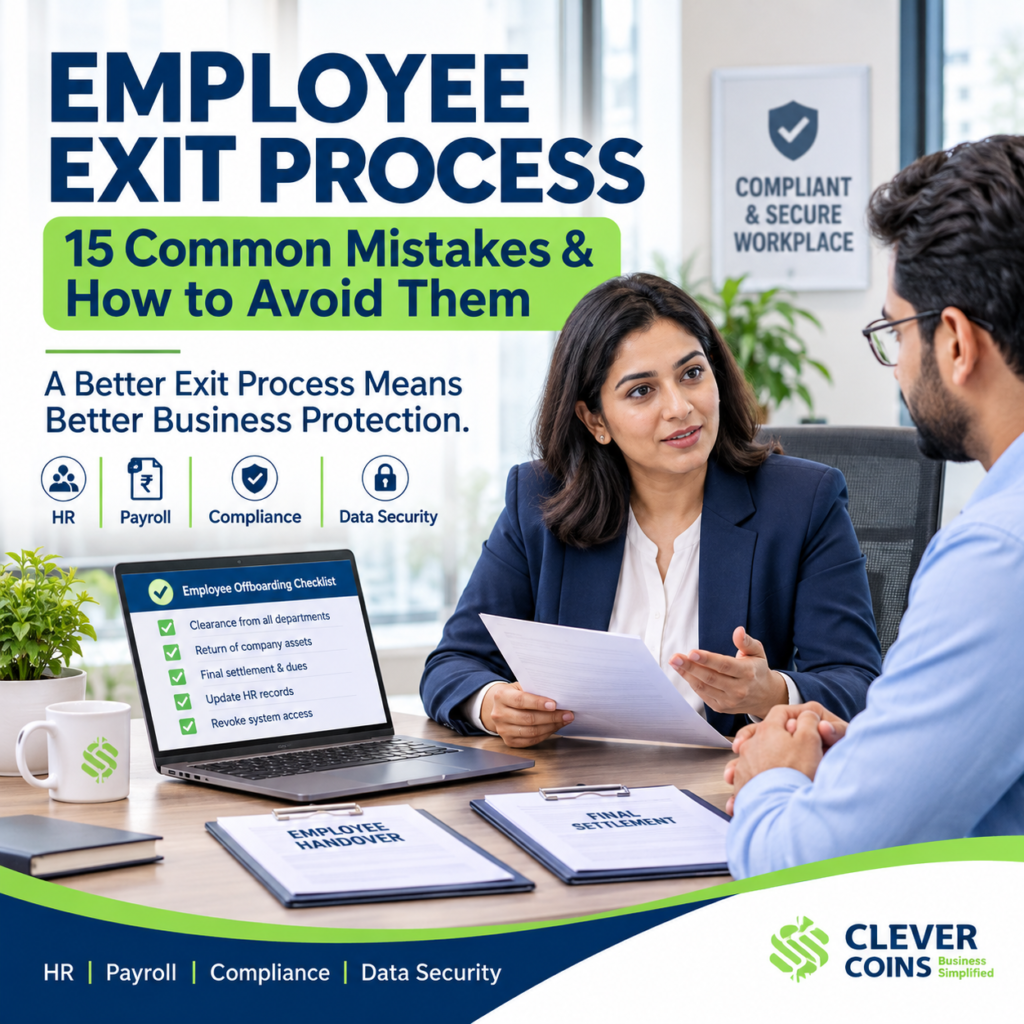
Common Mistakes in Employee Exit Process and How to Avoid Them
Introduction
Hiring the right employees is an important part of building a successful business. However, managing employees effectively also means knowing how to handle their departure professionally. Whether an employee resigns voluntarily, retires, completes a fixed-term contract, or is terminated by the employer, the way an organisation manages the departure can have a lasting impact on its operations, reputation, financial position, and legal compliance.
Many businesses invest considerable time and money in employee recruitment, onboarding, training, and development. Unfortunately, the same attention is not always given to the employee exit process. Some organisations consider employee offboarding a simple administrative formality involving the collection of company assets, cancellation of system access, and payment of outstanding salary.
This approach can create serious problems.
An improperly managed employee exit process can lead to payroll disputes, delayed settlements, missing documents, confidential data leaks, incomplete knowledge transfers, operational interruptions, and dissatisfied former employees. In some cases, businesses may even face legal complications because they fail to follow applicable employment regulations or contractual obligations.
For small and medium-sized enterprises (SMEs), these problems can be particularly challenging. Unlike large corporations with dedicated HR, legal, payroll, and IT departments, smaller businesses often depend on a limited team to manage the entire employee lifecycle.
A well-structured employee exit process helps businesses avoid these problems while ensuring that departing employees receive professional treatment and all necessary formalities are completed.
In this comprehensive guide, we will explore the most common mistakes businesses make during employee exits, why these mistakes happen, their possible consequences, and practical ways to avoid them. We will also discuss employee exit formalities, documentation, payroll considerations, compliance requirements, data security, knowledge transfer, and a practical employee offboarding checklist.
Whether you are a startup founder, business owner, HR professional, payroll manager, or SME operator, this guide will help you create a more organised and reliable employee exit process.
What Is an Employee Exit Process?
An employee exit process, also known as employee offboarding, refers to the structured procedure an organisation follows when an employee leaves the company.
It involves completing all administrative, financial, operational, legal, and security-related activities associated with an employee’s departure.
The process generally begins when an employee submits a resignation or receives formal communication regarding termination. It continues through the notice period, handover of responsibilities, clearance formalities, final settlement, and closure of employment records.
A typical employee exit process includes:
Receiving and acknowledging the resignation or communicating termination.
Confirming the employee’s last working day.
Reviewing employment agreements and notice period requirements.
Preparing a knowledge transfer and work handover plan.
Communicating the departure to relevant departments.
Collecting company-owned assets.
Removing physical and digital access permissions.
Conducting an exit interview.
Calculating outstanding salary and other eligible dues.
Completing applicable full and final settlement formalities.
Issuing relevant employment documents.
Updating payroll, HR, and statutory records.
Archiving employee documents securely.
The exact procedure depends on the organisation’s policies, employment agreements, employee category, reason for separation, and applicable laws.
An effective exit process should achieve two objectives: protect the organisation’s interests and ensure that the departing employee is treated fairly and respectfully.
Why Is a Proper Employee Exit Process Important?
Employee offboarding is not simply about completing paperwork. It is an important part of human resource management and business risk management.
Here are some reasons why organisations should establish a proper employee exit process.
1. Helps Maintain Legal and Regulatory Compliance
Employment separation involves several responsibilities relating to salary payments, statutory benefits, employment records, termination procedures, and contractual obligations.
Failure to complete these requirements correctly may expose a business to employee complaints, disputes, financial liabilities, and regulatory consequences.
A structured exit process helps HR teams identify applicable requirements and maintain supporting documentation.
2. Protects Confidential Business Information
Employees may have access to customer databases, financial records, business strategies, internal documents, software platforms, and confidential communications.
If access is not managed properly after an employee leaves, sensitive information may remain exposed.
An organised offboarding procedure ensures that access rights are reviewed, reassigned, and revoked at the appropriate time.
3. Ensures Smooth Business Operations
Employees often manage important client relationships, projects, internal processes, and operational responsibilities.
If their departure is not planned properly, other employees may struggle to continue their work.
A structured handover ensures that responsibilities are transferred before the departing employee becomes unavailable.
4. Reduces Payroll and Financial Disputes
Incorrect salary calculations, pending reimbursements, leave balances, notice period adjustments, and other settlement issues can create unnecessary disagreements.
A documented payroll closure process helps businesses calculate outstanding amounts accurately and explain the settlement to employees.
5. Protects Employer Reputation
A departing employee’s experience can influence how they speak about the organisation to former colleagues, potential candidates, customers, and professional networks.
Treating employees respectfully during their departure helps maintain a positive employer reputation.
6. Creates Opportunities for Organisational Improvement
Exit interviews can provide useful information about management practices, workplace culture, compensation, career development, and employee satisfaction.
When organisations analyse this feedback, they can identify recurring issues and improve employee retention.
For SMEs, a reliable employee exit process is therefore not just an HR activity. It is an investment in business continuity, compliance, and organisational stability.
15 Common Mistakes in Employee Exit Process and How to Avoid Them
Understanding common employee exit mistakes is the first step towards preventing them.
Let’s examine the most important mistakes organisations should avoid.
Mistake 1: Not Having a Standardised Employee Exit Policy
One of the most common mistakes businesses make is managing every employee departure differently.
For example, an organisation may complete all formalities for one employee while forgetting to collect important documents or company assets from another.
This usually happens when there is no written employee offboarding policy.
Without a standardised procedure, HR professionals may depend on memory, informal instructions, or scattered emails to manage employee exits.
Why Is This a Problem?
Important exit formalities may be missed.
Different employees may receive inconsistent treatment.
Payroll and documentation errors may occur.
Managers may not understand their responsibilities.
Compliance requirements may be overlooked.
How to Avoid It
Create a written employee exit policy that clearly explains every stage of the offboarding process.
The policy should define:
Who is responsible for accepting resignations.
How the last working day is confirmed.
What documents must be collected.
How knowledge transfer is managed.
Which departments must be informed.
How company assets are recovered.
When system access must be removed.
How outstanding payments are calculated.
Which documents must be issued.
How employee records are archived.
Use a standard employee exit checklist for every departure.
The checklist can be customised according to employee designation, department, employment type, and reason for separation.
Mistake 2: Delaying Resignation Acknowledgement
When an employee submits a resignation, some businesses fail to acknowledge it promptly.
In other situations, the employee’s manager verbally accepts the resignation but does not inform HR or payroll.
This creates confusion about the official resignation date, notice period, and final working day.
Why Is This a Problem?
A delayed acknowledgement can lead to disagreements about the notice period, pending responsibilities, payroll calculations, and employment records.
It may also create unnecessary uncertainty for the departing employee.
How to Avoid It
Establish a clear resignation acknowledgement procedure.
Whenever an employee submits a resignation:
Record the date on which the resignation was received.
Acknowledge receipt through an official email or written communication.
Review the applicable employment agreement.
Confirm the notice period requirements.
Discuss any notice period waiver or adjustment.
Communicate the proposed last working day.
Update the employee’s HR records.
Keep all resignation-related communications documented.
Verbal conversations can support the process, but important employment decisions should be confirmed in writing.
Mistake 3: Incorrectly Calculating the Notice Period
Another significant employee exit mistake is calculating the notice period incorrectly.
Different employees may have different notice requirements depending on their designation, employment agreement, company policy, and applicable employment regulations.
Some businesses assume that every employee must serve the same notice period. Others make informal adjustments without proper documentation.
Why Is This a Problem?
Incorrect notice period calculations can result in:
Disputes regarding the last working day.
Incorrect notice pay calculations.
Unauthorised salary deductions.
Delayed employee release.
Confusion regarding payroll closure.
How to Avoid It
Review the employee’s appointment letter, employment agreement, applicable company policy, and relevant legal requirements before confirming the exit date.
Maintain a record of:
Original resignation date.
Contractual notice period.
Notice period served.
Approved notice period waiver, if applicable.
Notice pay adjustment, if legally and contractually permitted.
Confirmed last working day.
Any agreement regarding early release or notice period adjustment should be documented and approved by authorised personnel.
Do not assume that a company policy automatically overrides applicable law.
Mistake 4: Ignoring Knowledge Transfer and Work Handover
Employees often possess knowledge that is not available in formal company documents.
They may understand customer requirements, vendor arrangements, internal workflows, project history, technical procedures, and important operational details.
When an employee leaves without transferring this information, the organisation may experience significant disruption.
Why Is This a Problem?
Projects may be delayed.
Customers may experience communication gaps.
Important tasks may be forgotten.
Remaining employees may struggle to understand existing processes.
The organisation may lose valuable institutional knowledge.
How to Avoid It
Prepare a detailed handover plan immediately after the employee’s departure is confirmed.
The plan should cover:
Current projects and their status.
Pending tasks and deadlines.
Customer and vendor contacts.
Important meetings and commitments.
Internal procedures and workflows.
Relevant files and document locations.
Software platforms and operational tools.
Escalation contacts.
Outstanding issues requiring attention.
Assign a responsible employee to receive and verify the handover.
Where possible, arrange knowledge transfer meetings between the departing employee and their replacement.
For important positions, ask the departing employee to prepare standard operating procedures (SOPs) for recurring activities.
A good handover process ensures that the business does not become dependent on information held by only one individual.
Mistake 5: Delaying Full and Final Settlement
Full and final settlement is one of the most sensitive stages of the employee exit process.
It generally involves calculating and settling the outstanding financial amounts payable to an employee, subject to applicable law and contractual terms.
Depending on the employee’s circumstances, the calculation may involve:
Unpaid salary.
Eligible leave encashment.
Approved reimbursements.
Eligible incentives or bonuses.
Gratuity, where applicable.
Notice pay adjustments.
Authorised deductions.
Other contractual or statutory dues.
Some organisations delay the entire settlement because one clearance form or company asset has not been submitted.
Others do not maintain an appropriate payroll closure schedule.
Why Is This a Problem?
Delayed or incorrect settlement can lead to financial hardship for former employees, complaints, legal disputes, and reputational damage.
It also creates unnecessary follow-up work for HR and finance departments.
How to Avoid It
Prepare a full and final settlement worksheet for each departing employee.
Verify the following:
Last working day.
Unpaid salary.
Attendance and leave balance.
Eligible leave encashment.
Approved expense claims.
Applicable incentives and benefits.
Gratuity eligibility and calculation, where applicable.
Notice period adjustments, where legally permitted.
Other authorised deductions.
Applicable statutory requirements.
Ensure that calculations are reviewed by the responsible payroll or finance professional.
Maintain a transparent breakdown of the settlement so that the employee can understand how the final amount was calculated.
Important India compliance consideration: The Code on Wages, 2019 became effective as part of India’s four Labour Codes from 21 November 2025. Section 17 provides for payment of wages within two working days in specified cases, including resignation, removal, dismissal, and retrenchment, subject to applicable provisions and government notifications. This requirement concerns wages payable and should not automatically be confused with every component of a complete full and final settlement. Businesses should verify the applicable rules and requirements for each payment component.
Mistake 6: Failing to Collect Company Assets
Employees may receive various company-owned assets during their employment.
These may include:
Laptops and desktop computers.
Mobile phones.
SIM cards.
Office access cards.
Identity cards.
Keys.
Company credit cards.
Storage devices.
Documents and records.
Uniforms and other equipment.
Some businesses collect only the laptop and forget other assets.
Others do not maintain proper records of the equipment issued to employees.
Why Is This a Problem?
Missing assets can create financial losses and security risks.
Unreturned devices may also contain confidential business information or customer data.
How to Avoid It
Maintain an employee asset register from the beginning of employment.
During offboarding:
Review the employee’s asset allocation record.
Prepare a list of assets to be returned.
Inspect the condition of returned equipment.
Record the return date.
Obtain an acknowledgement.
Coordinate with IT and administration for secure handling.
Document missing or damaged assets and follow the applicable policy.
Avoid making arbitrary deductions from an employee’s salary for missing or damaged assets. Any recovery must be supported by applicable law, contractual provisions, and a proper assessment.
Mistake 7: Not Revoking System and Application Access on Time
This is one of the most serious mistakes in modern employee offboarding.
Employees may have access to numerous systems, including:
Official email accounts.
Customer relationship management platforms.
Accounting software.
Cloud storage.
Internal databases.
Project management applications.
Banking or payment platforms.
HR management systems.
Virtual private networks.
Business communication tools.
Sometimes, HR informs IT about an employee’s departure only after the final working day.
In other cases, the organisation disables the email account but forgets access to other applications.
Why Is This a Problem?
Unauthorised access can expose sensitive company information, customer data, financial records, and internal business operations.
Inactive employee accounts can also become potential entry points for cyberattacks.
How to Avoid It
Create a coordinated access revocation process involving HR, IT, and information security.
Prepare a complete list of systems the employee can access.
On the employee’s departure, ensure that:
Email access is disabled or appropriately transferred.
Application permissions are removed.
VPN access is revoked.
Active sessions and authentication tokens are invalidated where appropriate.
Company devices are secured.
Shared credentials are reviewed and rotated.
Ownership of business files is transferred.
Administrative privileges are removed.
Access logs are retained according to policy.
For involuntary exits or high-risk situations, access management may need to be coordinated with the termination meeting.
The timing should be determined by the circumstances, legal requirements, and security risk.
Mistake 8: Skipping the Exit Interview
Many organisations conduct interviews when hiring employees but fail to conduct meaningful conversations when employees leave.
An exit interview is an opportunity to understand why employees decide to leave and what improvements the organisation can make.
Some businesses avoid exit interviews because they believe departing employees will not provide useful feedback.
This is a missed opportunity.
Why Is This a Problem?
The organisation may continue experiencing the same problems without understanding their underlying causes.
For example, several employees may leave because of poor management practices, unrealistic workloads, limited career opportunities, or compensation concerns.
Without collecting and analysing feedback, management may never identify these patterns.
How to Avoid It
Conduct a professional and confidential exit interview before the employee’s departure whenever practical.
Useful questions include:
What is the main reason for your decision to leave?
Were your job responsibilities clearly communicated?
How would you describe your relationship with your manager?
Did you receive sufficient support and training?
Were you satisfied with the workplace environment?
Did you have adequate opportunities for professional growth?
What changes would improve the employee experience?
Would you consider working with the organisation again?
Is there anything else you would like management to know?
Do not treat the exit interview as an argument or an opportunity to defend management decisions.
Focus on understanding feedback and identifying improvements.
Mistake 9: Poor Communication With Internal Teams
Employee departures can affect multiple departments.
HR, finance, payroll, IT, administration, reporting managers, and senior management may all need to take specific actions.
However, businesses sometimes communicate employee exits informally or at the last moment.
Why Is This a Problem?
Payroll may continue processing salary incorrectly.
IT may not remove access on time.
Finance may fail to transfer approval responsibilities.
Customers may continue contacting the departing employee.
Managers may not have enough time to redistribute work.
How to Avoid It
Create a standard employee exit communication workflow.
Notify the relevant departments once the resignation or termination is formally confirmed, while maintaining appropriate confidentiality.
The communication should include:
Employee name and identification within authorised internal records.
Department and designation.
Confirmed last working day.
Knowledge transfer requirements.
Asset recovery responsibilities.
Access removal schedule.
Payroll closure requirements.
Any special transition instructions.
Share only information that each department needs to perform its responsibilities.
Mistake 10: Mishandling Employee Documents and Records
Employee documentation is an essential part of the exit process.
Businesses sometimes fail to maintain complete records of resignations, termination letters, clearance forms, settlement statements, and other important documents.
In some cases, documents are stored in personal email accounts, local computers, or unorganised folders.
Why Is This a Problem?
Missing records can make it difficult to respond to employee queries, verify employment history, resolve disputes, or demonstrate compliance.
Poor record handling may also create privacy and confidentiality concerns.
How to Avoid It
Maintain a secure and organised employee record management system.
Depending on the circumstances, the exit file may include:
Appointment letter or employment agreement.
Resignation letter or termination communication.
Resignation acknowledgement.
Notice period confirmation.
Handover documents.
Asset return acknowledgement.
Exit interview record.
Final settlement statement.
Payment records.
Relieving letter.
Experience certificate, where applicable.
Other relevant statutory or employment documents.
Restrict access to authorised personnel and follow applicable record-retention and data protection requirements.
Mistake 11: Delaying Relieving Letters and Experience Certificates
Relieving letters and experience certificates are important employment documents for many departing employees.
A relieving letter generally confirms that an employee has been formally released from their duties, while an experience certificate provides information about their employment period and role.
Some organisations delay these documents without a clear reason or fail to communicate when they will be issued.
Why Is This a Problem?
Employees may need these documents when joining another employer, completing background verification, or maintaining their professional records.
Unnecessary delays can damage the relationship between the employee and the organisation.
How to Avoid It
Establish a clear document issuance procedure.
Before issuing documents, verify the employee’s employment records and complete the applicable formalities.
Prepare standard templates for:
Relieving letters.
Experience certificates.
Employment confirmation letters.
Other applicable separation documents.
Ensure that the information is accurate and consistent with the organisation’s records.
Communicate the expected issuance timeline to the departing employee.
Do not use document withholding as an arbitrary punishment for unrelated disputes.
Mistake 12: Ignoring Employee Privacy and Data Protection
During offboarding, businesses handle sensitive information such as salary records, personal contact details, bank information, identity documents, and employment history.
Some organisations fail to apply appropriate privacy controls when transferring, sharing, or storing these records.
Why Is This a Problem?
Unauthorised disclosure of employee information can create privacy complaints, reputational damage, and potential legal consequences.
How to Avoid It
Apply privacy and security controls throughout the exit process.
Share employee information only with authorised personnel.
Use secure systems for document storage.
Avoid sending sensitive records through unsecured channels.
Restrict access to settlement and personal information.
Follow applicable data retention and deletion requirements.
Securely dispose of records when legally permitted.
Document authorised data transfers.
Employee privacy responsibilities do not end when employment ends.
Mistake 13: Treating Every Employee Exit in the Same Way
Not every employee departure is identical.
A voluntary resignation, retirement, redundancy, termination for misconduct, fixed-term contract completion, and immediate separation may require different procedures.
However, some organisations use the same checklist and communication approach for every situation.
Why Is This a Problem?
The organisation may overlook specific legal, contractual, operational, or security requirements.
For example, a high-risk involuntary termination may require immediate coordination between HR, IT, management, and legal advisers.
A planned retirement may require a different transition and benefits process.
How to Avoid It
Develop separate exit workflows for different separation scenarios.
These may include:
Voluntary resignation.
Employer-initiated termination.
Retirement.
Fixed-term contract completion.
Redundancy or retrenchment.
Mutual separation.
Death or other exceptional circumstances.
Use a common core checklist while adding specific requirements according to the type of departure.
Mistake 14: Failing to Update Payroll and Statutory Records
Employee departure must be reflected accurately in payroll and relevant statutory records.
Some organisations complete the exit interview and collect company assets but forget to update payroll systems, benefits records, or applicable statutory information.
Why Is This a Problem?
Incorrect salary payments may continue.
Benefits may remain active unnecessarily.
Employee records may become inconsistent.
Applicable statutory filings may contain errors.
Future employment verification may become difficult.
How to Avoid It
Coordinate the employee’s departure with payroll and compliance professionals.
Review relevant requirements relating to:
Provident Fund records and processes.
Employee State Insurance, where applicable.
Professional tax.
Tax deduction and reporting.
Gratuity, where applicable.
Leave balances.
Payroll closure.
Benefits and insurance.
Other applicable employment-related records.
Verify the specific requirements applicable to the establishment and employee category.
Do not assume that updating the internal HR software automatically completes all statutory formalities.
Mistake 15: Not Analysing Employee Exit Data
Many organisations collect resignation letters and complete exit formalities without analysing why employees leave.
As a result, valuable information remains unused.
For example, if multiple employees from the same department resign within a short period, it may indicate workload problems, management challenges, or limited career opportunities.
Why Is This a Problem?
Businesses may continue losing employees for the same reasons.
This can increase recruitment costs, training expenses, productivity losses, and operational pressure.
How to Avoid It
Maintain an employee exit analysis report.
Track important indicators such as:
Employee turnover rate.
Voluntary resignation rate.
Involuntary separation rate.
Department-wise exits.
Average employee tenure.
Common reasons for resignation.
Exit interview feedback.
Recruitment replacement time.
Cost of employee replacement.
Review the data periodically and identify recurring trends.
Use these insights to improve recruitment, compensation, management practices, workplace culture, and employee engagement.
Important Employee Exit Compliance Considerations in India
Businesses operating in India should pay particular attention to employment-related compliance when managing employee exits.
India’s four Labour Codes were brought into effect from 21 November 2025:
Code on Wages, 2019.
Industrial Relations Code, 2020.
Code on Social Security, 2020.
Occupational Safety, Health and Working Conditions Code, 2020.
These codes rationalised 29 existing labour laws and introduced an updated framework for several employment-related matters.
Businesses should review the provisions applicable to their establishment and employee categories rather than relying entirely on outdated HR practices.
Some important areas to review include:
1. Payment of Outstanding Wages
Section 17 of the Code on Wages, 2019 addresses the time limit for payment of wages.
For specified separation situations, including resignation, removal, dismissal, and retrenchment, the provision requires wages payable to be paid within two working days, subject to the applicable statutory framework and government notifications.
HR and payroll teams should distinguish outstanding wages from other components of full and final settlement.
2. Gratuity
Gratuity eligibility and calculation should be assessed under the applicable provisions of the Code on Social Security, 2020.
Businesses should review the employee’s service period, employment category, applicable wage definition, and statutory eligibility conditions.
Special circumstances, including fixed-term employment and other qualifying events, may require specific consideration.
3. Provident Fund
Organisations should review applicable EPF obligations and employee records during separation.
Relevant procedures may include updating employment information, ensuring accurate contribution records, and assisting employees with applicable transfer or withdrawal processes.
4. Employee State Insurance
Where applicable, organisations should ensure that employee separation is correctly reflected in relevant ESIC records and administrative processes.
5. Notice Period and Termination Requirements
Employers should review employment agreements, applicable standing orders, industrial relations requirements, state-specific rules, and relevant protections before implementing termination or separation decisions.
6. Leave Encashment
Leave encashment should be calculated according to the applicable legal provisions, employment conditions, and company policy.
7. Employment Documentation
Maintain accurate records of resignation, termination, payments, clearances, and other relevant separation documents.
Important: Labour compliance can vary according to the nature of the establishment, employee classification, applicable government rules, and state-specific requirements. The above information is a general business guide, not a substitute for legal advice. Businesses should obtain professional guidance before implementing employment separation policies.
Step-by-Step Employee Exit Process: A Practical Guide for SMEs
Now that we have discussed common employee exit mistakes, let’s understand how SMEs can implement a structured offboarding procedure.
Step 1: Receive and Record the Resignation
Receive the employee’s resignation through an official communication channel.
Record the date of receipt and acknowledge it in writing.
For employer-initiated separation, prepare the required formal communication after reviewing the applicable legal and contractual requirements.
Step 2: Confirm the Last Working Day
Review the employment agreement, notice period, and any approved adjustments.
Communicate the confirmed final working day to the employee and relevant internal departments.
Step 3: Assign an Offboarding Coordinator
Assign an HR representative or authorised person to manage the exit process.
This individual should coordinate activities between HR, finance, IT, administration, and the employee’s reporting manager.
Step 4: Prepare a Handover Plan
Work with the reporting manager to identify pending assignments, customer relationships, important deadlines, and responsibilities.
Assign a receiving employee and create a documented handover schedule.
Step 5: Initiate Asset Recovery
Review the asset register and communicate the return requirements to the departing employee.
Arrange inspection and acknowledgement of all returned company property.
Step 6: Coordinate IT Access Removal
Inform IT and security teams about the confirmed departure.
Prepare a complete access removal schedule based on the employee’s role and separation circumstances.
Ensure that all accounts, devices, permissions, and business data are appropriately secured.
Step 7: Conduct the Exit Interview
Arrange a professional exit conversation.
Ask relevant questions, document useful feedback, and maintain appropriate confidentiality.
Step 8: Calculate Full and Final Settlement
Coordinate with payroll and finance to calculate all eligible outstanding amounts.
Verify salary, leave balances, reimbursements, applicable benefits, authorised deductions, and statutory obligations.
Step 9: Complete Employment Documentation
Prepare the required relieving letter, experience certificate, settlement statement, and other relevant documents.
Verify their accuracy before issuance.
Step 10: Close HR and Compliance Records
Update the employee’s status in HR and payroll systems.
Complete applicable statutory processes and archive the employee’s records securely.
Step 11: Communicate the Departure Professionally
Inform relevant colleagues and stakeholders about the employee’s departure.
Transfer customer relationships and responsibilities to the appropriate replacement or team member.
Step 12: Conduct a Final Offboarding Review
The HR coordinator should verify that every assigned activity has been completed.
Document any outstanding items, approvals, or exceptions.
This final review ensures that the employee exit process is properly closed.
Employee Exit Checklist for SMEs
A standard checklist helps ensure that important activities are not overlooked.
HR Department Checklist
Receive resignation or issue formal separation communication.
Acknowledge resignation.
Verify employment agreement.
Confirm last working day.
Communicate notice period requirements.
Schedule exit interview.
Prepare required employment documents.
Update employee records.
Coordinate final settlement.
Issue applicable relieving and experience documents.
Archive the employee file.
Reporting Manager Checklist
Identify pending projects.
Prepare a handover schedule.
Assign responsibilities to other team members.
Transfer customer and vendor relationships.
Review outstanding work.
Collect relevant process documentation.
Confirm successful knowledge transfer.
Inform relevant stakeholders.
IT Department Checklist
Identify all active accounts.
Review application permissions.
Disable access at the appropriate time.
Revoke VPN and remote access.
Secure company devices.
Transfer business file ownership.
Recover company-owned equipment.
Review shared credentials.
Retain relevant security records.
Finance and Payroll Checklist
Verify unpaid salary.
Check attendance records.
Calculate eligible leave encashment.
Verify expense reimbursements.
Review incentives and benefits.
Calculate eligible gratuity.
Verify authorised deductions.
Process applicable statutory requirements.
Prepare settlement statement.
Maintain payment evidence.
Administration Checklist
Collect identity cards.
Recover keys and access cards.
Collect office equipment.
Update building access records.
Recover company documents.
Update internal directories.
Close applicable administrative facilities.
Best Practices to Improve the Employee Exit Process
Avoiding mistakes is important, but businesses should also focus on building a more efficient and employee-friendly offboarding system.
1. Use a Centralised Offboarding Tracker
Maintain a centralised record of all employee exit activities.
A spreadsheet, HRMS platform, or workflow management tool can be used to assign responsibilities and track completion.
Each task should have:
A responsible person.
A due date.
A completion status.
Supporting documentation.
An approval requirement, where applicable.
2. Establish Clear Departmental Responsibilities
HR should not be expected to complete every offboarding activity independently.
Create a responsibility matrix that explains what HR, finance, IT, administration, and reporting managers must do.
3. Automate Repetitive Activities
Businesses can use HR management software to automate resignation acknowledgements, checklist creation, departmental notifications, asset recovery reminders, and document generation.
Automation reduces manual follow-ups and improves consistency.
However, automated workflows should always include appropriate human review for sensitive decisions.
4. Maintain Accurate Employee Records
Employee exit processes become easier when organisations maintain accurate records throughout employment.
Keep updated appointment letters, salary details, asset records, leave balances, and employment information.
5. Maintain Professional Communication
Employees should understand what will happen after submitting their resignation or receiving a separation notice.
Provide clear information regarding the notice period, handover, final settlement, documents, and contact details for questions.
6. Review Offboarding Performance Regularly
Analyse completed employee exits to identify recurring mistakes.
Review the time taken to complete exit formalities, outstanding payments, asset recovery, access revocation, and employee feedback.
Use these findings to improve the process.
7. Train HR and Management Teams
Ensure that managers and HR representatives understand their responsibilities.
Periodic training can help reduce inconsistent practices and improve compliance awareness.
How Poor Employee Exit Management Affects Small and Medium-Sized Businesses
Large organisations may have specialised teams to manage employee exits. SMEs often have fewer resources and depend on employees handling multiple responsibilities.
This makes a structured exit process particularly important.
Consider a small business with 20 employees.
One employee manages customer relationships, another handles accounting, and another supervises important operational activities.
If any of these employees leaves without a proper handover, the organisation may experience immediate difficulties.
Poor offboarding can affect SMEs in several ways.
Financial Impact
Missing assets, incorrect settlements, delayed payroll closure, and unnecessary disputes can increase business costs.
Operational Impact
Incomplete handovers can delay customer projects, interrupt services, and increase pressure on remaining employees.
Compliance Impact
Missing documentation and incorrect payment calculations can create avoidable employment-related risks.
Security Impact
Unrevoked access can expose confidential company information and digital systems.
Reputational Impact
An employee who feels unfairly treated may share a negative experience with professional contacts or potential candidates.
For SMEs, preventing these problems is often more economical than resolving them after they occur.
Practical Example: How an SME Can Improve Its Employee Exit Process
Consider a hypothetical company called ABC Solutions, which has 35 employees.
One of its senior operations executives submits a resignation with a notice period of 30 days.
Initially, the company follows an informal exit process.
HR acknowledges the resignation but does not notify IT and finance immediately.
The reporting manager assumes that the employee will transfer all responsibilities during the final week.
On the last working day, the organisation discovers that several customer files are stored in the employee’s personal work folders, two application accounts are still active, and an important vendor relationship has not been transferred.
Finance also discovers that the employee’s pending reimbursements have not been verified.
The result is operational confusion, additional workload, and unnecessary follow-ups.
Now consider how the same company could manage the departure using a structured process.
First week:
HR acknowledges the resignation.
The last working day is confirmed.
The offboarding checklist is activated.
The reporting manager identifies key responsibilities.
IT prepares an application and access inventory.
Second week:
The employee documents ongoing projects.
Customer and vendor contacts are identified.
The replacement team member begins shadowing important activities.
Finance reviews pending reimbursements and payroll information.
Third week:
Knowledge transfer meetings are completed.
Company assets are verified.
HR conducts an exit interview.
IT confirms the access revocation plan.
Final week:
The manager verifies the handover.
Administration coordinates asset return.
Payroll completes the applicable calculations.
HR prepares the required employment documents.
IT removes access at the appropriate separation time.
HR completes the final review.
The result is a more organised departure with fewer operational disruptions.
This example demonstrates why planning should begin as soon as an employee’s departure is confirmed rather than waiting until the final working day.
Frequently Asked Questions About Employee Exit Process
1. What is an employee exit process?
An employee exit process is the structured procedure an organisation follows when an employee leaves. It includes resignation or termination documentation, handover, asset recovery, access removal, exit interviews, payroll settlement, and closure of employment records.
2. What are the most common employee exit mistakes?
Common mistakes include delayed final settlement, incomplete documentation, incorrect notice period calculations, poor knowledge transfer, failure to revoke system access, missing company assets, skipped exit interviews, and non-compliance with applicable employment requirements.
3. Is an employee exit checklist necessary for SMEs?
Yes. An employee exit checklist helps SMEs manage employee departures consistently. It ensures that HR, finance, IT, administration, and reporting managers complete their assigned responsibilities.
4. What documents are required during employee offboarding?
Depending on the circumstances, documents may include a resignation letter, resignation acknowledgement, termination letter, handover report, clearance form, asset return acknowledgement, final settlement statement, payment records, relieving letter, and experience certificate.
5. What is full and final settlement?
Full and final settlement refers to the calculation and payment of outstanding amounts payable to an employee when employment ends. It may include unpaid salary, eligible leave encashment, approved reimbursements, eligible incentives, gratuity, and other applicable dues, subject to authorised deductions.
6. When should company system access be revoked?
Access should be removed according to the confirmed separation time and security requirements. For high-risk involuntary exits, IT and HR may need to coordinate access removal with the separation meeting. For planned resignations, access should remain appropriately controlled until the authorised end of employment.
7. Why is an exit interview important?
An exit interview helps organisations understand why employees leave and identify possible improvements in management, compensation, workplace culture, communication, and career development.
8. Can an employer withhold an employee’s final settlement?
Employers should not arbitrarily withhold amounts that are legally payable. Any deductions, adjustments, or recoveries must have a valid basis under applicable law and contractual conditions. The payment of wages and other settlement components may also be governed by different requirements.
9. What is the difference between an exit interview and an exit clearance?
An exit interview is a conversation used to collect feedback from a departing employee. Exit clearance is an administrative verification process involving the return of company property, completion of handover responsibilities, and other applicable formalities.
10. How can employee offboarding be automated?
Businesses can use HRMS platforms, payroll systems, digital checklists, and workflow automation tools to manage notifications, task assignments, document generation, asset tracking, and departmental approvals.
11. Does every employee need to serve a notice period?
Notice period requirements depend on the applicable employment agreement, company policy, employee category, and relevant employment laws. Employers should review these requirements before confirming an employee’s last working day.
12. What happens if an employee does not complete the handover?
The organisation should document pending responsibilities, review the applicable employment terms, and take reasonable steps to protect business continuity. Any action involving withheld payments or recovery must comply with applicable law.
13. How should an SME manage employee exits without a dedicated HR department?
SMEs can designate an authorised employee or manager as the offboarding coordinator. A centralised checklist, standard document templates, and coordination with payroll, IT, and professional compliance advisers can make the process manageable.
14. Why should employee exit records be maintained?
Exit records help organisations respond to future employment verification requests, resolve payment disputes, demonstrate compliance, maintain accurate payroll information, and support internal audits.
15. Can a former employee return to the organisation?
Yes. Some organisations maintain positive relationships with former employees and consider rehiring them when suitable opportunities arise. A professional offboarding experience can help preserve these relationships.
Conclusion: Make Employee Offboarding a Structured Business Process
An employee’s departure is a normal part of business operations. However, the way an organisation manages that departure can significantly influence its financial position, operational continuity, legal compliance, data security, and employer reputation.
Common mistakes such as delayed full and final settlement, incomplete handovers, missing documentation, unrevoked system access, and poor communication can create unnecessary complications for businesses.
The solution is to establish a structured employee exit process that defines responsibilities, maintains accurate records, protects confidential information, and treats departing employees professionally.
For small and medium-sized businesses, even a simple standardised checklist can make a significant difference.
Remember that a successful employee exit is not just about completing formalities. It is about closing the employment relationship responsibly while protecting the organisation and respecting the contribution of the individual.
Businesses that invest in better employee offboarding practices are better positioned to reduce administrative errors, improve compliance management, protect business information, and maintain positive professional relationships.
A professional employee exit process reflects the quality of an organisation just as much as its hiring and onboarding practices.
Need Professional Guidance for Your Business?
Managing employee exits involves several HR, payroll, documentation, and regulatory considerations. Businesses should ensure that their employee separation procedures are aligned with applicable employment requirements.
At CleverCoins, we believe that better compliance management and organised business practices help businesses build a stronger foundation for growth.
If your business needs assistance understanding its compliance responsibilities, payroll-related requirements, or business documentation, connect with the CleverCoins team.