Understanding Tax Planning for FY 2025-26: Expert Tips to Maximize Your Wealth
Every financial year brings a fresh opportunity to optimize your hard-earned income, align your investments with long-term goals, and legally minimize your tax outflow. However, tax planning for FY 2025-26 (Assessment Year 2026-27) is unlike any previous year in recent Indian financial history. Following the landmark structural overhauls introduced in the Union Budget 2025, the rules governing how salaried professionals, freelancers, senior citizens, and business owners calculate their liabilities have shifted dramatically.
With the tax-free income threshold under the New Tax Regime surging to ₹12 lakh—and effectively ₹12.75 lakh for salaried employees after accounting for the ₹75,000 standard deduction—millions of taxpayers are asking a critical question: Is traditional tax-saving investment dead, or does the Old Tax Regime still hold hidden value?
At CleverCoins, we believe that true tax planning is never a frantic, last-minute exercise undertaken in March to buy random insurance policies or lock funds into low-yield instruments. Instead, it is a disciplined, year-round financial architecture that balances liquidity, compounding wealth, and airtight statutory compliance. Whether you are navigating the revamped income tax slabs, evaluating Section 87A marginal relief, harvesting capital gains, or restructuring your salary components, this comprehensive guide breaks down every nuance of tax planning for FY 2025-26 with actionable expert strategies.
1. What Changed in FY 2025-26? Key Highlights You Must Know
Before selecting investments or declaring your regime choice to your employer, you must understand the foundational regulatory landscape for Financial Year 2025-26 (April 1, 2025, to March 31, 2026).
A. Revised Income Tax Slabs Under the New Tax Regime (Section 115BAC)
The government made the New Tax Regime significantly more attractive by widening tax brackets and lowering intermediate rates. Under Section 115BAC, the default tax structure for FY 2025-26 operates across seven distinct slabs:
| Annual Taxable Income Slab (FY 2025-26) | Applicable Tax Rate |
| Up to ₹4,00,000 | Nil (0%) |
| ₹4,00,001 to ₹8,00,000 | 5% |
| ₹8,00,001 to ₹12,00,000 | 10% |
| ₹12,00,001 to ₹16,00,000 | 15% |
| ₹16,00,001 to ₹20,00,000 | 20% |
| ₹20,00,001 to ₹24,00,000 | 25% |
| Above ₹24,00,000 | 30% |
B. The Enhanced Section 87A Rebate: Zero Tax Up to ₹12 Lakh (₹12.75 Lakh for Salaried)
The single biggest headline for FY 2025-26 is the expansion of the Section 87A tax rebate under the New Tax Regime from ₹25,000 to ₹60,000.
How the math works: If your net taxable income is ₹12,00,000, your gross slab tax is ₹20,000 (on ₹4L–₹8L at 5%) + ₹40,000 (on ₹8L–₹12L at 10%) = ₹60,000. Because the Section 87A rebate covers up to ₹60,000, your final income tax liability drops to zero.
Salaried advantage: Salaried individuals and pensioners continue to enjoy a ₹75,000 Standard Deduction under the New Regime. Consequently, a salaried employee earning up to ₹12,75,000 in gross annual salary pays zero income tax without needing to lock a single rupee into Section 80C instruments.
Crucial caveat on special rate income: The Section 87A rebate applies strictly to normal slab-rate income. Income taxed at special rates—such as Short-Term Capital Gains (STCG) under Section 111A or Long-Term Capital Gains (LTCG) under Section 112A—is excluded from the ₹60,000 rebate shield and will be taxed separately at applicable capital gains rates.
C. Major Rationalization in TDS and TCS Thresholds
Cash flow planning is an essential pillar of tax strategy, and FY 2025-26 delivers substantial relief by raising Tax Deducted at Source (TDS) and Tax Collected at Source (TCS) thresholds:
Rent TDS (Section 194-I): Increased from ₹2,40,000 per annum to ₹50,000 per month (₹6,00,000 annually), reducing compliance burdens for smaller commercial tenants and landlords.
Senior Citizen Interest TDS (Section 194A): Doubled from ₹50,000 to ₹1,00,000 per year on bank, post office, and cooperative society deposits, preventing unnecessary tax blockage for retirees. For non-senior citizens, the limit rose from ₹40,000 to ₹50,000.
Professional & Technical Fees (Section 194J): Increased from ₹30,000 to ₹50,000, improving liquidity for independent consultants and freelancers.
Dividend and Mutual Fund Income (Sections 194 & 194K): Threshold doubled from ₹5,000 to ₹10,000.
Foreign Remittances under LRS (Section 206C(1G)): Threshold raised from ₹7 lakh to ₹10 lakh, and TCS on overseas education remittances funded via loans from specified financial institutions has been completely eliminated.
Extended Updated Return (ITR-U) Window: Taxpayers now have up to 4 years (extended from 2 years) from the end of the relevant assessment year to file an Updated Return to voluntarily disclose omitted income and rectify compliance gaps.
2. Old Tax Regime vs. New Tax Regime: The Breakeven Analysis for FY 2025-26
Choosing between the Old Tax Regime and the New Tax Regime is the foundational decision of tax planning for FY 2025-26. Remember that the New Tax Regime is the default option. If you are a salaried taxpayer, you can switch between regimes every financial year; however, individuals with business or professional income can opt out of the New Regime only once and switch back only once in their lifetime.
Comparison of Key Features: Old vs. New Regime
| Parameter | New Tax Regime (FY 2025-26) | Old Tax Regime (FY 2025-26) |
| Basic Exemption Limit | ₹4,00,000 (uniform across all ages) | ₹2.5L (below 60), ₹3L (60–79), ₹5L (80+) |
| Standard Deduction (Salary) | ₹75,000 | ₹50,000 |
| Tax-Free Income Limit (u/s 87A) | ₹12,00,000 (₹12.75L for salaried) | ₹5,00,000 (₹5.50L for salaried) |
| Section 80C (PPF, ELSS, EPF, Life Ins.) | Not Allowed | Allowed up to ₹1,50,000 |
| Section 80D (Health Insurance) | Not Allowed | Allowed (₹25,000 self + ₹50,000 senior parents) |
| House Rent Allowance (HRA) | Not Allowed | Allowed (subject to rent & salary rules) |
| Home Loan Interest (Sec 24b) | Not Allowed (for self-occupied property) | Allowed up to ₹2,00,000 (self-occupied) |
| Employer NPS Contribution (80CCD(2)) | Allowed (up to 14% of Basic + DA) | Allowed (up to 10% for private, 14% govt) |
| Self NPS Contribution (80CCD(1B)) | Not Allowed | Allowed up to ₹50,000 |
When Does the Old Regime Still Beat the New Regime?
Because the New Regime offers zero tax up to ₹12.75 lakh and dramatically lower slabs up to ₹24 lakh, the breakeven deduction threshold for the Old Regime has climbed steeply.
Let us examine three practical income scenarios for a salaried individual (below 60 years of age):
Gross Salary: ₹12,50,000
New Regime: After the ₹75,000 standard deduction, net taxable income is ₹11,75,000. Because it is below ₹12,00,000, the Section 87A rebate applies, resulting in ₹0 tax.
Old Regime: Even if you claim ₹50,000 standard deduction, ₹1,50,000 under 80C, and ₹25,000 under 80D, your taxable income is ₹10,25,000, resulting in a tax liability of ₹1,24,800 (including 4% cess).
Winner: New Tax Regime by a massive ₹1,24,800 margin.
Gross Salary: ₹18,00,000
New Regime: Taxable income after ₹75,000 standard deduction = ₹17,25,000. Slab tax = ₹20,000 (5% on ₹4L–₹8L) + ₹40,000 (10% on ₹8L–₹12L) + ₹60,000 (15% on ₹12L–₹16L) + ₹25,000 (20% on ₹16L–₹17.25L) = ₹1,45,000. With 4% cess, total tax = ₹1,50,800.
Old Regime: To beat ₹1,50,800 in tax under the Old Regime, your taxable income must drop below ₹10,87,500—meaning you need at least ₹7,12,500 in combined exemptions and deductions (e.g., ₹50,000 standard deduction + ₹1.5L 80C + ₹50k 80CCD(1B) + ₹75k 80D + ₹2L Home Loan Interest + ₹1.875L HRA).
Winner: New Tax Regime unless you have high HRA and a home loan alongside full Chapter VI-A deductions.
Gross Salary: ₹25,00,000+
New Regime: Tax on ₹24,25,000 taxable income (after ₹75k standard deduction) is ₹3,07,500 + 4% cess = ₹3,19,800.
Old Regime: To beat ₹3,19,800, your total deductions and exemptions must exceed ₹8,37,500.
Expert Rule of Thumb: In FY 2025-26, if your total eligible deductions and exemptions (including Standard Deduction, HRA, LTA, 80C, 80D, 80CCD(1B), and Section 24b) are less than ₹7.5 lakh to ₹8.25 lakh, the New Tax Regime is mathematically superior.
3. Expert Tax Planning Strategies Under the New Tax Regime
A common misconception is that “there is no tax planning possible under the New Tax Regime.” While traditional investment-linked deductions like 80C and 80D are unavailable, savvy taxpayers can still deploy several powerful, legitimate levers to trim taxable income under Section 115BAC:
1. Maximize Employer Contribution to NPS (Section 80CCD(2))
Section 80CCD(2) remains one of the crown jewels of the New Tax Regime. For FY 2025-26, private-sector employees opting for the New Tax Regime can claim a deduction of up to 14% of their Basic Salary plus Dearness Allowance (DA) contributed by their employer into their National Pension System (NPS) Tier-I account (up from the earlier 10% cap for private employees).
Why it works: If your Basic Salary is ₹10,00,000 per annum, routing 14% (₹1,40,000) through your employer’s corporate NPS structure directly reduces your taxable income under the New Regime, saving up to ₹43,680 in taxes (at the 31.2% effective bracket) while building a low-cost, market-linked retirement corpus.
2. Leverage Employer Contribution to EPF and Superannuation
Under Section 17(2)(vii), combined employer contributions to Employees’ Provident Fund (EPF), NPS, and approved superannuation funds remain tax-free up to an aggregate ceiling of ₹7,50,000 per financial year. Restructuring your Cost-to-Company (CTC) with HR at the start of the financial year to optimize Basic Pay, EPF, and corporate NPS is completely compliant under the New Regime.
3. Utilize Tax-Free Perquisites and Official Reimbursements
Even under the New Tax Regime, specific employment perquisites and reimbursements incurred strictly for official duties remain exempt from tax:
Telecom and Internet Reimbursements: Actual bills for mobile phones and home broadband used for official work.
Books, Periodicals, and Professional Upskilling: Reimbursements for journals, technical subscriptions, and job-related certifications.
Conveyance for Official Duties: Travel expenses incurred while performing official responsibilities (distinct from standard home-to-office commute).
Employer-Provided Gadgets: Laptops, tablets, or smartphones owned by the employer and provided for official use.
4. Understand Marginal Relief Near the ₹12 Lakh Cliff
What happens if your net taxable income under the New Regime is ₹12,10,000—just ₹10,000 above the ₹12,00,000 tax-free threshold? Without marginal relief, your slab tax would suddenly jump from ₹0 to ₹61,500!
How Marginal Relief Protects You: Section 87A includes a built-in marginal relief mechanism for resident individuals. It ensures that the tax payable on income slightly exceeding ₹12,00,000 cannot exceed the amount of income earned above ₹12,00,000.
Example: On a taxable income of ₹12,10,000, your normal slab tax is ₹61,500, while your excess income over ₹12 lakh is ₹10,000. Thanks to marginal relief, your base tax is capped at ₹10,000 (plus 4% cess = ₹10,400), saving you over ₹51,000. Marginal relief remains effective up to a net taxable income of roughly ₹12,70,588 (or ₹13,45,588 gross salary for salaried taxpayers).
5. Set Off Rental Losses Against Rental Income (Let-Out Property)
While you cannot claim the ₹2,00,000 interest deduction on a self-occupied home under the New Regime, if you own a let-out (rented) property, you are permitted to deduct the entire home loan interest paid under Section 24(b) against the rental income received from that property (though any net loss under House Property cannot be set off against salary income or carried forward under the New Regime).
4. Expert Tax Planning Strategies Under the Old Tax Regime
If your deduction stack crosses the ₹7.5 lakh–₹8.25 lakh breakeven zone, staying in the Old Tax Regime unlocks over 70 exemptions and deductions. Here is how to optimize every bucket without falling into low-return product traps:
1. Section 80C (Up to ₹1,50,000): Prioritize Liquidity and Inflation-Beating Returns
Do not buy traditional endowment life insurance policies yielding 4%–5% solely for Section 80C. Instead, prioritize:
Equity Linked Savings Schemes (ELSS): Lowest lock-in period (3 years) among all 80C instruments, offering long-term equity wealth creation.
Employees’ Provident Fund (EPF) & Voluntary Provident Fund (VPF): Sovereign-backed, tax-free interest (subject to the ₹2.5 lakh annual employee contribution cap for tax-free interest).
Public Provident Fund (PPF): 15-year sovereign EEE (Exempt-Exempt-Exempt) debt pillar ideal for conservative portfolio allocation.
Existing Commitments: Remember that children’s school/college tuition fees (for up to two children) and home loan principal repayments automatically count toward your ₹1.5 lakh limit—check these before making fresh investments.
2. Section 80CCD(1B): The Exclusive ₹50,000 NPS Booster
Over and above the ₹1,50,000 limit of Section 80C, self-contributions to NPS Tier-I qualify for an additional ₹50,000 deduction under Section 80CCD(1B). For a taxpayer in the 30% slab, this single step saves ₹15,600 in taxes while compounding retirement wealth.
3. Section 80D: Comprehensive Health Shield (Up to ₹75,000 or ₹1,00,000)
Medical inflation in India runs at 12%–14% annually, making health insurance both a financial necessity and a smart tax deduction:
Self, Spouse, and Dependent Children: Up to ₹25,000 (or ₹50,000 if you are a senior citizen aged 60+).
Parents: Additional ₹25,000 if parents are under 60, or ₹50,000 if one or both parents are senior citizens.
Preventive Health Check-ups: Up to ₹5,000 within the overall limits above (can even be paid in cash, whereas insurance premiums must be paid via non-cash modes).
Senior Citizen Medical Expenditure: If your senior citizen parents do not have health insurance, actual medical expenses incurred on their treatment qualify for deduction up to ₹50,000 under Section 80D.
4. House Rent Allowance (HRA) & Section 80GG
If you live in rented accommodation and receive HRA as part of your CTC, you can claim exemption under Section 10(13A) equal to the lowest of:
Actual HRA received from your employer;
50% of (Basic Salary + DA) for metro cities (Mumbai, Delhi, Kolkata, Chennai) or 40% for non-metros;
Actual rent paid minus 10% of (Basic Salary + DA).
Expert Tip: If you live with your parents in a house owned by them, you can pay rent to your parents via bank transfer, obtain valid rent receipts, and claim HRA exemption—provided your parents declare that rental income in their ITR (where they can also claim a flat 30% standard deduction on rent and potentially pay zero tax if their total income is under ₹12 lakh under the New Regime!). If your annual rent exceeds ₹1,00,000, you must report your landlord’s PAN.
5. Home Loan Optimization: Section 24(b) & Joint Ownership
Interest Deduction: Under Section 24(b), interest paid on a home loan for a self-occupied property is deductible up to ₹2,00,000 per year.
Co-Borrower Strategy: If you and your spouse jointly own a property and co-borrow the home loan (and both contribute to EMIs), each co-owner can independently claim up to ₹2,00,000 under Section 24(b) and up to ₹1,50,000 under Section 80C for principal repayment—effectively doubling the family’s tax deduction to ₹7,00,000!
6. Education Loan Interest (Section 80E) & Charitable Donations (Section 80G)
Section 80E: 100% of the interest paid on an education loan taken for higher studies (for self, spouse, children, or a student for whom you are a legal guardian) is deductible with no upper monetary cap for up to 8 consecutive assessment years.
Section 80G: Donations to eligible charitable institutions and relief funds qualify for 50% or 100% deduction (ensure the institution holds a valid 80G registration and provides Form 10BE).
5. Capital Gains Tax Planning for FY 2025-26
Capital gains are taxed under special provisions regardless of whether you choose the Old or New Tax Regime. Mastering capital gains rules is essential for equity, mutual fund, gold, and real estate investors:
Short-Term Capital Gains (STCG) on Listed Equity & Equity Mutual Funds (Section 111A): Gains on units held for 12 months or less are taxed at a flat 20%.
Long-Term Capital Gains (LTCG) on Listed Equity & Equity Mutual Funds (Section 112A): Gains on units held for more than 12 months are taxed at 12.5% on gains exceeding the ₹1,25,000 annual exemption limit.
Other Assets (Real Estate, Gold, Debt Funds): Holding periods for LTCG are 24 months for real estate and physical gold, and 12 months for listed bonds and gold ETFs, taxed at 12.5% without indexation (note: resident individuals/HUFs who acquired land or building before July 23, 2024, retain the option to pay either 12.5% without indexation or 20% with indexation, whichever is lower).
Actionable Capital Gains Hacks for FY 2025-26:
Annual Tax-Gain Harvesting (₹1.25 Lakh Free Limit): Before March 31, 2026, review your equity and equity mutual fund portfolio. If you have unrealized long-term gains, sell units sufficient to realize up to ₹1,25,000 in LTCG and immediately repurchase them the next trading day. This resets your acquisition cost higher and ensures that ₹1.25 lakh of profit escapes tax permanently every year.
Tax-Loss Harvesting: If you have booked taxable STCG (20%) or LTCG (12.5%) during FY 2025-26, identify underperforming holdings sitting at an unrealized loss. Selling them before March 31 allows you to set off short-term capital losses against both STCG and LTCG, and long-term capital losses against LTCG, directly slashing your tax bill. Unabsorbed capital losses can also be carried forward for up to 8 assessment years, provided you file your ITR on or before the statutory due date.
Capital Gains Account Scheme (CGAS) & Sections 54 / 54F: When selling residential property (Section 54) or other long-term assets like gold/shares (Section 54F) to reinvest in a new residential house in India, park unutilized sale proceeds into a designated CGAS bank account before the ITR filing deadline to preserve your exemption. Alternatively, invest up to ₹50 lakh in Section 54EC Capital Gain Bonds (REC, PFC, IRFC) within 6 months of property transfer.
6. Tax Planning for Freelancers, Consultants, and MSMEs
Independent professionals, digital creators, IT consultants, and small business owners enjoy substantial tax-planning flexibility in FY 2025-26:
Presumptive Taxation Under Section 44ADA (Professionals): Doctors, engineers, lawyers, accountants, IT consultants, designers, and technical professionals with gross receipts up to ₹75 lakh (provided cash receipts do not exceed 5% of total receipts) can declare 50% of gross receipts as taxable profit without maintaining detailed books of account or undergoing a tax audit. Only the remaining 50% is added to your income—meaning a freelancer grossing ₹24 lakh declares ₹12 lakh profit and pays ₹0 tax under the New Regime!
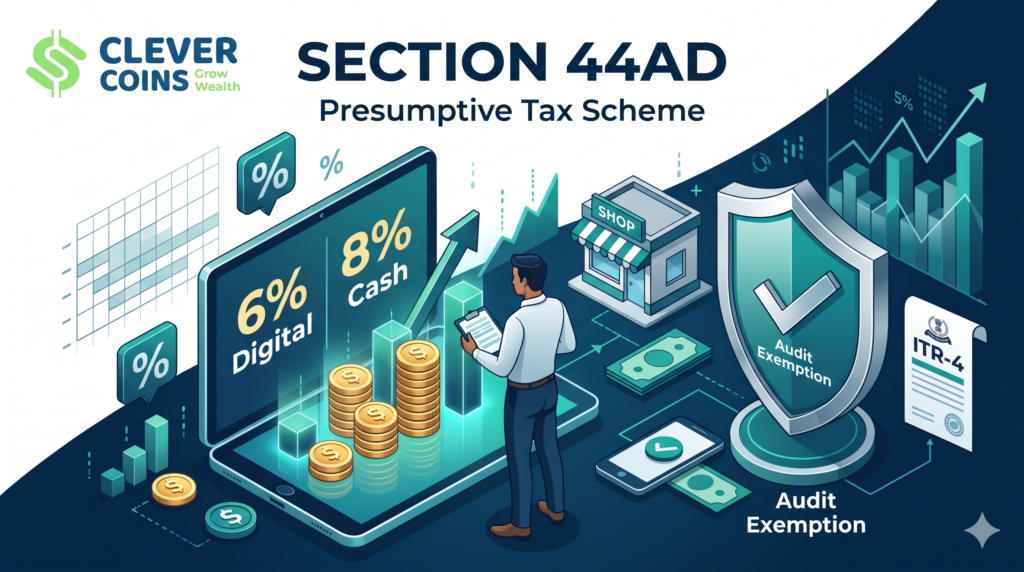
Presumptive Taxation Under Section 44AD (Small Businesses): Eligible businesses with turnover up to ₹3 crore (with at least 95% digital receipts) can declare just 6% of digital turnover (8% for cash turnover) as taxable income.
Claiming Genuine Business Expenses (Regular Books): If your actual profit margin is lower than 50% (under 44ADA) or 6% (under 44AD), maintain proper books and deduct legitimate business expenses: laptop/equipment depreciation, cloud software subscriptions, co-working rent, internet bills, client travel, and professional consultancy fees.
HUF (Hindu Undivided Family) Creation: Married individuals can create a separate HUF entity with its own PAN card, enabling a distinct ₹12 lakh basic exemption/rebate window under the New Regime for ancestral income, family investments, or rental properties.
7. Essential FY 2025-26 Tax Compliance Calendar
Missing statutory deadlines invites penal interest under Sections 234A, 234B, and 234C, plus late fees under Section 234F. Mark these crucial milestones:
April – May 2025: Submit initial investment and regime preference declarations to your employer’s payroll team to calibrate monthly TDS.
June 15, 2025: First Advance Tax installment (15% of estimated annual tax liability, applicable if total tax payable exceeds ₹10,000).
September 15, 2025: Second Advance Tax installment (cumulative 45%).
December 15, 2025: Third Advance Tax installment (cumulative 75%).
January – February 2026: Submit actual investment proofs (rent receipts, 80C/80D proofs if under Old Regime) to HR to prevent excess Q4 TDS deductions.
March 15, 2026: Final Advance Tax installment (100% of estimated tax liability; presumptive taxpayers under 44AD/44ADA pay 100% in a single installment by this date).
March 31, 2026: Absolute cut-off date to complete all FY 2025-26 tax-saving investments (Old Regime) and execute tax-loss/tax-gain harvesting trades.
July 31, 2026: Standard due date to file Income Tax Return (ITR) for AY 2026-27 (for non-audit taxpayers).
8. Common Tax Planning Mistakes to Avoid in FY 2025-26
Blindly Buying 80C Products Without Checking Regime Breakeven: Locking ₹1.5 lakh into a 5-year tax-saver FD or endowment plan when the New Regime already reduces your tax to zero wastes liquidity and yields sub-optimal post-tax returns.
Ignoring AIS, TIS, and Form 26AS Reconciliation: Before filing your return, cross-verify every interest entry, dividend payout, securities transaction, and TDS credit in your Annual Information Statement (AIS) and Taxpayer Information Summary (TIS) on the Income Tax e-filing portal to prevent automated mismatch notices.
Forgetting to Pay Advance Tax on Capital Gains & Freelance Income: Salaried individuals often assume employer TDS covers everything. If you earn significant capital gains, freelance fees, or FD interest resulting in net tax payable above ₹10,000, failing to pay quarterly advance tax triggers mandatory 1% monthly interest under Section 234B/234C.
Mixing Insurance with Investment: Keep term life insurance and comprehensive health insurance completely separate from wealth-building mutual funds or NPS.
Frequently Asked Questions (FAQs) on Tax Planning for FY 2025-26
Q1. Is income up to ₹12.75 lakh completely tax-free in FY 2025-26?
Yes, for resident salaried individuals opting for the New Tax Regime. After deducting the ₹75,000 Standard Deduction from a gross salary of ₹12,75,000, your net taxable income stands at ₹12,00,000, which qualifies for a 100% tax rebate of ₹60,000 under Section 87A—making your final tax liability zero (excluding any special-rate income like capital gains).
Q2. Can I claim both HRA and Home Loan Interest in FY 2025-26?
Yes, only under the Old Tax Regime, provided you genuinely live in a rented home (for instance, near your workplace) while owning a house in another city or a property that is under construction or let out. You must maintain valid rent receipts, rental agreements, and home loan interest certificates.
Q3. Can I switch from the New Tax Regime to the Old Tax Regime when filing my ITR?
Yes. If you are a salaried taxpayer without business or professional income, even if your employer deducted TDS based on the New Tax Regime during the year, you have the full legal right to choose the Old Tax Regime directly while filing your ITR before the July 31 due date (and vice versa).
Q4. Which tax-saving instruments are still deductible under the New Tax Regime?
Under the New Tax Regime for FY 2025-26, salaried individuals can claim the ₹75,000 Standard Deduction and employer contributions to NPS under Section 80CCD(2) (up to 14% of Basic + DA). Additionally, interest on home loans for a let-out property can be set off against the rental income of that property.
Partner with CleverCoins for Effortless Tax & Wealth Optimization
Navigating slab transitions, corporate NPS restructuring, capital gains harvesting, and presumptive taxation requires precision tailored to your exact income profile. At CleverCoins, our team of chartered tax strategists and financial advisors helps salaried professionals, freelancers, and growing businesses build audit-proof tax plans that maximize take-home wealth while maintaining 100% statutory compliance.
Ready to calculate your exact FY 2025-26 tax savings? Connect with CleverCoins today for a personalized Regime Comparison & Tax Optimization Audit.
Related posts:
No related posts.