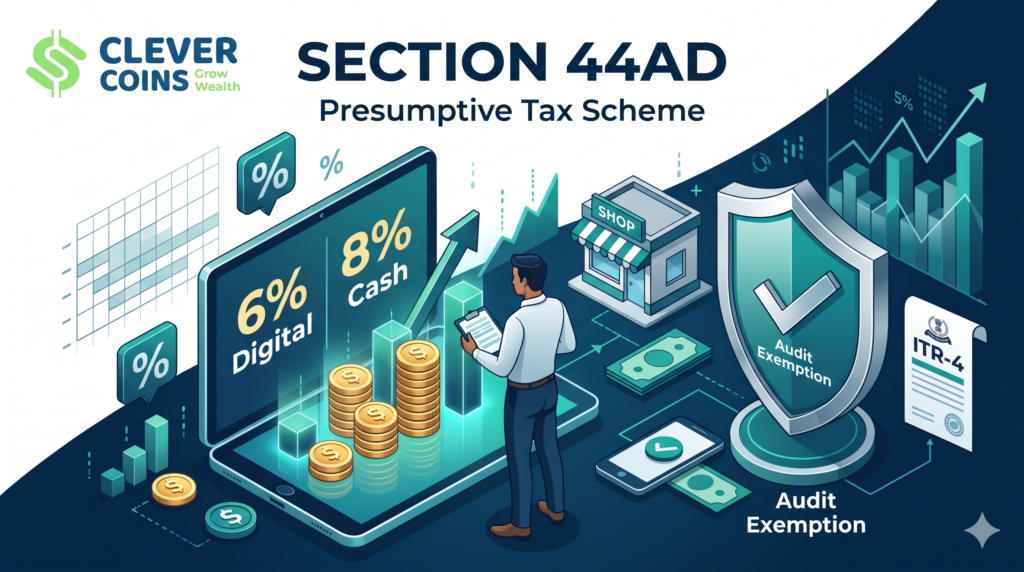
How to Master Presumptive Tax Scheme 44AD in 2025: The Ultimate Guide for Indian Small Businesses
Running a small or medium-sized business in India demands relentless focus. Between managing inventory, acquiring customers, handling vendor payments, and navigating Goods and Services Tax (GST) compliance, the last thing an entrepreneur wants at the end of the financial year is to drown in thousands of expense vouchers, complex balance sheets, and expensive statutory tax audits.
Recognizing this administrative burden on MSMEs (Micro, Small, and Medium Enterprises) and retail traders, the Indian Income Tax Department introduced Section 44AD of the Income Tax Act, 1961—commonly known as the Presumptive Tax Scheme. Designed to simplify tax compliance, Section 44AD allows eligible small businesses to declare their taxable income at a fixed, predetermined percentage of their total turnover, completely eliminating the requirement to maintain detailed books of account or undergo a mandatory tax audit.
In 2025 (covering Financial Year 2024–25 / Assessment Year 2025–26, as well as planning for FY 2025–26), mastering Section 44AD is more lucrative than ever. With the enhanced ₹3 Crore turnover limit for digital-first businesses, differential tax rates rewarding cashless transactions, and the sweeping Section 87A tax rebate under the New Tax Regime, smart entrepreneurs can legally slash both their compliance costs and their final income tax outgo.
Whether you are a local retailer, an e-commerce seller, a distributor, a restaurant owner, or a freelance consultant wondering if you qualify, this comprehensive guide breaks down every rule, calculation, trap, and tax-saving strategy under Section 44AD.
What is the Presumptive Tax Scheme Under Section 44AD?
Under standard income tax provisions, every business owner must calculate their net taxable profit using the traditional accounting formula:
To prove those expenses (such as shop rent, employee salaries, electricity bills, internet charges, travel, and asset depreciation) to the Income Tax Department, you are legally obligated under Section 44AA to maintain meticulous accounting ledgers, invoices, and receipts. Furthermore, once your turnover crosses specific thresholds, Section 44AB mandates a formal Tax Audit conducted by a practicing Chartered Accountant (CA).
Section 44AD turns this traditional model upside down.
Under the Presumptive Tax Scheme, the Income Tax Department tells eligible small businesses: “You do not need to track every single rupee of expense or maintain formal accounting books. Simply tell us your total annual sales (turnover), and we will presume a fixed minimum percentage of that turnover as your net profit. Pay tax on that presumed profit, and your compliance is complete.”
Why Was Section 44AD Created?
Ease of Doing Business: Removes bookkeeping friction for millions of small shopkeepers, traders, and micro-entrepreneurs.
Audit Relief: Frees small taxpayers from expensive Chartered Accountant audit fees under Section 44AB.
Digital Economy Push: By offering a lower presumptive profit rate on digital receipts compared to cash receipts, the government actively incentivizes UPI, NEFT/RTGS, card payments, and banking transactions.
Faster Return Filing: Eligible taxpayers can file their returns using the simplified ITR-4 (Sugam) form instead of the exhaustive ITR-3.
(Note on Regulatory Evolution: While the newly enacted Income-tax Act, 2025 reorganizes presumptive taxation provisions under Section 58 effective from April 2026, all tax filings and compliance for FY 2024–25 and FY 2025–26 continue to be governed directly under Section 44AD of the Income-tax Act, 1961.)
Who is Eligible for Section 44AD in 2025?
Before opting into Section 44AD, you must pass a strict two-tier eligibility test: first based on your legal entity structure, and second based on the nature of your business.
1. Eligible Taxpayer Entities
Only Resident Assessees falling into the following three categories can opt for Section 44AD:
Resident Individuals: Sole proprietors, freelance business owners, shopkeepers, and individual traders.
Resident Hindu Undivided Families (HUFs): Family-run businesses operating under an HUF PAN.
Resident Partnership Firms: Traditional partnership firms registered under the Indian Partnership Act, 1932.
2. Entities Strictly Excluded from Section 44AD
The following entities cannot claim benefits under Section 44AD, regardless of how small their turnover is:
Limited Liability Partnerships (LLPs): Even though LLPs are taxed similarly to partnership firms, they are explicitly barred from Section 44AD.
Private Limited & Public Limited Companies: Corporate entities must maintain statutory books under the Companies Act and cannot use presumptive taxation.
Non-Resident Indians (NRIs) & Foreign Entities: Only individuals, HUFs, and firms qualifying as “Resident in India” for the relevant financial year are eligible.
Association of Persons (AOP) & Body of Individuals (BOI): Trusts, societies, and cooperative entities are excluded.
3. Eligible vs. Ineligible Businesses
Section 44AD covers almost any legitimate commercial trade, manufacturing, retail, wholesale, or service business—except specific categories that have their own rules or are expressly excluded:
| Business Category | Eligible for 44AD? | Applicable Rule / Alternative Section |
| Retail & Wholesale Traders | Yes | Covered under Section 44AD (6% / 8%) |
| E-Commerce Sellers (Amazon, Flipkart, D2C) | Yes | Covered under Section 44AD (mostly 6% digital) |
| Small Manufacturers & Job Workers | Yes | Covered under Section 44AD |
| Restaurants, Cafes & Cloud Kitchens | Yes | Covered under Section 44AD |
| Contractors & Civil Builders | Yes | Covered under Section 44AD |
| Speculative & F&O Trading | Yes | Treated as business income; eligible for 44AD (subject to turnover calculation rules) |
| Specified Professionals (Doctors, Lawyers, CAs, Engineers, Architects, Interior Designers, IT/Technical Consultants, Film Artists) | No | Must use Section 44ADA (50% presumptive rate up to ₹50L/₹75L) |
| Goods Carriage / Transport Operators (Plying, hiring, or leasing trucks/goods vehicles) | No | Must use Section 44AE (per-vehicle monthly presumptive calculation) |
| Commission or Brokerage Agents (Insurance agents, real estate brokers, stockbrokers) | No | Explicitly excluded from 44AD; must maintain regular books if threshold crossed |
| Agency Businesses | No | Explicitly excluded from Section 44AD |
Crucial Distinction: Many independent IT developers, UI/UX designers, and management consultants mistakenly file under Section 44AD to enjoy the 6% tax rate. However, “Technical Consultancy” and “Engineering” fall under Section 44AA(1). If the Income Tax Department classifies your work as a “Specified Profession,” declaring 6% under 44AD instead of 50% under 44ADA can trigger a defective return notice or tax scrutiny.
Turnover Limits Explained: ₹2 Crore vs. ₹3 Crore Threshold
To democratize digital payments across India, the Finance Act enhanced the turnover ceiling under Section 44AD from ₹2 Crore to ₹3 Crore for cash-light businesses. Understanding the exact math behind this threshold is critical because crossing it by even ₹1 disqualifies you from the scheme.
1. The Standard ₹2 Crore Limit
If your business accepts significant physical cash—specifically, if more than 5% of your total annual turnover is received in cash—your maximum eligibility limit under Section 44AD remains ₹2 Crore.
2. The Enhanced ₹3 Crore Limit (The 95% Digital Rule)
Your eligibility limit jumps by 50% to ₹3 Crore if the aggregate cash receipts during the financial year do not exceed 5% of your total turnover or gross receipts.
What Counts as “Cash” vs. “Digital/Banking” Receipts?
The Income Tax Act is extraordinarily strict about this definition:
Treated as Digital/Banking: Account Payee Cheque, Account Payee Bank Draft, Electronic Clearing System (ECS), UPI, NEFT, RTGS, IMPS, Credit/Debit Cards, and Payment Gateways (Razorpay, Stripe, PayU, etc.).
Treated as Cash: Physical currency notes, Bearer Cheques, and Crossed Cheques/Drafts that are NOT “Account Payee”. Even if a customer hands you a regular cheque that isn’t marked “Account Payee,” the law deems it to be cash!
Practical Example of the ₹3 Crore Eligibility Check
Suppose Sharma Electronics has a total annual turnover of ₹2.60 Crore in FY 2024–25:
Scenario A: ₹2.50 Crore is received via UPI, cards, and bank transfers, and ₹10 Lakh is received in cash.
Cash percentage = $\frac{₹10\text{ Lakh}}{₹2.60\text{ Crore}} = 3.85\%$.
Since $3.85\% \le 5\%$, Sharma Electronics qualifies for the ₹3 Crore limit and can opt for Section 44AD.
Scenario B: ₹2.40 Crore is received via bank transfers, and ₹20 Lakh is received in cash.
Cash percentage = $\frac{₹20\text{ Lakh}}{₹2.60\text{ Crore}} = 7.69\%$.
Since $7.69\% > 5\%$, the ₹3 Crore limit is lost. The business reverts to the ₹2 Crore limit—and because ₹2.60 Crore exceeds ₹2 Crore, Sharma Electronics is disqualified from Section 44AD and must undergo a mandatory Tax Audit.
Does “Turnover” Include GST?
A common mistake among small businesses is adding collected GST to their gross receipts when checking the ₹2 Crore / ₹3 Crore limit.
If you follow the Exclusive Method of accounting (where GST collected is credited to a separate GST liability account and not recorded as sales revenue), GST is excluded from turnover.
Always ensure your declared business turnover in ITR-4 reconciles cleanly with your annual GSTR-9 / GSTR-1 returns. Unexplained mismatches between GST turnover and Income Tax turnover are the #1 trigger for automated AI scrutiny notices from the Income Tax Department.
How Presumptive Profit is Calculated: The 6% vs. 8% Rule
Once you confirm eligibility, calculating your taxable business profit is remarkably straightforward. Under Section 44AD, your minimum presumptive income is bifurcated into two buckets based on how and when you receive your sales proceeds:
6% of Turnover: Applicable to all receipts collected through digital or prescribed banking modes either during the financial year OR on or before the due date of filing the Income Tax Return (ITR) under Section 139(1) (typically July 31 / August 31 for non-audit cases).
8% of Turnover: Applicable to all receipts collected in cash, non-account-payee cheques, or credit sales whose payment is not realized in your bank account by the ITR filing due date.
Step-by-Step Calculation Example
Let’s look at Mehta Trading Co. for FY 2024–25 with a total turnover of ₹1,50,00,000 (₹1.50 Crore):
Digital receipts received up to March 31, 2025: ₹1,10,00,000
Credit sales on March 25, 2025, paid via NEFT on May 15, 2025 (before ITR due date): ₹15,00,000
Physical cash sales during the year: ₹20,00,000
Unpaid credit sales still pending after the ITR due date: ₹5,00,000
Taxable Profit Calculation:
Eligible for 6% Rate: $₹1,10,00,000 + ₹15,00,000 = ₹1,25,00,000$
Presumed Profit @ 6% = $₹7,50,000$
Subject to 8% Rate: $₹20,00,000\text{ (cash)} + ₹5,00,000\text{ (uncollected by due date)} = ₹25,00,000$
Presumed Profit @ 8% = $₹2,00,000$
Total Presumptive Business Income: $₹7,50,000 + ₹2,00,000 =$ $₹9,50,000$
Notice how following up on pending receivables before the ITR filing deadline saved Mehta Trading Co. 2% on ₹15 Lakh (₹30,000 reduction in taxable income)!
Can You Declare Higher Than 6% or 8%?
Yes. The 6% and 8% figures are minimum thresholds. If your actual net profit margin is 12% and you wish to declare 12% (for instance, to reflect higher income when applying for a home loan or business expansion credit), you are completely free to voluntarily declare a higher profit percentage without triggering any audit.
Deductions, Depreciation, and Chapter VI-A: What You Can & Cannot Claim
One of the most misunderstood areas of Section 44AD is how deductions work. You must separate Business Deductions (Sections 30 to 38) from Personal/Total Income Deductions (Chapter VI-A).
1. Business Expenses Are Deemed Allowed (Zero Extra Claims)
When you declare 6% or 8% as your profit, the law assumes that all business expenses under Sections 30 to 38 have already been subtracted. You cannot deduct:
Shop or office rent
Staff salaries and wages
Electricity, internet, and telephone bills
Interest on business loans or overdrafts
Accounting, software, or marketing costs
Asset Depreciation (Section 32): You cannot deduct annual depreciation on laptops, machinery, furniture, or commercial vehicles.
The Written Down Value (WDV) Trap: Even though you cannot claim depreciation in your profit calculation while under Section 44AD, the Income Tax Department notionally reduces the Written Down Value (WDV) of your business assets every year as if depreciation had been claimed. If you sell a business asset later or exit Section 44AD in the future, your opening asset value will be the reduced WDV—not the original purchase price.
2. Special Rule for Partnership Firms
Prior to 2016, partnership firms opting for Section 44AD were allowed to deduct partner salaries (remuneration) and interest on partner capital from their 6%/8% presumptive profit. That rule no longer exists. Today, for a partnership firm, the 6% or 8% figure is the absolute final business income—no further deduction for partner remuneration or capital interest is permitted.
3. Personal Deductions (Chapter VI-A) ARE Still Allowed!
Your presumptive business income is added to your other heads of income (such as savings bank interest, fixed deposit interest, rental income, or capital gains) to arrive at your Gross Total Income. From this Gross Total Income, you can still claim personal tax-saving deductions—provided you opt for the Old Tax Regime:
Section 80C (up to ₹1.5 Lakh): PPF, ELSS mutual funds, life insurance premiums, children’s tuition fees, and home loan principal repayment.
Section 80D: Health insurance premiums for yourself, your spouse, children, and parents.
Section 80CCD(1B): Additional ₹50,000 contribution to the National Pension System (NPS).
Section 24(b): Interest on a housing loan for a self-occupied property (up to ₹2 Lakh under the Old Regime).
Old Tax Regime vs. New Tax Regime: Maximizing Tax Savings with 44AD in 2025
By default, all taxpayers in India are placed under the New Tax Regime (Section 115BAC) unless they explicitly opt out. Combining Section 44AD with the New Tax Regime creates an extraordinary tax-saving opportunity for small business owners.
The Zero-Tax Sweet Spot
Under the New Tax Regime rules applicable for FY 2025–26 (enhanced in Budget 2025), resident individuals enjoy a Section 87A tax rebate up to ₹60,000, effectively making net taxable income up to ₹12,00,000 (₹12 Lakh) completely tax-free!