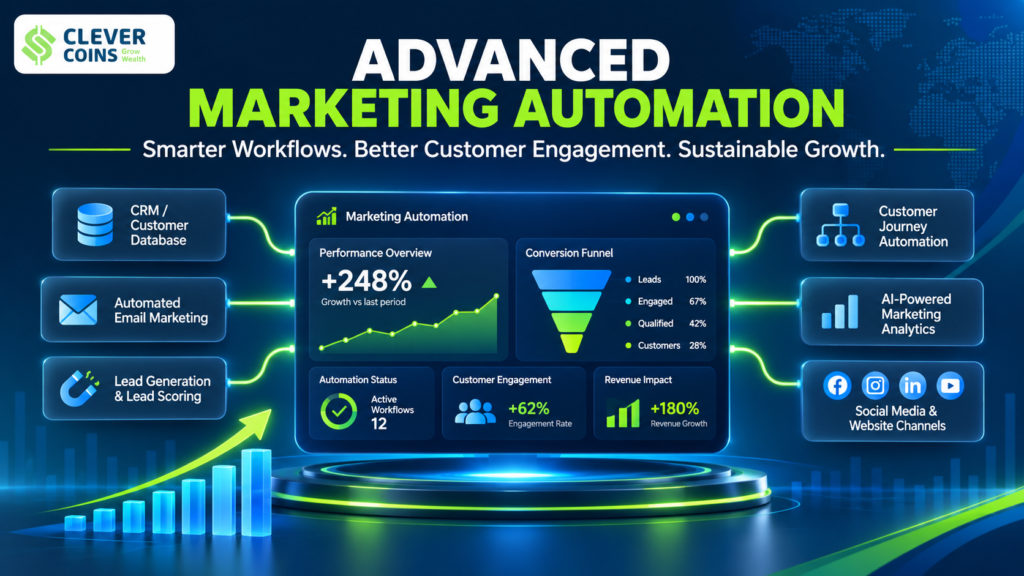
Advanced Strategies for Marketing Automation Setup: A Complete Guide to Smarter Business Growth
Introduction
In today’s competitive digital business environment, attracting potential customers is only one part of building a successful business. Businesses must also engage prospects, understand customer behaviour, maintain consistent communication, manage sales opportunities and build long-term relationships. Managing all these activities manually can become increasingly difficult as a company grows.
This is where marketing automation becomes an essential business strategy.
Marketing automation allows businesses to use technology, software and predefined workflows to manage repetitive marketing activities automatically. From sending personalised emails and capturing leads to tracking customer interactions and nurturing prospects, automation helps businesses create more organised, efficient and measurable marketing operations.
However, simply purchasing marketing automation software does not guarantee better marketing performance. Businesses need a properly structured automation system that connects their marketing channels, customer information, sales processes and performance measurements.
An effective marketing automation setup requires strategic planning, customer segmentation, workflow design, CRM integration, behavioural tracking, lead scoring, personalised communication and continuous optimisation.
For startups, small businesses and established organisations, implementing advanced marketing automation strategies can reduce repetitive work, improve customer engagement, increase conversion opportunities and support sustainable business growth.
In this comprehensive guide, we will explore advanced strategies for marketing automation setup, including essential components, implementation processes, practical workflows, common mistakes, performance indicators and future developments.
1. What Is Marketing Automation?
Marketing automation refers to the use of specialised software and technology to automate repetitive marketing tasks and manage customer interactions across different digital channels.
Instead of manually performing every marketing activity, businesses can establish predefined rules and workflows that automatically execute actions when specific conditions are met.
For example, when someone completes a contact form on a business website, an automation workflow can:
Capture the visitor’s contact information.
Add the prospect to a customer relationship management system.
Send an automatic confirmation email.
Assign the lead to the appropriate sales representative.
Add the prospect to a relevant nurturing campaign.
Notify the sales team when the prospect demonstrates strong buying intent.
Track subsequent interactions and engagement.
All these activities can happen through a connected automation system with minimal manual intervention.
Why Marketing Automation Matters
Marketing automation is not simply about reducing the number of marketing tasks employees perform. It is about creating a consistent, organised and measurable customer experience.
Businesses can use automation to:
Reduce repetitive administrative work.
Respond to customer enquiries more quickly.
Improve lead management.
Deliver personalised marketing messages.
Maintain consistent communication.
Identify high-intent prospects.
Improve marketing and sales coordination.
Track campaign performance.
Reduce missed follow-ups.
Support business growth without proportionately increasing operational workload.
The real advantage comes when automation connects different stages of the customer journey rather than operating as an isolated email-sending system.
2. Understanding the Core Components of a Marketing Automation System
Before implementing advanced marketing automation strategies, businesses must understand the major components required to build an effective system.
2.1 Customer Relationship Management (CRM)
A CRM system acts as the central database for managing customer and prospect information.
It stores important details such as:
Customer names and contact information.
Company details.
Previous enquiries.
Purchase history.
Communication records.
Lead status.
Customer preferences.
Sales opportunities.
Marketing campaign interactions.
Integrating marketing automation with CRM software allows businesses to create workflows based on actual customer information.
For example, when a prospect moves from the enquiry stage to the qualified lead stage, the automation system can automatically initiate a different communication sequence.
2.2 Email Marketing Automation
Email automation allows businesses to send targeted messages based on customer actions, preferences, interests and lifecycle stages.
Common examples include:
Welcome emails.
Enquiry acknowledgement emails.
Product information sequences.
Educational newsletters.
Abandoned cart reminders.
Appointment confirmations.
Customer onboarding emails.
Renewal reminders.
Re-engagement campaigns.
The most effective email automation strategies focus on delivering relevant information rather than sending large volumes of generic messages.
2.3 Lead Capture and Management
Lead capture involves collecting information from individuals who demonstrate interest in a company’s products or services.
Common lead capture methods include:
Website contact forms.
Landing pages.
Downloadable guides.
Webinar registrations.
Newsletter subscriptions.
Consultation booking forms.
Social media lead forms.
Enquiry forms.
Once a prospect submits information, automation should transfer that information to the appropriate CRM record and trigger the relevant next action.
2.4 Workflow Automation
A workflow is a sequence of automated activities triggered by a particular event or condition.
For example:
Trigger: A visitor downloads a business guide.
Actions:
Record the download activity.
Add the visitor to the relevant audience segment.
Send a thank-you email.
Deliver additional educational content.
Monitor engagement.
Notify the sales team if the visitor requests a consultation.
Workflows are the foundation of a successful marketing automation setup.
2.5 Analytics and Reporting
Analytics help businesses understand whether their marketing automation activities are producing meaningful results.
Important measurements include:
Lead generation volume.
Email engagement.
Website conversion rate.
Marketing-qualified leads.
Sales-qualified leads.
Cost per lead.
Customer acquisition cost.
Campaign-attributed revenue.
Customer retention.
Return on marketing investment.
A strong automation system must provide visibility into the complete customer journey, not just the number of emails delivered.
3. Advanced Strategies for Marketing Automation Setup
A basic automation system handles repetitive tasks. An advanced system uses customer data, behavioural insights, segmentation and intelligent workflows to improve the entire marketing process.
The following strategies can help businesses develop a more sophisticated marketing automation infrastructure.
3.1 Develop a Data-Driven Marketing Automation Strategy
The first step towards advanced automation is establishing a clear strategy.
Businesses should avoid implementing workflows simply because automation software makes them available. Every workflow should support a specific business objective.
Begin by identifying the marketing challenges that need to be addressed.
For example:
Too many enquiries remain unanswered.
Sales representatives forget to follow up.
Website visitors leave without submitting enquiries.
Marketing campaigns generate irrelevant leads.
Existing customers receive inconsistent communication.
The marketing team cannot identify which campaigns generate revenue.
After identifying these challenges, determine how automation can solve them.
A practical strategic framework includes:
Step 1: Define business objectives.
Set measurable objectives such as improving enquiry response time, increasing qualified leads or reducing manual follow-up activities.
Step 2: Identify customer journey stages.
Understand how customers discover the business, evaluate its services, request information, make purchasing decisions and continue their relationship.
Step 3: Identify repetitive activities.
List activities that can be automated without reducing service quality or personal attention.
Step 4: Select appropriate technology.
Choose tools that support the business requirements, budget, integration needs and future growth.
Step 5: Establish performance indicators.
Decide how the organisation will measure the success of each workflow.
A strategy-first approach prevents businesses from investing in complicated automation systems that do not solve actual operational problems.
3.2 Implement Advanced Customer Segmentation
Customer segmentation is one of the most important elements of successful marketing automation.
Sending the same message to every prospect often results in low engagement because different customers have different interests, requirements and purchasing intentions.
Advanced segmentation divides audiences into smaller groups based on meaningful characteristics.
Businesses can segment customers using several dimensions.
Demographic segmentation
This includes information such as age group, location, profession and other relevant demographic characteristics where appropriate and lawfully collected.
Geographic segmentation
Businesses can group prospects according to location, region, city or service availability.
Behavioural segmentation
This focuses on customer actions, including:
Website visits.
Specific page views.
Form submissions.
Email clicks.
Content downloads.
Product comparisons.
Previous purchases.
Consultation requests.
Firmographic segmentation
B2B businesses can classify prospects based on company size, industry, annual revenue range, business model and organisational structure.
Lifecycle segmentation
Customers can be categorised according to their relationship with the business:
New subscribers.
New enquiries.
Prospective customers.
Qualified leads.
Active customers.
Repeat customers.
Inactive customers.
For example, a business consultancy can create separate segments for startup founders, established companies, small business owners and individuals seeking specific professional services.
Each segment can receive relevant information rather than a generic marketing message.
3.3 Build Behaviour-Based Automation Workflows
Traditional automation often relies on fixed schedules. Advanced automation responds to actual customer behaviour.
This makes communication more relevant and timely.
Consider a visitor who views a service page several times but does not submit an enquiry.
A behaviour-based workflow could:
Record the relevant page interaction.
Check whether the visitor has provided valid marketing consent.
Determine whether the visitor belongs to an existing CRM segment.
Deliver relevant educational content if appropriate.
Monitor subsequent engagement.
Create a follow-up opportunity when the visitor submits an enquiry.
Another example involves an existing customer who visits a renewal information page.
The system could identify the relevant customer record and trigger an appropriate reminder or service update.
However, businesses should avoid excessive tracking and messaging. Automation must respect consent, privacy requirements, communication preferences and applicable data protection regulations.
3.4 Create Intelligent Lead Scoring Models
Not every lead has the same level of purchasing intent.
Lead scoring helps businesses prioritise prospects according to their characteristics and engagement.
A scoring model assigns points to specific actions or attributes.
For example:
| Lead activity | Illustrative score |
|---|---|
| Visits the pricing page | +10 |
| Downloads a service guide | +10 |
| Submits an enquiry form | +20 |
| Requests a consultation | +30 |
| Opens an educational email | +3 |
| Clicks a service-related email link | +8 |
| Demonstrates prolonged inactivity | -10 |
These values are examples and should be adjusted using actual business data.
A business could establish the following illustrative categories:
0–19 points: Early-stage prospect.
20–39 points: Engaged prospect.
40–59 points: Marketing-qualified lead.
60+ points: Priority sales follow-up.
Lead scoring should consider both engagement and fit.
For example, a person who frequently opens emails may be interested in the content but may not be an appropriate customer. Similarly, a business owner who submits a consultation request may demonstrate strong buying intent even if they have limited previous engagement.
Advanced scoring models can incorporate:
Company characteristics.
Service requirements.
Engagement frequency.
Buying intent.
Previous enquiries.
Customer lifecycle stage.
Negative qualification indicators.
Sales and marketing teams should periodically review scoring thresholds to ensure that the model reflects actual conversion behaviour.
3.5 Design Multi-Channel Marketing Automation
Modern customers interact with businesses through multiple channels.
These may include:
Websites.
Email.
Social media.
SMS.
WhatsApp.
Online advertising.
Customer portals.
Telephone enquiries.
An advanced automation system should coordinate communication across appropriate channels.
For example, a prospect who submits a website enquiry might receive an email acknowledgement, while the internal team receives a CRM notification.
If the prospect books a consultation, the system can send a confirmation and an appropriate reminder.
The objective is not to communicate everywhere. It is to ensure that each communication channel serves a defined purpose.
Businesses should establish channel-specific rules, including:
Which channel is appropriate for each message.
What consent is required.
How frequently communication can occur.
How customer preferences are recorded.
How duplicate messages are prevented.
How customers can unsubscribe or opt out.
This approach creates a more consistent customer experience.
3.6 Use Dynamic Personalisation
Personalisation makes marketing communication more relevant to individual customers.
Basic personalisation includes using a recipient’s name. Advanced personalisation considers customer interests, previous interactions, lifecycle stage and service requirements.
For example, a business consultancy may send different educational content to:
A person researching company incorporation.
A business owner exploring GST services.
A startup founder interested in registrations.
An established company reviewing compliance requirements.
Dynamic content can also be used on landing pages, email campaigns and website experiences.
However, personalisation should be based on reliable information. Incorrect assumptions can damage customer trust.
Businesses should also avoid using sensitive personal information for marketing personalisation unless there is a clear lawful basis and appropriate authorisation.
3.7 Develop Automated Lead Nurturing Campaigns
Many potential customers do not make purchasing decisions immediately.
They may need more information, compare providers, discuss requirements internally or wait until the right time.
Lead nurturing keeps the business connected with these prospects through useful and relevant communication.
A typical nurturing campaign may include:
Day 0: Welcome message
Acknowledge the enquiry or subscription and explain what the recipient can expect.
Day 2: Educational content
Share an article, checklist or guide related to the prospect’s interests.
Day 5: Problem-solving content
Explain common challenges and practical ways to address them.
Day 8: Service information
Introduce the relevant service and explain its benefits.
Day 12: Consultation invitation
Offer an opportunity to discuss the prospect’s requirements.
The timing should be adjusted according to the customer’s behaviour, industry and expected decision cycle.
If a prospect requests a consultation, the system should immediately stop the general nurturing sequence and move the person into the appropriate sales workflow.
This prevents irrelevant or repetitive communication.
3.8 Automate Customer Onboarding
Marketing automation should not stop when a customer makes a purchase.
Customer onboarding is an important opportunity to establish trust, explain processes and create a positive initial experience.
An automated onboarding workflow can include:
Purchase or service confirmation.
Welcome communication.
Introduction to the assigned contact person.
Document or information checklist.
Instructions for the next steps.
Progress notifications.
Feedback collection.
Relevant service recommendations.
For a professional consultancy, onboarding automation can help customers understand documentation requirements, appointment schedules and service milestones.
However, important customer interactions should still include human support where judgement, clarification or reassurance is required.
3.9 Implement Automated Customer Retention Campaigns
Acquiring a new customer is only one part of business growth. Maintaining relationships with existing customers is equally important.
Retention automation helps organisations maintain regular communication and identify opportunities to support customers.
Examples include:
Renewal reminders.
Service anniversary messages.
Educational newsletters.
Customer satisfaction surveys.
Follow-up communication.
Relevant additional service information.
Inactive customer re-engagement.
Businesses should use customer history and preferences to determine which communication is appropriate.
For example, a customer who has previously used a registration service may appreciate a relevant update about ongoing compliance obligations.
The goal is to create genuine customer value rather than continuously promoting additional services.
3.10 Integrate AI With Marketing Automation
Artificial intelligence is increasingly becoming an important part of marketing automation.
AI-enabled tools can support marketing teams by analysing data, identifying patterns, assisting with content creation and improving workflow decisions.
Potential applications include:
AI-assisted customer segmentation
Analyse customer interaction data to identify meaningful audience groups.
Predictive lead scoring
Estimate which prospects are more likely to convert based on historical patterns.
Content recommendations
Suggest relevant articles, guides and resources based on customer interests.
Automated customer support
Use conversational assistants to answer routine questions and direct complex enquiries to human representatives.
Campaign optimisation
Identify potential improvements in message timing, audience selection and campaign performance.
Marketing analytics
Summarise campaign results and highlight unusual performance patterns.
AI should support human decision-making rather than replace accountability.
Businesses should validate AI-generated outputs, establish access controls, protect customer data and monitor the quality of automated decisions.
3.11 Establish Automated Follow-Up Systems
One of the most common reasons businesses lose potential customers is inconsistent follow-up.
A prospect may submit an enquiry and receive no response for several hours or days.
An automated follow-up system helps prevent such situations.
A practical process includes:
A prospect submits an enquiry.
The CRM creates or updates the contact record.
An acknowledgement message is sent.
The enquiry is assigned to the appropriate team member.
A follow-up task is created.
A notification is triggered if the task remains incomplete.
The lead status is updated after the interaction.
Additional follow-ups are scheduled according to the prospect’s preferences.
The system should also recognise when a lead has already been contacted or has opted out.
Automation should improve responsiveness without making customers feel that they are interacting with an impersonal system.
3.12 Use Predictive Analytics for Better Campaign Decisions
Predictive analytics uses historical and current data to identify patterns and estimate possible future outcomes.
Businesses can use predictive insights to:
Identify customers who may become inactive.
Estimate lead conversion probability.
Understand customer purchasing patterns.
Identify high-performing campaign segments.
Forecast potential demand.
Improve campaign budget allocation.
For example, a company may analyse previous enquiries and discover that prospects who request a consultation and visit specific service pages are more likely to become customers.
This information can help the marketing team prioritise similar prospects.
Predictive models should be tested against real outcomes and should not be treated as guaranteed predictions.
4. Step-by-Step Process to Set Up an Advanced Marketing Automation System
A successful implementation requires a structured approach.
Step 1: Audit Existing Marketing Activities
Begin by reviewing the current marketing process.
Identify how the business currently generates leads, communicates with prospects, manages customer information and measures campaign results.
Document existing activities such as:
Website enquiry management.
Email campaigns.
Social media lead generation.
Customer follow-ups.
CRM operations.
Sales reporting.
Customer onboarding.
This audit helps identify activities that should be automated and processes that require improvement before automation.
Step 2: Map the Complete Customer Journey
Create a visual representation of the customer’s journey.
A typical customer journey includes:
Awareness: The customer discovers the business through search engines, social media, advertisements or referrals.
Interest: The customer visits the website and explores available information.
Consideration: The customer compares services and evaluates possible solutions.
Conversion: The customer submits an enquiry, requests a consultation or purchases a service.
Onboarding: The customer receives instructions and begins the service process.
Retention: The business maintains the relationship through relevant communication.
Advocacy: Satisfied customers may recommend the business or provide testimonials.
Mapping these stages helps determine which automation workflows are required.
Step 3: Define Automation Objectives
Every workflow should have a measurable purpose.
Examples include:
Reduce enquiry response delays.
Increase the percentage of qualified leads.
Improve email engagement.
Reduce missed follow-ups.
Improve customer onboarding consistency.
Increase repeat business.
Avoid using vague objectives such as simply improving marketing efficiency.
Step 4: Select the Right Marketing Automation Platform
Selecting the appropriate platform is essential.
Different tools provide different capabilities, pricing models and integration options.
Popular options include:
HubSpot: CRM, marketing automation, sales management and reporting.
ActiveCampaign: Email automation, customer segmentation and CRM-related workflows.
Mailchimp: Email campaigns, audience management and marketing automation.
Zoho CRM and Zoho Marketing Automation: Customer management and connected marketing workflows.
Brevo: Email, SMS and customer communication automation.
Salesforce Marketing Cloud: Advanced enterprise-level marketing automation and customer journey management.
Before selecting a platform, compare:
Pricing.
Ease of use.
Available automation features.
CRM functionality.
Integration support.
Reporting capabilities.
Security controls.
Scalability.
Customer support.
The best platform is not necessarily the one with the most features. It is the one that meets the organisation’s actual requirements.
Step 5: Organise and Clean Customer Data
Poor-quality customer information can create serious automation problems.
Before launching workflows:
Remove duplicate records.
Correct inaccurate contact information.
Standardise field formats.
Review existing customer records.
Identify incomplete profiles.
Record communication preferences.
Maintain consent information.
Establish data ownership rules.
Businesses should collect only information that is relevant to their stated purpose.
Step 6: Integrate Essential Business Systems
Connect the automation platform with the tools that support daily operations.
Potential integrations include:
CRM systems.
Website forms.
Landing page platforms.
Email marketing software.
E-commerce platforms.
Appointment scheduling systems.
Customer support software.
Analytics platforms.
Internal notification systems.
Use secure APIs or supported integrations wherever possible.
Test the complete data flow before activating campaigns.
Step 7: Create Your First Automation Workflows
Start with workflows that solve the most important operational problems.
Recommended starting workflows include:
New enquiry acknowledgement.
Lead assignment.
Welcome email.
Consultation reminders.
Lead nurturing.
Customer onboarding.
Customer feedback collection.
Launch these workflows gradually and review their performance.
Step 8: Establish Tracking and Reporting
Set up reporting before the system goes live.
Track relevant indicators such as:
Number of leads generated.
Lead qualification rate.
Enquiry response time.
Email engagement.
Consultation bookings.
Conversion rate.
Customer acquisition cost.
Revenue contribution.
Make sure the reporting system distinguishes between activity metrics and actual business outcomes.
Step 9: Test Every Workflow
Testing is essential before launching an automated campaign.
Check:
Trigger conditions.
Contact eligibility.
Personalisation fields.
Message content.
Links and buttons.
Duplicate communication.
CRM updates.
Internal notifications.
Opt-out handling.
Error conditions.
Use test contacts and realistic scenarios.
Step 10: Monitor and Optimise
Automation is not a one-time installation.
Review campaign performance regularly and improve workflows based on actual results.
Identify bottlenecks, remove unnecessary steps and update outdated communication.
5. Practical Marketing Automation Workflow Examples
The following examples demonstrate how advanced automation can be implemented in real business situations.
Workflow 1: Website Enquiry Automation
Trigger: A visitor submits a website contact form.
Automated actions:
Create or update a CRM contact.
Record the enquiry source.
Send an acknowledgement email.
Categorise the enquiry.
Assign the lead to the relevant representative.
Create a follow-up task.
Notify the internal team.
Expected benefit: Better enquiry organisation and reduced chances of missed leads.
Workflow 2: Abandoned Cart Automation
Trigger: A customer adds a product to the cart but does not complete checkout.
Automated actions:
Record the abandoned cart event.
Check whether the customer is eligible for marketing communication.
Send an appropriate reminder.
Provide relevant product information.
Stop reminders if the purchase is completed.
Expected benefit: An opportunity to recover otherwise lost sales.
Workflow 3: Lead Nurturing Automation
Trigger: A prospect downloads an educational resource.
Automated actions:
Add the prospect to the relevant audience segment.
Deliver the requested resource.
Share related educational content.
Monitor engagement.
Update lead scoring.
Notify sales when qualification criteria are met.
Expected benefit: More consistent prospect engagement.
Workflow 4: Customer Onboarding Automation
Trigger: A customer confirms a service purchase.
Automated actions:
Send confirmation.
Share onboarding instructions.
Provide a document checklist.
Introduce the assigned representative.
Send relevant progress updates.
Request feedback after completion.
Expected benefit: A more organised customer experience.
Workflow 5: Customer Retention Automation
Trigger: A customer approaches a relevant renewal date or becomes inactive.
Automated actions:
Check the customer record.
Identify the appropriate service or communication.
Send a relevant reminder.
Create an internal follow-up task.
Record the outcome.
Expected benefit: Better relationship management and fewer missed opportunities.
6. Choosing the Right Marketing Automation Tools
Businesses should evaluate automation platforms according to their size, objectives, technical capabilities and budget.
Some commonly used tools include:
| Platform | Key capabilities |
|---|---|
| HubSpot | CRM and marketing automation |
| ActiveCampaign | Behaviour-based email workflows |
| Mailchimp | Email marketing and audience management |
| Zoho | CRM and business workflow integration |
| Brevo | Email and SMS communication |
| Salesforce | Enterprise customer journey automation |
| Zapier | Connecting different applications |
| Make | Visual workflow and integration automation |
Businesses should evaluate the total cost of ownership, including subscriptions, implementation, integrations, training and ongoing maintenance.
A smaller business may achieve excellent results using a relatively simple CRM and email automation setup. A larger organisation may require advanced customer data integration and more sophisticated reporting.
7. Marketing Automation Best Practices
To achieve sustainable results, businesses should follow these important practices.
Keep Automation Customer-Centric
Every automated communication should provide value.
Avoid sending messages simply because a workflow has been activated.
Maintain Accurate Customer Data
Review contact records, preferences and consent information regularly.
Use Clear Workflow Documentation
Document triggers, conditions, actions, ownership and expected outcomes for every important workflow.
Avoid Excessive Automation
Not every customer interaction should be automated.
Complex enquiries, complaints, sensitive situations and important business decisions often require human involvement.
Maintain Consistent Brand Communication
Automated emails, landing pages and notifications should use consistent branding, tone and messaging.
Respect Customer Preferences
Provide appropriate unsubscribe and preference-management options and follow applicable privacy and electronic communication requirements.
Monitor Workflow Performance
Check for failed integrations, duplicate messages, unexpected triggers and inaccurate data transfers.
Maintain Human Oversight
Assign clear responsibility for monitoring automation systems and resolving issues.
8. Common Marketing Automation Mistakes and How to Avoid Them
Even advanced marketing platforms cannot compensate for poor planning.
Some common mistakes include:
Mistake 1: Automating Without a Clear Strategy
Businesses sometimes activate multiple workflows without defining what they are expected to achieve.
Solution: Establish objectives and measurable success indicators before implementation.
Mistake 2: Using Poor-Quality Customer Data
Incorrect contact details and duplicate records can result in failed communication.
Solution: Introduce data-cleaning procedures and regular CRM audits.
Mistake 3: Sending Generic Messages
Customers may lose interest when they repeatedly receive irrelevant content.
Solution: Use meaningful segmentation and appropriate personalisation.
Mistake 4: Overcomplicating Workflows
Excessively complicated automation can be difficult to manage and troubleshoot.
Solution: Start with simple workflows and introduce complexity only when justified.
Mistake 5: Ignoring Mobile Experiences
Many customers interact with marketing content through mobile devices.
Solution: Test email layouts, landing pages and forms across different screen sizes.
Mistake 6: Failing to Coordinate Marketing and Sales
If both teams operate with different lead definitions, valuable opportunities may be lost.
Solution: Establish shared qualification criteria, lead ownership and handoff procedures.
Mistake 7: Ignoring Customer Consent
Sending promotional messages without the appropriate legal basis or permission can create privacy and compliance risks.
Solution: Maintain consent records, respect opt-outs and review relevant regulations.
Mistake 8: Not Monitoring Results
An automated campaign can continue operating even when its performance deteriorates.
Solution: Establish regular reporting and optimisation reviews.
9. Measuring the Success of Marketing Automation
Measuring automation performance helps businesses understand whether their investment is delivering value.
Important KPIs include:
Lead Generation Rate
Measures how effectively marketing activities generate new leads.
Lead Conversion Rate
Measures the percentage of leads that progress to a defined conversion event.
Marketing Qualified Leads (MQLs)
Measures prospects who meet the organisation’s marketing qualification criteria.
Sales Qualified Leads (SQLs)
Measures prospects accepted as suitable for direct sales engagement.
Customer Acquisition Cost (CAC)
Estimates the cost of acquiring a new customer.
Customer Lifetime Value (CLV)
Estimates the total economic value generated by a customer throughout the relationship.
Email Click-Through Rate
Measures the percentage of delivered emails that generate clicks.
Email Conversion Rate
Measures the percentage of recipients who complete the intended action.
Marketing Return on Investment
A simplified calculation is:
Marketing ROI = (Revenue attributable to marketing − Marketing investment) ÷ Marketing investment × 100
Attribution should be handled carefully. Businesses should avoid assigning all revenue from a customer to the last campaign they interacted with.
A combination of first-touch, last-touch and multi-touch reporting may provide a more balanced understanding of marketing contribution.
10. Data Privacy, Security and Compliance in Marketing Automation
Marketing automation systems process customer information, making privacy and security important implementation considerations.
Businesses should establish appropriate safeguards before collecting and using customer data.
Important considerations include:
Consent management: Record and respect the permissions or other lawful basis required for each communication activity.
Data minimisation: Collect only information that is necessary for the stated business purpose.
Access controls: Restrict customer information to authorised employees.
Secure integrations: Use trusted integrations, appropriate authentication and secure data transmission.
Retention policies: Define how long customer information should be retained and when it should be deleted.
Unsubscribe management: Ensure opt-out requests are respected across connected marketing systems.
Vendor assessment: Evaluate the privacy and security practices of third-party automation providers.
For businesses operating in India, relevant considerations may include the Digital Personal Data Protection Act, 2023, applicable rules and other laws governing electronic communications and personal information. Requirements should be assessed according to the applicable provisions, commencement notifications and the organisation’s specific circumstances.
Businesses serving international customers may also need to consider regulations such as the European Union’s GDPR and applicable US privacy and marketing laws.
11. Marketing Automation Strategies for Small Businesses and Startups
Small businesses often operate with limited marketing budgets and smaller teams.
A practical automation strategy should prioritise high-impact activities rather than implementing every available feature.
Recommended priorities include:
Automate website enquiry acknowledgement.
Introduce a simple CRM.
Create a welcome email sequence.
Establish lead assignment rules.
Automate consultation reminders.
Develop a basic lead nurturing campaign.
Track campaign performance.
Create customer feedback workflows.
For example, a startup offering professional services can use a website form to collect enquiries, CRM software to organise leads and email automation to provide useful information.
As the business grows, it can introduce more advanced capabilities such as behavioural segmentation, lead scoring, AI-assisted analysis and predictive reporting.
This gradual approach reduces implementation costs and allows the organisation to build automation maturity over time.
12. The Future of Marketing Automation
Marketing automation continues to evolve as businesses adopt artificial intelligence, predictive analytics and increasingly integrated customer data platforms.
Several developments are shaping its future.
AI-Powered Personalisation
AI systems can help businesses deliver more relevant content based on customer behaviour and preferences.
Predictive Customer Analytics
Advanced analytical systems can identify patterns that help businesses anticipate customer requirements and potential churn.
Conversational Automation
AI-powered assistants can support customer interactions, answer routine questions and route complex enquiries to human representatives.
Omnichannel Customer Experiences
Businesses are increasingly connecting email, websites, messaging platforms and customer support systems to provide consistent experiences.
Real-Time Decision Making
Automation platforms are becoming more capable of responding to customer actions as they happen.
Greater Emphasis on Privacy
Businesses will need stronger data governance, transparency, security and consent-management practices.
The organisations that benefit most will be those that combine technological innovation with customer trust and responsible data management.
13. A Practical 30-Day Marketing Automation Implementation Plan
Businesses can begin building an effective automation system through a structured 30-day implementation programme.
Week 1: Planning and Audit
Review existing marketing processes.
Identify repetitive activities.
Define business objectives.
Map customer journey stages.
Evaluate existing software.
Document data requirements.
Week 2: Platform and Integration Setup
Select an appropriate automation platform.
Configure CRM fields.
Clean existing customer data.
Integrate website forms.
Connect email communication.
Establish user permissions.
Week 3: Workflow Development
Create welcome email automation.
Configure enquiry acknowledgement.
Establish lead assignment.
Develop lead nurturing sequences.
Set up consultation reminders.
Configure internal notifications.
Week 4: Testing and Optimisation
Test all workflows.
Validate CRM updates.
Check personalisation fields.
Review consent and unsubscribe processes.
Launch selected campaigns.
Monitor performance indicators.
Document improvements.
This programme provides a starting framework. More complex integrations, data migrations and enterprise implementations may require additional time.
14. How Marketing Automation Supports Sustainable Business Growth
Marketing automation contributes to business growth by creating more consistent processes across the customer lifecycle.
Its benefits extend beyond marketing departments.
For business owners: It provides better visibility into enquiries, customer interactions and marketing performance.
For marketing teams: It reduces repetitive campaign management and allows more time for strategy and creative work.
For sales teams: It improves lead organisation, prioritisation and follow-up consistency.
For customer support teams: It helps maintain communication and provides useful context about previous customer interactions.
For growing businesses: It creates repeatable processes that can support increasing customer volumes.
However, automation should never be viewed as a replacement for business strategy, professional expertise or genuine customer relationships.
The strongest results come from combining reliable systems, relevant communication, accurate information and human decision-making.
Conclusion
Advanced marketing automation setup is an important step for businesses that want to improve marketing efficiency, strengthen customer relationships and create more organised growth processes.
From CRM integration and customer segmentation to lead scoring, behaviour-based workflows, AI-powered personalisation and predictive analytics, modern automation offers multiple opportunities to improve how businesses attract, engage and retain customers.
However, successful implementation requires more than choosing a software platform.
Businesses must understand their customer journey, establish clear objectives, maintain accurate information, design meaningful workflows, respect privacy requirements and continuously evaluate performance.
For startups and SMEs, the best approach is to begin with essential automation activities and gradually expand the system as business requirements evolve.
A well-designed marketing automation strategy does not remove the human element from business. Instead, it reduces repetitive work and allows teams to focus more effectively on customer needs, strategic decisions and long-term growth.
Ready to build a smarter and more organised business?
Visit CleverCoins to explore business support, professional consultancy and services that help businesses manage essential operational requirements while focusing on sustainable growth.
Frequently Asked Questions (FAQs)
1. What is marketing automation setup?
Marketing automation setup is the process of selecting, configuring and integrating software to automate repetitive marketing activities such as lead capture, email communication, customer segmentation, follow-ups and campaign reporting.
2. Why is marketing automation important for small businesses?
It helps small businesses manage enquiries, communicate with prospects consistently, organise customer information and reduce repetitive administrative work without requiring a large marketing team.
3. Which tools are best for marketing automation?
Popular platforms include HubSpot, ActiveCampaign, Mailchimp, Zoho, Brevo and Salesforce. The right choice depends on business size, budget, integration requirements and marketing objectives.
4. How much does marketing automation cost?
Costs vary according to software subscriptions, contact volumes, feature requirements, integrations and implementation complexity. Small businesses can start with affordable plans, while larger organisations may require enterprise-level solutions.
5. What are the main benefits of marketing automation?
The main benefits include improved efficiency, faster enquiry responses, better lead management, personalised communication, consistent follow-ups, stronger customer engagement and improved performance measurement.
6. Can marketing automation generate leads?
Yes. Marketing automation can support lead generation through website forms, landing pages, downloadable resources, email campaigns and connected marketing channels. It also helps organise and nurture the leads generated through these activities.
7. What is the difference between CRM and marketing automation?
CRM software primarily manages customer relationships, contact information and sales opportunities. Marketing automation focuses on automating marketing activities and customer communication. Integrating both creates a more connected business process.
8. What is lead scoring in marketing automation?
Lead scoring assigns values to prospect characteristics and interactions to help businesses identify and prioritise leads according to their potential fit and buying intent.
9. Can marketing automation improve customer retention?
Yes. Businesses can use automated renewal reminders, customer feedback campaigns, educational communication and re-engagement workflows to maintain relationships with existing customers.
10. How long does marketing automation implementation take?
A basic implementation may take a few days to several weeks, depending on the software, data quality and integration requirements. More advanced implementations may require several months.
11. Is marketing automation suitable for startups?
Yes. Startups can begin with basic CRM integration, enquiry notifications, welcome emails and lead nurturing. Additional features can be introduced as the business grows.
12. How does AI improve marketing automation?
AI can support customer segmentation, predictive lead scoring, content recommendations, campaign analysis and automated customer support. Human oversight remains important for accuracy, privacy and decision-making.
13. What are the biggest marketing automation mistakes?
Common mistakes include implementing automation without a strategy, using poor-quality customer data, sending generic messages, creating complicated workflows, ignoring consent and failing to measure performance.
14. How can businesses measure marketing automation ROI?
Businesses can evaluate marketing investment against attributable revenue while monitoring customer acquisition cost, lead conversion rates, campaign performance and customer lifetime value.
15. Is marketing automation only useful for large companies?
No. Small businesses, startups, professional service providers and large enterprises can all benefit from marketing automation. The implementation should match the organisation’s operational requirements and available resources.
Related posts:
No related posts.