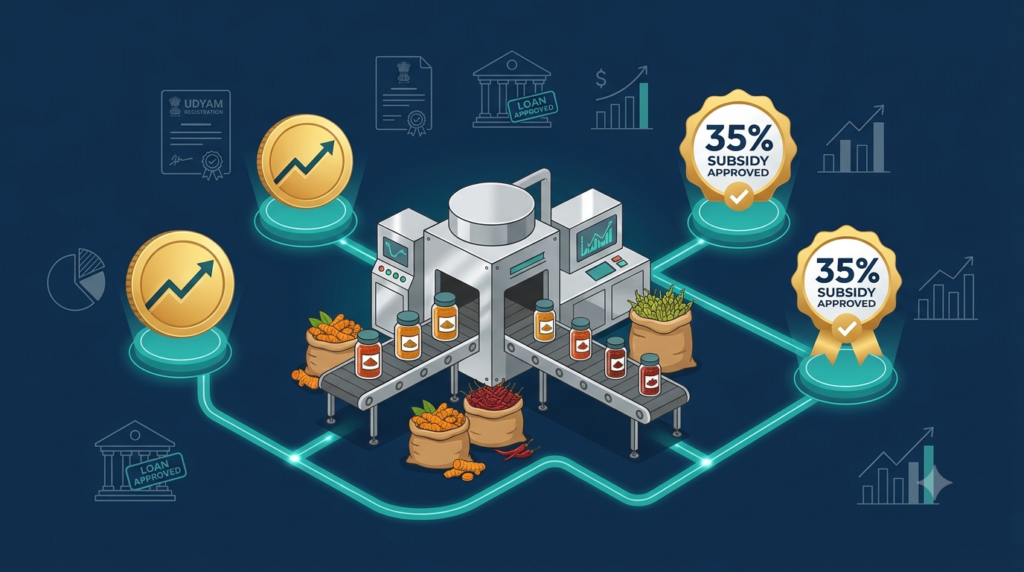
PMFME Scheme 2026: Complete Guide to 35% Capital Subsidy, Eligibility, Documents & Online Application
India’s food processing industry sits at the intersection of agriculture and manufacturing, yet millions of small-scale spice grinders, pickle makers, flour mills, cold-pressed oil units, bakeries, and dairy processors operate in the unorganized sector. Without formal registrations, standardized packaging, or access to institutional credit, these micro-enterprises struggle to scale beyond local markets or compete with established FMCG brands.
To bridge this structural gap, the Ministry of Food Processing Industries (MoFPI) launched the Pradhan Mantri Formalisation of Micro Food Processing Enterprises (PMFME) Scheme under the Aatmanirbhar Bharat Abhiyan. Designed to transition micro food units into the formal economy, the PMFME Scheme 2026 framework provides a 35% credit-linked capital subsidy, seed capital for Self-Help Groups (SHGs), common infrastructure grants, branding and marketing support, and technical handholding.
Whether you are upgrading an existing family-run food unit or launching a new enterprise aligned with your district’s One District One Product (ODOP) priority, understanding the exact financial mechanics, eligibility rules, and bank appraisal criteria is the difference between a rejected file and a sanctioned subsidy. This comprehensive 2026 masterclass breaks down every aspect of the PMFME Scheme—from financial structuring and Detailed Project Report (DPR) preparation to step-by-step online filing and post-sanction compliance.
1. What is the PMFME Scheme? Overview & Core Objectives
The Pradhan Mantri Formalisation of Micro Food Processing Enterprises (PMFME) Scheme is a centrally sponsored initiative implemented by the Ministry of Food Processing Industries (MoFPI) in partnership with State and Union Territory governments. Originally rolled out in June 2020 with a total financial outlay of ₹10,000 crore to formalize 2,00,000 micro food processing units, the scheme has become the cornerstone of grassroots agro-industrial development in India.
Current Status & Extension Window in 2026
Following the completion of its initial implementation cycle through March 31, 2026, MoFPI issued directives extending operational continuity through September 30, 2026, alongside a formal proposal for a five-year continuation (2026–2031) aligned with the 16th Finance Commission cycle. Because policy ceilings, portal windows, and state-level allocations are periodically updated during transition phases, applicants must verify active district targets on the official portal (pmfme.mofpi.gov.in) before locking in machinery orders.
Core Objectives of the PMFME Scheme
MoFPI designed PMFME around six foundational pillars to eliminate the bottlenecks holding back micro-processors:
Enhanced Access to Institutional Credit: Overcoming the lack of collateral and formal financial history by pairing bank loans with a 35% government-backed capital subsidy.
Formalisation of Unorganized Units: Bringing informal home-based and small-scale food businesses under statutory frameworks including Udyam Registration, FSSAI licensing, and GST compliance.
Integration with Organized Supply Chains: Helping micro-enterprises move from loose, unbranded commodity sales to retail-ready, standardized packaging capable of entering modern supermarkets and e-commerce platforms.
Access to Shared Infrastructure: Funding Common Incubation Centres (CICs), cold storages, testing laboratories, and primary processing lines so individual entrepreneurs do not have to bear heavy capital expenditure alone.
Strengthening Grassroots Collectives: Empowering Farmer Producer Organizations (FPOs), Self-Help Groups (SHGs), and Producer Cooperatives across the entire agricultural value chain.
Technical & Institutional Capacity Building: Leveraging premier institutions like NIFTEM (National Institute of Food Technology Entrepreneurship and Management) and IIFPT to deliver hands-on training in food safety, hygiene, packaging, and enterprise management.
Fund Sharing Pattern Between Centre and States
As a centrally sponsored scheme, PMFME expenditure is shared between the Government of India and State/UT governments in the following ratios:
| Region / Territory Classification | Central Government Share | State / UT Government Share |
| General States | 60% | 40% |
| North Eastern & Himalayan States (incl. J&K, Ladakh, HP, Uttarakhand) | 90% | 10% |
| Union Territories with Legislature (Delhi, Puducherry) | 60% | 40% |
| Other Union Territories (without Legislature) | 100% | 0% |
2. The Four Pillars of Financial & Technical Support Under PMFME
Unlike single-track loan schemes, PMFME operates through four distinct, complementary components. Understanding which bucket your enterprise falls into ensures you claim the maximum permissible grant.
Component 1: Support to Individual Micro Food Processing Enterprises
This is the most widely utilized component of the scheme, tailored for individual proprietors, partnerships, and micro-entities.
Subsidy Rate: 35% credit-linked capital subsidy on the eligible project cost.
Maximum Subsidy Ceiling: ₹10.00 lakh per unit.
Beneficiary Margin Contribution: Minimum 10% of the eligible project cost must be funded from the entrepreneur’s own sources.
Bank Term Loan: The remaining balance (typically 55% to 90% initially, with the 35% subsidy adjusted against the loan) must be sanctioned as a term loan by a scheduled commercial bank, Regional Rural Bank (RRB), or eligible cooperative bank.
Crucial Financial Rule: PMFME is strictly a credit-linked subsidy. If you self-fund 100% of your machinery without taking a bank loan, you are not eligible for the 35% grant. No bank loan means no subsidy.
Component 2: Support to Groups (FPOs, SHGs, and Producer Cooperatives)
To create economies of scale at the village and cluster level, PMFME provides multi-tiered financial assistance to collective organizations:
Seed Capital for Self-Help Groups (SHGs):
Amount: Up to ₹40,000 per SHG member actively engaged in food processing.
Purpose: Meeting immediate working capital needs and purchasing small tools, utensils, weighing scales, or packaging equipment.
Disbursement Mechanism: Routed as a grant to the SHG Federation (via the State Rural Livelihood Mission / State Nodal Agency), which in turn lends it to eligible SHG members on soft terms. Priority is given to SHGs processing their district’s ODOP produce.
Credit-Linked Capital Grant for Groups (FPOs / SHG Federations / Cooperatives):
Subsidy Rate: 35% credit-linked grant on eligible capital investment.
Maximum Limit: As prescribed under state/central project norms (often scaling higher than individual caps for large collective processing lines, subject to MoFPI approval for grants exceeding ₹10 lakh).
Individual SHG Member Option: Alternatively, an individual SHG member can apply as a single enterprise unit to claim the 35% credit-linked subsidy up to ₹10 lakh.
Component 3: Support for Common Infrastructure & Incubation Centres
Individual micro-entrepreneurs rarely have the capital to buy expensive sorting, grading, cold storage, or testing machinery. PMFME funds shared facilities on a custom-hiring or commercial incubation basis:
Subsidy Rate: 35% credit-linked capital grant.
Maximum Grant Ceiling: Up to ₹3.00 crore per project.
Eligible Entities: FPOs, SHGs, Cooperatives, State Government agencies, and private entrepreneurs setting up shared infrastructure.
Covered Facilities:
Common Incubation Centres (CICs) featuring 3–5 processing lines (primary, secondary, and tertiary) covering ODOP and allied products across a minimum area of 7,000 sq. ft. with a 1–2 MT/day capacity.
Primary processing, assaying, sorting, grading, and waxing lines.
Cold storage, ripening chambers, and modern warehousing.
Food testing and quality control laboratories.
Component 4: Branding, Marketing & Institutional Capacity Building
Manufacturing a quality food product is only half the battle; selling it profitably requires shelf appeal and compliance.
Branding & Marketing Support (For Groups/FPOs/Cooperatives):
Grant Coverage: Up to 50% of total expenditure on brand development, standardized packaging design, quality control protocols, and retail tie-ups with national/regional supermarket chains.
Condition: Proposals must generally relate to ODOP products, involve consumer retail packs, and meet prescribed minimum turnover thresholds (such as ₹5 crore for state/cluster-level branding proposals). Note that opening physical retail outlets is not covered under this grant.
Capacity Building & Training:
Credit-Linked Grant Beneficiaries: Eligible for a 3-day (24-hour) specialized training program covering food safety, hygiene, GMP (Good Manufacturing Practices), packaging, and financial management.
SHG Seed Capital Beneficiaries: Eligible for a 1-day (8-hour) foundational training program.
3. Summary Comparison of PMFME Subsidy Components
| Beneficiary Category | Financial Support Type | Subsidy / Grant Percentage | Maximum Ceiling | Minimum Own Contribution |
| Individual Micro Enterprise (New or Existing) | Credit-linked capital subsidy | 35% of eligible project cost | ₹10 Lakh per unit | 10% of project cost |
| SHG Member (Working Capital) | Seed capital via SHG Federation | 100% grant to Federation (repayable loan to member) | ₹40,000 per member | Nil (commitment to use for tools/working capital) |
| FPO / Cooperative / SHG Federation | Credit-linked capital grant | 35% of eligible project cost | As prescribed (MoFPI approval > ₹10 Lakh) | 10% + working capital margin |
| Common Infrastructure / Incubation Centre | Credit-linked capital grant | 35% of eligible project cost | ₹3 Crore | Minimum 10% + balance bank loan |
| Branding & Marketing (FPOs/Groups) | Reimbursable / approved project grant | Up to 50% of total branding/packaging expenditure | As per DPR & MoFPI guidelines | 50% of branding expenditure |
4. Detailed Eligibility Criteria for PMFME Scheme 2026
Before investing time in preparing quotations and project reports, verify that you meet every mandatory eligibility parameter set by MoFPI.
A. Eligibility for Individual Micro Enterprises
Both existing micro food processing units seeking expansion/technology upgradation and new units (particularly those aligned with ODOP) can apply, provided they satisfy the following conditions:
Enterprise Size: Must qualify as a micro-enterprise under MSME norms (and employ fewer than 10 workers for traditional unorganized category criteria).
Legal Constitution: Individual proprietorships, partnership firms, Farmer Producer Companies, NGOs, cooperatives, and private limited companies operating at a micro scale are eligible.
Age Requirement: The applicant must be at least 18 years of age on the date of application.
Educational Qualification: The applicant must possess at least an VIII (8th) standard pass educational qualification.
One-Family-One-Unit Rule: Only one person from one family is eligible to receive financial assistance under PMFME. For this scheme, “family” strictly includes self, spouse, and children.
Premises Ownership / Lease Rights: The applicant must hold clear ownership rights over the business premises or possess a valid, registered lease/rent agreement with sufficient remaining tenure covering the loan and subsidy lock-in period.
Willingness to Formalize: The unit must commit to obtaining FSSAI registration/license, Udyam Registration, and GST (where applicable), and contribute at least 10% of the project cost alongside a bank loan.
B. Eligibility for FPOs, Cooperatives, and SHGs (Group Category)
Group applicants face stricter operational track-record requirements to ensure public funds are deployed into viable collectives:
Product Alignment: Preferably engaged in processing the district’s notified One District One Product (ODOP) produce.
Minimum Turnover: For FPOs and Producer Cooperatives seeking capital investment grants, the entity must have a minimum annual turnover of ₹1 crore.
Project Cost Cap: The proposed project cost should not exceed the entity’s existing annual turnover.
Domain Experience: The members must have sufficient operational knowledge and experience in dealing with the proposed food product for a minimum period of 3 years.
Internal Margin Capability: The FPO, cooperative, or SHG must demonstrate sufficient internal reserves (or a formal state government sanction) to fund the 10% project contribution plus adequate margin money for working capital.
5. Understanding One District One Product (ODOP) & Eligible Food Sectors
A defining pillar of the PMFME Scheme is the One District One Product (ODOP) approach. MoFPI, in consultation with State Governments, has identified one signature agricultural, horticultural, dairy, marine, or minor forest produce for every district across India.
Why ODOP Matters for Your Application
Priority Appraisal: Applications aligned with your district’s ODOP receive faster screening from District Resource Persons (DRPs) and District Level Committees (DLCs).
Ecosystem Advantage: Common Incubation Centres, cold chains, and state-level branding campaigns are concentrated around ODOP clusters.
Can Non-ODOP Units Apply? Yes. Existing micro food processing units manufacturing non-ODOP products are not excluded from applying for upgradation grants. However, new units generally receive strong preference when aligned with ODOP or allied local value chains.
Popular Food Processing Businesses Funded Under PMFME
Across India, banks routinely approve PMFME projects in high-demand categories such as:
Spices & Condiments: Turmeric grinding, red chilli powder, garam masala blending, ginger-garlic paste, and dehydrated onion/garlic flakes.
Grains, Pulses & Millets: Modern flour mills (atta chakki), dal milling, millet processing (ragi, jowar, bajra flours and snacks), poha/murmura units, and idli-dosa batter plants.
Edible Oils: Cold-pressed wood/steel kachi ghani oil units (groundnut, mustard, sesame, coconut).
Fruits & Vegetables: Mango pulp, tomato puree and ketchup, fruit juices, banana and potato chips, dehydrated figs (anjeer), and pomegranate arils.
Dairy & Bakery: Paneer, khoa, ghee, flavored milk, curd packaging, and commercial bakeries (biscuits, rusks, bread).
Traditional Snacks & Sweets: Pickles (achaar), papad, namkeen, extruded snacks, jaggery (gur) powder/cubes, and honey processing.
6. Eligible vs. Ineligible Project Costs: How the 35% Subsidy is Calculated
One of the biggest reasons applicants face last-minute loan reductions is including non-eligible expenses in their subsidy calculation. Under PMFME guidelines, the 35% subsidy applies only to eligible capital expenditure.
What is Covered (Eligible Project Cost)
Plant & Machinery: Core processing equipment, sorting/grading machines, pulverizers, roasters, boilers, packaging and sealing machines, and quality testing instruments.
Technical Civil Works: Specialized structural civil work directly required to house machinery, food-grade epoxy flooring, clean-room partitions, and utility installations (typically capped as a percentage of total project cost under scheme norms).
Essential Utilities: Captive power backup (DG sets), solar power systems for the processing unit, effluent treatment plants (ETP), and cold-room panels integrated into the processing line.
What is Excluded (Not Eligible for Subsidy)
Cost of Land: Purchase of land or existing commercial buildings is strictly excluded from eligible project cost.
Working Capital: Raw material inventory, packaging material stock, salaries, electricity bills, and marketing spend are excluded from the capital subsidy (though banks may sanction a separate Cash Credit limit alongside your term loan).
Second-Hand Machinery: Refurbished or used machinery does not qualify; equipment must be brand new with valid GST tax invoices and vendor quotations.
Non-Commercial Vehicles: Personal cars or general transport vehicles not specialized (such as insulated/reefer vans where specifically permitted) are excluded.
Practical Financial Illustration: ₹15 Lakh Spice Processing Unit
Suppose you are setting up or upgrading a chilli and turmeric powder unit with an Eligible Project Cost of ₹15,00,000 (comprising ₹12,50,000 for machinery and ₹2,50,000 for technical civil works):
Total Eligible Project Cost: ₹15,00,000
Beneficiary Own Contribution (Minimum 10%): ₹1,50,000
Bank Term Loan Sanctioned (90%): ₹13,50,000
PMFME Capital Subsidy (35% of ₹15,00,000): ₹5,25,000 (Well within the ₹10 lakh ceiling)
Effective Net Loan Burden After Subsidy Adjustment: ₹8,25,000
(Note: Even if your eligible project cost is ₹40,00,000—where 35% equals ₹14,00,000—your maximum PMFME subsidy will be capped at ₹10,00,000 per unit.)
7. How the Credit-Linked Subsidy Actually Works (Lock-In & Bank Mechanism)
Many first-time borrowers assume the government transfers ₹10 lakh directly into their personal savings account upon applying. In reality, PMFME follows a strict back-ended / credit-linked reserve mechanism designed to prevent misuse:
Loan Sanction & Disbursement: Once the District Level Committee (DLC) recommends your file, the lending bank evaluates creditworthiness and sanctions the term loan. You deposit your 10% margin money, and the bank disburses funds directly to the machinery suppliers.
Subsidy Claim by Bank: After unit setup and verification, the bank uploads the claim on the PMFME portal, and MoFPI releases the 35% subsidy amount to the lending bank.
Subsidy Reserve Fund Account: The bank places the subsidy in a dedicated Subsidy Reserve Fund Account linked to your loan. No interest is charged by the bank on the portion of the loan covered by this subsidy, drastically lowering your effective EMI burden.
3-Year Lock-In Period: The subsidy remains locked for a prescribed period (typically 3 years from the date of commercial production/disbursement). If your unit remains operational and your loan account stays standard (non-NPA) throughout the lock-in period, the subsidy is permanently adjusted against your principal loan balance.
8. Complete Document Checklist for PMFME Scheme 2026
Incomplete documentation is the single biggest cause of application delays at the District Resource Person (DRP) and bank stages. Organize your file into four clear folders before logging into the portal:
1. KYC & Identity Documents
Aadhaar Card of the proprietor / all partners / authorized directors (linked to an active mobile number for OTP verification).
PAN Card of the individual applicant and the business entity (for Partnership/LLP/Company).
Passport-size photographs of the applicant(s).
Educational qualification certificate (minimum Class 8th pass marksheet/certificate).
Caste / Category certificate (SC/ST/OBC/Minority), if applicable, for statistical and priority tracking.
2. Business & Statutory Registrations
Udyam Registration Certificate (MSME registration under the relevant NIC food processing code).
FSSAI Registration or State/Central License (or proof of application for new units, mandatory before commercial production).
GST Registration Certificate (mandatory if turnover crosses threshold or for interstate sales; helpful for claiming Input Tax Credit on machinery).
Partnership Deed / Certificate of Incorporation / Bye-laws & Registration Certificate (for FPOs/Cooperatives/SHGs).
3. Premises & Technical Quotations
Premises Proof: Registered Sale Deed / Property Tax Receipt (if owned) OR Registered Rent/Lease Agreement along with owner’s NOC and utility bill (if rented).
Machinery Quotations: Original, signed, and stamped proforma invoices from reputed machinery manufacturers showing GST number, machine specifications, capacity, and price breakup.
Civil Work Estimate: Certified engineer’s estimate for technical civil works (if included in project cost).
4. Financial & Project Documents
Detailed Project Report (DPR): Bankable project report covering promoter profile, raw material sourcing, production process, market demand, 5-to-7 year financial projections, DSCR, and break-even analysis.
Bank Account Statement: Last 6 to 12 months’ savings/current account statement.
Existing Financial Statements (For Existing Units): Last 2–3 years’ Income Tax Returns (ITRs), audited/certified Balance Sheets, and Profit & Loss accounts.
9. Step-by-Step Online Application Process on the PMFME Portal
The entire application workflow is digitized through the official MoFPI portal (pmfme.mofpi.gov.in). Follow these seven steps to file an error-free application:
Step 1: Portal Registration & Applicant Profile Creation
Visit the official website pmfme.mofpi.gov.in and navigate to Login → Applicant Login → Sign Up. Select your beneficiary category (Individual Entrepreneur, FPO, SHG, or Cooperative), enter your name, email ID, active mobile number, state, and district. Verify via OTP to receive your login credentials.
Step 2: Connect with Your District Resource Person (DRP)
Upon registration, the portal allows you to view and connect with an assigned District Resource Person (DRP). DRPs are empaneled field professionals appointed by the State Nodal Agency to provide free handholding support—helping you refine your DPR, verify documents, and coordinate with bank branches.
Step 3: Fill the 7-Section Online Application Form
Log in with your credentials, click Apply Online, and carefully complete all seven modules:
Applicant Details: Personal KYC, education, and family details.
Existing Enterprise Details: Current turnover, products, and registrations (if upgrading an operational unit).
Proposed Business Details: Product selection (ODOP or non-ODOP), installed capacity, raw material linkage, and marketing plan.
Financial Details: Itemized breakup of plant & machinery, technical civil works, working capital, and means of finance.
Lending Bank Selection: Select your preferred bank and specific branch (pro tip: speak with the branch manager before selecting the branch on the portal to ensure they actively process PMFME files).
Upload Documents: Upload clear, legible PDF scans of KYC, DPR, quotations, premises proof, and statutory licenses.
Declaration & Final Submission: Review every figure against your DPR and submit.
Step 4: DRP Verification & District Level Committee (DLC) Scrutiny
Your submitted application moves to the DRP for initial document verification, followed by scrutiny by the District Level Committee (DLC) chaired by the District Collector/Magistrate. The DLC evaluates project eligibility, ODOP alignment, and local viability before recommending the application to your chosen bank.
Step 5: Bank Credit Appraisal & Loan Sanction
The recommended file reaches your selected bank branch. The bank conducts a physical site inspection, checks your CIBIL score, evaluates your DPR cash flows, and issues a formal Loan Sanction Letter.
Step 6: Mandatory Entrepreneurship & Food Safety Training
Once recommended by the DLC, you are enrolled in the 3-day (24-hour) PMFME training program conducted by state training partners under NIFTEM/IIFPT supervision. Completing this certification is essential for smooth subsidy release.
Step 7: Margin Deposit, Machinery Installation & Subsidy Release
Deposit your 10% own contribution with the bank, execute loan documentation, and receive machinery disbursements directly to your vendors. Following joint physical verification of installed machinery and FSSAI license verification, the bank claims and credits your 35% subsidy into the Subsidy Reserve Fund Account.
10. How to Craft a Bank-Ready Detailed Project Report (DPR) That Gets Approved
In PMFME, the DPR decides your fate. Even if the District Level Committee recommends your application, the lending bank has full authority to reject a loan if the financial projections are unrealistic. A winning DPR must satisfy both government norms and banking credit metrics:
Realistic Capacity Utilization: Never project 95% capacity utilization in Year 1. Banks expect conservative, credible ramp-up assumptions—such as 50%–60% in Year 1, 70% in Year 2, and 80%–85% from Year 3 onward.
Healthy Debt Service Coverage Ratio (DSCR): Your projected net cash accruals divided by annual loan principal + interest obligations must maintain an average DSCR above 1.50 (and never dip below 1.25 in any single year).
Verified Vendor Quotations: Avoid inflated or generic online price screenshots. Attach authentic proforma invoices from established machinery vendors with complete GSTIN and technical specs.
Clear Raw Material & Offtake Linkages: Explain specifically where you will procure raw agricultural produce (mandis, FPOs, contract farmers) and how you will sell finished goods (B2B wholesale distributors, retail chains, D2C e-commerce, or local kirana networks).
Regulatory & Tax Readiness: Demonstrate upfront compliance with FSSAI standards, Udyam registration, GST filing, and Trademark protection for your brand name—signals that immediately build banker confidence.
11. PMFME vs. PMEGP vs. Agriculture Infrastructure Fund (AIF): Which Scheme Should You Choose?
Food processing entrepreneurs often confuse PMFME with other central credit-linked schemes. Here is how they compare in 2026:
| Feature | PMFME Scheme | PMEGP (KVIC) | Agriculture Infrastructure Fund (AIF) |
| Ministry | Ministry of Food Processing Industries (MoFPI) | Ministry of MSME | Ministry of Agriculture & Farmers Welfare |
| Target Sector | Exclusively Food Processing micro-units, FPOs, SHGs | All manufacturing & service micro-enterprises | Post-harvest management & primary processing infrastructure |
| Subsidy / Benefit | 35% credit-linked capital subsidy (max ₹10 lakh for individuals) | 15% to 35% margin money subsidy (up to ₹50 lakh project cost in manufacturing) | 3% interest subvention per annum + CGTMSE credit guarantee fee reimbursement |
| Existing Units Eligible? | Yes (both existing upgradation & new units) | No (strictly for new projects only) | Yes (for eligible post-harvest/primary processing infrastructure) |
| Can They Be Combined? | Cannot be combined with PMEGP for the same project | Cannot be combined with PMFME or any other capital subsidy | Yes, primary processing units under PMFME can often converge with AIF 3% interest relief |
Strategic Takeaway: If you are upgrading an existing food unit, PMFME is your primary choice because PMEGP prohibits existing businesses. If you are setting up a new primary food processing unit (such as grain cleaning, cold storage, or dal milling), you can leverage PMFME’s 35% capital subsidy alongside AIF’s 3% interest subvention to dramatically reduce both capital cost and interest rates.
12. Common Mistakes That Lead to PMFME Rejection (And How to Avoid Them)
Purchasing Machinery Before Loan Sanction: Never buy machinery or pay advances before your bank formally sanctions the loan and issues a disbursement order. Pre-sanction purchases are treated as “already implemented” and disqualified from subsidy.
Applying Without Visiting the Bank Branch First: Submitting an application online to a random bank branch without prior discussion often leads to files sitting untouched. Meet the Branch Manager beforehand with your draft DPR to confirm their appetite for PMFME lending.
Poor CIBIL Score or Existing Defaults: Because PMFME is credit-linked, banks run a strict CIBIL check on the applicant and co-applicants. Ensure any old overdue credit card or loan discrepancies are cleared before applying.
Mismatched Names Across Documents: Spelling differences between Aadhaar, PAN, Udyam Registration, and bank records trigger automated verification holds. Align your KYC records before starting.
Unregistered or Short-Term Rent Agreements: Banks will not finance fixed machinery inside a rented shed if the lease expires in 11 months. Execute a registered lease agreement covering at least 5 to 7 years.
Related posts:
SIDBI SMILE Scheme: Soft Loan for MSME Growth Explained
Procurement and Marketing Support Scheme: Reimbursement for MSME Trade Fairs – Complete Guide
PMEGP Urban vs Rural Subsidy 2025: The Ultimate Guide to Funding, Eligibility, and Location Strategy...
ECLGS Extension 2025: Is Emergency Credit Line Still Available for MSMEs?
Credit Guarantee Scheme for Exporters (CGSE): New 2025 Scheme for MSME Exporters
PM MUDRA Yojana 2026: Shishu, Kishor, Tarun & Tarun Plus Loan Limits, Interest Rates, and Comple...
GST Appellate Tribunal 2025 Is Live: How MSMEs Can File Appeal Online
Self Reliant India (SRI) Fund: Rs 50,000 Cr Equity Infusion for MSMEs Explained
MSME Competitive (LEAN) Scheme: How Indian Enterprises Can Claim 90% Government Support for Lean Cer...
National Logistics Policy Benefits for MSME Exporters: The Complete Cost Reduction Guide
Related posts:
 Self Reliant India (SRI) Fund: Rs 50,000 Cr Equity Infusion for MSMEs Explained
 Credit Guarantee Scheme for Exporters (CGSE): New 2025 Scheme for MSME Exporters
 Agri Infra Fund for Food Processing MSMEs: Complete Guide to 3% Interest Subvention, Eligibility, Benefits and Application Process
 GST on Corporate Guarantee to Subsidiary MSME: New Valuation Rule 2025 – Complete Guide to Rule 28(2), 1% GST Valuation and ITC