When Will CBDT Release New ITR Forms for AY 2026-27 Under the New Income Tax Act, 2025? Complete Compliance Guide
Navigating India’s direct tax landscape has rarely required sharper attention to detail than it does right now. With the historic Income-tax Act, 2025 officially coming into force on 1 April 2026 to replace the six-decade-old Income-tax Act, 1961, taxpayers, Chartered Accountants, startup founders, and corporate finance teams have been asking one urgent, high-stakes question: When will the Central Board of Direct Taxes (CBDT) release the new ITR forms for AY 2026-27 under the New Act, 2025?
If you have been waiting for brand-new, renumbered Income Tax Return (ITR) forms under the 2025 Act to file your Assessment Year (AY) 2026-27 return, you can stop waiting—because those forms were already notified in March 2026, and they do NOT fall under the Income-tax Act, 2025.
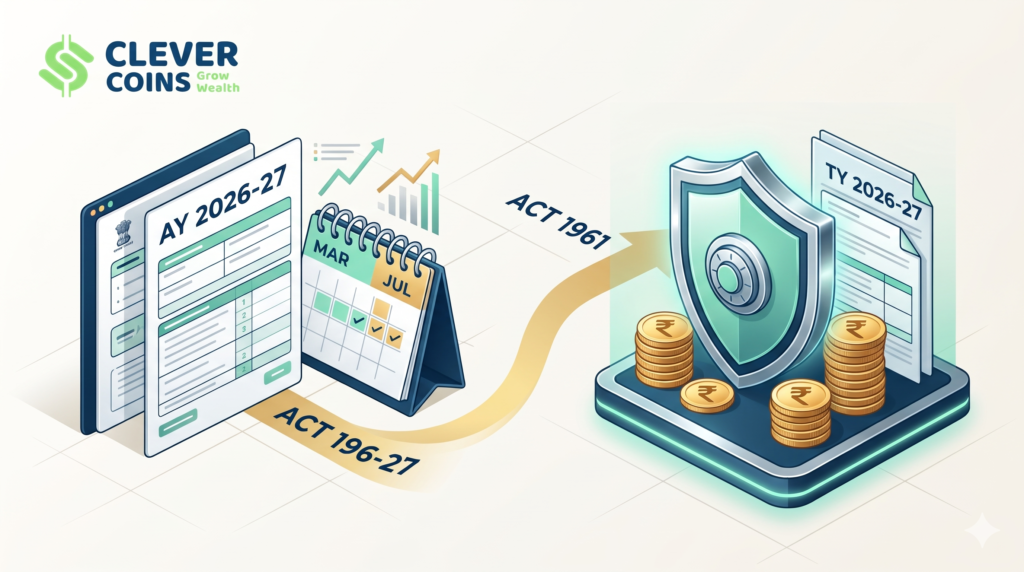
Understanding why requires separating two concepts that thousands of taxpayers are currently conflating: Assessment Year (AY) 2026-27 versus Tax Year (TY) 2026-27.
In this comprehensive, end-to-end guide, we break down the exact CBDT notification timeline, clarify the legal boundary between the 1961 Act and the 2025 Act, examine every single modification made to ITR-1 through ITR-7 and ITR-U for AY 2026-27, explain when the true “New Act 2025” ITR forms will actually arrive for Tax Year 2026-27, and map out the newly overhauled compliance form numbers under the Income-tax Rules, 2026.
1. The Short Answer: Release Timeline & The Critical Legal Distinction
To eliminate confusion immediately, here are the two governing facts established by the Ministry of Finance and the CBDT:
ITR Forms for AY 2026-27 Are Already Released: The CBDT officially notified all seven Income Tax Return forms (ITR-1 to ITR-7), along with the updated ITR-U and ITR-V forms, at the end of March 2026 (notified on 30–31 March 2026), and enabled the e-filing utilities on the Income Tax portal in May 2026. Because AY 2026-27 covers income earned during Financial Year (FY) 2025-26 (1 April 2025 to 31 March 2026), these returns are governed strictly by the Income-tax Act, 1961.
Tax GardenITR Forms Under the New Income-tax Act, 2025 Apply to “Tax Year 2026-27”: The Income-tax Act, 2025 came into operation on 1 April 2026. Under the new statute, the dual terminology of “Previous Year” and “Assessment Year” has been abolished and replaced by a single, unified concept called the “Tax Year.” Consequently, income earned between 1 April 2026 and 31 March 2027 belongs to Tax Year 2026-27. Per official CBDT guidance, the brand-new ITR forms drafted under the Income-tax Act, 2025 and Income-tax Rules, 2026 will be notified well ahead of the filing cycle for Tax Year 2026-27—which begins after 31 March 2027, with standard non-audit return due dates falling in July and August 2027.
Adwani & Co LLP+ 1
Key Takeaway: If you are filing a return for income earned between April 2025 and March 2026 (including extended audit filings due on 21 November 2026, transfer pricing returns due on 30 November 2026, belated returns due by 31 December 2026, or revised returns due up to 31 March 2027), you must use the AY 2026-27 ITR forms notified in March 2026 under the Income-tax Act, 1961. The new ITR forms under the Income-tax Act, 2025 will govern Tax Year 2026-27 and are scheduled for notification prior to the 2027 filing season (typically in the Q4 FY 2026-27 / Q1 FY 2027-28 window, i.e., February–April 2027).
Tax Garden
2. Why Taxpayers Are Confused: AY 2026-27 vs. Tax Year 2026-27
The root cause of widespread confusion across social media, tax forums, and business circles is a simple calendar overlap. On 1 April 2026, two major compliance events collided:
The Income-tax Act, 2025 and the Income-tax Rules, 2026 became legally effective for ongoing transactions, TDS deductions, advance tax, and newly renumbered compliance forms.
EZTax.inSimultaneously, taxpayers entered the filing window for AY 2026-27, which assesses the income earned during the just-concluded FY 2025-26.
Tax Garden
Under Section 536(2)(c) of the Income-tax Act, 2025 (the savings and transitional provisions), all returns, tax audits, rectifications under Section 139(9), scrutiny assessments, and updated returns (ITR-U) pertaining to any period ending on or before 31 March 2026 continue to be governed by the substantive and procedural provisions of the Income-tax Act, 1961.
To keep both compliance tracks crystal clear, compare them side by side:
| Compliance Parameter | Assessment Year (AY) 2026-27 | Tax Year (TY) 2026-27 |
|---|---|---|
| Income Earning Period | 1 April 2025 to 31 March 2026 (FY 2025-26) | 1 April 2026 to 31 March 2027 (FY 2026-27) |
| Governing Statute | Income-tax Act, 1961 | Income-tax Act, 2025 |
| Governing Rules | Income-tax Rules, 1962 | Income-tax Rules, 2026 |
| ITR Form Release Status | Already Notified (30–31 March 2026) | Upcoming (To be notified before TY 2026-27 filing cycle in 2027) |
| Return Filing Window | May 2026 to 31 March 2027 (including belated/revised) | April 2027 onwards (Standard due dates in July–November 2027) |
| Portal Selection Tag | Select AY 2026-27 on the e-Filing Portal | Will appear under Tax Year 2026-27 on the e-Filing Portal |
| Applicable TDS / Audit Forms | Old numbers (Form 16, Form 26AS, Form 3CA/3CB-3CD) | New numbers (Form 130, Form 168, Form 26) |
Because both compliance regimes operate concurrently on the Income Tax e-filing portal during 2026 and 2027, the portal explicitly supports dual-track workflows. Your historical assessments and AY 2026-27 filings run on the 1961 Act engine, while your real-time TDS certificates, advance tax challans, and upcoming return for TY 2026-27 run on the 2025 Act engine.
3. When Will the New ITR Forms Under the Income-tax Act, 2025 Actually Be Released?
While the CBDT has confirmed in its official FAQ on Income Tax Returns that “the new ITR forms under the Income Tax Rules, 2026 will be notified by the Government well before the due dates for filing returns for Tax Year 2026-27”, we can pinpoint the exact administrative timeline based on how the Ministry of Finance has rolled out the 2025 Act ecosystem:
Phase 1 — Foundation Rules & Non-ITR Compliance Forms (Completed March–November 2026):In March 2026, the CBDT notified the core Income-tax Rules, 2026 alongside redesigned operational forms effective 1 April 2026. Throughout September, October, and November 2026, the Board has continued issuing targeted amendment rules (up to the Eighth Amendment Rules, 2026) to finalize specialized forms such as Form 26 (Tax Audit Report), Form 130 (TDS Certificate), Form 168 (Annual Tax Statement), Form 112A (NPO Mergers), and Form 161 (Penalty Waiver).
EZTax.inPhase 2 — Union Budget 2027 Consequential Amendments (February 2027): Before finalizing the ITR schema for Tax Year 2026-27, the Finance Bill, 2027 (presented on 1 February 2027) will incorporate any final transitional tweaks or rate adjustments affecting TY 2026-27.
Phase 3 — Official Gazette Notification of New ITR Forms for TY 2026-27 (Expected February–March 2027): Consistent with the CBDT’s reformed practice of releasing ITR forms before the close of the financial year (as seen when AY 2026-27 forms were notified on 30 March 2026), the redesigned ITR forms under the Income-tax Rules, 2026 are expected to be notified in February or March 2027.
Phase 4 — JSON Schema & Online Utility Activation (April–May 2027): Following Gazette notification, the Directorate of Income Tax (Systems) will release the Excel/Java utilities, JSON schemas, and pre-filled AIS/TIS APIs on the e-filing portal in April–May 2027, ahead of the 31 July 2027 due date for salaried individuals and 31 August 2027 due date for non-audit businesses.
4. Major Changes Already Live in the Notified AY 2026-27 ITR Forms
Even though the AY 2026-27 forms operate under the Income-tax Act, 1961, the CBDT introduced sweeping structural upgrades in its March 2026 notification and the Finance Act, 2026. If you are preparing a belated return, a revised return, or an audit/transfer pricing return for AY 2026-27 right now, you must account for these crucial changes:
A. Expanded Eligibility for ITR-1 (Sahaj) and ITR-4 (Sugam)
Historically, owning even a second house property disqualified salaried taxpayers and presumptive small businesses from using the simple one-page ITR-1 or ITR-4 forms, forcing them into the much longer ITR-2 or ITR-3.
Two House Properties Allowed: For AY 2026-27, taxpayers with income from up to two house properties can file ITR-1 (Sahaj) or ITR-4 (Sugam), provided total income does not exceed ₹50 lakh and no brought-forward losses are claimed.
Tax GardenLong-Term Capital Gains (LTCG) Relief in ITR-1: Resident individuals with exempt LTCG under Section 112A up to ₹1.25 lakh (from listed equity shares or equity-oriented mutual funds) and no capital losses to carry forward can now report those gains directly inside ITR-1 instead of switching to ITR-2.
B. Mandatory Dual Contact Details & Secondary Address
To eliminate disputes where taxpayers claim they never received automated scrutiny or intimation notices under Section 143(1), all seven forms (ITR-1 through ITR-7) now mandate primary and secondary mobile numbers and email addresses, alongside a field for a secondary address. If a Chartered Accountant’s email is entered as the primary contact, the taxpayer’s personal email and mobile number can be captured in the secondary fields so statutory alerts reach both parties simultaneously.
C. Structured Representative Assessee Disclosures
Previously, legal heirs filing on behalf of deceased taxpayers, or guardians filing for minors, had to rely on limited free-text entries. The AY 2026-27 forms introduce a dedicated, structured Representative Assessee block capturing capacity, PAN, and authorization details cleanly.
D. Strict Drop-Down Reporting for Deductions & Aadhaar Validation
No More Free-Text Deductions: Deductions under Chapter VI-A (Sections 80C to 80U) and House Rent Allowance (HRA) exemptions under Section 10(13A) require granular, section-specific drop-down selections and policy/lender identification details.
CompuTax28-Digit Aadhaar Enrolment ID Discontinued: The e-filing portal strictly requires a valid 12-digit Aadhaar Number linked with PAN. The 28-digit Aadhaar Enrolment ID is no longer accepted for AY 2026-27 filings.
Adwani & Co LLP
E. Enhanced Capital Gains & Buy-Back Loss Reporting in ITR-2
Following legislative changes taxing share buy-backs as deemed dividends in the hands of shareholders while treating the cost of acquisition as a capital loss, ITR-2 now includes a dedicated line item in Schedule CG (Capital Gains) to capture capital losses arising from share buy-backs, provided corresponding dividend income is duly offered to tax.
F. Higher ₹1 Crore Threshold for Schedule AL (Assets & Liabilities)
Individuals and HUFs filing ITR-2 or ITR-3 are now required to disclose detailed movable and immovable assets and liabilities in Schedule AL only if their total taxable income exceeds ₹1 crore (up from the earlier ₹50 lakh limit), significantly reducing compliance friction for upper-middle-income professionals.
G. Expanded 48-Month Window for Updated Returns (ITR-U)
Under amendments carried forward into the AY 2026-27 ITR-U schema, taxpayers can file an Updated Return within 48 months (4 years) from the end of the relevant assessment year (meaning up to 31 March 2031 for AY 2026-27). Additionally, taxpayers can now use ITR-U to reduce carried-forward losses, and a dedicated column tracks additional tax payable where an updated return is filed following a Section 148 reassessment notice. The tiered additional tax slabs scale as follows:
Within 12 months from end of AY: 25% of aggregate tax and interest
Tax GardenBetween 12 and 24 months: 50%
Tax GardenBetween 24 and 36 months: 60%
Tax GardenBetween 36 and 48 months: 70%
5. Complete AY 2026-27 ITR Filing Deadlines (Including Extended Dates)
Because the Finance Act, 2026 permanently restructured non-audit due dates and the CBDT issued Circular No. 07/2026 on 28 September 2026 extending audit deadlines, taxpayers must track the exact statutory calendar for AY 2026-27:
| Taxpayer Category & Applicable Form | Original Due Date | Revised / Extended Due Date (AY 2026-27) |
|---|---|---|
| Salaried Individuals & Pensioners (ITR-1, ITR-2 — Non-Audit) | 31 July 2026 | 31 July 2026 (Passed) |
| Non-Audit Businesses & Professionals (ITR-3, ITR-4) | 31 August 2026 (Permanent shift via Finance Act, 2026) | 31 August 2026 (Passed) |
| Tax Audit Report (Form 3CA/3CB-3CD under Sec 44AB) | 30 September 2026 | 21 October 2026 (Extended via Circular 07/2026) |
| Tax Audit ITR Filers (ITR-3, ITR-5, ITR-6, ITR-7) | 31 October 2026 | 21 November 2026 (Extended via Circular 07/2026) |
| Transfer Pricing / International Transaction Cases (Form 3CEB + ITR) | 30 November 2026 | 30 November 2026 |
| Belated Return (Sec 139(4) — Missed Original Deadline) | 31 December 2026 | 31 December 2026 |
| Revised Return (Sec 139(5) — Correcting Filed Return) | 31 March 2027 (Extended from Dec 31) | 31 March 2027 |
| Updated Return (ITR-U under Sec 139(8A)) | 31 March 2031 (48 months) | 31 March 2031 |
Urgent November 2026 Compliance Alert: For companies, LLPs, partnership firms, trusts, and audited proprietorships whose AY 2026-27 filing deadline was extended from 31 October 2026 to 21 November 2026 under CBDT Circular No. 07/2026, the filing window closes in just days. Transfer pricing taxpayers face their statutory 30 November 2026 deadline immediately thereafter.
Tax Garden+ 1
6. How the New Income-tax Act, 2025 & Rules, 2026 Transform Tax Forms
When the CBDT notifies the new ITR forms for Tax Year 2026-27 in 2027, they will sit atop an already overhauled ecosystem of Income-tax Rules, 2026. Under the new Act, the government eliminated redundant provisions, reduced section counts by nearly half, and consolidated scattered compliance forms into smart, unified digital schedules.
If you are running a business or managing personal finances during FY 2026-27 (Tax Year 2026-27), you are already interacting with these new form numbers:
| Erstwhile Form (1962 Rules) | New Form Number (Income-tax Rules, 2026) | Purpose of the Form |
|---|---|---|
| Form 16 | Form No. 130 | Salary TDS Certificate issued by employers |
| Form 26AS | Form No. 168 | Annual Tax Credit & Information Statement |
| Form 3CA, 3CB & 3CD | Form No. 26 (Unified Smart Audit Form) | Tax Audit Report (Applicable for TY 2026-27, due 30 Sept 2027) |
| Form 15G & Form 15H | Form No. 121 | Self-declaration for Nil TDS deduction |
| Form 10E | Form No. 39 | Relief for salary arrears / advance salary |
| Form 15CA & Form 15CB | Form No. 145 & Form No. 146 | Foreign remittance information & CA certificate |
| Forms 26QB, 26QC, 26QD, 26QE | Form No. 141 (Consolidated) | Challan-cum-statement for property, rent, and contractor TDS |
| Form 10A / 10AB | Form No. 104 | Charitable trust / NPO registration application |
What to Expect in the Upcoming TY 2026-27 ITR Forms
Based on the architecture of the Income-tax Act, 2025 and the consolidated Form 26 audit template, the upcoming ITR forms for Tax Year 2026-27 will feature:
Mapped Section Citations: Every schedule—from Salary (Sections 15–19 of the 2025 Act) and House Property to Business Income and Capital Gains—will replace 1961 Act section numbers with the clean, linear section numbering of the Income-tax Act, 2025.
Native AIS/TIS Auto-Population & Hard-Lock Reconciliation: Pre-filled data from Form 168 (formerly Form 26AS), AIS, and TIS will populate directly into standardized JSON blocks, with automated validation checks flagging mismatches in dividend, interest, SGB secondary-market capital gains, or derivative STT data prior to submission.
Tax GardenUnified Loss Carry-Forward Bridge: Under the transitional rules of the 2025 Act, business losses and unabsorbed depreciation validly determined in AY 2026-27 under the 1961 Act will carry forward seamlessly into Schedule CFL of the new TY 2026-27 ITR forms for the remainder of their statutory 8-year window.
Income Tax Department12-Month Revised Return Window: Under Section 263(5) of the Income-tax Act, 2025, taxpayers will enjoy a full 12 months from the end of the relevant Tax Year (up to 31 March 2028 for Tax Year 2026-27) to file a revised return, replacing the restrictive historical deadlines.
7. Actionable Compliance Checklist for Taxpayers & Businesses
Because you are simultaneously closing out AY 2026-27 under the old Act while maintaining books for Tax Year 2026-27 under the new Act, follow this structured checklist to prevent notices, defective return flags, or lost tax credits:
Segregate Your Accounting Ledgers Strictly by Cutoff Date:Ensure that all revenue, expenses, TDS deductions, and advance tax challans up to 31 March 2026 are reconciled strictly for AY 2026-27 (using Form 16 and Form 26AS). Maintain a separate compliance folder for transactions from 1 April 2026 onwards mapped to Form 130, Form 168, and the new section numbers of the Income-tax Act, 2025.
Income Tax Department+ 1Verify AIS, TIS, and Form 26AS Before Submitting AY 2026-27 Returns:Automated processing systems cross-verify every rupee of interest, dividend, mutual fund redemption, and high-value property or equity transaction against third-party Statement of Financial Transactions (SFT) feeds. Any unexplained variance triggers an immediate adjustment notice under Section 143(1).
CompuTaxPreserve Loss Carry-Forward Eligibility: If your business or capital gains portfolio incurred losses during FY 2025-26, filing your AY 2026-27 return within the applicable due date is mandatory to carry those losses forward into Tax Year 2026-27 under the Income-tax Act, 2025.
Update Dual Contact Credentials on the e-Filing Portal:Log into
incometax.gov.inand verify that both your primary and secondary mobile numbers and email addresses are active and e-verified so no statutory intimation goes unanswered.CompuTaxAudit-Case & Transfer Pricing Filers — Act Before November 21 / November 30, 2026:If you are a company, LLP, or audited entity filing under the extended 21 November 2026 deadline, or an enterprise with international/specified domestic transactions filing by 30 November 2026, ensure your ITR figures align 100% with your audited financial statements, Form 3CD, and Form 3CEB.
Tax Garden
8. Frequently Asked Questions (FAQs)
Q1. Did the CBDT release new ITR forms for AY 2026-27 under the Income-tax Act, 2025?
No. The CBDT notified all seven ITR forms (ITR-1 to ITR-7), ITR-U, and ITR-V for AY 2026-27 on 30–31 March 2026, and they are governed entirely by the Income-tax Act, 1961. Because AY 2026-27 taxes income earned in FY 2025-26 (before the new Act took effect on 1 April 2026), the 2025 Act does not apply to AY 2026-27 returns.
Q2. When will the ITR forms under the new Income-tax Act, 2025 be released?
The new ITR forms drafted under the Income-tax Act, 2025 and Income-tax Rules, 2026 apply to Tax Year 2026-27 (income earned between 1 April 2026 and 31 March 2027). Per official CBDT guidance, they will be notified well ahead of the Tax Year 2026-27 filing cycle—expected in February–March 2027, ahead of the July 2027 and August 2027 filing deadlines.
Q3. What is the difference between Assessment Year 2026-27 and Tax Year 2026-27?
Assessment Year (AY) 2026-27 is the year in which you file taxes for income earned during FY 2025-26 under the old 1961 Act. Tax Year (TY) 2026-27 is the newly introduced term under the Income-tax Act, 2025 representing income earned during FY 2026-27 (1 April 2026 to 31 March 2027), for which returns will be filed starting April 2027. Both are independent statutory obligations.
Q4. Can I file a revised or belated return for AY 2026-27 right now?
Yes. If you missed the original 31 July or 31 August 2026 due date for non-audit returns, you can file a belated return up to 31 December 2026 (subject to late filing fees under Section 234F and interest under Section 234A). If you already filed on time and spotted an error, you can file a revised return for AY 2026-27 up to 31 March 2027.
Q5. Will my Form 16 from FY 2025-26 still work for AY 2026-27 even though Form 16 was renamed Form 130?
Yes. While the Income-tax Rules, 2026 renumbered the salary TDS certificate to Form No. 130 for Tax Year 2026-27 onwards, Form 16 issued for FY 2025-26 remains completely valid for filing your AY 2026-27 return.
Q6. How can CleverCoins help me manage dual-Act compliance and tax filing?
Transitioning between the Income-tax Act, 1961 and the Income-tax Act, 2025 requires accurate AIS/Form 26AS reconciliation, loss carry-forward mapping, and timely return filing. At CleverCoins, our dedicated tax advisory team handles end-to-end ITR preparation, tax audit support, capital gains optimization, and scrutiny defense—ensuring every rupee is accounted for and every statutory deadline is met without stress.